
Cascabel Chile, Two Official Heat Scores for One Round Pod
A reddish-brown dried globe with a nutty, woody taste, named for the little bell it sounds like.
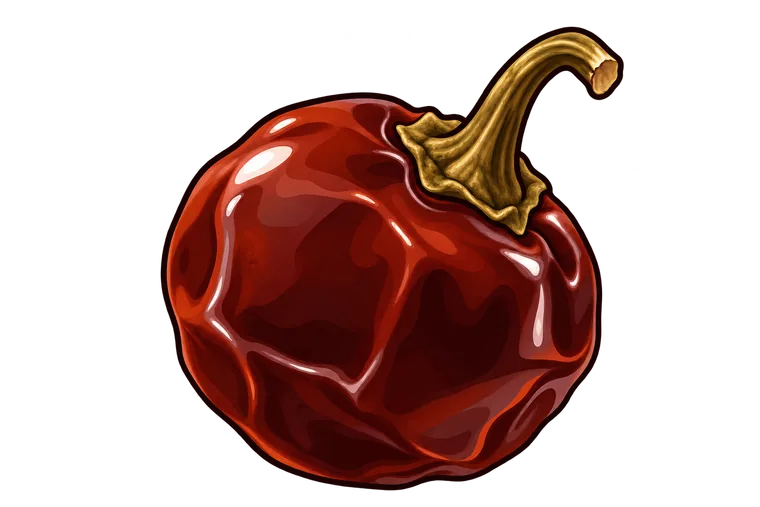 Mild
1,500–2,500 SHU on Iowa State's chart; Mexico's dried-chile standard rates it medium, 3,001–5,000 SHU
- Round, reddish brown and smooth when dry; a fresh pod weighed 3.28 g on average in a 2024 Guerrero trial
- Mexico's standard caps its moisture at 10 %, dry enough for the loose seeds to rattle
On this page
- 1How hot is a cascabel by the two official yardsticks?
- 2Why does a dried cascabel rattle?
- 3How does Mexico grade a bag of cascabels?
- 4What does a fresh cascabel plant look like?
- 5What does cascabel bring to a sauce?
- 6Where does cascabel sit among Mexico's dried chiles?
- 7Can you grow cascabels from seed?
- 8How do you keep dried cascabels from going soft or dusty?
- 9Make your first pot of cascabel purée
How hot is a cascabel by the two official yardsticks?
Mild to medium, and which word you get depends on who's measuring. Iowa State's heat chart puts cascabel at 1,500 to 2,500 SHU1, while Mexico's national standard for dried chiles rates it medium, at 3,001 to 5,000 SHU5. Both are real sources; they just measure different things.
The Mexican number comes from a lab conversion you can check. The standard counts 15 Scoville units for every microgram of capsaicinoids per gram of dry chile5. So 201 µg/g × 15 = 3,015 SHU, and 334 µg/g × 15 = 5,010 SHU, which rounds to the band it prints.
Why is the dried score higher? Drying removes water, so the same capsaicin sits in fewer grams of chile. A dried pod reads hotter per gram than the fresh pod it came from, even though nothing new formed. For your cooking, use the gentler Iowa State band to set your expectations and the Mexican band as the honest ceiling.
The index shows the Iowa State range on the heat bar. If you're choosing between cascabel and its usual shelf partner, the cascabel and guajillo comparison works through that pair number by number.
Why does a dried cascabel rattle?
Because its seeds come loose inside a dry, firm shell. Mexico's standard says the name comes from the sound the loose seeds make inside the dry fruit when you shake it5, and El Guapo's package says the name means a small bell or rattle4.
The rattle also works as a quick quality test in the shop. A pod that rattles is dry all the way through. A pod that stays silent may have picked up moisture in storage, and soft, damp pods are the ones that mold. Pick up the bag, give it a shake, and listen before you buy.
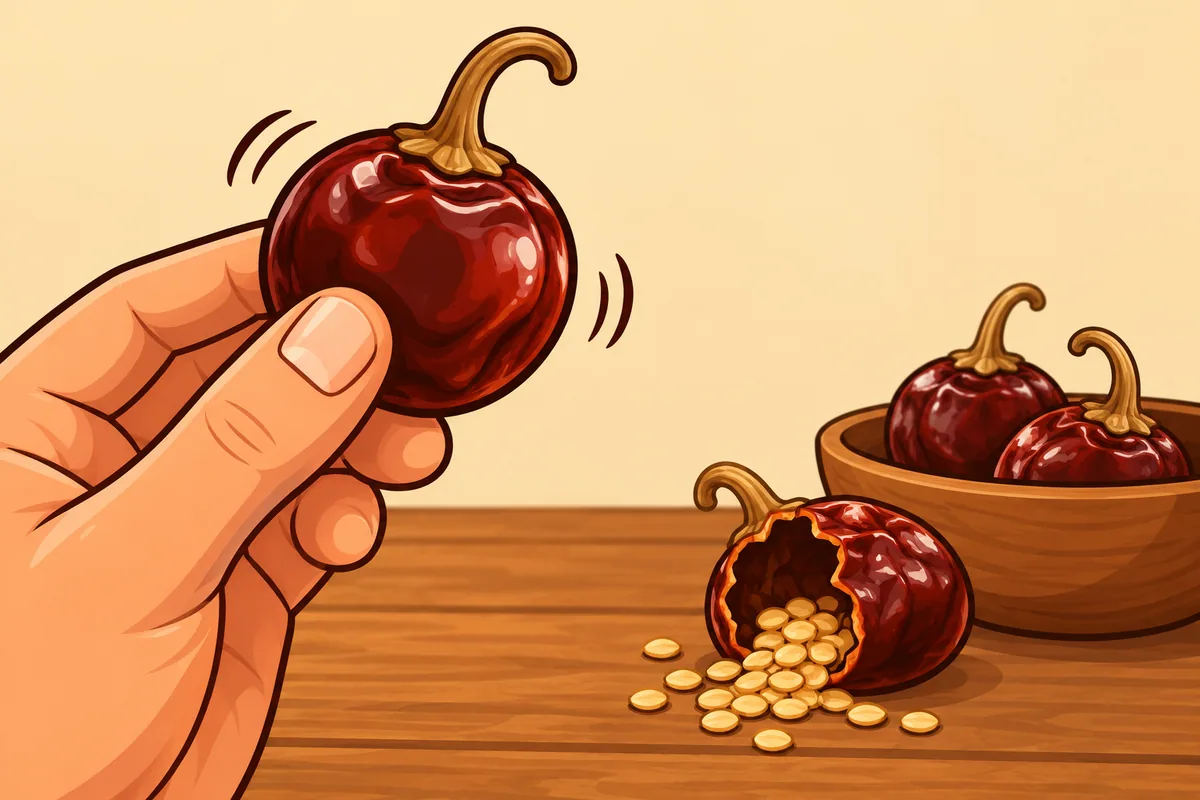
The standard describes the dried pod's skin as smooth and firm, with a reddish-brown color5. If you see white bloom, soft spots or a dull gray cast, leave the bag on the shelf.
How does Mexico grade a bag of cascabels?
By size and dryness. The NMX-FF-107 standard sorts whole dried cascabels into three classes and sets a moisture limit for the group of small, round chiles they belong to5:
| Rule | Value for cascabel |
|---|---|
| Extra class | Larger than 5 cm |
| Class I | Larger than 3 cm |
| Class II | Smaller than 3 cm |
| Maximum moisture | 10 % (shared with catarina, piquín and puya) |
| Heat level | Medium, 3,001–5,000 SHU |
The moisture limit tells you a lot. Thick pasillas and guajillos may hold up to 13.5 % water under the same standard, while cascabels must stay at 10 % or less5. That drier shell is why your cascabels crack instead of bending, and why they toast faster than a guajillo in the same pan.
You won't often see the class printed on a bag sold outside Mexico. Use the size numbers instead: pods bigger than a walnut shell belong in the top grade, and a bag of small, mixed pods is closer to Class II.
What does a fresh cascabel plant look like?
Bushy and wide, with small round fruit. In a 2024 greenhouse study of eight native chiles from Guerrero, the cascabel was the only one with pale yellow flowers; the rest had white ones3. Its fruit was round and red when ripe.
The cascabel gave the lightest fruit of all eight chiles in that study, against 33.55 g for the chilaca3. That's a useful number in your kitchen: about 300 fresh cascabels make a kilogram, and once dried, each pod weighs far less again.
A seed seller lists its cascabel as a globe about 1¼ inches long and wide, ripening from dark green to dark red6. So if you grow your own, expect walnut-sized pods that turn from green to red, then darken to reddish brown as they dry.
What does cascabel bring to a sauce?
A toasty, nutty depth more than heat. El Guapo describes a deep-red chile with mild heat and a nutty, woody flavor4, and Mexico's standard simply calls the taste pleasant5. Think of it as the chile that gives a salsa body and a roasted note.
El Guapo suggests it for soups, salsas, enchiladas, chili, tacos and stews, and mixed with other chiles in birria4. Most of those dishes start the same way: you turn the dried pods into a smooth red purée. NMSU's extension method for dried red pods works for cascabels too7:
- 1
Sort your pods
Throw out any pod with mold, insects or decay before you start.7
- 2
Stem and seed
Crack each cascabel open and shake out the loose seeds; the round shell makes this quicker than with a long pod.7
- 3
Rinse
Wash the shells in warm water, lifting them out and changing the water several times.7
- 4
Soak
Cover them with boiling water for 30 minutes, until the flesh is soft and slips off the skin.7
- 5
Blend and strain
Blend with enough fresh hot water for a smooth purée, then push it through a sieve to catch the peel.7
- 6
Simmer
Simmer the purée for 10 minutes before you use or store it.7
NMSU's yield is 12 to 14 large pods for about a pint of purée7, and cascabels are small, so you'll need more of them. Weigh your pods instead of counting, and add a little more water to the blender if your purée turns out thick as paste.
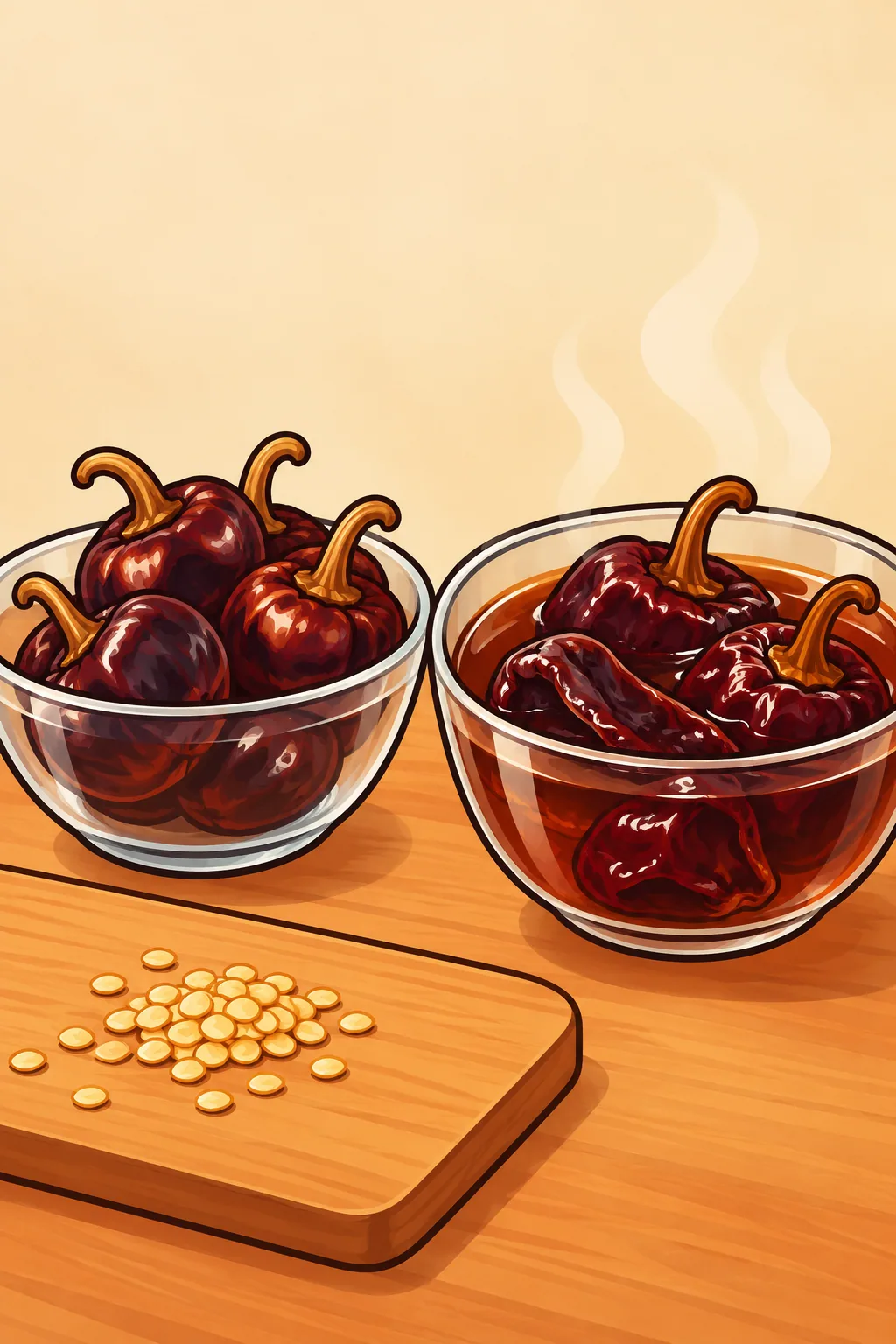
Keep the purée cold. NMSU says to refrigerate it promptly and use or freeze it within 3 days7. If you make a big batch, freeze it flat in a zip bag so you can snap off what you need for a pot of beans or a tray of enchiladas.
Many cooks toast the shells briefly in a dry pan before soaking for a deeper roasted note. NMSU's method skips that step, so if you try it, keep it short: a small, thin-skinned pod like this one scorches fast, and a burned chile turns your whole sauce bitter. The rehydrating guide compares the soaking and toasting options for every dried chile.
Where does cascabel sit among Mexico's dried chiles?
In the middle class, beside guajillo. Mexico's standard ranks its dried chiles in five heat classes, each with an example pod5. Use the table to pick a dried chile by how hot you want your pot.
| Heat class | Capsaicinoids (µg/g dry) | SHU | Examples |
|---|---|---|---|
| Mild | 60–200 | 900–3,000 | Ancho, mulato, pasilla |
| Medium | 201–334 | 3,001–5,000 | Guajillo, cascabel, catarina |
| Medium to hot | 335–2,009 | 5,001–30,000 | Puya, de árbol |
| Hot | 2,010–6,670 | 30,010–100,000 | Piquín |
| Extra hot | Above 6,670 | Above 100,000 | Habanero |
Read across the rows and you see the jump. Going from cascabel to a puya or árbol can multiply your heat by up to six (30,000 ÷ 5,000), while swapping cascabel for guajillo keeps you in the same class. For a gentler, sweeter pot, step down to a pasilla or ancho.
The small piquín in the hot row is a close cousin of the wild chiltepin, so don't let its size fool you. If you're stocking a shelf of dried pods, the dried chiles guide sorts them by use as well as heat.
Can you grow cascabels from seed?
Yes, and the plant suits a long, warm summer. A seed seller lists 85 days for its cascabel and suggests it as a drying pepper for spice powder6. The listing doesn't say whether it counts from sowing or from transplant, so plan as if it counts from transplant.
The Guerrero researchers sowed their seed in late October and grew the plants under a greenhouse at 758 m altitude3, which shows how easily the plant takes to a sheltered spot. In a garden with a short season, start your seed indoors early and wait for warm nights before you plant out; the planting dates guide helps you set that week.
For drying, let the pods turn fully red on the plant, then pick and hang them somewhere warm and airy. You'll know they're ready when they rattle.
How do you keep dried cascabels from going soft or dusty?
Keep them as dry as the standard wants them: at 10 % moisture or less, the shell stays brittle and the seeds stay loose5.
Habits for a bag of cascabels
- Store them in a sealed jar or zip bag, away from the stove's steam.
- Shake the jar now and then; if the rattle stops, check the pods for soft spots.
- Wipe off dust with a dry cloth before toasting rather than rinsing; water softens the shell.
- Freeze a big bag in portions if your kitchen is humid.
- Toss pods that smell musty or show white fuzz.
For the general rules on keeping dried and fresh peppers, including how long they hold their flavor, the pepper storage guide has the details.
Make your first pot of cascabel purée
Buy a small bag, shake it to hear the rattle, and make the purée above. Stir half into a tomato salsa and half into a tomatillo salsa, then taste them side by side; you'll learn what the cascabel's nutty depth does to each.
Then try it in a pot of red sauce with a guajillo or two. If you can't tell the dried pods on your shelf apart, the dried chile names guide shows you which is which by shape and color.
Related peppers
 GuajilloMedium13,705 SHU average
 MirasolMedium2,500–5,000 SHUPasillaMild1,000–2,000 SHU
 ChiltepinExtra-hot70,000–160,000 SHU
Published ranges.Sources for this line1. Iowa State University Extension8. Molecules 18(11):13471-13486 (MDPI)9. Botanical Interests (seed company's product page for its own seed)10. Revista Mexicana de Ingeniería Química 9(2):197-207 (CIAD)
Related in Peppers
-
Cherry Pepper Scoville, 0 SHU Sweet to Hot
A small round pepper, sweet or hot, grown for jars and stuffing.6 min read -
Ñora Pepper, Sweet Pimentón Pod Under 480 SHU
The small round sweet pepper behind Murcia's pimentón.5 min read -
Aji Charapita, the Pea-Sized Amazon Chile at 30K–50K SHU
A tiny yellow chile from Iquitos and Pucallpa with a citrus aroma and a heat seed sellers compare to cayenne.6 min read -
Bird's Eye Chili Heat and Names, 50,000–100,000 SHU
A tiny upright chile whose name points to the animals that plant it.6 min read -
Espelette Pepper, 10 Basque Communes and 15 Days on the Wall
A conical red pepper from the French Basque Country whose powder the AOP rules call strong but not burning.7 min read -
Anaheim Pepper Scoville, 1,000–5,000 SHU
A long, mild green chile with a New Mexican family tree.6 min read
Sources
· 10
- 1Iowa State University Extension PM 1888(S): Guía de Horticultura, El huerto doméstico, Chiles (Everhart, Haynes, Jauron)
- 2USDA Agricultural Research Service, GRIN-Global Taxon: Capsicum annuum L.
- 3Tropical and Subtropical Agroecosystems 27:050 Caracterización fenotípica de chiles nativos de la región Montaña, Guerrero, México (Guzmán-Olea et al.)
- 4McCormick & Company (El Guapo), manufacturer page for its own product El Guapo Cascabel Chili Pod, 1.5 oz
- 5Secretaría de Economía, Mexico NMX-FF-107/1-SCFI-2014, Productos alimenticios: chiles secos enteros, especificaciones y métodos de prueba
- 6Reimer Seeds (seed seller's product page for its own seed) Cascabel Pepper Seeds
- 7New Mexico State University Cooperative Extension Service (Guide E-327) Making Red Chile Purée and Sauce from Dried Pods
- 8Molecules 18(11):13471-13486 (MDPI) Characterization of Different Capsicum Varieties by Evaluation of Their Capsaicinoids Content by High Performance Liquid Chromatography, Determination of Pungency and Effect of High Temperature (González-Zamora et al.)
- 9Botanical Interests (seed company's product page for its own seed) Pasilla Bajio Chile Pepper Seeds
- 10Revista Mexicana de Ingeniería Química 9(2):197-207 (CIAD) Capsaicinoides y color en chiltepín (Capsicum annuum var. aviculare). Efecto del proceso sobre salsas y encurtidos (Montoya-Ballesteros et al.)