
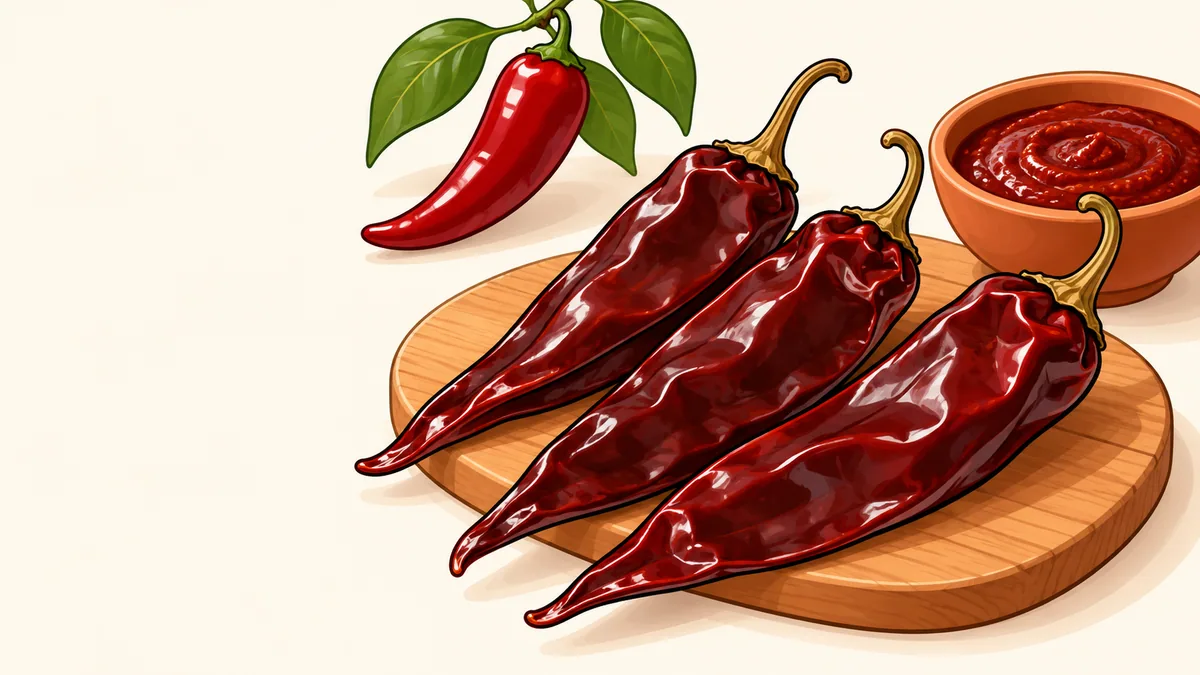
Guajillo Chile, 2,500–5,000 SHU as Fresh Mirasol
The smooth, glossy dried red chile of Zacatecas and Durango, made for marinades, moles and sauces.
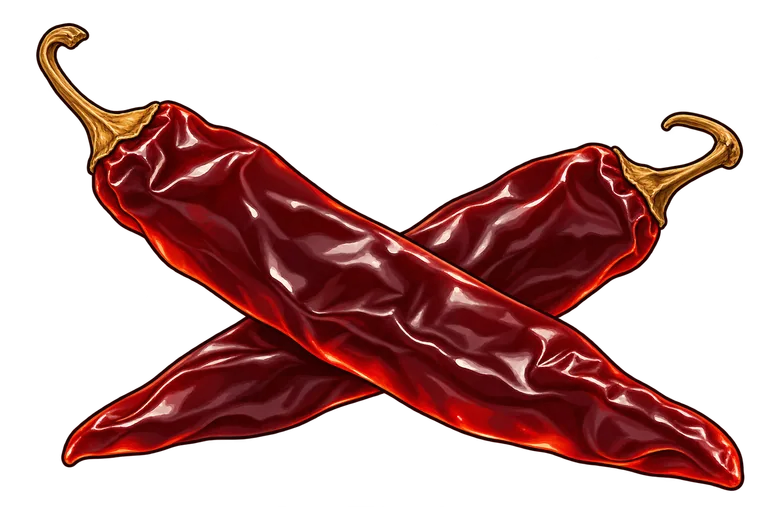 Medium
Short answer
Medium heat that swings with the weather
- A field crop tested 13,705 SHU on dry weight; heat-stressed plants gave 69,210
- The dried form of the mirasol chile; 83.7 % of it comes from four northern states
On this page
- 1How hot is a guajillo?
- 2What fresh chile becomes guajillo?
- 3Where do guajillos come from?
- 4How do you pick a good bag of guajillos?
- 5What dishes use guajillo most often?
- 6Which dried chile does your dish need, guajillo or another?
- 7Can you grow and dry your own guajillos?
- 8How long do dried guajillos keep?
- 9Why did your guajillo sauce turn out gritty or flat?
How hot is a guajillo?
Medium, with a wide swing. A 2013 HPLC study from the Comarca Lagunera in Durango tested field-grown guajillo at 13,705 SHU on dry weight, the mildest of its six varieties1. Iowa State's extension heat chart puts mirasol, the fresh form of the same chile, in the 2,500–5,000 SHU band beside the jalapeño4. So which number should you believe? Both, once you know what each one measures.
The guajillo bar is one dry-weight lab test; the others are fresh-pod ranges, so read it as an upper guide. Log scale; bars are published ranges.15
Those two numbers don't contradict each other. The lab weighed pods after drying, which strips out the water and pushes every figure up; the same study put a field jalapeño far above any fresh-pod range. In your pot, a guajillo behaves like a medium chile: you'll taste warmth and color long before you feel real burn.
| Figure | What it measures | What it tells you |
|---|---|---|
| 2,500–5,000 SHU4 | Mirasol, the fresh pod, on an extension heat chart | Close to a jalapeño fresh |
| 13,705 SHU1 | Dried cv. San Luis, open field, dry weight, HPLC | The mildest variety in that lab |
| 69,210 SHU1 | The same cultivar grown under 40–48 °C greenhouse heat | Heat stress multiplied it about five times |
Why does the same guajillo test five times hotter in a hot year?
Stress. In the Durango trial, guajillo plants grown in a greenhouse that reached 40–48 °C made pods with 4.74 mg of capsaicinoids per gram, against 1.46 mg in the field1. That's 69,210 SHU against 13,705, about 5 times more, from one cultivar and one change.
For you at the shop, that means two bags can taste different with nothing on the label to warn you. Toast or simmer one pod first, taste the sauce, and only then decide how many more go in.
What fresh chile becomes guajillo?
The mirasol. INIFAP's researchers write it as "guajillo chili (mirasol)": guajillo is the trade name for the dried pod, mirasol the name of the chile in the field2. You'll see the fresh pod's full story, and its name clashes, on the mirasol entry.
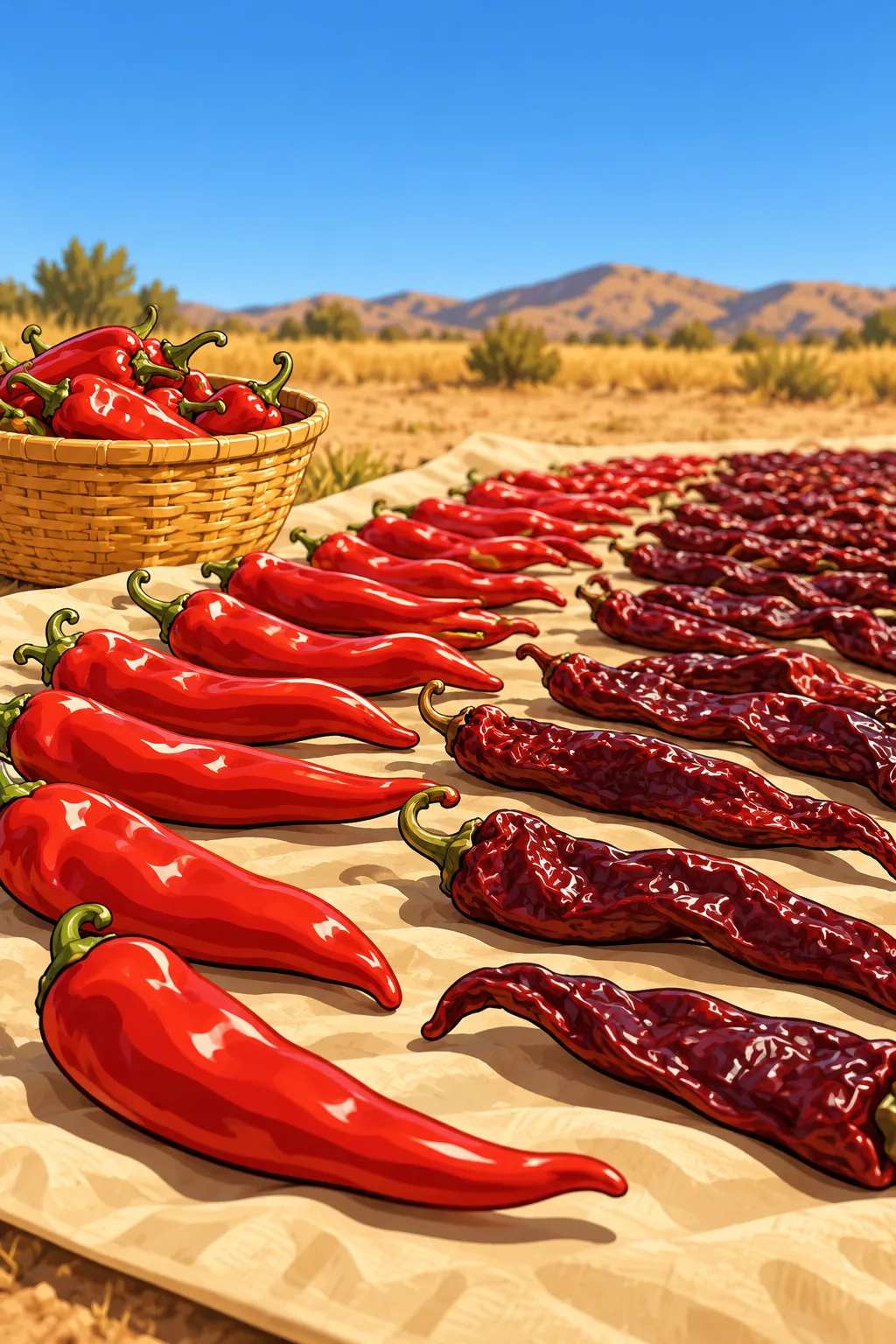
Growers pick the pods ripe and red, then dry them; the INIFAP team dried its 30 collections naturally at 32 °C2. Drying costs a lot of weight. In Zacatecas, where guajillo leads the dried chile crop, 284,187 tonnes of fresh chile of all dried types became 56,837 tonnes dry in 20016, so about 5 kg of fresh pods make 1 kg of dried. That ratio is why a light bag of guajillos costs what a heavy crate of fresh chiles does.
HEAT 101, a pepper channel that links to a seed shop in its video description, holds up one grown guajillo pod from Refining Fire Chiles, so you can check its shape and color against the pods in your own bag.
Two other peppers share the name and aren't this one. NMSU's 'NuMex Mirasol' is a small upright ornamental chile bred in New Mexico, used on wreaths8, and Peru's ají mirasol is a different species altogether. If your recipe is Mexican, the bag you want says guajillo.
Where do guajillos come from?
From the high plains of north-central Mexico. Four states grow most of it, and in Zacatecas it's the chile the local economy depends on most3.
83.7%of guajillo production in Chihuahua, Durango, San Luis Potosí and Zacatecas2
32,000 haof dried chile grown in Zacatecas in spring–summer 20016
150days of labor each hectare of dried chile needs6
Much of the Zacatecas crop still comes from native populations, local landraces that farmers keep from their own seed3. A survey of 96 of those landraces found they differ mainly in the fruit: size, weight, shape, color, the cross wrinkles on the pod and the shape of the stalk3. So when your bag holds a mix of long and short pods, you're looking at that diversity, not a grading mistake.
How do you pick a good bag of guajillos?
Look first at the color, because that's what the Mexican standard grades. INIFAP cites the NMX-FF-107 standard, which reads a hue angle of 47.33–56.96° as intense red or a uniformly dark skin2. In plain terms: you want deep, even red, with no pale or faded patches.
What to check at the shelf
- Deep, even red all over: the color the Mexican grading standard rewards.2
- A mix of sizes is fine: landraces vary in length, weight and wrinkling.3
- Clear glass or film where you can see in: condensation or damp spots mean the pods took on moisture.9
- No fuzz or mold anywhere: moldy dried food goes in the bin.9
The INIFAP collections ranged in hue from 49.52° to 173.05°2, so color really does vary from bag to bag. If you can, pick the deepest red on the shelf, since the color is a big part of what guajillo gives your sauce.
What dishes use guajillo most often?
Marinades, moles and sauces: INIFAP calls guajillo the main ingredient for all three across Mexico, and it also serves as a natural dye2. That dye use tells you something about cooking with it too: the color is strong, so a few pods will tint a whole pot red. Most of those dishes start the same way, with the pods soaked and blended into a smooth red base.
- Stem, seed and rinseChange the warm water several times
- Cover with boiling water30 minutes, until soft
- Blend with fresh hot waterUntil smooth
- Pass through a sieveLeaves the tough skin behind
- Simmer the purée10 minutes before use
New Mexico's extension guide for dried red chile pods gives the times10, and guajillos follow the same path. The steps below add the details you'll want at the stove.
- 1
Clean the pods
Pull off the stems, shake out the seeds, then wash the pods in warm water, lifting them out and changing the water several times.10
- 2
Soak
Cover them with boiling water for 30 minutes so the skins soften.10
- 3
Blend and sieve
Blend with enough fresh hot water for a smooth purée, then push it through a sieve to catch the bits of skin.10
- 4
Simmer and use
Simmer the purée for 10 minutes, then season it for your marinade or mole. Chill leftovers promptly and use or freeze them within 3 days.10
That base is your starting point for a marinade, a mole or a red table sauce, the three jobs INIFAP names. If your mole recipe lists several dried chiles, the guajillo usually carries the color while the darker pods carry the depth.
Which dried chile does your dish need, guajillo or another?
Pick guajillo when you want color and moderate heat in a smooth sauce. The table sets it beside the dried chiles you'll find next to it on the shelf, each with its own published heat.
| Dried chile | Published heat | Pick it when |
|---|---|---|
| Guajillo14 | 13,705 SHU dry weight; mirasol fresh 2,500–5,000 | You want red color and moderate heat |
| Ancho (dried poblano)4 | 1,000–1,500 SHU | You want a milder, darker base |
| Cascabel4 | 1,500–2,500 SHU | You want a gentle, round pod |
| Chile de árbol1 | 194,592 SHU dry weight, same lab | You want real burn in small amounts |
| Chipotle (smoked jalapeño)5 | Jalapeño 2,000–8,000 SHU | You want smoke |
The most common swaps each have their own head-to-head. The árbol and guajillo match-up works out how many árbols replace one guajillo, and the guajillo against chipotle page covers smoke against color.
For a milder base, ancho brings the darkest color of the group, while a cascabel stays the gentlest. Mixing one or two of them with guajillo is the usual way you build depth in a mole without piling on heat.
Can you grow and dry your own guajillos?
Yes, if you have a long warm season and patience at the end. Growers treat it as a dried chile, so your plants need to hold their pods until they turn fully red, the stage the INIFAP team picked for drying2. Iowa State notes that you can pick chiles green or let them ripen to red, and eat them raw, in salsas, pickled, frozen or dried4; for guajillo, red and dried is the whole point.
A recent trial in a hydroponic greenhouse gives you an idea of the yield. The best guajillo line, CHG-Barril, grown in pots, gave about 1,094 g of dried chile per plant, and its plants grew shorter, with fewer leaves, flowers and fruits than chile de árbol beside them11. A home plant won't match a fertigated greenhouse, but you can expect a light harvest by weight, since drying takes most of it away.
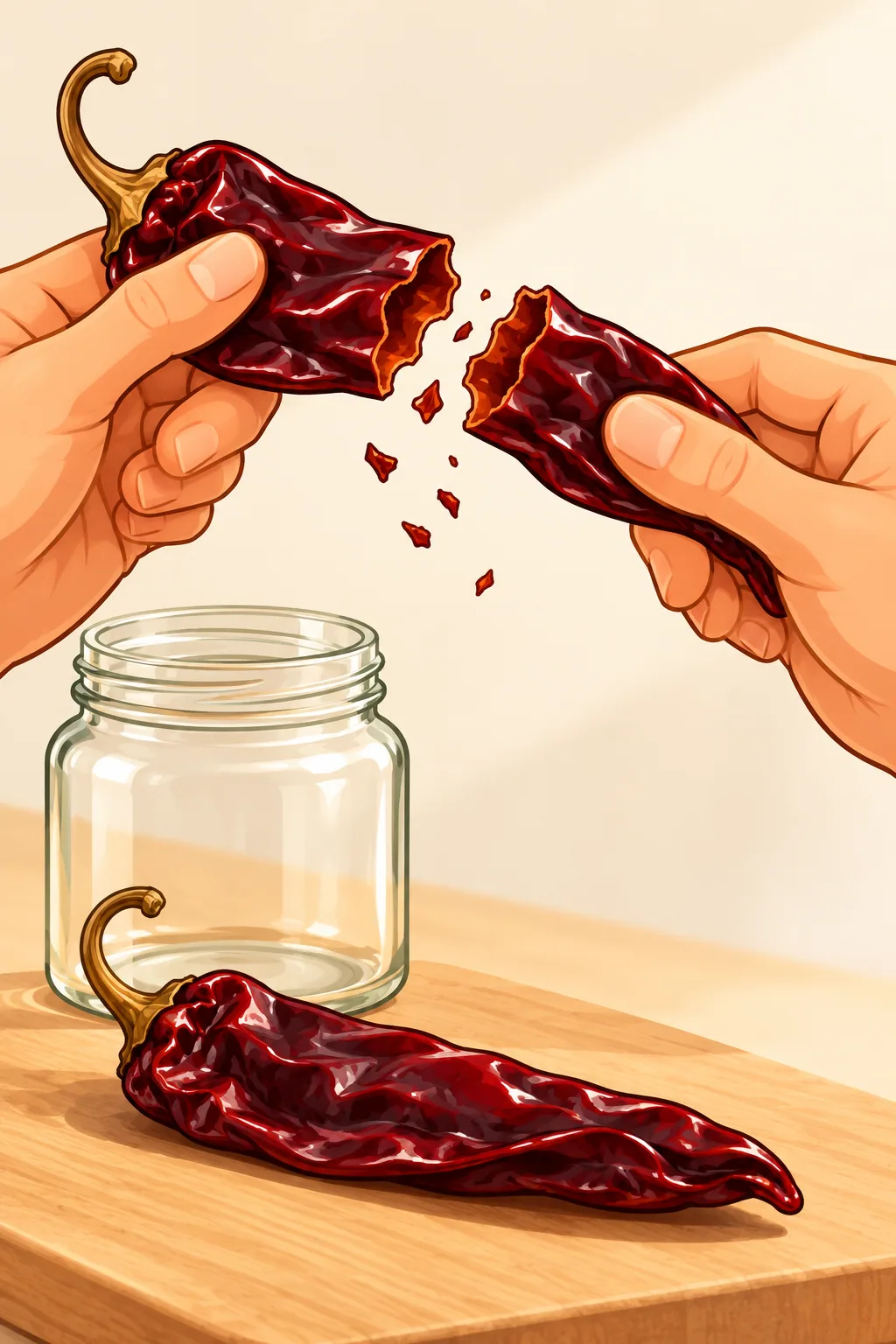
Here's the practical part. Lay your ripe red pods out in a warm, dry, airy place, turn them now and then, and store them only once they snap rather than bend. That snap is the test NCHFP gives for any dried vegetable: brittle or crisp, at about 10 percent moisture9. A pod that still flexes in your hand will go moldy in the jar, which wastes a whole season of work. The home pepper drying guide covers oven and dehydrator times if your weather won't help. And keep the plants evenly watered through a heat wave if you want mild pods, since heat stress is what pushed the Durango guajillos from 13,705 to 69,210 SHU1.
How long do dried guajillos keep?
Months, if you keep them cool, dry and dark. The National Center for Home Food Preservation says most dried fruits keep 1 year at 60 °F and 6 months at 80 °F, and that dried vegetables keep about half as long9; we worked that out for a dried chile below.
| Where you keep them | Rough shelf life | Why |
|---|---|---|
| Cool cupboard, about 60 °F | About 6 months | Half the 1-year figure for dried fruit |
| Warm kitchen, about 80 °F | About 3 months | Half the 6-month figure for dried fruit |
| Sealed jar or vacuum bag | Toward the top of that range | Less air and moisture each time you open it |
Pack them in clean, dry canning jars or tight freezer containers, and fill several small ones rather than one big one, since every opening lets in air9. Glass lets you spot condensation; if your pods feel damp but show no mold, use them right away or dry them again9.
Why did your guajillo sauce turn out gritty or flat?
Most sauce problems trace back to the soak, the sieve or the bag you bought.
Guajillo problems and their fixes
- Gritty sauce: tough skin got through. Push the purée through a sieve or colander before you simmer it.10
- The blender left lumps: the pods were still stiff. Give them the full 30 minutes in boiling water.10
- Dull, brownish color: a faded bag. Buy the deepest even red you can find; color is what the grading standard measures.2
- This batch is far hotter than the last: a hot growing season can multiply guajillo heat about five times. Taste one pod's worth before you add the rest.1
- Leftover sauce smells off: it sat too long. Refrigerate it promptly and use or freeze it within 3 days.10
Out of guajillos tonight? The guajillo swap list gives you amounts for the closest dried chiles. And if you want the whole family side by side, the dried chile guide shows every pod on the shelf with its fresh name, so your next shopping trip starts with the right bag.
Related peppers
Published ranges.4
Related in Peppers
-
Pasilla Chile, the Dried Chilaca at 1,000–2,000 SHU
A long, nearly black dried chile with a raisin skin and a smoky, fruity taste.6 min read -
Jalapeño Scoville, 2,000–8,000 SHU and Chipotle
The medium-heat chile most heat comparisons start from.6 min read -
Ñora Pepper, Sweet Pimentón Pod Under 480 SHU
The small round sweet pepper behind Murcia's pimentón.5 min read -
Habanero Pepper Scoville, 100,000–350,000 SHU
A fruity, floral chile in the extra-hot band.7 min read -
Poblano Pepper Scoville, 1,000–2,000 SHU
A big, thick-walled, mild chile from the valley of Puebla.5 min read -
Serrano Pepper Scoville, 10,000–25,000 SHU
A slim, fleshy chile one clear step above the jalapeño.5 min read
Sources
· 11
- 1Molecules 18(11):13471-13486 (MDPI) Characterization of Different Capsicum Varieties by Evaluation of Their Capsaicinoids Content by High Performance Liquid Chromatography, Determination of Pungency and Effect of High Temperature (González-Zamora et al.)
- 2Revista Mexicana de Ciencias Agrícolas 10(1) (INIFAP) Intensity of color and bioactive compounds in collections of guajillo chili from Northern Mexico (Martínez-Damián, Cruz-Álvarez, Moreno-Pérez, Valle-Guadarrama)
- 3Emirates Journal of Food and Agriculture 31(6) Morphological diversity of Zacatecas Guajillo chile landraces is broad and is given mainly by fruit traits (Moreno-Ramírez et al.)
- 4Iowa State University Extension PM 1888(S): Guía de Horticultura, El huerto doméstico, Chiles (Everhart, Haynes, Jauron)
- 5University of Florida IFAS Extension HS-859/TR010: Pepper Production in Miami-Dade County, Florida
- 6Convergencia 14(43) (Universidad Autónoma del Estado de México) El servicio de asistencia técnica a los productores de chile seco en Zacatecas (Galindo González, INIFAP)
- 7HEAT 101 Guajillo Pepper From Refining Fire Chiles!
- 8New Mexico State University Circular 706: The Chile Cultivars of New Mexico State University, 1913–2022 (Coon, Walker, Lozada, Guzman, Bosland)
- 9National Center for Home Food Preservation (University of Georgia) Packaging and Storing Dried Foods
- 10New Mexico State University, College of ACES Guide E-327: Using Chile to Make Ristras and Chile Sauce (Coon and Walker), revised July 2015
- 11Agro Productividad (Colegio de Postgraduados) Evaluation of guajillo and chile de árbol peppers in a hydroponic greenhouse system (García-Herrera et al.)