
Ñora Pepper, Sweet Pimentón Pod Under 480 SHU
The small round sweet pepper behind Murcia's pimentón.
 Mild
Short answer
Sweet, almost no heat
- Pimentón de Murcia may hold at most 0.003 % capsaicin, roughly 450–480 SHU worked out
- Sun-dried whole, then ground for pimentón or soaked for sauces like romesco
On this page
Is a ñora pepper hot?
Barely, so you can use it by the spoonful. The variety behind it is a sweet pepper in the mild band, and the official rules for Pimentón de Murcia cap capsaicin at 0.003 % in both legal grades1. No primary source prints a Scoville figure for the pod itself, so we worked one out from that limit for you.
Here is the math you can check yourself. 0.003 % is 30 parts per million, and labs turn parts per million into SHU by multiplying by 163 or, in some papers, 154: 30 × 15 = 450 and 30 × 16 = 480.
Even at the legal ceiling, Murcia pimentón carries, gram for gram, about a tenth of an average jalapeño's heat. The cap counts capsaicin only, so read it as a rough ceiling, not a lab result for the pod in your hand.
What is a ñora?
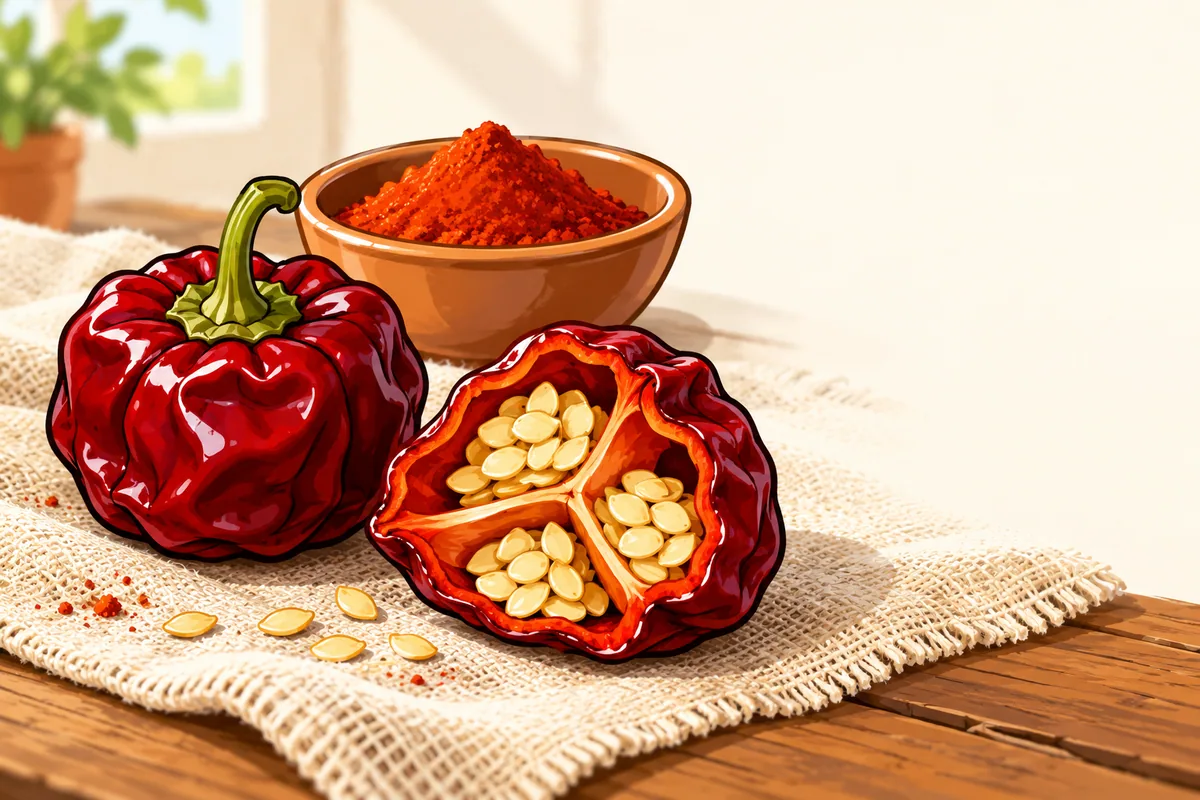
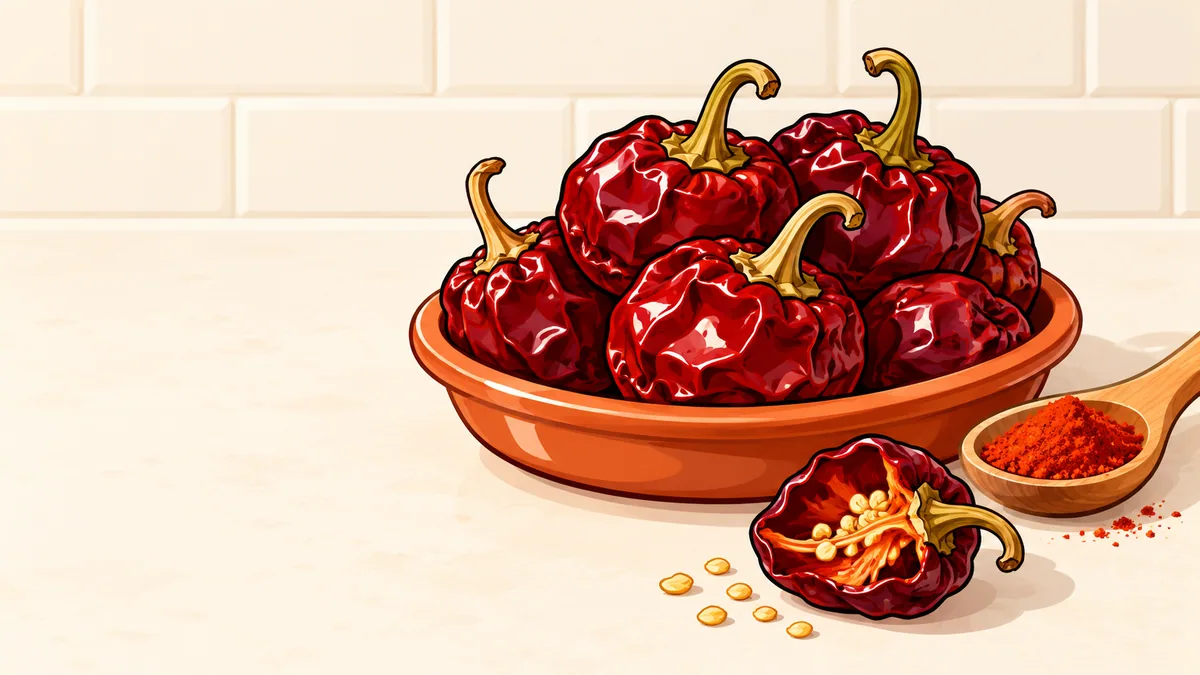
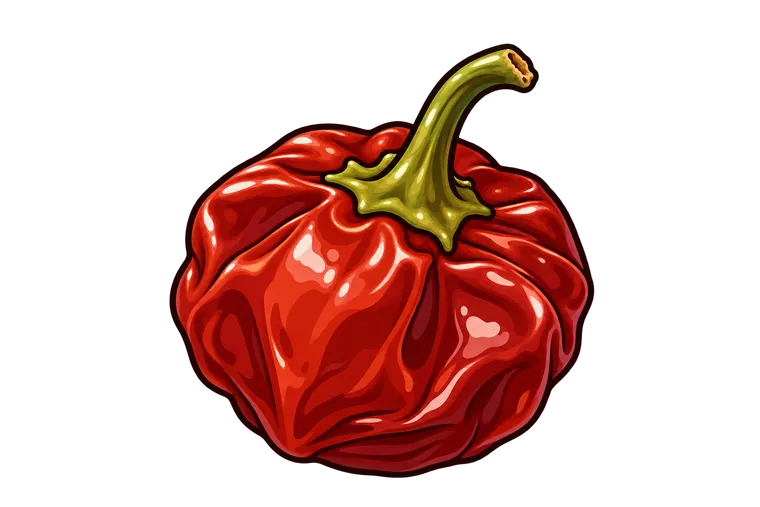
A ñora is a small, round, sun-dried pepper of Capsicum annuum, variety Bola2; picture a small, dark red ball, light enough that the seeds rattle when you shake it. The Murcia specification calls the same variety "Bola" or "Americano" and describes a sweet, light, nearly spherical pepper1. The specification calls the dried pod a "cáscara", a shell1.
Drying takes most of the weight away, which is why your bag of ñoras feels almost empty. The specification allows at most 5 kg of fresh pepper for 1 kg of dried shell1, so a 5 kg crate of fresh ñoras gives you at least 1 kg of shell.
Where does the ñora come from?
Today it is a Murcia pepper, and the tins you buy say so. The protected Pimentón de Murcia comes only from the Region of Murcia and listed towns in the provinces of Almería, Granada and Alicante in south-east Spain1. If you ask where the name comes from, ICEX, Spain's trade agency, says monks spread its cultivation to their brothers at La Ñora in Murcia, the place that shares the pepper's name2.
ICEX also says the pepper first came from Peru and Bolivia2. The genus monograph points elsewhere for the species: research places the start of C. annuum domestication in central-east Mexico over 6,500 years ago6. We print the Murcia origin, which both sources support, and leave the deeper story with that conflict noted so you can weigh it yourself.
Bill Moore's Hot & Spicy Reviews, a hobby pod-review channel, shows one nora up close and tells its own version of how the pepper reached Murcia, so you can see the pod up close, and you can weigh the story against the sources above.
What is the ñora's year, from seed to string?
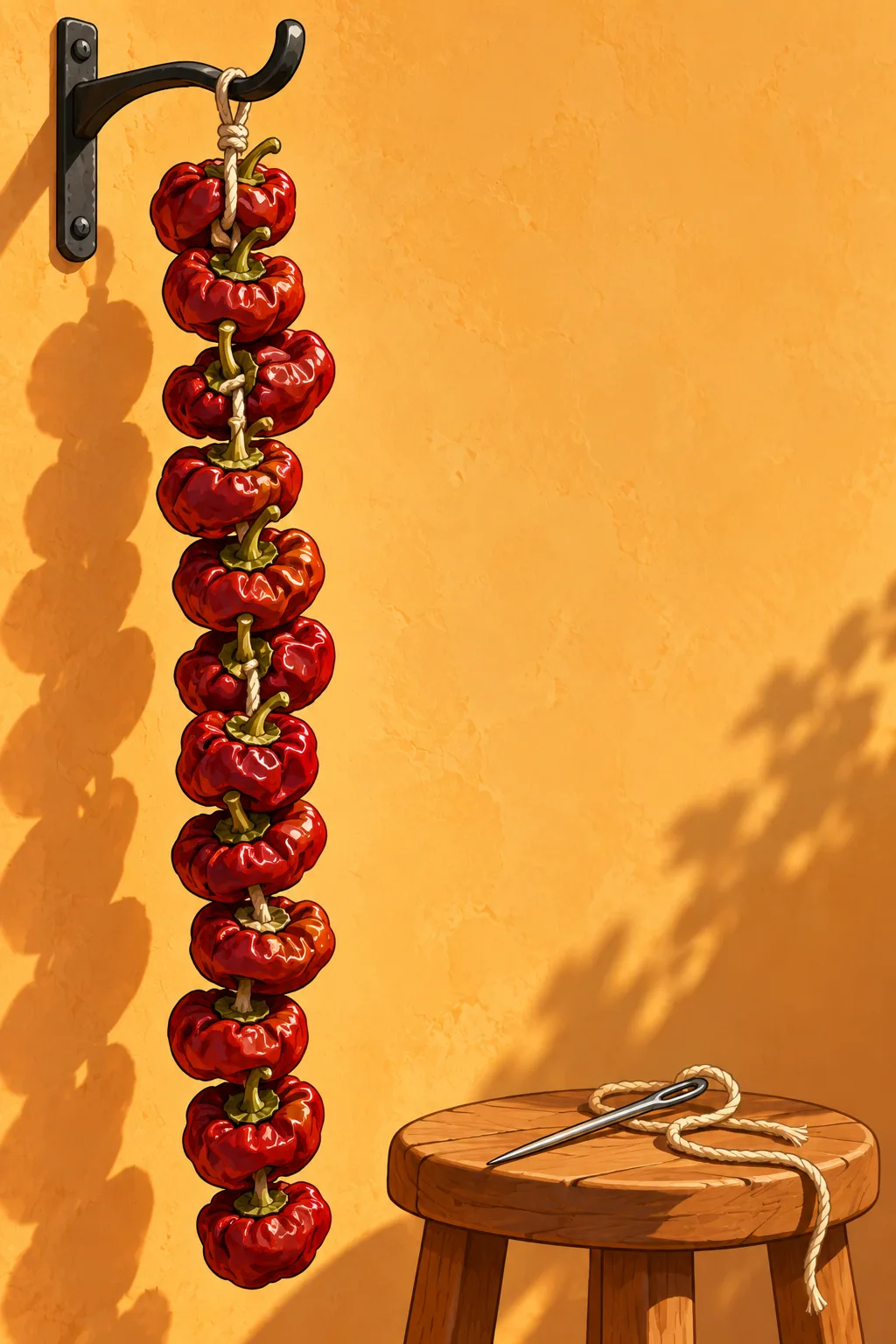
A ñora takes most of a year to reach your pan. ICEX gives the Murcia calendar: seed goes in during January, the pods come off the plants in August and September, and drying starts around October2.
- January: sow the seedPlants start in seedbeds months before summer
- Spring and summer: plants growPods ripen to deep red on the plant
- August to September: pick by handOnly pods at full color
- October: sew pods into stringsChains 1.5 m long, about 1 kg each
- Into the sun every dayUntil fully dry, or the pods mildew
- Whole shells or the millSold whole or ground to pimentón
- Back to January: sow the seed
The strings go out under the sun day after day until they are fully dry; ICEX warns that pods left damp go mildewy and spoil2. That's the same risk you face at home, and it's why the specification's hot-air dryers keep the shell at no more than 14 % moisture1. If you want to dry peppers at home, the same moisture rule applies to your batch.
How does a ñora become pimentón?
By hand, sun and mill, in that order, and you can trace every step on the tin's label. The Pimentón de Murcia specification sets each step1:
- 1
Pick at full color
Pick by hand, in several passes, only the pods at peak ripeness: deepest red, most pigment, least water.1
- 2
Dry in the sun
Spread the pods on drying grounds in the sun for several days, then slit the wall so the inside dries too.1
- 3
Or dry with hot air
Wash the pods and run them through a belt or tray dryer for 8 to 10 hours, keeping the pepper below its critical 65–75°C, with the outgoing air near 40°C.1
- 4
Check the shell
The dried shell leaves the dryer at no more than 14 % moisture and stays in a dry room until milling.1
- 5
Grind fine
Mill until the powder passes an ASTM No. 16 sieve, a 1.19 mm mesh. Up to 8 % edible vegetable oil may go in.1
The sun method is the old one you'll see in photos of Murcia. Growers once spread the pods on racks, open ground or hillsides until the sun dried them, and that method is still in use beside the dryers1.
What do the grades on a tin mean?
Only two grades carry the Pimentón de Murcia name, Extra and Primera, and your tin names one of them. Color is the big difference you'll notice, measured in ASTA units1. Buy Extra when you want the deepest red in your rice.
| Measure | Extra | Primera |
|---|---|---|
| Color, ASTA units (minimum) | 120 | 90 |
| Moisture (maximum) | 14 % | 14 % |
| Ether extract on dry matter (maximum) | 20 % | 23 % |
| Crude fiber on dry matter (maximum) | 27 % | 28 % |
| Capsaicin (maximum) | 0.003 % | 0.003 % |
The red in your tin comes from carotenoids. In the Bola variety, capsanthin makes up about 50 % of them and capsorubin about 12 %, the mix that sets it apart from other varieties1.
Do you want Murcia or La Vera pimentón?
Pick Murcia for clean, sweet color and La Vera for smoke. Both are protected Spanish paprikas and both may use the Bola variety, but they dry the pods in opposite ways18.
Pimentón de Murcia
Pimentón de la Vera
- Region of Murcia and listed towns in Almería, Granada and Alicante1WhereLa Vera and three nearby valleys in northern Cáceres8
- Bola (the ñora)1PepperBola plus the longer Jaranda, Jariza and Jeromín8
- Sun on drying grounds, or hot air for 8 to 10 hours1DryingOak or holm oak smoke for 10 to 15 days, from 80 % water to under 15 %8
- Fully sweet, strong aroma, no smoke1TasteSmoky, intense and penetrating8
- Sweet only, capsaicin capped at 0.003 %1Heat typesSweet, bittersweet (ocal) and hot8
- Up to 8 %1Added oilUp to 3 % sunflower oil8
The smoke you taste comes from the weather. The La Vera specification explains that the climate there makes sun drying impossible, so farmers dry the pods over a fire on their own holdings8. If your recipe says "smoked paprika", Murcia pimentón won't give you that taste; if it says sweet pimentón for color, either tin works, and Murcia gives you the cleaner pepper flavor.
How do you cook with ñoras?
Most ñoras end up as pimentón, but you can also use them whole to flavor dishes and in sauces such as romesco2. A whole dried pod needs softening first, and the method New Mexico's extension service gives for dried red chile pods works for a ñora too9:
- 1
Wash and break open
Rinse the pods in warm water, lifting them out and changing the water a few times. Snap off the stalk and shake out the loose seeds.9
- 2
Cover with boiling water
Pour boiling water over the pods and leave them for 30 minutes.9
- 3
Test the pulp
The pulp is ready when it is soft and comes away from the skin easily. Scrape it off with a spoon, or blend the whole pod with a little fresh hot water and pass it through a sieve.9
That scraped red pulp is what you stir into a romesco or a pot of rice, and the soaking water, strained, adds color to a stock. A pod gives you only a spoonful or so, since the dried wall is thin. If you can't find them, the ñora swap list covers what to use instead. The ground pepper is fully sweet, bright red and strongly aromatic, with a lot of coloring power1, so a teaspoon turns your whole pan of rice orange.
If you wonder how it fits the wider spice shelf, the NMSU Chile Pepper Institute defines paprika as any non-pungent chile, red at maturity, used as a spice or for color10, and the ñora fits that exactly. The wider family, from sweet to hot, is in the entry on what paprika is made from.
What goes wrong with ñoras and pimentón?
Most problems you'll hit come from moisture or heat, the two things the specification controls most closely.
Problems and their fixes
- White or gray fuzz on whole pods: mildew from drying that stopped too early. ICEX notes damp pods spoil; throw out fuzzy ones and keep the rest dry and sealed.2
- Your tin of pimentón tastes smoky and you wanted sweet: you bought La Vera, which the specification defines by its oak smoke. Look for the Pimentón de Murcia label for a clean, sweet taste.18
- The pulp won't come away from the skin: the pod needs more time. NMSU's test is pulp that is soft and separates easily, so leave it in the hot water until it does.9
- The pimentón turned dark and bitter in the pan: it scorched. A powder fine enough to pass a 1.19 mm mesh has nothing to shield it from hot oil, so take the pan off the heat before you stir it in.1
If you can't find ñoras at all, the round and long pods in the dried chile guide show you what else dries the same way.
Related peppers
Related in Peppers
-
Jalapeño Scoville, 2,000–8,000 SHU and Chipotle
The medium-heat chile most heat comparisons start from.6 min read -
Aleppo Pepper, the Halaby Flake Cured With Oil and Salt
A burgundy flake from the old Silk Road city of Aleppo, sweet and fruity first, with a moderate heat behind it.6 min read -
Guajillo Chile, 2,500–5,000 SHU as Fresh Mirasol
The smooth, glossy dried red chile of Zacatecas and Durango, made for marinades, moles and sauces.6 min read -
Piquillo Pepper, the Sweet Flame-Roasted Pod of Lodosa
A small triangular red pepper that almost always reaches you roasted, peeled and in a jar.6 min read -
Habanero Pepper Scoville, 100,000–350,000 SHU
A fruity, floral chile in the extra-hot band.7 min read -
Serrano Pepper Scoville, 10,000–25,000 SHU
A slim, fleshy chile one clear step above the jalapeño.5 min read
Sources
· 12
- 1Ministerio de Agricultura, Pesca y Alimentación (Spain) Pliego de condiciones de la Denominación de Origen "Pimentón de Murcia"
- 2ICEX España Exportación e Inversiones (Foods & Wines from Spain) Ñora
- 3HortScience 42(2):222-224 'Bhut Jolokia', the world's hottest known chile pepper, is a putative naturally occurring interspecific hybrid
- 4Molecules 19(5):6474 (MDPI) Capsaicin and Dihydrocapsaicin Determination in Chili Pepper Genotypes Using Ultra-Fast Liquid Chromatography
- 5University of Florida IFAS Extension HS-859/TR010: Pepper Production in Miami-Dade County, Florida
- 6PhytoKeys 200:1-423 (Pensoft) Monograph of wild and cultivated chili peppers (Capsicum L., Solanaceae)
- 7Bill Moore's Hot & Spicy Reviews The "Nora" a Pod Review for Refining Fire Chiles
- 8WIPO Lisbon System, appellation of origin AO-1212 (EU specification ES/PDO/005/0321) Pimentón de la Vera: particulars concerning the quality, reputation or characteristics
- 9New Mexico State University Cooperative Extension (Guide E-327) Using Chile to Make Ristras and Chile Sauce (Danise Coon and Stephanie Walker)
- 10New Mexico State University, Chile Pepper Institute Chile Terminology
- 11New Mexico State University Circular 706: The Chile Cultivars of New Mexico State University, 1913–2022 (Coon, Walker, Lozada, Guzman, Bosland)
- 12New Mexico State University, Chile Pepper Institute (seed shop) Red Cherry Sweet Pepper