
Hot Sauce Guide to Storage, Safety and the pH 4.6 Line
The questions people ask about the bottle, answered with a number each.
Hot sauce is safe on the shelf when its pH sits below 4.6, its label lists ingredients by weight, and its heat rating is the maker's own figure.
- Ingredients appear heaviest first: Cholula Original lists water before its 5.0 % chiles
- Below pH 4.6, botulism bacteria cannot grow
- Homemade and fermented sauces belong in the fridge
What do people most want to know about hot sauce?
Most of them come back to two facts: the acid that keeps a sauce safe, and the air that dulls it once open.
-
Storage
4 questionsDoes a bought bottle need the fridge?
Not for safety if you bought it off a room-temperature shelf; the fridge slows darkening and flavor loss.13
How long hot sauce keepsHow long is an open bottle good?
Cholula says best within 6 months, and fine after that while inside its Best By date.2
Can I freeze it?
Yes, out of the glass bottle: regular glass jars break easily at freezer temperatures.14
Why is my sauce darker than when I bought it?
Oxygen after opening fades color and flavor; Cholula says there is no health risk.2
-
Safety
3 questionsDoes homemade sauce need the fridge?
Yes. A ferment left warm keeps souring, and an uncanned sauce has no seal.15
Three ways to make itWhat makes hot sauce safe?
A pH below 4.6, where botulism bacteria cannot grow.10
Why did the cap hiss when I opened it?
Some sauces build up gas; Huy Fong asks you to open its bottles facing away from people.16
-
Label and heat
3 questions
How do you read a hot sauce ingredient list?
Top to bottom, heaviest to lightest. Federal rules require ingredients in descending order of predominance by weight, so the first word tells you what most of the bottle is.4
On this page
What does a short ingredient list tell you?
It tells you what most of the bottle is, and often why it rates the heat it does. Read top to bottom, Cholula Original is mostly water with 5.0 % chiles1, which helps explain why its maker rates it at only 1,000–2,000 SHU2. Compare TABASCO Original Red, whose maker names just three things: aged red peppers, salt and distilled vinegar3.
A short list tells you what the maker added and nothing about quality. Cholula names its xanthan gum a stabiliser1, and a thickener that low on the list means the maker added only a little of it. Every ingredient sits in order of weight, so you can rank anything on the list against its neighbors4.
Two more clues sit in the list. The acid named hints at the style: TABASCO uses distilled vinegar3, while Cholula blends spirit and cider vinegar for its Mexican table sauce1. And a list that opens with peppers rather than water tells you peppers outweigh everything else in the bottle.
How much salt is in a dash of hot sauce?
Usually little, because you use so little of it at a time. USDA's FoodData Central puts a generic hot pepper sauce at 2,640 mg of sodium per 100 g and weighs one teaspoon at 4.7 g, so that teaspoon holds about 124 mg of sodium5.
Worked out, 124 ÷ 2,300 is about 5 % of the Daily Value, and the FDA calls 5 % DV or less per serving low8. The thicker sriracha lands near 6 % per teaspoon because its teaspoon weighs more7.
The catch is the pour, not the bottle. Shake a full tablespoon, three teaspoons, of the generic sauce over your wings and you have added about 370 mg, roughly 16 % of the day's limit. If you watch sodium, the label's serving size and your own spoon tell you more than the style does.
What does the heat rating on a bottle mean?
The number you see is the maker's own Scoville figure, printed as a range, a floor or a single number, and many bottles print none at all. TABASCO prints a range for each sauce, from 600–1,200 SHU for its Green Jalapeño to 23,000–33,000 SHU for its Scorpion3.
Ranges overlap more than names suggest. Cholula Original at 1,000–2,000 SHU2 and TABASCO Buffalo Style at 1,200–2,400 SHU3 share most of their span, so on a given day either one could taste hotter to you. The hot sauce Scoville scale puts every rated bottle on one chart and explains each format, including the 1–10 scales some sellers use.
What do the dates on a bottle mean?
They tell you about quality, and the maker decides how long that lasts. Cholula prints a Best By date and a lot code on every bottle made since mid-2018; older bottles carry a Julian date code instead2.
- 1
Find the Best By date
Look on the neck or the back label. Cholula says not to use a bottle without a clear Best By date.2
- 2
Write the opening date on the cap
Cholula says its sauce is best within 6 months of opening, and still fine past that while it stays inside its Best By date.2
- 3
Check the color and smell
A darker color after months open comes from oxygen; Cholula says that carries no health risk, only a change in flavor.2
Other makers set their own windows, so you treat the Cholula figures as one maker's rule for its own sauce. For every other kind, from bought bottles to homemade ferments, you can compare how long each one keeps side by side.
When should you throw a bottle out?
When it shows spoilage, or when it is homemade and you cannot say how it reached a safe pH. A bought, sealed sauce made to sit at pH 4.6 or below9 is the safest bottle in your fridge door; a homemade one is only as safe as the recipe behind it10.
- store-boughtBought off a shelfMade to sit at pH 4.6 or below; check the Best By date
- sealed at homeHome cannedBulging lid, spurting liquid, odd smell or mold: do not taste it
- not cannedHomemade, kept coldFridge or freezer only; use it relatively quickly unless fermented
Is this bottle still good? The question to ask depends on where it came from
For a home-canned jar, NCHFP lists the signs: a lid that has lost its vacuum, streaks of dried food from the top of the jar, rising bubbles, an unnatural color or smell, spurting liquid and cotton-like mold in white, blue, black or green11. If you see any of them, do not taste the sauce, not even a drop.11
A homemade fridge sauce is simpler: Ohio State asks you to keep a sauce you did not can in the fridge or freezer and use it relatively quickly12. A ferment keeps longer in the cold, and the fermented hot sauce page shows how to tell harmless film from mold.
Checking the bottles you already own
Pull every bottle out of your fridge door and cupboard and give each one the same three looks. You can do the whole shelf in about the time it takes a kettle to boil.
What survives the check goes back in the order you reach for it. If a homemade bottle has no date and no record of how you made it, our habit is to let it go and make the next batch from a tested route.
More in Hot Sauce
The newest from Hot Sauce
-
Fermented Hot Sauce in 7 Steps, With a 3 % Salt Brine
Salt ratio, timing and the signs it is done.Oct 18, 2026 · Guide -
Louisiana-Style Hot Sauce, 3 Ingredients
Three ingredients, a long wait and a thin, sharp pour.Oct 18, 2026 · Guide -
Mexican Hot Sauce, 5 Bottles by Chile and Heat
The bottle on every taquería table, read off its makers' own pages.Oct 18, 2026 · Guide -
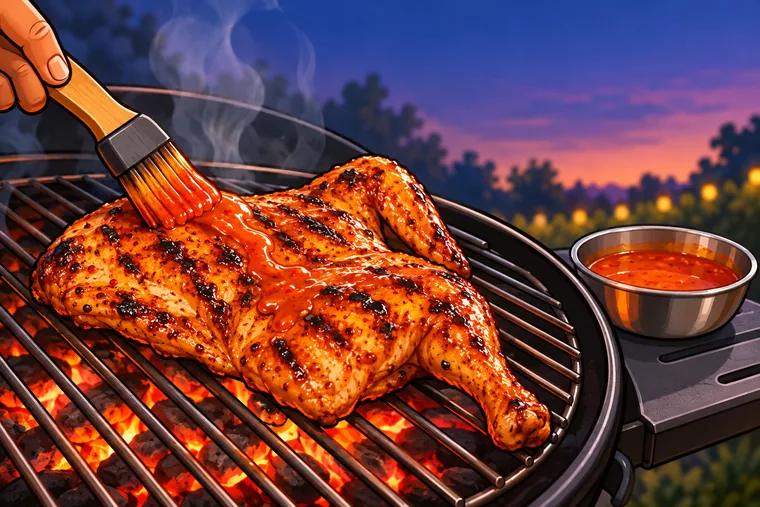
Peri Peri Sauce, What It Is and a 10-Chilli Base Recipe
Bird's eye chillies, lemon and garlic, brushed on over the coals.Oct 18, 2026 · Guide -
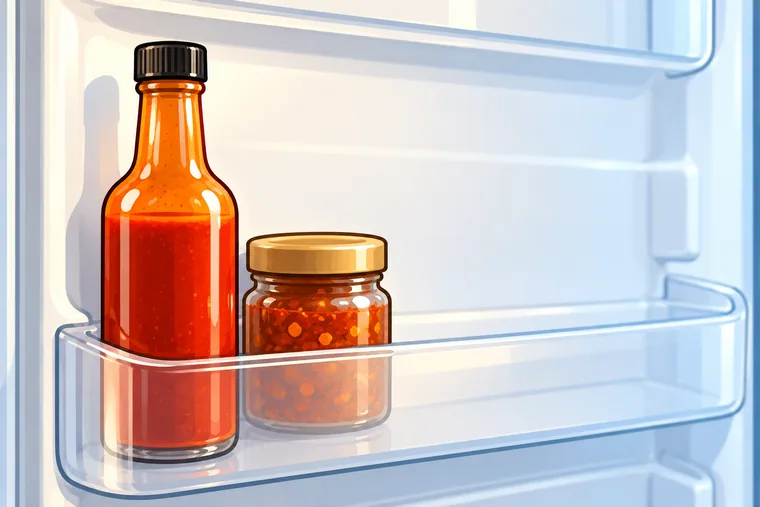
Does Hot Sauce Go Bad? Shelf Life for 7 Kinds of Sauce
What changes in the bottle, how fast, and when to let it go.Oct 18, 2026 · Guide -
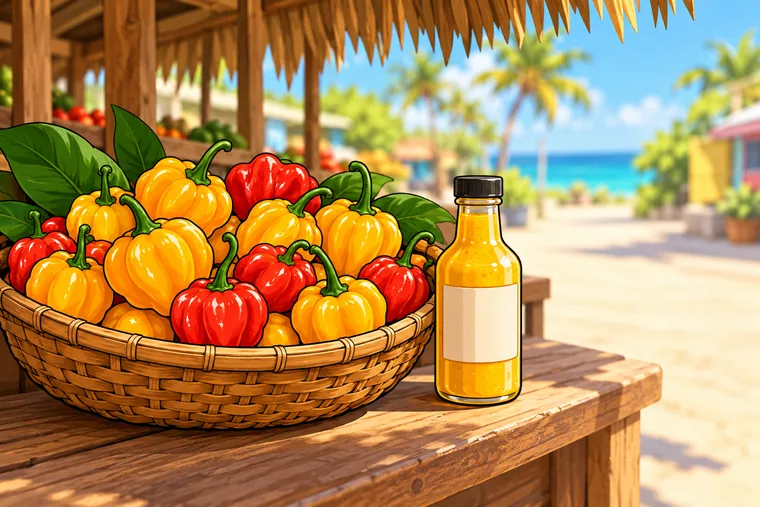
Caribbean Hot Sauce and the 350,000 SHU Scotch Bonnet
Scotch bonnet heat, softened with vinegar, onion and island herbs.Oct 18, 2026 · Guide
Sources
· 16
- 1Cholula (manufacturer, own product; Singapore product page) Cholula Original
- 2Cholula (manufacturer, own product) FAQ
- 3McIlhenny Company (manufacturer, own products) TABASCO Original Red Sauce (includes the TABASCO Scoville Chart)
- 4U.S. Code of Federal Regulations, 21 CFR 101.4 (via Cornell LII) Food; designation of ingredients
- 5USDA Agricultural Research Service, FoodData Central (SR Legacy) Sauce, ready-to-serve, pepper or hot (FDC ID 174527)
- 6USDA Agricultural Research Service, FoodData Central (SR Legacy) Sauce, ready-to-serve, pepper, TABASCO (FDC ID 174528)
- 7USDA Agricultural Research Service, FoodData Central (SR Legacy) Sauce, hot chile, sriracha (FDC ID 171186)
- 8U.S. Food and Drug Administration Sodium in Your Diet
- 9U.S. Code of Federal Regulations, 21 CFR 114.3 (via Cornell LII) Acidified foods: definitions
- 10SDSU Extension How to Make a Safe Hot Sauce (Curtis Braun)
- 11National Center for Home Food Preservation (University of Georgia) Identifying and Handling Spoiled Canned Food
- 12Ohio State University Extension (CFAES) HYG-5365: Food Preservation: Making and Preserving Barbecue and Hot Sauces
- 13University of Georgia (UGA Today), quoting Carla Schwan, Extension food safety specialist Food safety specialist chimes in on condiment storage
- 14National Center for Home Food Preservation (University of Georgia) Containers for Freezing
- 15K-State Research and Extension MF3491: Taking a New Look at Fermented Foods (Donna Krug)
- 16Huy Fong Foods (manufacturer, own products) Products

Your pocket pepper index.
Built from the same index as this site.
- Every entry offline
- Compare any two peppers
- Keep a list of peppers you have tried