On this page
- 1What salt ratio should you use?
- 2Which chiles, water and extras go in the jar?
- 3How do you ferment hot sauce?
- 4What happens inside the jar?
- 5How long does fermented hot sauce take?
- 6How do you know the ferment has finished?
- 7Is fermented hot sauce safe?
- 8Is that white film kahm yeast or mold?
- 9What goes wrong, and how do you fix it?
- 10Fermented or fresh vinegar sauce?
- 11Does fermented hot sauce last longer than fresh?
- 12Before you blend your first jar
- 13Sources
What salt ratio should you use?
Use 2 to 3 % salt for a pepper mash and up to 5 % for whole pods in brine. Vegetable ferments typically hold 2–3 % salt, and above 2 % the salt gives the lactic acid bacteria an edge over the bacteria you do not want1. Illinois Extension sets 3 % for shredded vegetables and 5 % for large pieces2.
Weigh the salt; a spoon of flaky salt and a spoon of fine salt do not hold the same amount. NCHFP warns that flake salt varies in density3, and Illinois Extension says to weigh salt for accuracy2.
Adding more salt does not buy you extra safety. Above 2.5 %, the review notes, you hold back the first wave of bacteria and lose some of the aroma compounds that make your ferment taste like one1.
How much salt for your batch?
For a brine, you work out the percentage as salt weight against water weight. Illinois Extension gives the grams per quart of water2:
| Method | Salt | For example |
|---|---|---|
| Brine for chopped or sliced chiles2 | 3 % of the water | 1 quart water + 27 g (2 tbsp) salt |
| Brine for whole or halved pods2 | 5 % of the water | 1 quart water + 45 g (3 tbsp) salt |
| Brine by the cup4 | 2 tsp salt per cup of water | K-State's figure for peppers and other watery vegetables |
| Mash (chiles blended with salt, no water)1 | 2–2.5 % of the chile weight | 500 g chiles × 0.025 = 12.5 g salt |
The pepper mash row is our arithmetic on the 2.0–2.5 % that the Food Protection Trends review recommends for consistent batches1. Use canning or pickling salt; table salt clouds your brine and iodized salt can slow the ferment and brown the vegetables5.
Here is a worked quart. K-State puts about 1 pound of vegetables and 2 cups of brine in a 1-quart jar4, so you mix one quart of water with 27 g of salt, pour in what the jar takes and keep the rest in the fridge in case the level drops. Going bigger? Illinois Extension sizes a crock at 1 gallon for every 5 pounds of produce5.
Do not cut the salt to make a "healthier" batch. NCHFP says not to reduce it3, and in some low-salt ferments the pH has climbed back above 4.61.
Which chiles, water and extras go in the jar?
Any fresh, firm chile works, from mild jalapeños to habaneros; your pepper sets the heat and the color, and the bacteria do the rest. What matters more is the state of your chiles and the water you pour over them.
- Fresh, firm chiles with no soft spots. Illinois Extension lists firm produce free of spoilage as one way you keep mold out of the jar2.
- Cut size changes the pace. Acid soaks into small pieces faster than large ones, so your jar of chopped chiles sours sooner than a jar of whole pods1. That is also why you give whole pods the stronger 5 % brine.
- Water without chlorine. Tap water usually carries chlorine or chloramines, which you need to remove before a ferment; Illinois Extension prefers filtered or spring water and says to skip distilled water2.
- Garlic, onion and fruit are flavor, not safety. Garlic's allicin and the chiles' own capsaicin fight some microbes, but the review says you cannot count on either for safety, because their strength varies by variety and growing conditions1. The salt and the falling pH are what keep you safe.
How do you ferment hot sauce?
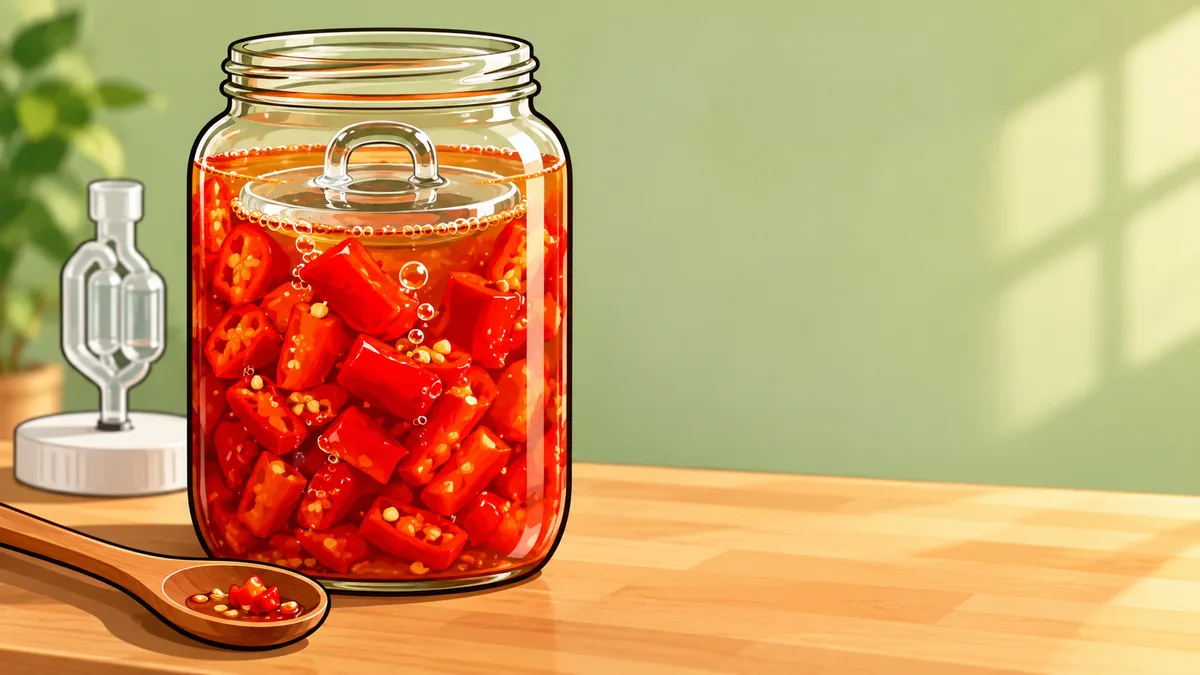
You pack chopped chiles under a weighed brine, seal the jar so gas can escape and air cannot get in, and wait for the bacteria to sour it. You can skip the airlock if you keep every piece under the brine; Illinois Extension recommends one but says a ferment works without it5. The steps:
America's Test Kitchen walks through making a lacto-fermented hot sauce in under six minutes, so you can watch the whole job once, and then follow the weighed brine and the pH 4.6 line from this page.
- 1
Clean the jar and tools
Wash your jar, lid, weight and knife in hot soapy water. Boiling the jar for 10 minutes also sanitizes it.2
- 2
Weigh and cut the chiles
Pull the stems and chop or halve the pods. A 1-quart jar holds about 1 pound of vegetables with about 2 cups of brine.4
- 3
Mix the brine
Dissolve the salt from the table above in filtered or spring water. Weigh it on your kitchen scale.2
- 4
- 5
Seal with an airlock or burp it
Use an airlock lid, or loosen a plain lid now and then so the gas can escape.4
- 6
- 7
Check the pH, then blend
Once the pH reads below 4.6 and the signs below line up, blend the chiles with some of the brine. Add vinegar now if you want a sharper sauce.1
The steps above lean on three pieces of gear, and here is what to look for in each.
Gear for a hot sauce ferment
An airlock, a weight and a pH meter handle the three jobs the steps ask of you.
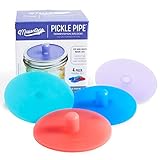
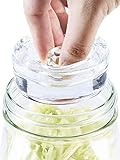
Fermentation airlock lid for a wide-mouth jar
You let gas out and keep oxygen away from the chiles without opening the jar.
- Illinois Extension: fermentation locks keep oxygen out while carbon dioxide escapes
- A ferment can also work without one, so it is optional
- Where: On the jar, in a cool spot
- View on Amazon: Glass fermentation weight
Glass fermentation weight
You hold every piece of chile under the brine, where it cannot grow mold.
- View on Amazon: Digital pH meter
Digital pH meter
You read your brine against the pH 4.6 line before you blend.

As an Amazon Associate we earn from qualifying purchases. We choose product types from what their labels and extension sources say; the commission does not change what we recommend. Our affiliate disclosure
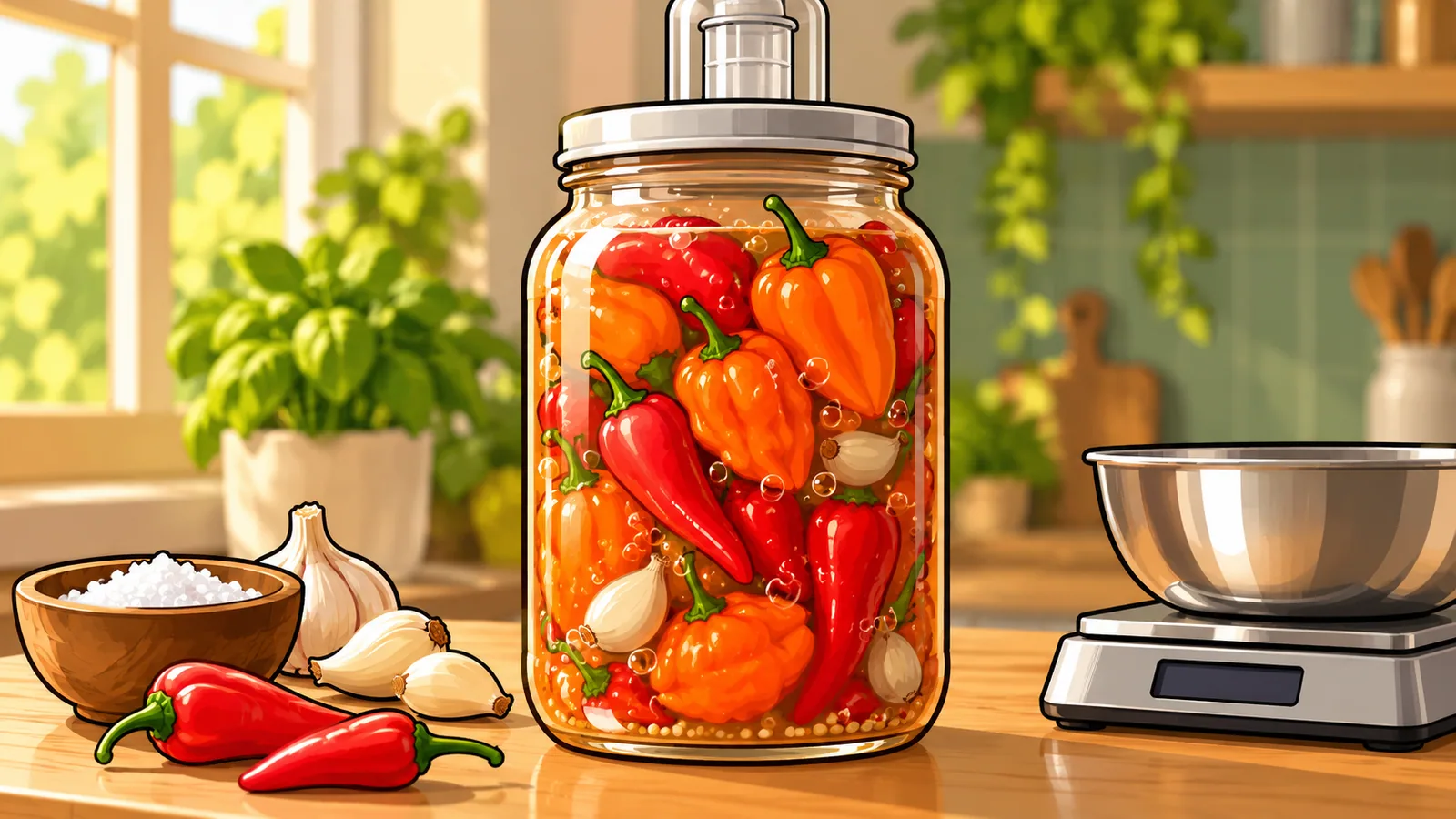
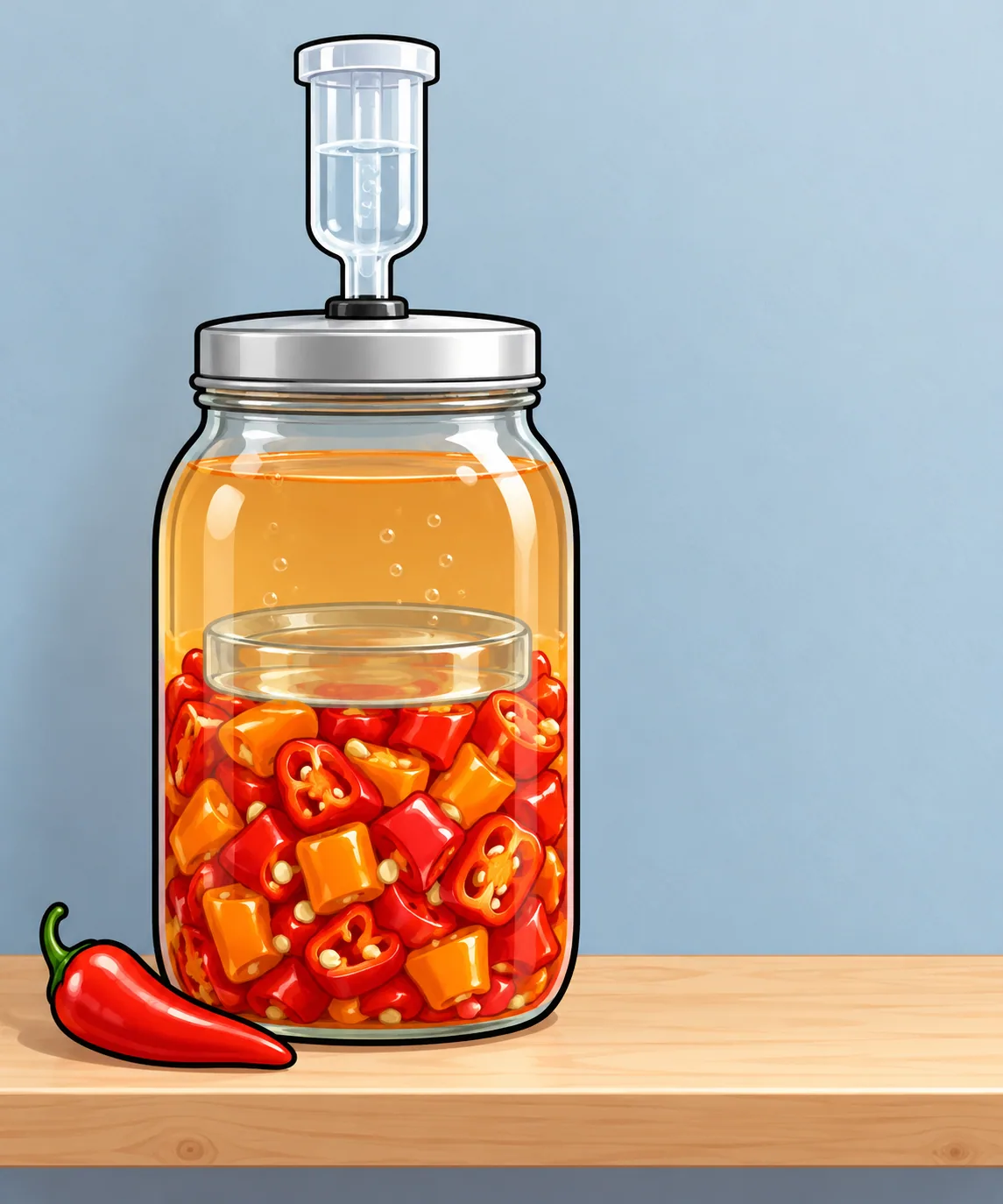
Here is what your packed quart jar looks like on day one. Every part of it has one job: keep air away from the chiles while the gas gets out.
What happens inside the jar?
Two teams of lactic acid bacteria take turns in your jar. The first makes the bubbles and a mix of acids, the second finishes the souring, and the pH line of 4.6 falls in between1.
- Jar packedBrine near pH 6; vegetables start with 2–4 % sugar
- Surface microbes give waySalt and low oxygen favor lactic acid bacteria
- First stage: Leuconostoc, WeissellaLactic and acetic acid; gas shows as bubbles
- pH passes 4.6Sauerkraut brine: 6.2 to 4.2 in 4 days
- Second stage: LactobacillusFrom about week one; lactic acid only
- Finished brineSugar used up, pH often 3.1–3.2
The stages of a vegetable ferment, from packed jar to finished brine 12
The bubbling you watch in the first week comes from that first team; Illinois Extension notes that lactic acid bacteria make gas, which you see as bubbles in the brine2. The second team makes lactic acid with little or no gas1, which is why a jar goes quiet while it keeps getting more sour.
That acid is what protects you. In the review's data, a brine at pH 3.1 cut E. coli a hundred-thousandfold in about 3 days, while a brine with almost no lactic acid took about 3 weeks to do the same1.
How long does fermented hot sauce take?
Your jar usually passes pH 4.6 within the first week, but you wait longer for the full flavor: typical vegetable ferments run three to six weeks at 65–72°F1.
- Days 1–4
The brine sours fast. In a sauerkraut study the brine pH fell from about 6.2 to 4.2 in the first 4 days.1
- Within a week
Most well-run vegetable ferments reach a pH below 4.6.1
- Weeks 3–6
The usual length of a vegetable ferment at 65–72°F; you taste it as it goes.1
- After blending
Keep your sauce in the fridge. Fermented vegetables keep for many months there and turn very sour if left at room temperature.4
Your room temperature sets the pace. Warmth speeds things up: kimchi held at 77°F dropped below pH 4.6 in 46 hours in one study the review cites1. If your kitchen tops 80°F in July, though, spoilage bacteria gain ground, while a cold pantry only slows your jar down.
| Room | What happens |
|---|---|
| Below 50°F (10°C)1 | Fermentation proceeds but slowly, so it takes longer to reach the final pH |
| 60–65°F (16–18°C)7 | Sauerkraut takes 5 to 6 weeks; below 60°F it may not ferment at all |
| 65–72°F (18–22°C)1 | The range most vegetable ferments are kept at |
| 70–75°F (21–24°C)7 | Sauerkraut finishes in about 3 to 4 weeks |
| Above 75–80°F (24–27°C)17 | Spoilage bacteria gain ground: soft texture, off flavors, discoloration |
If your only cool spot is a closet floor or a basement shelf, use it. A slow ferment that keeps dropping in pH beats a fast one that turns soft.
How do you know the ferment has finished?
You know it has finished when the bubbling slows, the jar smells pleasantly sour and the pH sits below 4.6 and stays there. Check all four before you blend.
- You see the bubbling slow or stop. NCHFP counts sauerkraut done when bubbling ceases.7
- Your jar smells pleasantly and slightly sour, never rotten.2
- It tastes as tangy as you like; a longer ferment gives more tang.2
- Your brine reads below pH 4.6 on a calibrated meter and does not rise on the next reading.1
If you use pH strips, expect less precision. The review says a calibrated meter gives the most accurate reading, and paper strips are fine once the brine is below 4.01. Producers take a reading daily for the first several days and less often after that1, a rhythm that works in your kitchen too.
Is fermented hot sauce safe?
Your ferment is safe when the pH drops below 4.6 and keeps falling: below that line, botulism bacteria cannot grow11. The Food Protection Trends review makes that steady drop the one critical safety step and says to throw out any ferment that never gets there1.
Mold and yeast grow where air reaches the jar, so keep every chile under the brine. Yeasts and molds tolerate salt better than the bacteria you want, so salt alone will not stop them if oxygen gets in12.
A jar that stalls also deserves a second look. The review warns that a very sluggish ferment can drift into secondary fermentations that raise the risk1, so a pH that stops falling above 4.6 means you start again.
Is that white film kahm yeast or mold?
If you see a flat, smooth white film, it is kahm yeast; Illinois Extension calls it very common and safe5. Raised, fuzzy spots are mold, and NC State Extension rates mold in a ferment as unsafe12.
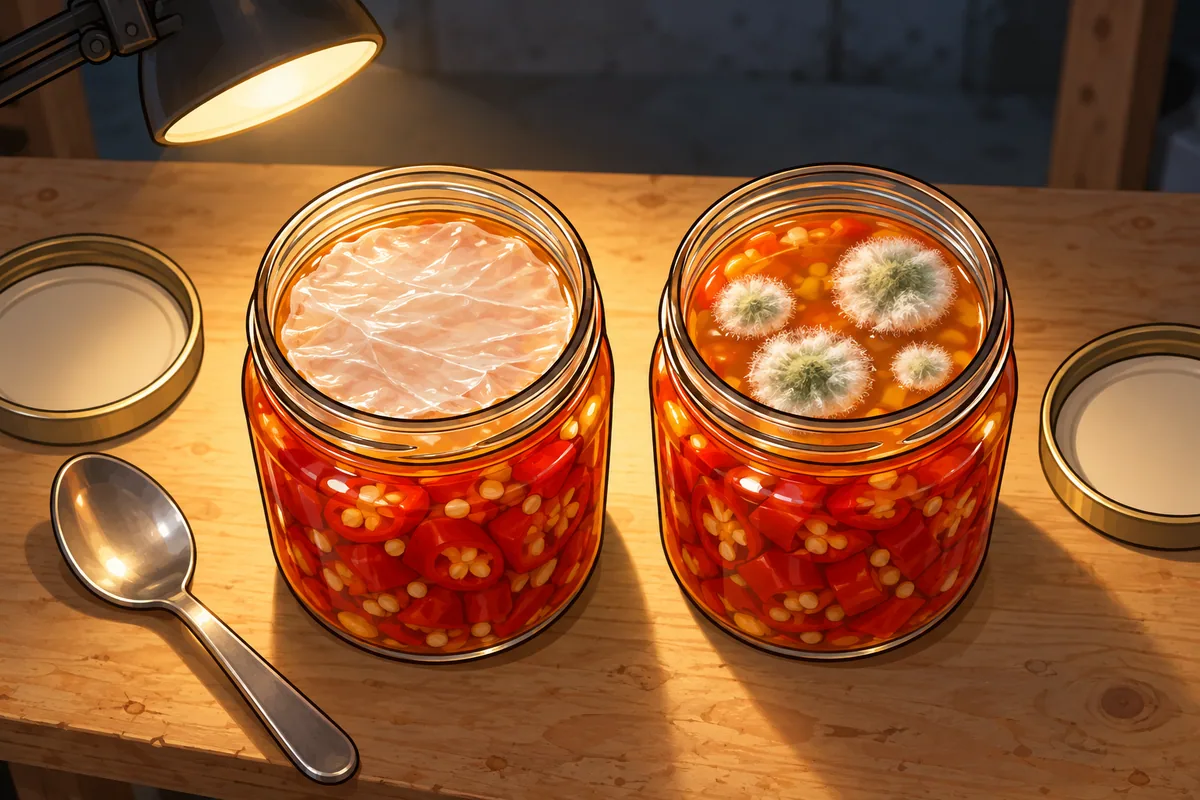
Look at your jar from the side as well as from above. Kahm lies flat on the brine like a skin, while mold stands up off it in round, fuzzy patches.
| What you see | What it is | What to do |
|---|---|---|
| A flat white film, not fuzzy, not in round patches512 | Kahm yeast, harmless | Skim it off and push the chiles back under the brine |
| Fuzzy, raised spots or round patches12 | Mold, rated unsafe | Throw out the batch |
| Soft, slimy or slippery chiles212 | Slime-making microbes | Throw out the batch |
| A little white sediment on the bottom12 | Yeast that settled, or salt additives | Normal in small amounts while the chiles stay firm |
| A spoiled or rotten smell5 | Spoilage | Throw out the batch |
Kahm yeast is harmless, but it tells you air got in. The review finds film yeast where the brine meets air in a jar that is not well sealed1, so after you skim, check the brine level and the lid.
What goes wrong, and how do you fix it?
When a batch fails, you can usually trace it to one of three things: heat, air or the wrong salt. NC State's problem table lists the causes for each symptom12.
- Soft or mushy chiles. NC State points to a weak brine, a room above 75°F, too little brine or scum you did not remove12. If they feel slippery, you throw the batch out; next time, weigh the salt and pick a cooler spot.
- Cloudy brine. It has more than one cause: spoilage, hard water, or table salt whose anti-caking agents cloud the liquid12. Judge it with your nose and fingers; a clean sour smell and firm chiles point to the salt or water.
- Mold even though you used plenty of salt. NC State links mold to a room above 75°F and to too much salt, which holds back the acid-making bacteria12. Stick to the table above.
- Dark or brown chiles near the top. Pieces that touch the air lose color, and iron in the water darkens them too12. Keep your weight on and your brine up to the neck.
- No bubbles after a few days. A cold room slows everything; below 60°F a kraut may not ferment at all7. Move the jar somewhere warmer and keep reading the pH.
- Too sour for you. Ferment fewer days next time; Illinois Extension notes that a shorter ferment gives a less sour product2.
Fermented or fresh vinegar sauce?
Pick fermented if you can wait weeks for the sour flavor the bacteria make, and fresh vinegar sauce when you want sauce today. Both are safe only when the finished sauce sits at pH 4.6 or below.
Fermented
Fresh with vinegar
- Lactic acid made by bacteria in the brine4Where the acid comes fromVinegar (5 % acidity) or lime juice added to the chiles311
- About a week to pass pH 4.6, often 3–6 weeks for flavor1TimeSame day11
- None needed; store it in the fridge4Heat stepBring to a boil; boiling kills Salmonella and Listeria cells, but botulism spores survive, so the acid still matters11
Federal rules call a low-acid food with added acid and a finished pH of 4.6 or below an acidified food10. That is the vinegar route; with a ferment, you reach the same line through bacteria.
You can also do both: ferment the chiles, then blend in a splash of vinegar for a sharper edge. If you have a quart of chiles and three weeks, ferment. If friends come over on Saturday, make the quick vinegar sauce.
Does fermented hot sauce last longer than fresh?
In the fridge, yes. K-State Extension says fermented vegetables stay fresh for many months there4, while Ohio State tells you to use an uncanned fresh sauce relatively quickly13. The shelf-life table puts both next to bought bottles.
Your sauce keeps changing in the cold, slowly. Illinois Extension says to expect subtle flavor changes in the fridge as the process continues2, and the review notes that unheated bacteria keep making gas and acid during storage; heating the sauce stops them1.
Your sauce stays about as hot as the chiles you started with. In a 2022 study, six chile cultivars, from cayenne to habanero and Carolina Reaper, fermented as plain paste for 21 days at 20°C, and the authors found the capsaicinoids very stable through it14.
Fermenting changes the sourness and the keeping time; the pepper you pick still sets the heat. So whether fermented is better comes down to your taste: pick it for the lactic tang, and the vinegar route for sauce today.
Before you blend your first jar
Strain the chiles and keep the brine in a bowl. Blend with a little brine at a time until the sauce pours the way you want, then taste for salt and acid. For your next batch in a bigger or smaller jar, the brine calculator turns the percentage into grams of salt.
Bottle it with some room at the top and keep it in the fridge, since the live bacteria can still build a little gas. Open a bottle that has sat a while slowly, over the sink.
If it comes out runny, you can fix it with the steps for thickening hot sauce. Plan to keep the bottle on a shelf? Read how to make hot sauce shelf stable before you seal it.