
Thai Peppers and the 50 Local Chili Lines Thailand Grows
Small, upright and hot, in two species at once.
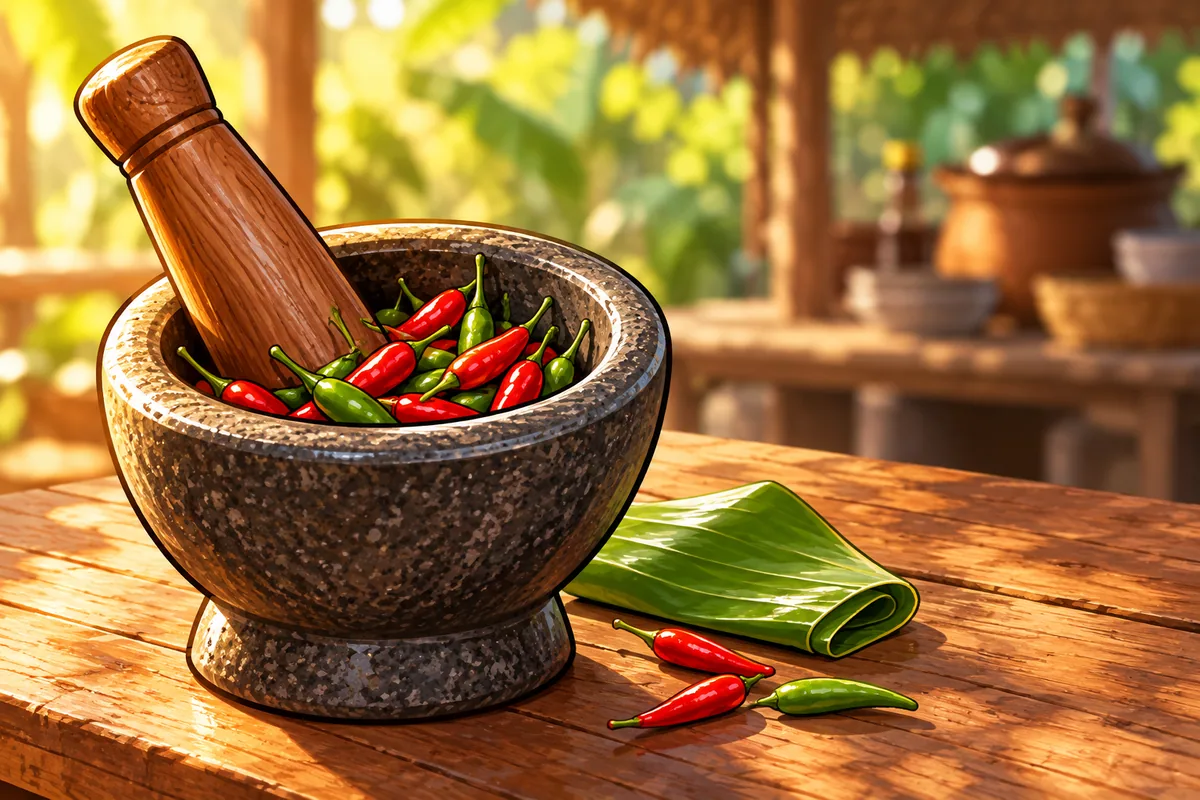
Most Thai chili land grows the small, upright prik khee noo; the rest is a mix of local lines in two species, C. annuum and C. frutescens.
- Over 60 % of Thailand's 75,955 ha of chili in 2006/2007 was small upright chili
- The Thai pepper sold abroad rates 50,000–100,000 SHU
Plains and hills
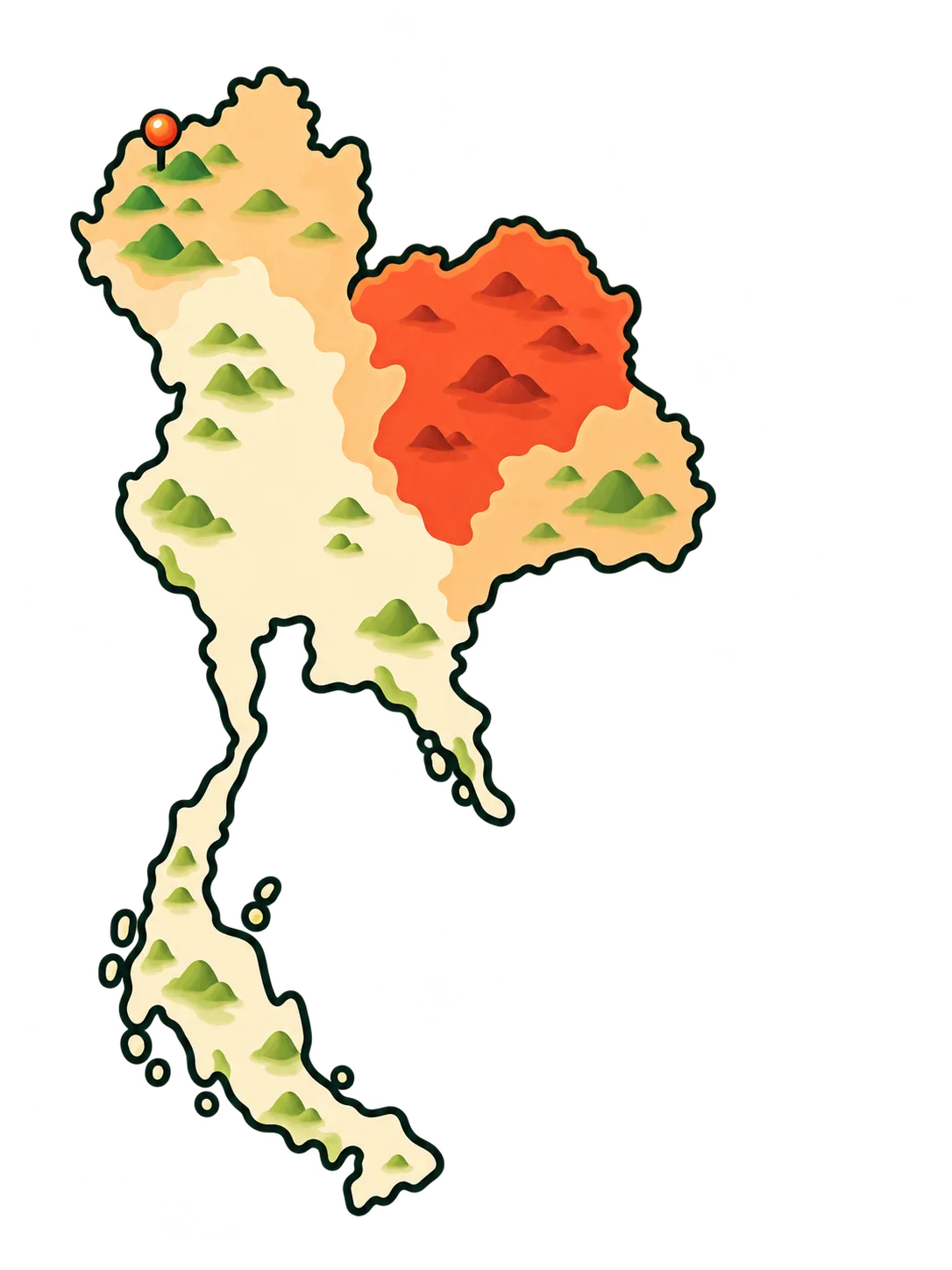
The lowland crop by region, and the highland Karen chili.
-
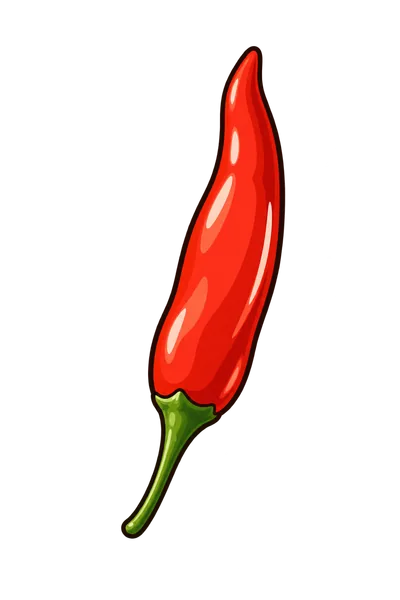
Thai chili
Hot50,000–100,000 SHU Capsicum annuum -
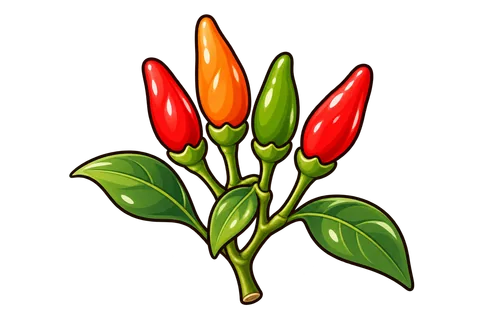
Bird's eye chili
Hot50,000–100,000 SHU Capsicum annuum
Nothing matches this filter yet.
Published heat ranges. Sources on each entry page.
Peppers from around the world
On this page
- 1What are Thai peppers?
- 2Which chilies do Thai farmers grow?
- 3How hot are Thai peppers?
- 4Are Thai peppers C. annuum or C. frutescens?
- 5When and where do Thai chilies grow?
- 6How do Thai cooks use their chilies?
- 7Which Thai chili should you buy for your dish?
- 8Why does your dish come out hotter than last time?
What are Thai peppers?
Small, upright, hot chilies, grown on a scale you might not expect. In 2006/2007 Thailand planted 75,955 ha of chili and harvested 333,672 t, about 8.1 t per hectare, and over 60 % of that land grew small, erect-fruited chili, the prik khee noo1.
Thai chilies are Thai by long use, not by origin. Like every pepper they trace back to the Americas, and the peppers by country page shows how they got to Asia. What you buy as a Thai chili in a shop abroad is one slice of a much wider crop, and the rest of this page shows you the other slices.
Which chilies do Thai farmers grow?
You'll find prik khee noo on the plains and local landraces in the hills. The table brings together what a Kasetsart University study and a Department of Agriculture survey say about each type12.
| Type | Thai name | Species | What the source says |
|---|---|---|---|
| Small erect-fruited chili1 | Prik khee noo | C. annuum (the 28 lines studied) | Over 60 % of chili land; most grown in the Northeast |
| Jinda chili2 | Prik khee noo jinda | Local line in the survey | Highest yield of 50 local lines: 1,765.10 g per plant |
| Karen chili2 | Prik kariang | C. frutescens | Highland landrace, aromatic and hot, fruit about 4–6 cm |
| Hmong chili2 | Prik mong | Local line in the survey | One of the higher-yielding local lines |
| Huarua3 | None given | C. annuum | Above 80,000 SHU, among the three hottest of ten cultivars tested |
| K073 | None given | C. frutescens | Above 80,000 SHU, the highest capsaicin of the ten |
| Thai chili as sold abroad4 | None given | C. annuum per UF/IFAS | 50,000–100,000 SHU, about 1 inch long |
With most of the chili land in one type, the small upright prik khee noo is the Thai chili most people mean. The hill lines are a different story: for the Karen chili, the Department of Agriculture notes a distinctive aroma and a hot bite2.
If you buy seed, you'll meet both kinds, because Thai farmers keep both in use. The Kasetsart study puts the split at about 20 % F1 hybrids to 80 % open-pollinated varieties, and the 28 prik khee noo lines it tested came mostly from the Northeast, with a narrow genetic spread between them1.
How hot are Thai peppers?
The Thai pepper sold in the United States rates 50,000 to 100,000 SHU, the top of the hot band5. That's 10 to 20 times an average jalapeño at about 5,000 SHU4.
Log scale; bars are published ranges.4
On the chart you'll see the Thai chili sit above cayenne at 25,000–50,000 SHU and below the habanero at 100,000–350,0004. So if your recipe asks for five Thai chilies and you only have cayenne pods, expect a milder dish at the same count.
Local lines give you a much wider spread. Thailand's Department of Agriculture measured capsaicin in 50 lines and found anything from 14.12 to 2,111.61 mg per kg of fruit, with 36 of the 50 above 500 mg per kg2. The UC Master Gardeners describe Thai chilies as fruity, sometimes citrusy and very spicy with lingering heat6, and that last word is the one to plan around.
A Kasetsart lab study of ten Thai cultivars gives you the field picture in Scoville terms: all but one rated 45,000 to 80,000 SHU, and two, Huarua and K07, went above 80,0003.
Are Thai peppers C. annuum or C. frutescens?
Both, and that's why sources disagree. The Kasetsart study says C. annuum and C. frutescens are Thailand's main cultivated species, and that the commercial hybrids are C. annuum1. The Department of Agriculture's survey sorted 50 local lines by flower and seed color, and C. frutescens came out ahead, 33 lines to 16, with one line of C. pubescens, the rocoto's species2.
C. annuum in Thailand
C. frutescens in Thailand
- Commercial hybrids and the prik khee noo lines of the plains1Where you meet itLocal landraces such as the highland Karen chili2
- 16 of the 50 local lines in the survey2Lines counted33 of the 50 local lines in the survey2
- Huarua and Huayseeton SK1, both high in capsaicin3Hottest testedK07, the highest capsaicin of ten cultivars3
So when UF/IFAS files the Thai pepper under C. annuum4 and the University of Guam lists Thai under C. frutescens7, both can be describing real Thai chilies. The Capsicum species key shows you how to tell which one is on your plant.
When and where do Thai chilies grow?
Prik khee noo grows mostly in the Northeast, then the North and the East1. The Karen chili is a hill crop: farmers in Mae Hong Son grew 8,436 rai of chili in 2012, mostly local lines saved from year to year, often planted among upland rice or maize2.
The highland year runs as a loop, because the seed for next season comes off this season's plants.
- Plant with the rainsMay to July, often among upland rice or maize
- First podsAugust
- Repeat pickingThrough December, on plants 1.0 to 1.5 m tall
- Save seedLocal lines kept from year to year
- Back to Plant with the rains
The survey found the Karen chili growing at up to about 1,000 m above sea level2. If you grow Thai chilies in a pot far from Thailand, the useful lesson is the length of that season: from the May planting to the December pick runs about eight months, so your plants need a long warm stretch to give you their full crop.
How do Thai cooks use their chilies?
Fresh and processed. The Department of Agriculture's report names six uses, from fresh seasoning to curry paste and food color, and the use tiles above list each one2.
Pounding them fresh in a mortar, drying them or taming a dish that came out too hot are all cooking with hot peppers questions, and that silo takes it from here. For curry paste and sauce, your choice of line matters more than the name on the bag, since the hottest Thai lines carry over a hundred times the capsaicin of the mildest2.
Which Thai chili should you buy for your dish?
Start from how much heat your dish can carry, then pick by size. The three cases below come from the figures on this page.
- You want the familiar burn of a Thai restaurant dish: buy the small 1-inch Thai chili sold abroad at 50,000–100,000 SHU4, and if you're used to jalapeños, the Thai chili and jalapeño pair walks you through the jump.
- You want aroma as much as heat: look for the longer, 4–6 cm Karen chili, which the Department of Agriculture singles out for its smell2.
- You're cooking for people who rarely eat chili: taste one pod first, since local lines differ in capsaicin by a factor of about 1502.
Why does your dish come out hotter than last time?
Usually because the pods changed, not your recipe. Three causes show up in the sources: a different line in the bag (14.12 to 2,111.61 mg of capsaicin per kg across local lines)2, a first-harvest batch, which runs hotter than later pickings3, and a different species behind the same "Thai chili" label1. When you can, buy from the same seller each time, and add the chilies in two rounds so you can taste between them.
Quick answers
Do Thai farmers grow hybrid chilies?
Some. A Kasetsart University study puts the split at about 20 % F1 hybrids to 80 % open-pollinated varieties, and notes that the commercial hybrids are C. annuum.1
How big is a Thai chili?
Small. UF/IFAS gives the Thai pepper sold in the United States as about 1 inch long; Thailand's highland Karen chili runs a little longer, about 4 to 6 cm.24
Why does one bag of Thai chilies burn more than another?
Because the lines differ. Thailand's Department of Agriculture measured local Karen chili lines from 14.12 to 2,111.61 mg of capsaicin per kg, a 150-fold spread inside one named type.2
More in Pepper Index
The newest from Pepper Index
-
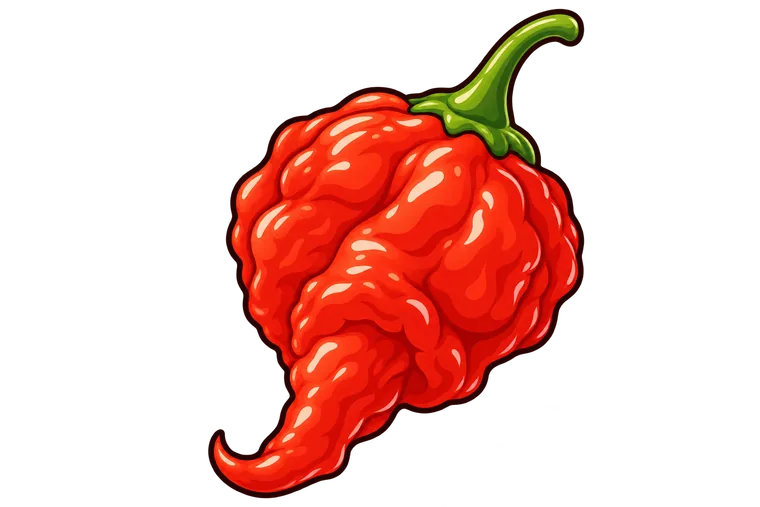
Carolina Reaper Scoville, 1.64 Million SHU
A fruity, sweet superhot from South Carolina, bred from a habanero and a Naga Viper.Oct 18, 2026 · Pepper -
Ghost Pepper Scoville, About 1 Million SHU
The Bhut Jolokia of Assam, India: the first pepper measured at a million SHU.Oct 18, 2026 · Pepper -
Ñora Pepper, Sweet Pimentón Pod Under 480 SHU
The small round sweet pepper behind Murcia's pimentón.Oct 18, 2026 · Pepper -
Pepper X Scoville, 2.69 Million SHU and Record
Ed Currie's record pepper from South Carolina, at an average of 2.69 million SHU.Oct 18, 2026 · Pepper -
Aleppo Pepper, the Halaby Flake Cured With Oil and Salt
A burgundy flake from the old Silk Road city of Aleppo, sweet and fruity first, with a moderate heat behind it.Oct 18, 2026 · Pepper -
Calabrian Chili Heat, 5,000–70,000 SHU by EU Rule
Peperoncino di Calabria: the protected chili of Italy's toe, sold fresh, on strings, as flakes and as powder.Oct 18, 2026 · Pepper
Sources
· 7
- 1Agriculture and Natural Resources 50(1):43-47 (Kasetsart University) Variation of small erect-fruited chili in Thailand (Milerue, Chunwongse, Struss, Wasee)
- 2Department of Agriculture, Thailand (Mae Hong Son Agricultural Research and Development Center) The Study Genetics Characterization and Phytochemicals of Karen Chili (Capsicum frutescens L.) in Field Collection and Local Habitat (Saendamuen, Didlek, Fusaeng), final research report, in Thai
- 3Agriculture and Natural Resources (Kasetsart Journal) 42(4):611-616 (Kasetsart University) Capsaicin and Dihydrocapsaicin Contents of Thai Chili Cultivars (Kraikruan, Sukprakarn, Mongkolporn, Wasee)
- 4University of Florida IFAS Extension HS-859/TR010: Pepper Production in Miami-Dade County, Florida
- 5UF/IFAS Gardening Solutions Peppers by Scoville Units
- 6University of California Agriculture and Natural Resources, UC Master Gardeners of Ventura County Ventura Garden to Table Series: Peppers
- 7University of Guam, College of Natural and Applied Sciences, Cooperative Extension and Outreach FPP-05: Hot Pepper (Capsicum spp.), Important Crop on Guam (Tuquero, Chargualaf, Marutani)
Your pocket pepper index.
Built from the same index as this site.
- Every entry offline
- Compare any two peppers
- Keep a list of peppers you have tried