
Calabrian Chili Heat, 5,000–70,000 SHU by EU Rule
Peperoncino di Calabria: the protected chili of Italy's toe, sold fresh, on strings, as flakes and as powder.
 Hot
Short answer
5,000–70,000 SHU, medium-high heat
- The EU specification for Peperoncino di Calabria sets the range and lists 16 varieties
- Grown and dried only in Calabria; sold fresh, on 20–120 cm strings, in pieces, as flakes or as powder
On this page
- 1How hot is a Calabrian chili?
- 2What counts as a Calabrian chili under the EU label?
- 3How does a Calabrian chili go from field to flakes?
- 4Which Calabrian chili form should you buy?
- 5What does Calabrian chili taste like, and where does it go?
- 6How do you cook with Calabrian chilies at home?
- 7How long do Calabrian chilies keep, fresh, frozen or dried?
- 8Why is there a "Calabrian pepper" in Brazilian shops?
- 9Can you keep Calabrian chilies in oil at home?
- 10Calabrian chili against Fresno, peperoncino and paste
- 11What goes wrong with Calabrian chilies?
How hot is a Calabrian chili?
Anywhere from jalapeño-warm to hotter than a cayenne. The EU specification for Peperoncino di Calabria calls the heat medium-high, between 5,000 and 70,000 SHU1, a span of 14 times from the mildest legal pod to the hottest. That range is wide because the label covers many varieties, not one pepper.
Two named Calabrian varieties give you a feel for the middle. A breeding study cites earlier Italian lab work that found about 14,700 SHU in 'Amando' and 7,400 SHU in 'Sigaretta'3, both well inside the legal band and close to a serrano or a hot jalapeño.
How many jalapeños' worth of heat is that?
We worked it out against UF/IFAS's average jalapeño of about 5,000 SHU and its cayenne at 25,000–50,0002. The bottom of the legal range equals that jalapeño; the top runs about 14 times hotter and past the hottest cayenne.
| Calabrian chili | Heat | Against a 5,000 SHU jalapeño |
|---|---|---|
| Mildest legal pod | 5,000 SHU | About the same |
| 'Sigaretta' | About 7,400 SHU | About 1.5 × |
| 'Amando' | About 14,700 SHU | About 3 × |
| Hottest legal pod | 70,000 SHU | About 14 × |
Because one jar can sit anywhere in a 14-fold range, taste a single flake or a sliver of pod before you season a whole dish with it. The label tells you where it grew, not which end of the range you bought.
What counts as a Calabrian chili under the EU label?
Any fresh or dried Capsicum annuum fruit of 16 named varieties, grown in Calabria1. The list surprises most people, because it mixes local landraces with international types you may have grown yourself.
The 16 varieties the specification allows
So a cayenne grown near Cosenza can carry the Calabrian label while the same seed grown in Puglia can't. The pods also vary in shape: conical, long and conical, slightly oval or tapering to a round tip, 3 to 25 cm long, or round like cherries at 1 to 4 cm across1.
The rules want fresh pods red (unripe ones turn up green or yellow), whole, firm and compact, with a green stalk and no marks1. Dried ones run from brick red to an intense deep carmine, with yellow bits only where the seeds stay in, and may hold no more than 15 % moisture1. That moisture cap is worth remembering: a dried chili that bends instead of snapping in your fingers is wetter than the rules allow.
How does a Calabrian chili go from field to flakes?
Through a chain of steps that must stay in Calabria until the very last one. The specification lists cultivation, harvest, whole-pod drying, forming the strings or lines, cutting into pieces and grinding into powder or flakes as work done in the region; only packing may happen elsewhere1.
- Grow in Calabria16 listed varieties
- HarvestAutumn is the main harvest
- Dry the whole podsNatural or oven drying, max 15 % moisture
- String or cutStrings 20–120 cm, or pieces
- GrindFlakes or powder
- PackMay happen outside Calabria
The strings are the form you see hanging in Calabrian doorways and on balconies. The rules allow strings or lines from 20 to 120 cm long1, and a label may also tell you whether the pods dried naturally or in an oven1.
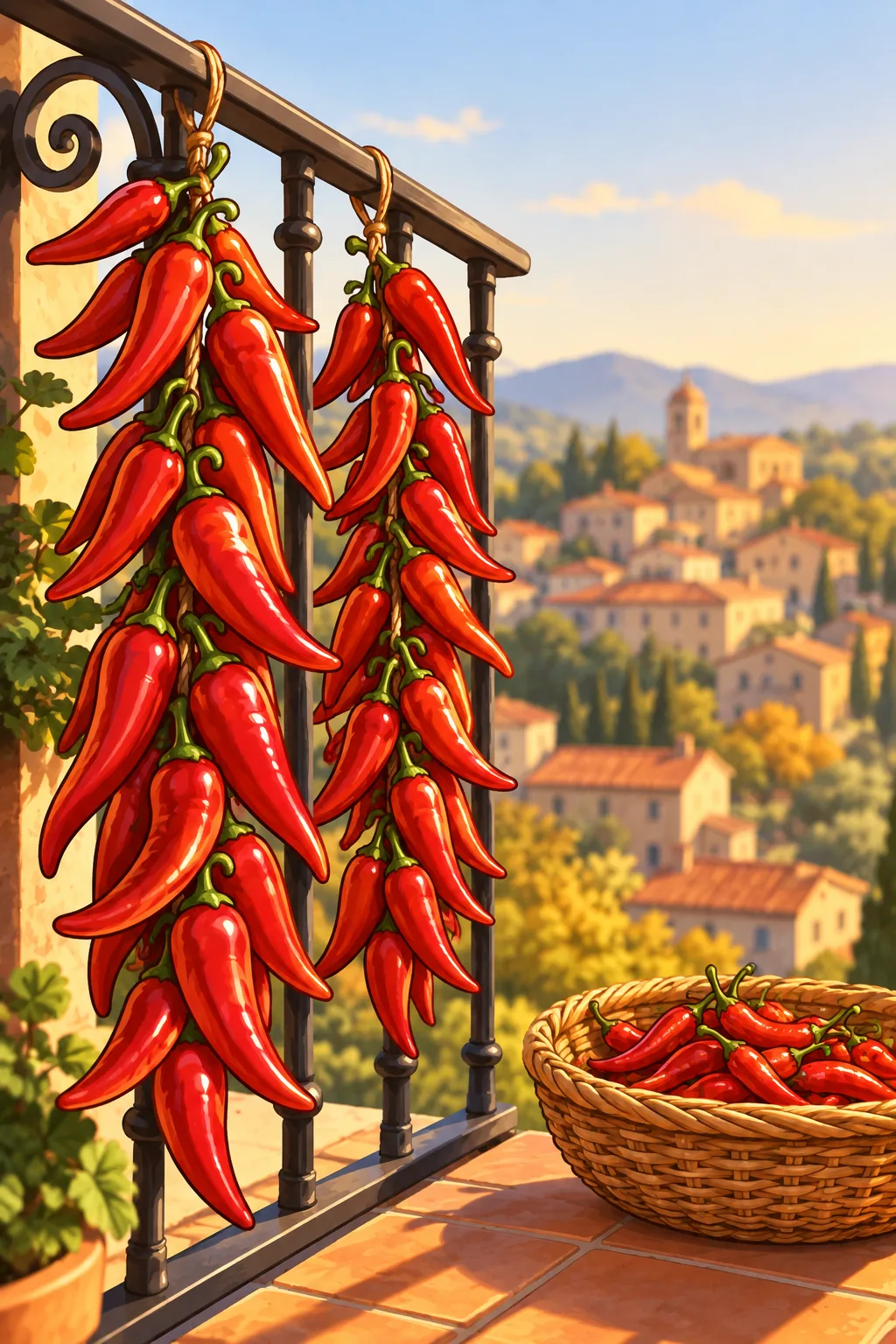
The main harvest falls in autumn, which the specification ties to Calabria's climate: its autumn months run hotter than its spring months, and the plants stand in full growth through July and August1. If you grow your own, that's your cue to expect the heaviest picking late in the season.
Which Calabrian chili form should you buy?
Buy by what you cook. The specification defines five forms with their own pack limits1; the last column is our suggestion for each.
| Form | Label wording | Pack limit | Reach for it when |
|---|---|---|---|
| Fresh | Peperoncino di Calabria IGP fresco | Up to 1 kg retail | You want to slice it into a sauce or pickle it |
| Dried strings | Essiccato in collane or filari | 20–120 cm long | You want a year's supply to crush as needed |
| Whole or in pieces | Essiccato intero or in pezzi | Up to 3 kg | You want to warm whole pods in oil or a stew |
| Flakes | Essiccato a scaglie | Up to 10 kg | You want heat to sprinkle at the table |
| Powder | Essiccato in polvere | Up to 10 kg | You want even heat and color through a dish |
The PGI took effect in 2026: the Commission entered Peperoncino di Calabria in the EU register by Implementing Regulation 2026/1273 of 4 June 2026, with no objections filed4. Older jars won't carry the IGP wording, and pastes in oil sit outside the five forms entirely, so read a paste's own label for what's in it.
Pasta Grammar taste-tests jarred Calabrian chili products in a 21-minute video, mostly pastes, crushed chili and whole pods in oil, which sit outside the five legal forms above, so watch it for shopping ideas and not for heat numbers.
What does Calabrian chili taste like, and where does it go?
Fresh pods have a penetrating, intense aroma with herbaceous and fruity notes, in the specification's own words1. Dried, the flavor shifts toward the deep red of the pod, and the heat stays.
Its home dishes are pasta. The specification names the chili as a key ingredient in the dressings for struncatura and fileja, two pasta shapes that started in Calabria1. Locally you'll hear it called cancaricchio, the traditional name the specification records1.
1992the year Diamante began its Peperoncino Festival1
2016the producers' association founded in San Marco Argentano1
16varieties allowed under the label1
The region even keeps a Chilli Museum, in Maierà1. If you're planning a trip, the Diamante festival is the one place you'll see every form of the chili, fresh to powder, on one street.
- Fruity
- Herbaceous
- Hot
How do you cook with Calabrian chilies at home?
Start where Calabria starts: with pasta. The local dressings for struncatura and fileja build on the chili1, and you can borrow the idea for any pasta you make. Warm a few dried pieces or a pinch of flakes in olive oil over low heat, let the oil turn faintly red, then toss in your cooked pasta and a splash of its water.
Your choice of form changes how the heat lands:
- Flakes scatter heat in bursts, so you get a hot bite here and a mild one there. Add them at the end if you want that.
- Powder spreads heat and color evenly through a sauce. Stir it in early so it cooks into the base.
- Whole dried pods give you control: drop one into a stew, taste after twenty minutes, and fish it out when the pot is hot enough for you.
- Fresh pods bring the herbaceous, fruity aroma the specification describes1. Slice them thin into a sauce near the end of cooking so that smell survives.
Because the legal range runs from 5,000 to 70,000 SHU, cook with your own jar a few times before you trust a recipe's amount. Your jar sets the dose, not the recipe.
How long do Calabrian chilies keep, fresh, frozen or dried?
From a couple of weeks to a year, depending on the form you pick. Fresh hot chiles keep 2 to 3 weeks at 45–50 °F and 85–90 % humidity6, which in your kitchen means a loose bag in the crisper drawer, not the coldest shelf.
| Form | Where | How long |
|---|---|---|
| Fresh pods6 | Crisper drawer, 45–50 °F, humid | 2–3 weeks |
| Fresh pods, frozen whole7 | Freezer, flat packs under 2 inches deep | Up to 12 months |
| Homemade chilies in oil8 | Refrigerator | 4 days, or freeze |
| Dried strings, pieces, flakes1 | Cool, dry, dark cupboard | Keep them at or below 15 % moisture, sealed |
Freezing is the easy win for a glut of fresh pods. NMSU's chile guide says whole chiles freeze fine unpeeled, and that home freezers chill packs deeper than 2 inches too slowly, which leaves the flesh mushy7. Lay your pods flat in freezer bags, press the air out and you can take out exactly as many as a sauce needs.
Why is there a "Calabrian pepper" in Brazilian shops?
Because Brazil uses the name for its own crushed red pepper. A 2017 breeding study explains that Brazilian "Calabrian pepper" flakes come from red ripe fruits, mainly of C. baccatum and C. annuum, and that one original batch tested 32,100 SHU3. The lines the breeders then selected ran from about 5,200 to 15,700 SHU, with fruit 9.7 to 15.6 cm long3.
So a bag labelled pimenta calabresa in a Brazilian market isn't the Italian PGI product, and it may not even be the same species. If your recipe is Italian and you want the protected chili, look for the Peperoncino di Calabria IGP wording on the label instead.
Can you keep Calabrian chilies in oil at home?
Only for a few days in the fridge, or in the freezer. Chilies in oil are a low-acid food that can carry Clostridium botulinum, the bacterium behind botulism.
That rule covers what you make yourself, not a sealed commercial jar, which follows its maker's own process and label. For a homemade version, mix small batches you'll finish in a few days, or freeze chopped chilies in oil in ice-cube portions and take out one cube at a time.
Calabrian chili against Fresno, peperoncino and paste
A Fresno is the fresh red chili people most often swap in; the Calabrian and Fresno pair page lines up their heat and uses.
The broader Italian word for a small hot chili has its own peperoncino entry, since not every peperoncino comes from Calabria.
When your store has none at all, the Calabrian chili swap list gives you amounts. And if what you really want is the spreadable kind, the Calabrian chili paste page covers what goes into a jar of it.
What goes wrong with Calabrian chilies?
Most problems you'll meet come from the wide heat range, from moisture, or from oil.
Calabrian chili problems and their fixes
- Last jar was mild, this one is fierce: the label spans 5,000 to 70,000 SHU. Taste one flake before you season.1
- Flakes clump or smell musty: they took on moisture above the 15 % the rules allow. Keep them sealed and dry, and throw out anything moldy.1
- Homemade chili oil sat on the counter for a week: low-acid oil infusions risk botulism. Throw it out; next time keep it in the fridge and use it within 4 days.8
- Your hands burn after slicing fresh pods: wear rubber gloves, keep your hands away from your eyes, and soak burning fingers in vinegar.7
Your next step: pick the form you'll actually use from the table above, then open the Pepper Index and filter by heat to see which other Italian and Mediterranean chilies sit in the same band. Most of the time a string of dried pods on a hook is the version that keeps you supplied all winter.
Related peppers
Published ranges.2
Related in Peppers
-
Jalapeño Scoville, 2,000–8,000 SHU and Chipotle
The medium-heat chile most heat comparisons start from.6 min read -
Serrano Pepper Scoville, 10,000–25,000 SHU
A slim, fleshy chile one clear step above the jalapeño.5 min read -
Cherry Pepper Scoville, 0 SHU Sweet to Hot
A small round pepper, sweet or hot, grown for jars and stuffing.6 min read -
Chiltepin Heat, 70,000–160,000 SHU in a Pea-Sized Wild Pod
The wild bird pepper of Sonora, Arizona and Texas, picked from shrubs that grow under desert trees.6 min read -
Count Dracula Pepper Heat, 25,000–50,000 SHU on Black Leaves
A compact hot pepper grown for its near-black foliage, with pods that ripen from black to blood red.5 min read -
Habanero Pepper Scoville, 100,000–350,000 SHU
A fruity, floral chile in the extra-hot band.7 min read
Sources
· 8
- 1Official Journal of the European Union, C/2026/1101 Publication of an application for registration of a geographical indication: Peperoncino di Calabria, single document (EU No PGI-IT-03421)
- 2University of Florida IFAS Extension HS-859/TR010: Pepper Production in Miami-Dade County, Florida
- 3Horticultura Brasileira 35(2) Breeding Calabrian pepper lines for Brazilian agriculture from sui generis introduction of germplasm (Ribeiro et al.)
- 4Commission Implementing Regulation (EU) 2026/1273 of 4 June 2026, as reproduced in Staatscourant 2026 nr. 22283 Entry of Peperoncino di Calabria (PGI) in the Union register of geographical indications
- 5Pasta Grammar We Tried ALL the Calabrian Peppers We Could Find
- 6Iowa State University Extension PM 1888(S): Guía de Horticultura, El huerto doméstico, Chiles (Everhart, Haynes, Jauron)
- 7New Mexico State University Cooperative Extension (Guide E-324) Processing Fresh Chile Peppers (revised by Nancy C. Flores and Cindy Schlenker Davies), revised January 2016
- 8Oregon State University Extension Service SP 50-701: Herbs and vegetables in oil (Raab, Woodburn), revised January 2025