
Peperoncino Is Italy's Hot Chili, Not the Mild Pepperoncini
The small, thin, red chili Italians dry, crush and stir into oil, and why it isn't the pickled pepperoncini in your sandwich.
 Medium
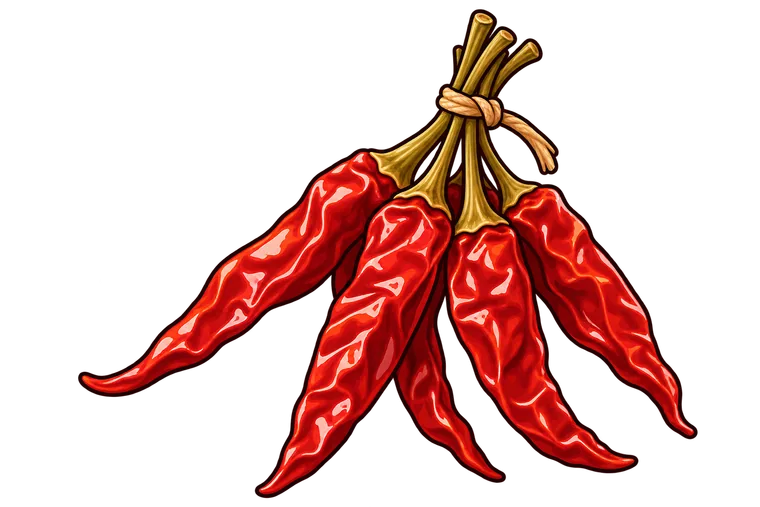
A hot Italian chili, mostly sold dried
- Italy's only protected peperoncino, from Calabria, runs 5,000–70,000 SHU
- Pepperoncini, the mild pickling pepper, sits at 100–500 SHU on an extension chart
On this page
- 1What does peperoncino mean in Italy?
- 2Is a peperoncino the same as a pepperoncini?
- 3How hot is a peperoncino, really?
- 4Where in Italy does peperoncino come from?
- 5How do Italians cook with peperoncino?
- 6Can you grow a peperoncino plant at home?
- 7How do you dry and keep your own peperoncini?
- 8What goes wrong when you cook with peperoncino?
What does peperoncino mean in Italy?
A small hot chili, and in most Italian kitchens, a dried one. The Treccani dictionary defines peperoncino as a pepper with small, thin, elongated fruits, green or red and very hot, eaten fresh or pickled but most often dried and ground as a seasoning; the powder can also go by paprica or pepe rosso3. So when an Italian recipe says "un pizzico di peperoncino", it usually means a pinch of crushed dried chili.
That's the first thing worth knowing if you shop outside Italy. A jar labelled peperoncino will most likely hold flakes or small whole dried pods, not fresh chilies. The word names a use and a type of pod more than a single variety.
One trap hides in that definition. Because Italians may call the ground powder paprica3, an Italian recipe that says paprica can mean hot ground peperoncino, while an English recipe that says paprika almost always means the sweet red paprika powder. If the dish comes from southern Italy and the amount is tiny, read it as hot chili.
Is a peperoncino the same as a pepperoncini?
No, and the gap between them is huge. Pepperoncini, the pale green pickling pepper in sandwich jars, sits in a 100–500 SHU band on Iowa State's extension heat chart4. Italy's protected peperoncino from Calabria runs 5,000–70,000 SHU1.
Peperoncino
Pepperoncini
- Italy's word for a small hot chili, usually dried3What it isA mild pepper grown for pickling and sautéing5
- 5,000–70,000 SHU for the protected Calabrian kind1Heat100–500 SHU on an extension chart4
- Small, thin and long, green or red3PodPicked at 3–4 inches, green or red5
- Dried flakes, powder or whole pods3You buy it asPickled, in jars5
Swap one for the other and you either get a sandwich pepper with no kick, or a pasta that's up to hundreds of times hotter than you meant. At the top of each range, 70,000 SHU against 500 SHU is a factor of 140. The mild pickling pepper has its own pepperoncini entry if that's the one you were after.
The growing habits differ too. Johnny's, which breeds the 'Paisan' pepperoncini, lists it at 60 days to green and 80 days to red ripe, picked at 3 to 4 inches, mild to slightly spicy, on large vigorous plants that do best staked5. If your seed packet promises a stocky, staked plant and long pale pods for the pickle jar, you're holding pepperoncini seed, not peperoncino.
How hot is a peperoncino, really?
It depends on which chili sits in your jar, and the sources don't agree on a single figure. The Treccani dictionary calls peperoncini very hot3, while a peer-reviewed breeding study describes peperoncino fruits as having mild to medium pungency2. No primary source we found gives one Scoville range for the generic word.
Peperoncino has no single published range; the protected Calabrian one is the only legal band. Log scale; bars are published ranges.16
What we can give you is the one official range: the EU specification for Calabrian chili sets 5,000 to 70,000 SHU1. Against a 5,000 SHU average jalapeño, that's 1 to 14 times hotter.
The top end of that band passes a cayenne at 25,000–50,0006. Treat an unlabelled jar as somewhere in that band until you've tasted it.
How much heat is in a pinch of flakes?
More than you'd think at the top of the range. We set the Calabrian band against an average 5,000 SHU jalapeño16 and worked out how many grams of jalapeño carry the same heat as a given weight of flakes.
| Flakes | At 5,000 SHU | At 70,000 SHU |
|---|---|---|
| 0.5 g, a small pinch | Like 0.5 g of jalapeño | Like 7 g of jalapeño |
| 1 g, a big pinch | Like 1 g of jalapeño | Like 14 g of jalapeño |
| 2 g, about half a teaspoon | Like 2 g of jalapeño | Like 28 g of jalapeño |
So half a teaspoon from a fierce jar can match a whole small jalapeño in your sauce, while the same spoon from a mild jar barely registers. That's why we keep telling you to taste first.
Where in Italy does peperoncino come from?
From all over the south, with Calabria as the region that put its name on it. Peperoncino di Calabria is the protected form, grown, dried and ground only in the Region of Calabria, from 16 listed varieties1. The full label rules, forms and pack sizes live on the Calabrian entry linked above.
A Brazilian breeding study adds that "Calabrian pepper" is also used particularly in Sicily and Sardinia2. We print that with care: the EU text ties the protected chili to Calabria alone, so read it as a note that Italians cook with these chilies across the south, not as a second protected origin.
If you want to see how much the chili matters there, visit Diamante on the Calabrian coast, which has run a Peperoncino Festival since 1992, and the region keeps a Chilli Museum in Maierà1. You'll find every form of the pod for sale on one street, and you can taste your way from mild to fierce before you buy a string to take home.
How do Italians cook with peperoncino?
Mostly as a seasoning for meats and sauces, which is how the breeding study sums up its use2. The forms below each suit a different job in your kitchen; the last column is our suggestion.
| Form | How Italians eat it | Use it for |
|---|---|---|
| Dried flakes3 | Dried and crushed, the most common form | Pasta with oil and garlic, pizza, greens |
| Dried powder3 | Ground; also called paprica or pepe rosso | Even heat through a sauce or a meat rub |
| Whole dried pods3 | Kept whole until needed | Slow sauces and stews, removed when hot enough |
| Fresh or pickled3 | Less common, small green or red pods | Slicing into a quick sauce or onto a plate |
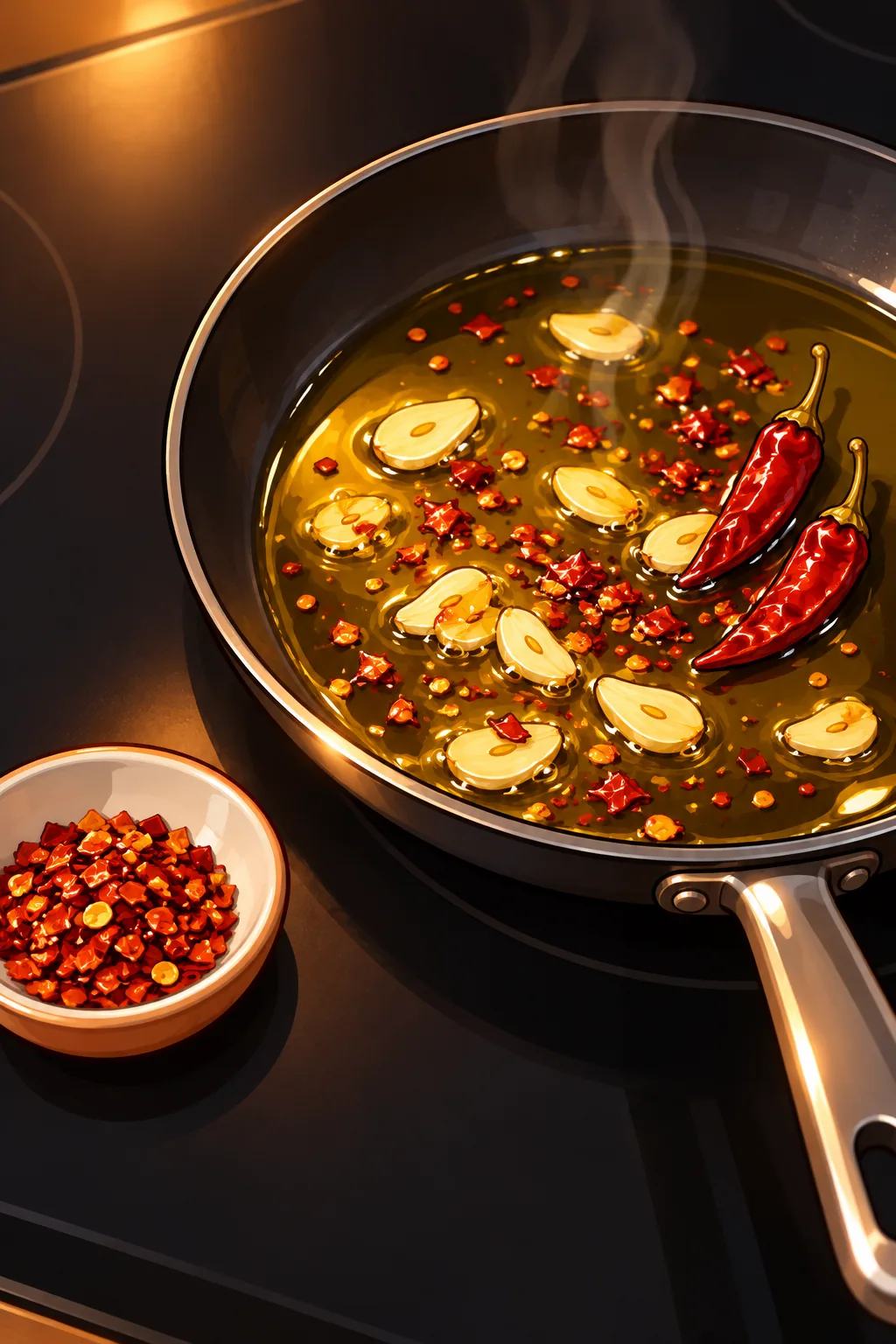
The pan method in the figure is the one you'll use most. It takes a few minutes and works with flakes or whole pods.
- 1
Warm the oil gently
Pour olive oil into a cold pan with sliced garlic, then set it over low heat so the garlic softens without browning.
- 2
Add the peperoncino
Add a pinch of flakes or one or two whole dried pods once the garlic turns pale gold, and let the oil take on a faint red color for a minute.
- 3
Pull it off the heat
Take the pan off the heat before the flakes darken; scorched chili turns bitter fast.
- 4
Toss and taste
Toss in your cooked pasta with a splash of its water, taste, and add more flakes at the table if you want more bite.
For two plates of pasta, a small pinch of flakes or one whole pod is a sensible start; you can always add more at the table, and you can't take heat back out. Whatever you make, keep it to the meal at hand. Chilies in oil count as a low-acid food that can carry botulism bacteria, so Oregon State Extension says to refrigerate homemade versions and use them within 4 days, or freeze them7.
Can you grow a peperoncino plant at home?
Yes, and you can even pick a variety Calabria itself allows. The EU list for Peperoncino di Calabria includes Cayenne and named Italian types such as Calabrese, Sigaretta and Corno di Capra1, so a packet of cayenne seed gets you a pod the Calabrian rules recognize, even if only Calabria can sell it under that name.
Give your plants a long warm run. Iowa State's chile guide has you sow indoors 6 to 8 weeks before planting out, set plants out once frost risk has passed, and space them 18 inches apart4. Calabria's main harvest falls in autumn after a hot summer1, so in a cooler garden expect your pods to redden late and plan to pick before the first cold nights.
For drying, leave the pods on the plant until they're fully red. A red pod dries to the deep color you want in flakes, while a green one dries dull.
How do you dry and keep your own peperoncini?
String them up, the way Italian and New Mexican households both do. NMSU's ristra guide describes chile dried in the sun and then stored, still on its string, for use through the winter8. Small thin pods like peperoncini dry fast that way.
Drying and storing your peperoncini
- Dry them until brittle: NCHFP's test for any dried vegetable is brittle or crisp, at about 10 % moisture.9
- Store them cool, dry and dark, in clean dry jars or tight containers; most dried fruits keep 1 year at 60 °F and 6 months at 80 °F, and dried vegetables about half as long.9
- Pack small amounts, since every opening lets in air and moisture.9
- Check jars often: condensation means the pods took on moisture, so use them soon or dry them again; anything moldy goes in the bin.9
If you crush your own flakes, do it with a window open and gloves on, and keep your hands away from your eyes; Iowa State's guide gives that same advice for any hot chile4. A string of whole pods keeps better than a jar of flakes, so crush only what you'll use in the next few weeks.
What goes wrong when you cook with peperoncino?
Most trouble comes from the name, the heat range or the pan.
Peperoncino problems and their fixes
- Your sandwich peppers set your mouth on fire: you bought peperoncino, not pepperoncini. The mild pickling pepper sits at 100–500 SHU.4
- Your pasta came out much hotter than last time: Calabria's peperoncino alone spans 5,000 to 70,000 SHU. Taste a flake from each new jar.1
- The oil tastes bitter: the flakes scorched. Keep the heat low and add them only after the garlic softens.
- Your homemade chili oil sat out for a week: throw it out. Refrigerate homemade chili oil and use it within 4 days, or freeze it.7
- Your flakes clump in the jar: they picked up moisture. Dry them again until brittle, or replace them if you see mold.9
Out of peperoncino tonight? The peperoncino swap list gives you amounts for flakes you probably already own, and red pepper flakes explains what's in a standard shaker.
Your next step is the wider family: the Italian peppers page lines up every Italian chili and sweet pepper by heat.
Related peppers
Related in Peppers
-
Paprika Scoville Heat, Sweet Under 500 SHU or Hot Over 8,000
A ground red pepper sold for color first and heat second.7 min read -
Jalapeño Scoville, 2,000–8,000 SHU and Chipotle
The medium-heat chile most heat comparisons start from.6 min read -
Aleppo Pepper, the Halaby Flake Cured With Oil and Salt
A burgundy flake from the old Silk Road city of Aleppo, sweet and fruity first, with a moderate heat behind it.6 min read -
Cherry Pepper Scoville, 0 SHU Sweet to Hot
A small round pepper, sweet or hot, grown for jars and stuffing.6 min read -
Ñora Pepper, Sweet Pimentón Pod Under 480 SHU
The small round sweet pepper behind Murcia's pimentón.5 min read -
Thai Chili Pepper Scoville, 50,000–100,000 SHU
A small, sharp chile about an inch long, also sold as bird's eye.6 min read
Sources
· 9
- 1Official Journal of the European Union, C/2026/1101 Publication of an application for registration of a geographical indication: Peperoncino di Calabria, single document (EU No PGI-IT-03421)
- 2Horticultura Brasileira 35(2) Breeding Calabrian pepper lines for Brazilian agriculture from sui generis introduction of germplasm (Ribeiro et al.)
- 3Istituto della Enciclopedia Italiana Treccani, Vocabolario peperoncino
- 4Iowa State University Extension PM 1888(S): Guía de Horticultura, El huerto doméstico, Chiles (Everhart, Haynes, Jauron)
- 5Johnny's Selected Seeds (breeder, own cultivar) Paisan Organic Pepperoncini Pepper Seed
- 6University of Florida IFAS Extension HS-859/TR010: Pepper Production in Miami-Dade County, Florida
- 7Oregon State University Extension Service SP 50-701: Herbs and vegetables in oil (Raab, Woodburn), revised January 2025
- 8New Mexico State University, College of ACES Guide E-327: Using Chile to Make Ristras and Chile Sauce (Coon and Walker), revised July 2015
- 9National Center for Home Food Preservation (University of Georgia) Packaging and Storing Dried Foods