
Habanero Pepper Scoville, 100,000–350,000 SHU
A fruity, floral chile in the extra-hot band.
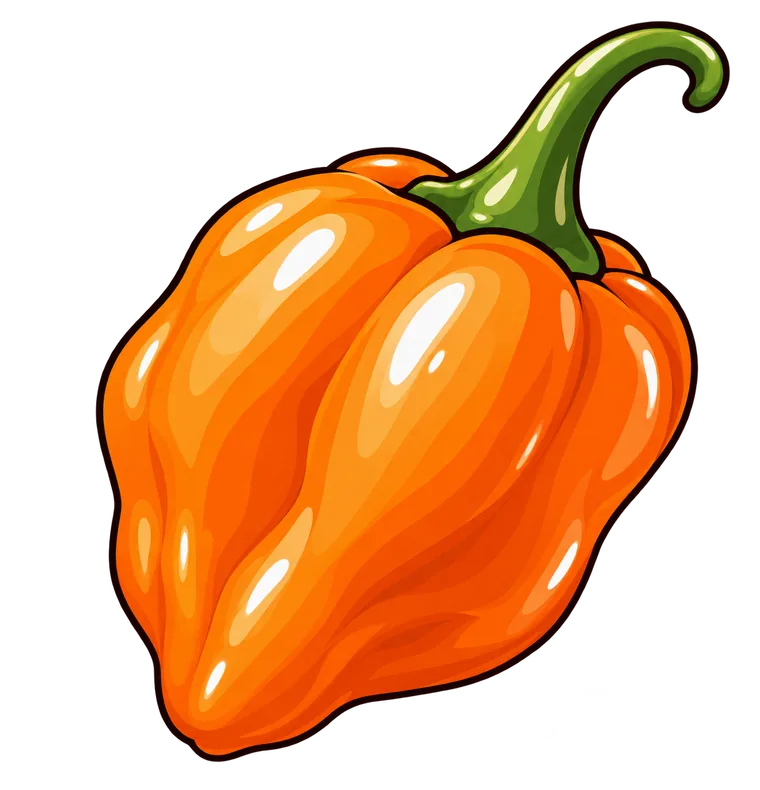 Extra-hot
100,000–350,000 SHU
- About 20 to 70 times the heat of an average jalapeño
- Ripens 90–120 days after transplanting
On this page
- 1How hot is a habanero?
- 2Why do habanero Scoville numbers differ?
- 3What does a habanero taste like?
- 4Which habanero varieties are there?
- 5Where does the habanero come from?
- 6How do you make a habanero less hot?
- 7How do you cook with habaneros?
- 8Which habanero should you buy?
- 9What goes wrong with habaneros?
- 10How long do habaneros keep, and can you freeze or dry them?
- 11Is a habanero the same as a Scotch bonnet?
- 12What sits one step above the habanero?
- 13Can you grow a habanero or swap it?
How hot is a habanero?
A habanero rates 100,000 to 350,000 Scoville heat units, the range UF/IFAS Extension publishes1 and repeats on its Scoville list4. Its midpoint, 225,000 SHU, puts it in the extra-hot band of the index, well above anything you'd call medium.
Gram for gram, even the mildest habanero carries about 20 times the heat of an average jalapeño.
How many jalapeños or serranos make one habanero?
The ratio depends on which pods you compare. UF/IFAS puts the average jalapeño at about 5,000 SHU and the serrano at 10,000 to 25,0001. Divide the habanero range by those figures and you get the spread below; the ratios compare heat per gram, not per pod.
| Against | Its heat | Habanero is | How we got it |
|---|---|---|---|
| Jalapeño (average) | about 5,000 SHU | 20–70 times hotter | 100,000 ÷ 5,000 and 350,000 ÷ 5,000 |
| Serrano | 10,000–25,000 SHU | 4–35 times hotter | 100,000 ÷ 25,000 and 350,000 ÷ 10,000 |
| Scotch bonnet | 100,000–350,000 SHU | about the same | same published range |
A mild habanero beside a hot serrano is only about four times hotter for you. A hot habanero beside an average jalapeño is about seventy times hotter, which is why the same swap can feel fine one night and painful the next.
Why do habanero Scoville numbers differ?
Each source you read measures something different: a range across many plants, a lab mean from one field trial, or a rounded figure. Growing conditions also move the number. The New Mexico researchers who ran the trial below note that the environment changes a cultivar's heat5.
| Pepper | Figure | Kind of figure |
|---|---|---|
| Habanero | 100,000–350,000 SHU | Range |
| Orange habanero | 357,729 SHU | Lab mean (HPLC), Las Cruces NM field trial, 2005 |
| Orange habanero | about 250,000 SHU | Rounded figure |
| Red Savina | 248,556 SHU | Lab mean (HPLC), same 2005 trial |
| Red Savina | about 500,000 SHU | Rounded figure |
| Chocolate habanero | about 700,000 SHU | Rounded figure |
The lab mean for an orange habanero sits just above the extension range, and Red Savina measured lower in the 2005 trial than its rounded figure. We show the extension range on this entry because it covers many pods instead of one harvest, which matches what you'll buy across a year.
What does a habanero taste like?
UF/IFAS describes a fruity, citrus-like flavor with a floral aroma1, and you'll smell it the moment you cut one open. The monograph on the genus says people prize C. chinense fruit for its fleshiness and distinct aroma, and eat it both sweet and pungent in sauces and powders2. The UC Master Gardeners of Ventura County add a subtle smokiness and note it goes into sweet dishes as well as savory ones6.
Most habaneros you'll meet still end up in a bottle: UF/IFAS lists hot sauces and spicy foods as its main uses4.
- Fruity
- Citrus
- Floral
Which habanero varieties are there?
Habaneros ripen orange, red, chocolate brown and more, and the variety name tells you more about the heat than the color does. New Mexico State University has released three habaneros with almost no burn: NuMex Suave Orange at 335 SHU, NuMex Suave Red at 774 and NuMex Trick-or-Treat, in which its breeders found no heat they could detect7.
| Variety | Ripe color | Heat |
|---|---|---|
| Orange habanero | Orange | 357,729 SHU trial mean; NMSU gives an average of 300,000 |
| Red Savina | Red | 248,556 SHU trial mean; 577,000 SHU when Guinness listed it as the record in 2006 |
| Chocolate habanero | Dark brown | about 700,000 SHU, rounded |
| NuMex Suave Red (2004) | Red | 774 SHU |
| NuMex Suave Orange (2004) | Orange | 335 SHU |
| NuMex Trick-or-Treat (2015) | Orange | No detectable heat |
| Caribbean Red, white, Devil's Tongue and others | Red, white, yellow | No primary figure found yet, so no number here |
A habanero with no heat and one at 300,000 SHU can be the same orange, so read the seed packet, not the pod. Trick-or-Treat came from crossing an Orange Habanero with a no-heat C. chinense from Colombia, and both pods ripen to a similar orange7.
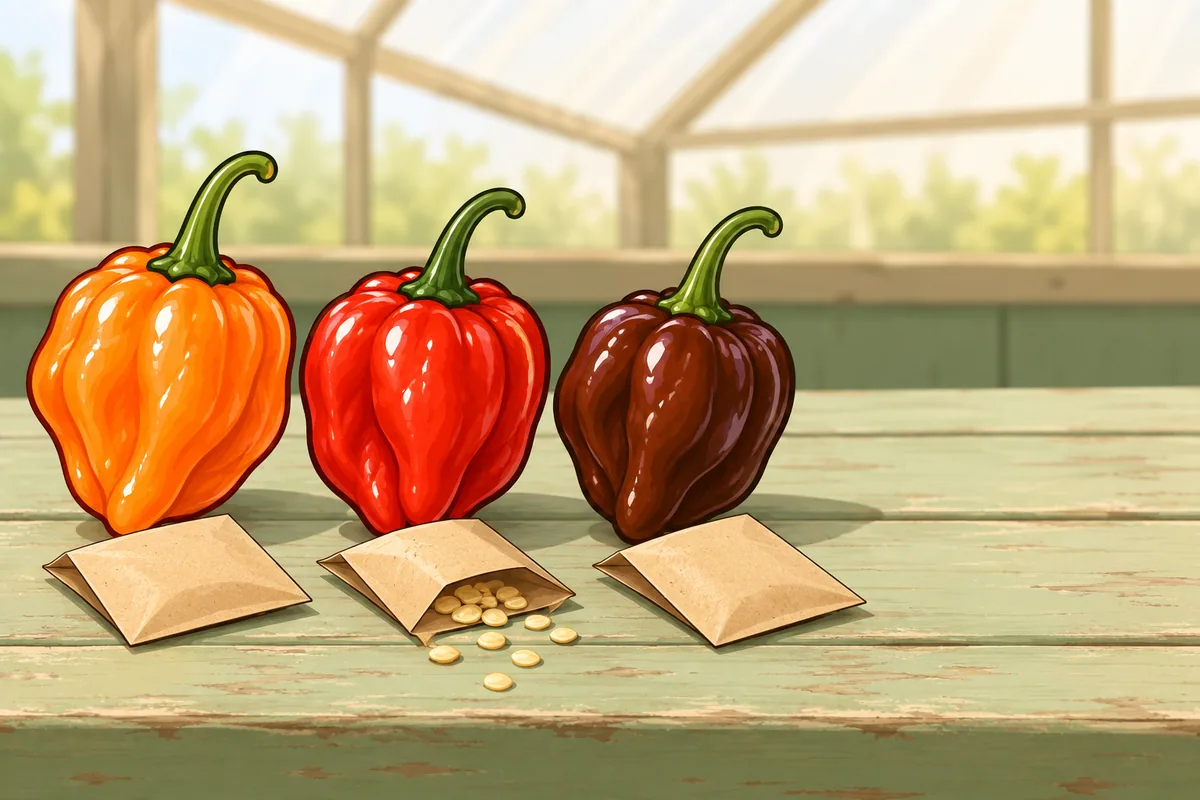
The famous red one has its own entry, Red Savina, and so does the chocolate habanero.
Where does the habanero come from?
The habanero belongs to Capsicum chinense, and botanists think its wild forms first grew in the north-central Amazon Basin lowlands of Brazil2. UF/IFAS gives Peru as the likely origin and says farms on Mexico's Yucatán Peninsula grow most habaneros today1.
If you wonder about the name, chinense points to China, a mistake by taxonomists in the 1800s1. We print the Amazon origin because it comes from the taxonomic monograph that reviewed the wild populations.
How do you make a habanero less hot?
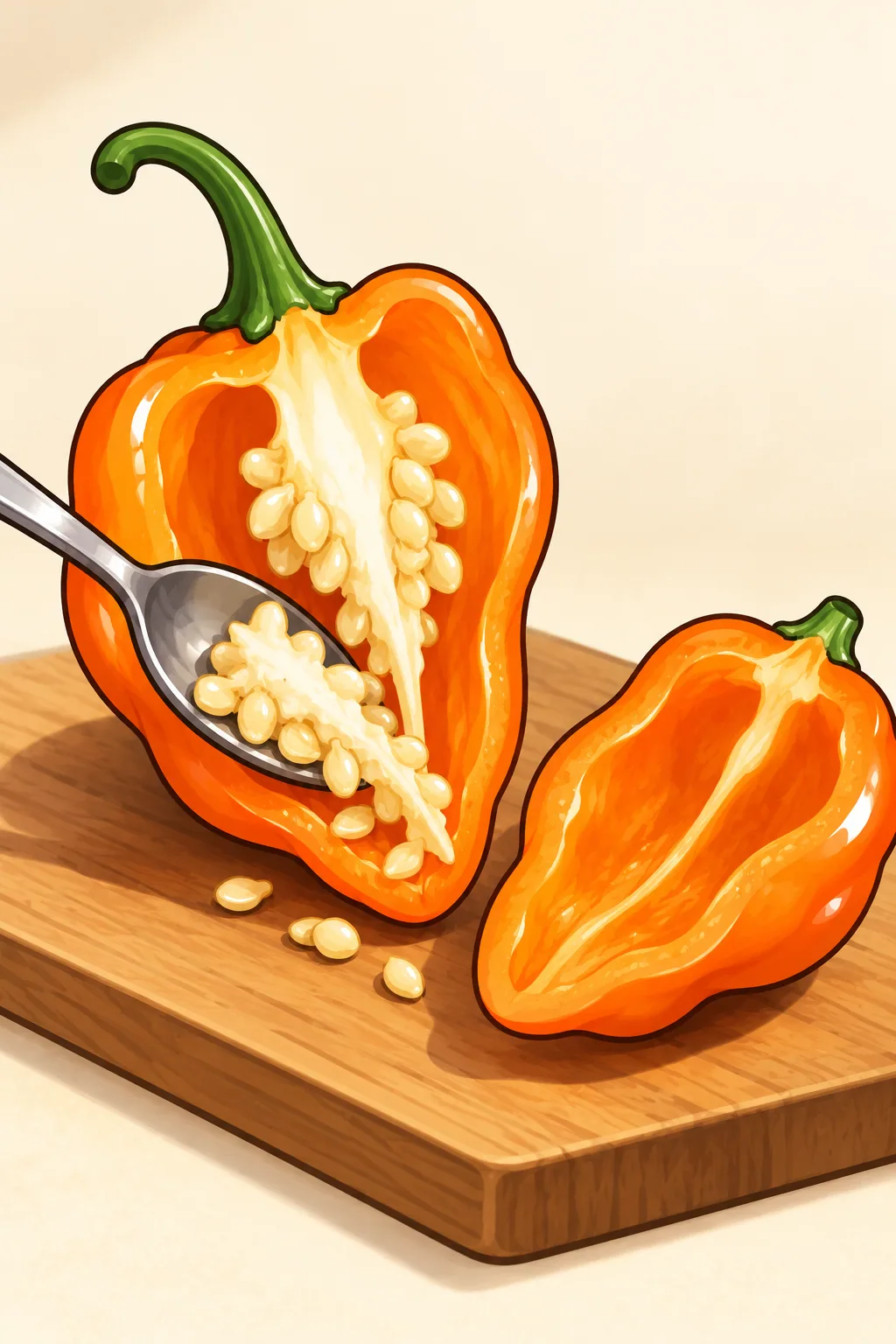
Most of the burn lives in a part of the pod you can cut away. Here is how the heat is spread through one habanero, and what each cut leaves you with.
- Whole podAll the capsaicin is still inside
- White ribs (placenta)About 89 % of the capsaicin
- SeedsCoated by the ribs they hang from
- Orange fleshOnly 5–6 % of the capsaicin, plus all the fruit
- Your dishFlesh only: fruity, still hot, far gentler
How do you cook with habaneros?
Use them where a small amount spreads through a lot of food. A habanero has enough heat that one pod can season a whole pot, and its fruity smell carries through sauces better than through a dry rub. The amounts below are kitchen starting points, not sourced rules; taste and add more.
- Hot sauce: the job UF/IFAS lists first4. Blend a few pods with vinegar, carrot or mango; the fermented sauce guide covers the salt ratio if you want to age it first.
- Salsa: start with half a seeded pod for a bowl that serves four, then taste after five minutes, since the heat builds as the juice spreads.
- Stews, beans and soups: drop one whole pod in while it simmers and fish it out before serving. You get the aroma with a fraction of the burn.
- Sweet dishes: the UC Master Gardeners note that cooks use it in sweet dishes as well as savory ones6; a little minced flesh in a fruit salsa or a glaze goes a long way.
Mexico's Yucatán Peninsula grows most habaneros today1, and its kitchens use them raw in table salsas. If you cook from that region, buy more than you think you need, because a seeded pod loses a lot of its punch.
Which habanero should you buy?
Buy for the heat you want, then pick the color you like. The variety decides the burn, and two orange pods can sit 300,000 SHU apart7.
| If you want | Pick | Why |
|---|---|---|
| The classic fruity burn for sauce | Orange habanero | Trial mean 357,729 SHU 5 |
| The habanero flavor with almost no heat | NuMex Suave Orange | 335 SHU 7 |
| No heat at all for a child's plate | NuMex Trick-or-Treat | No detectable heat 7 |
| A darker, hotter pod | Chocolate habanero | About 700,000 SHU, rounded 8 |
| A Caribbean dish that names Scotch bonnet | Scotch bonnet if you can find it | Same species and range 1 |
At the store you rarely get a variety name, so assume any unlabeled orange pod is a full-heat habanero until your first taste says otherwise.
What goes wrong with habaneros?
Most problems start at the cutting board or with too much pod in the pot. Here are the four you're most likely to meet, with the fix for each.
Problems and their fixes
- Your hands burn for hours after chopping: capsaicin oil on the skin. Poison Control advises rubber, latex or nitrile gloves, and suggests warm water flushes or a little vegetable oil on the skin afterwards.10
- The dish came out too hot: make the pot bigger with more of the base, and serve it with milk on the side. In a Penn State study of 72 people, milk cut the burn the most, skim as well as whole.11
- Your habanero has no heat: you may have a NuMex Suave or Trick-or-Treat, which ripen to the same orange as a full-heat pod.7
- Soft, pitted spots after a week in the fridge: chilling injury. Purdue gives 45 to 55°F for peppers; colder shelves damage them, though ripe colored pods suffer less than green ones.12
Your heat also changes from one harvest to the next. The New Mexico researchers note that the growing environment changes a cultivar's heat5, so a habanero from this summer can bite harder than the one you bought last spring.
If pepper juice gets in your eye, rinse it with warm water for 15 minutes; call 911 for trouble breathing or chest pain, and Poison Control at 1-800-222-1222 in the US for anything that doesn't settle10.
How long do habaneros keep, and can you freeze or dry them?
A fresh habanero keeps best cool rather than cold, a frozen one lasts about a year, and a dried one longest of all. Pick the method by what you'll cook next.
| Method | How long it keeps | Best for |
|---|---|---|
| Crisper drawer, dry, loose bag12 | Best at 45–55°F and 90–95 % humidity; colder shelves cause chilling injury | Salsa and anything raw |
| Away from bananas and apples6 | Slows spoiling; their ethylene gas harms peppers | Any fresh storage |
| Frozen whole, unpeeled, in flat bags13 | Up to 12 months | Sauces, stews, marinades |
| Dried | Longest of the three, in a sealed jar | Powder and flakes |
Freezing suits habaneros well because you'll cook most of them anyway. New Mexico's extension guide for chiles says to freeze them whole and unpeeled if you like, and to pack them in containers no deeper than 2 inches, since a home freezer can't chill a deeper pack fast enough and the pods turn mushy13. A frozen habanero is easy to grate straight into your pot while it's still hard, which gives you finer control than chopping a soft one.
Drying concentrates the heat into a lighter pod, so a teaspoon of habanero powder goes much further than a teaspoon of chopped fresh pepper. Grind it with a window open and gloves on; the dust gets into your nose and eyes faster than juice does. Both oven and dehydrator drying work for habaneros.
Is a habanero the same as a Scotch bonnet?
Same species and the same published range, 100,000 to 350,000 SHU1, but you can tell them apart by shape. A habanero is a lantern, longer than wide; a Scotch bonnet is squat, with three or four lobes in the cup-and-saucer form that Jamaica's export handbook uses to grade top-quality pods14.
In a pot, the swap works one for one. The difference you'll notice is in the flavor notes the UC Master Gardeners give: a subtle smokiness for the habanero, plain fruit for the bonnet6. Where you shop also decides which one you find: UF/IFAS says most habaneros now come from Mexico's Yucatán Peninsula, while the Scotch bonnet grows mainly in the Caribbean, Guyana and the Maldives1. In a Caribbean grocery you'll see bonnets; in most US supermarkets, habaneros. The Scotch bonnet entry covers its own growing season and the Jamaican export grades.
What sits one step above the habanero?
The ghost pepper. In the same 2005 field trial the ghost pepper measured 1,001,304 SHU and the orange habanero 357,729 SHU5, so the ghost pepper came out about 2.8 times hotter. One ghost pod brings you the heat of almost three habaneros.
The ghost pepper and habanero side by side shows both ranges and flavors, and the serrano against the habanero covers the milder end.
Can you grow a habanero or swap it?
Habanero types ripen 90 to 120 days from transplanting, against 70 to 85 days for most sweet and hot peppers3. That long season is the first thing to plan for if you want to grow habanero plants yourself.
If the store has none, a Scotch bonnet is the closest swap: same species, same 100,000 to 350,000 SHU range1. Milder options and amounts are in the habanero swap list.
Related peppers
Related in Peppers
-
Jalapeño Scoville, 2,000–8,000 SHU and Chipotle
The medium-heat chile most heat comparisons start from.6 min read -
Serrano Pepper Scoville, 10,000–25,000 SHU
A slim, fleshy chile one clear step above the jalapeño.5 min read -
Ghost Pepper Scoville, About 1 Million SHU
The Bhut Jolokia of Assam, India: the first pepper measured at a million SHU.6 min read -
Trinidad Moruga Scorpion, 1.2–2 Million SHU
A lumpy, tailed superhot from Trinidad that topped NMSU's 2012 heat study.6 min read -
Carolina Reaper Scoville, 1.64 Million SHU
A fruity, sweet superhot from South Carolina, bred from a habanero and a Naga Viper.7 min read -
Cayenne Pepper Scoville, 25,000–50,000 SHU
The long red chile behind most ground red pepper and a lot of vinegar hot sauce.6 min read
Sources
· 15
- 1University of Florida IFAS Extension HS-859/TR010: Pepper Production in Miami-Dade County, Florida
- 2PhytoKeys 200:1-423 (Pensoft) Monograph of wild and cultivated chili peppers (Capsicum L., Solanaceae)
- 3University of Maryland Extension Growing Peppers in a Home Garden
- 4UF/IFAS Gardening Solutions Peppers by Scoville Units
- 5HortScience 42(2):222-224 'Bhut Jolokia', the world's hottest known chile pepper, is a putative naturally occurring interspecific hybrid
- 6University of California Agriculture and Natural Resources, UC Master Gardeners of Ventura County Ventura Garden to Table Series: Peppers
- 7New Mexico State University, Agricultural Experiment Station (Research Report 792) The Chile Cultivars of New Mexico State University Released from 1913 to 2016 (Coon and Bosland)
- 8New Mexico State University, Chile Pepper Institute Heat
- 9Heliyon (Cell Press) A comprehensive review of capsaicin: Biosynthesis, industrial productions, processing to applications, and clinical uses
- 10National Capital Poison Center (Poison Control) Capsaicin: when the chili is too hot (Amanda McDaniel-Price, RN)
- 11Physiology & Behavior 208:112557 Putting out the fire: efficacy of common beverages in reducing oral burn from capsaicin (Nolden, Lenart and Hayes)
- 12Purdue University, Vegetable Crops Hotline (Issue 632) Optimal Storage Conditions for Vegetables (Wenjing Guan)
- 13New Mexico State University Cooperative Extension (Guide E-324) Processing Fresh Chile Peppers (revised by Nancy C. Flores and Cindy Schlenker Davies)
- 14Ministry of Agriculture, Jamaica, via FAO Growing Scotch Bonnet Pepper in Jamaica (McGlashan, De Bac, Goldsmith, Williamson, Protz)
- 15UF/IFAS Extension St. Johns County (Hort-3) Gardening with Datil Peppers (Terra Freeman)