On this page
- 1Which drying method should you use?
- 2What happens between the fresh pod and the jar?
- 3Can you dry peppers whole?
- 4How do you dry peppers in a dehydrator?
- 5Can you dry peppers in the oven?
- 6How do you air dry peppers on a string?
- 7Can you dry peppers in the sun?
- 8Do you need to pasteurize air- or sun-dried peppers?
- 9How do you know when peppers are dry?
- 10What goes wrong when you dry peppers?
- 11How long do dried peppers last?
- 12How do you use your first dry batch?
- 13Sources
Which drying method should you use?
Use a dehydrator if you have one; it holds the low, steady heat that drying needs. An oven works if it can hold 140°F. Strings work for small, thin-walled hot peppers in dry air, and the sun only in hot, dry weather.
| Method | Temperature | Time | Works when |
|---|---|---|---|
| Dehydrator12 | 140°F (60°C) for 2 hours, then 130°F (54°C) | 8–12 hours | Always; the most controlled method |
| Oven23 | 140–145°F, checked with an oven thermometer | Up to twice as long as a dehydrator | Your oven holds a low setting; door open 2–6 inches |
| String (air drying)14 | Room air | 3–4 weeks | Small hot peppers, low humidity, air that moves freely |
| Sun15 | Daytime above 85°F (29°C) | Several days | Humidity below 60 %; Penn State finds it unsatisfactory in Pennsylvania |
If the air in your kitchen is humid, skip the string: Penn State warns that high humidity can make peppers spoil before they dry.1
So the best way to dry chili peppers depends on your kit and your weather more than on the pepper. With a dehydrator you get the same result in any season. Without one, your oven covers a wet autumn, and a string or the sun only pays off where the air stays dry.
What happens between the fresh pod and the jar?
Every method runs through the same stages: prepare, dry, test, condition, store. Peppers you dry outdoors add one step, a pasteurizing pass that kills insects and their eggs6.
- PrepareWash, stem, core; gloves on for hot peppers
- Dry140°F for 2 hours, then 130°F; or a string or the sun
- TestCool a piece; tough to brittle means done
- PasteurizeOutdoor batches only: freezer at 0°F for 48 hours or oven at 160°F for 30 minutes
- ConditionJar two-thirds full, shake daily for 4–10 days
- StoreAirtight, cool and dark; 6–12 months
Sources for this line1. Penn State Extension2. Colorado State University Extension, PreserveSmart3. NDSU Extension6. National Center for Home Food Preservation (from So Easy to Preserve, 6th ed., UGA Cooperative Extension Bulletin 989; Andress and Harrison)
Two loops in that chain catch most failures. A piece that bends soft goes back to the trays, and a jar that fogs during conditioning goes back too. Each section below covers one stage in detail.
Can you dry peppers whole?
Yes, small hot peppers dry whole. Oregon State has you wipe whole peppers with a damp cloth and spread them in a thin layer on the trays, or dry them in pieces 1/4 to 1/2 inch across7. Large, thick-walled peppers go faster cut: Penn State dehydrates firm, thick-walled peppers in 3/8-inch pieces and keeps strings for small hot ones1.
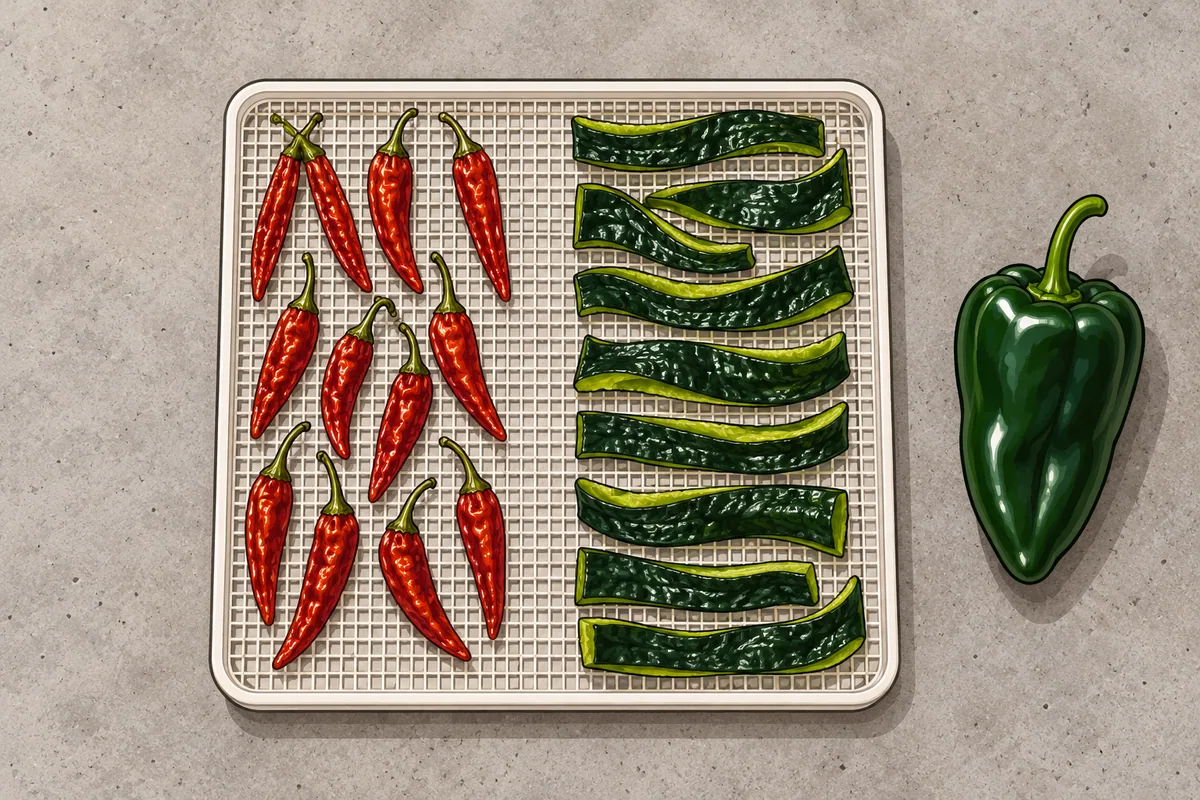
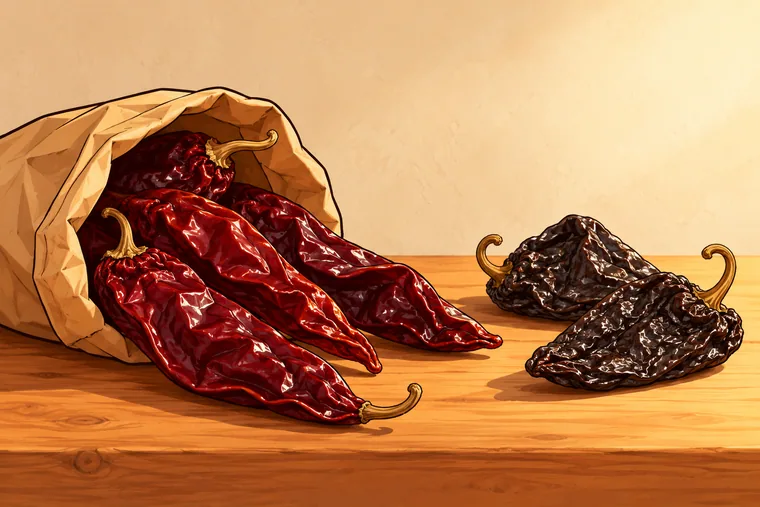
Whole pods are ready once they turn shriveled, dark red and crisp; take out the seeds and stems before you use them7. Penn State adds two conditions for whole chiles: the air has to be dry and warm enough, and the room free of insects1.
Cutting buys you more than speed. According to Penn State, diced chili peppers dry faster than whole ones and keep better color and aroma1. So for a thick poblano or a big batch you plan to grind, cut first and you get a brighter powder.
How do you dry peppers in a dehydrator?
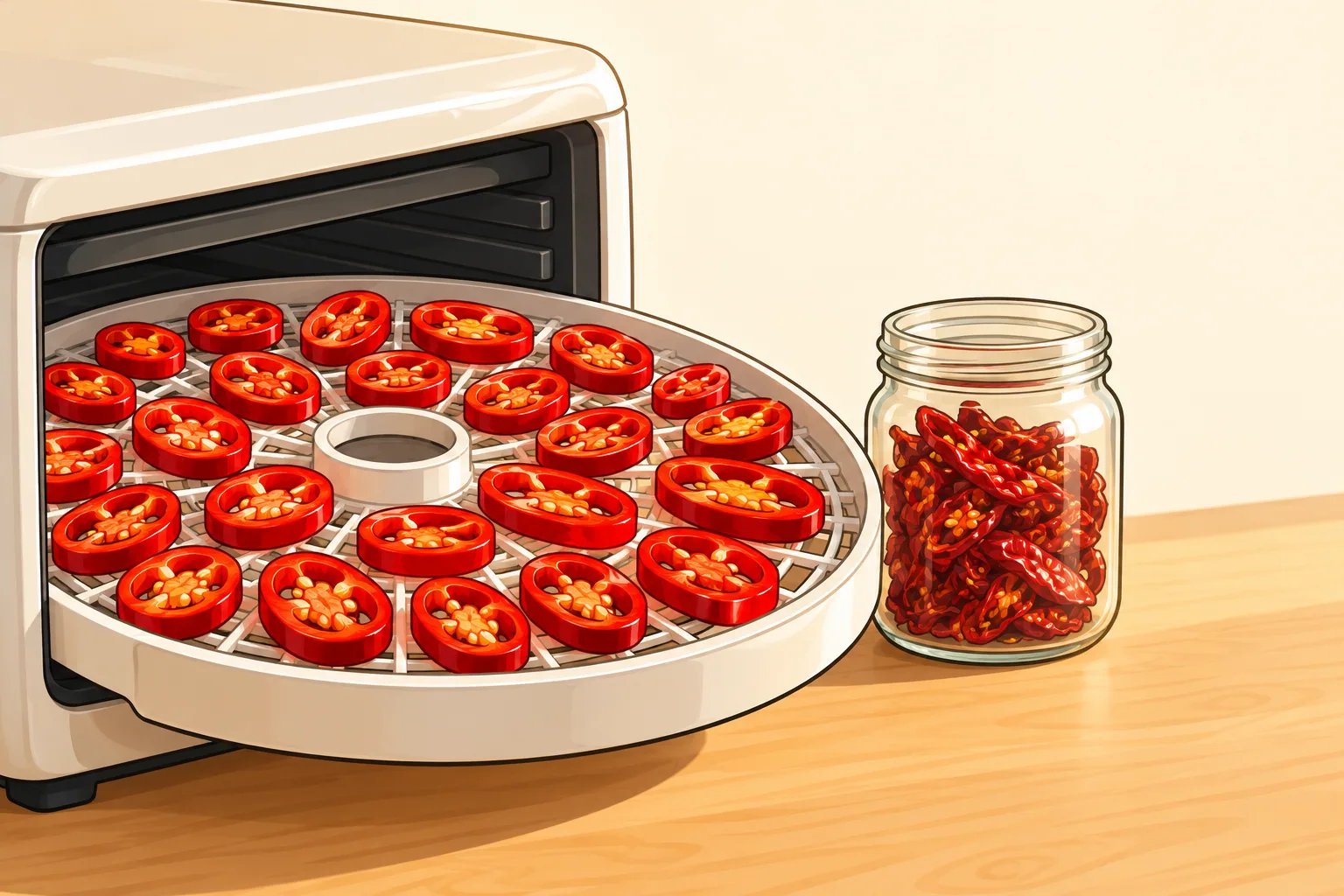
Cut the peppers into small pieces, lay them on mesh, and run the dryer at 140°F for two hours before you turn it down to 130°F. You do not need to blanch them1. NCHFP describes dehydrators as machines that dry food fast at 140°F, and a good one has a thermostat from 85°F to 160°F8.
- 1
Put on gloves
Wear plastic gloves while you cut hot peppers, and wash your hands with soap and water before you touch your face.1
- 2
Wash, stem and core
Wash and drain the peppers, then remove the stems, cores, partitions and seeds.2
- 3
Cut to size
Cut 3/8-inch (9.5 mm) pieces, or slices 1/4–3/8 inch (6–9.5 mm) thick.1
- 4
- 5
Start at 140°F
Run the dryer at 140°F (60°C) for 2 hours.1
- 6
For sizing a machine, NCHFP's rule of thumb is that 12 square feet of trays dries about half a bushel of produce8. If your trays hold less, split the harvest into two runs rather than piling pieces on top of each other.
The airflow design decides how evenly your trays dry and where the pepper smell goes, so here are the two kinds you will find on a shelf.
Two kinds of dehydrator for drying peppers
The airflow design decides how evenly your trays dry and whether pepper flavor reaches the other food on the trays.
- Best overall
Food dehydrator with the fan and heater on the side (horizontal airflow)
Cosori Food Dehydrator, 5 Stainless Steel Trays, 3.1 ft² Drying Space | 176°F Temperature Control, Horizontal Airflow, 4 Presets, 48H Timer, No Plastic Contact with Food, Compact Design
$107.97View on Amazon: Food dehydrator with the fan and heater on the side (horizontal airflow)Airflow: Horizontal: heating element and fan on the side of the unit
Flavor: Less flavor mixing between trays
Temperature: Look for a thermostat from 85°F to 160°F
Capacity: 12 square feet of tray space dries about a half-bushel of produce
Food dehydrator with the fan and heater at the base (vertical airflow)
Rosewill Compact Food Dehydrator, 5 Stackable Trays with Adjustable 48H Timer and Temperature Control - 400W Electric Food Dryer for Jerky, Fruits, Herbs, Veggies, Meat & Dog Treats
$34.99View on Amazon: Food dehydrator with the fan and heater at the base (vertical airflow)Airflow: Vertical: heating element and fan at the base
Flavor: Flavors can mix between trays
Temperature: Look for a thermostat from 85°F to 160°F
Capacity: 12 square feet of tray space dries about a half-bushel of produce


As an Amazon Associate we earn from qualifying purchases. We choose product types from what their labels and extension sources say; the commission does not change what we recommend. Our affiliate disclosure
Chili Pepper Madness walks through dehydrating chili peppers step by step, so you can watch the job done once before you start your own batch, and keep the extension temperatures from the steps above as your settings.
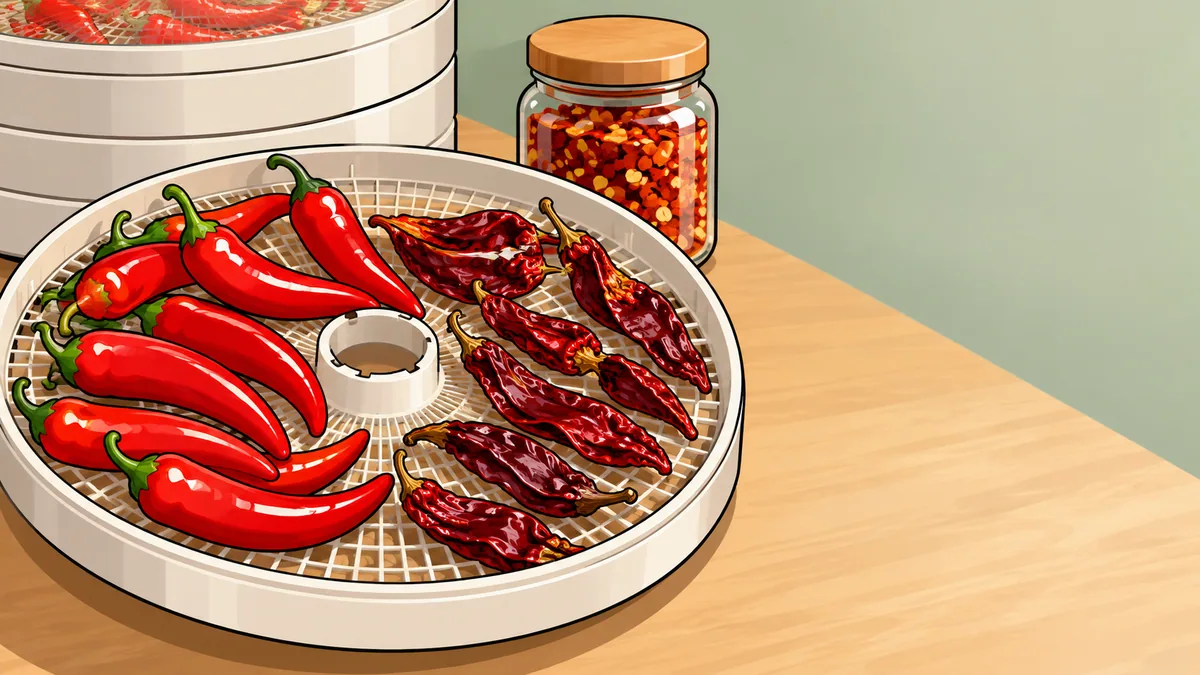
Should you take the seeds out first? For cut pieces, yes: Penn State and CSU both have you remove the cores, partitions and seeds before slicing12. For whole pods you dry them seeds and all, then pull out the seeds and stems when you use them7.
Can you dry peppers in the oven?
Yes, if your oven can hold 140 to 145°F. Put an oven-safe thermometer on the rack, prop the door open 2 to 6 inches, and set a fan near the gap so moist air can leave3. Expect it to take up to twice as long as a dehydrator2.
Space the racks 2 inches apart, with at least 3 inches clear at the top and bottom3. Check the thermometer after the first half hour. If the oven will not hold 145°F or lower, it fails NDSU's condition, and a string or a dehydrator is the better route.
How do you air dry peppers on a string?
Slit each small pepper, run a heavy thread through the stems with a large needle, and hang the string where air moves freely1. Iowa State adds that the spot should be warm, dry and well ventilated, and that a mesh rack works too4.
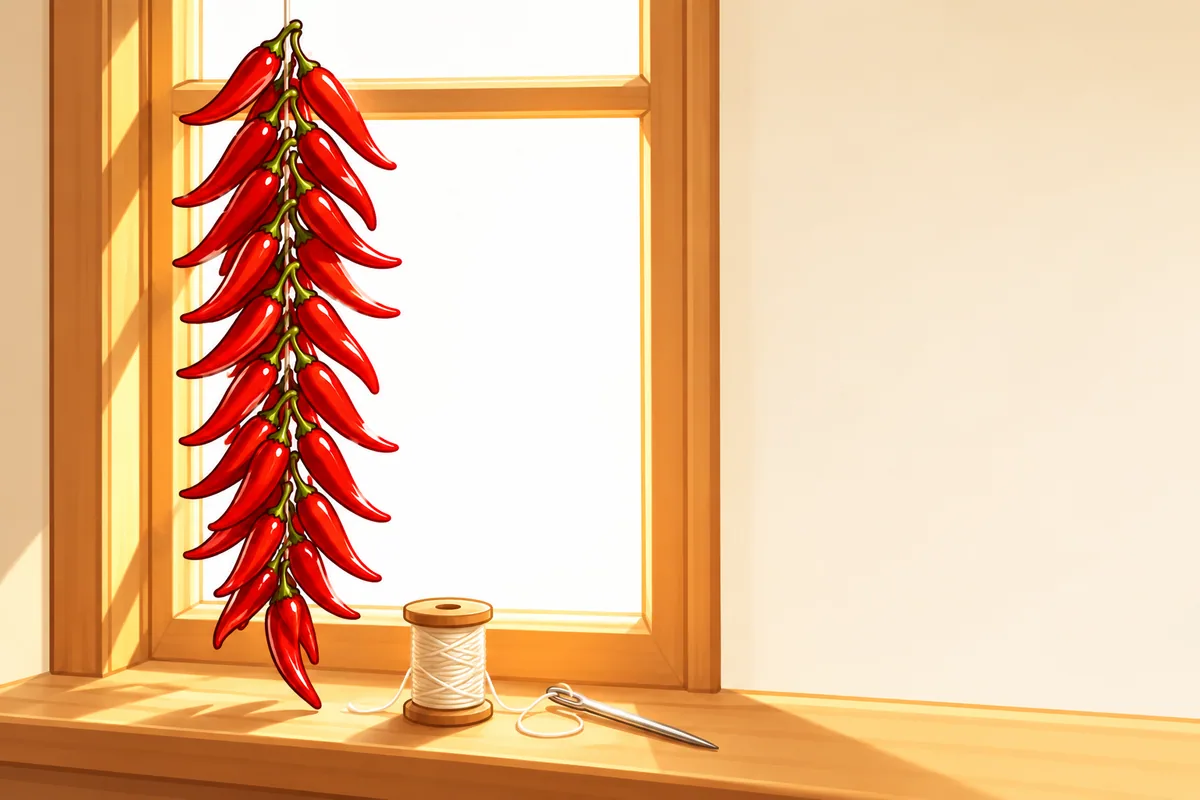
New Mexico has its own large version of this: the ristra, a long string of New Mexican chiles used for storage and decoration10. NMSU describes stringing mature red pods into ristras as symbols of hospitality and good luck11.
If you want to tie one, pick your pods with care. NMSU's ristra guide takes only mature red pods that are fresh, straight and free of blemishes, because green chile only shrivels and turns a dull orange as it dries12. It names 'New Mexico 6-4' and 'Sandia' as the usual cultivars, warns that many modern thick-walled types rot rather than dry on a string, and counts about 130 pods for a 2-foot ristra12.
Can you dry peppers in the sun?
Only where the weather cooperates. NCHFP sets a floor of 85°F with humidity below 60 %, and drying out of doors takes several days5. Penn State calls the method unsatisfactory in Pennsylvania1, which tells you how much the climate decides.
If your summer fits, set it up the way NCHFP describes:
- Raise the trays. Put racks or screens on blocks so air moves underneath5.
- Use the ground's heat. A concrete driveway, or a sheet of metal under the racks, raises the drying temperature5.
- Pick safe screens. Stainless steel, Teflon-coated fiberglass or plastic work; skip galvanized hardware cloth, copper and aluminum5.
- Cover the top. NCHFP uses two screens, one as the shelf and one laid over the food as a cover5.
- Bring them in at night. Food drying outdoors needs a cover, such as cheesecloth, or a spot under shelter after dark5.
Do you need to pasteurize air- or sun-dried peppers?
Yes, if the peppers dried outdoors. NCHFP says food dried in the open needs a treatment to kill insects and their eggs, and it gives two ways to do it6. Peppers from your dehydrator or oven skip this step.
Freezer method
Oven method
The freezer is the easier choice for a string of whole pods, since you just slide the pods into a bag. The oven is quicker if you need the jar filled today. Either way, let the peppers come back to room temperature before you condition them, so no condensation forms in the jar.
How do you know when peppers are dry?
They are dry when they are tough to brittle once cooled13. Then condition them for a few days, so any moisture left in a few pieces spreads out or shows itself.
- Let the pieces cool before you test them for dryness.3
- Bend a piece: tough or brittle means done, soft or sticky means more time.12
- Thin green chili disks should feel crisp and brittle and stay a medium green.3
- Fill a glass or plastic container about two-thirds full, cover it lightly and keep it in a dry, airy place.2
- Shake or stir it every day for 4–10 days.2
- If beads of moisture form inside, put the peppers back on the trays and condition again.2
A glass jar makes this step easier because you can see any moisture that collects inside13. NCHFP puts dried vegetables at about 10 % moisture when they are done13, which is why a dry piece snaps or bends stiffly instead of folding.
What goes wrong when you dry peppers?
Most failures trace back to heat that runs too high or air that stays too wet. Here is what you see, why it happens, and what you do about it.
- The outside is hard but the inside stays soft. That is case hardening, a crust that forms when an oven cannot hold a low enough heat3. Test your oven with a thermometer first and keep it at 140–145°F.
- Pods on a string turn soft or moldy. High humidity can make peppers spoil before they dry1. Move them to a dehydrator, and save strings for dry weather.
- Thick pods rot on the ristra. NMSU warns that many modern thick-walled types deteriorate instead of drying when hung12. Cut thick peppers and dry them on trays.
- The last tray scorches. Vegetables scorch easily near the end of drying2, so check more often in the final hours.
- The jar fogs up. Warm food sweats in a closed jar and gives mold enough moisture to grow13. Cool the pieces fully, and put a foggy batch back on the trays.
- The color fades within weeks. Light makes dried peppers fade quickly1. Store them in the dark, or in the fridge or freezer.
How long do dried peppers last?
Properly stored, dried peppers keep 6 to 12 months. Store them airtight in a cool, dark place, or in the fridge or freezer if you want the color to last12.
That last number sizes your jars: USDA puts fresh red chiles at 88 % water and sun-dried ones at 7 %1415, so a 1 kg harvest dries down to about 130 g. Label each jar with the pepper, the date and how you dried it2. Throw out any batch that smells off or grows mold3.
Warmth shortens all of this. NCHFP notes that the higher the storage temperature, the shorter the storage time, and that vegetables keep about half as long as dried fruit13. So a jar beside your stove runs out of quality sooner than one in a cool pantry. Pack your peppers in amounts you will use at once, because each time you open a jar, air and moisture get in13.
How do you use your first dry batch?
Grind some, keep some whole, and soak what you need for sauce. Penn State notes that whole dried hot peppers blend into cayenne or chili powder, and that grinding also gets around the tough skins of large rehydrated pieces1.
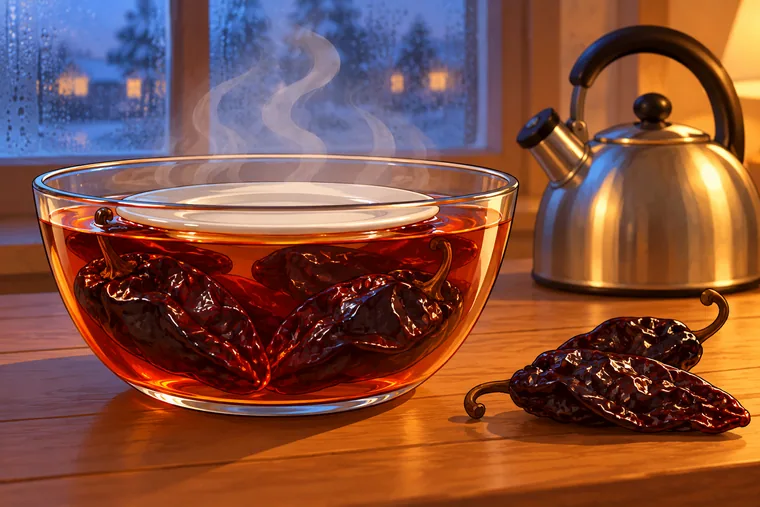
Before you grind, the types of chili powder show you which pepper sits behind each store powder, so you can match your own jar to a recipe. Want them soft again for a sauce? The steps to rehydrate dried chiles cover soaking times.
If you plan to dry every fall, the pepper gear guide covers what to look for in a dehydrator. The other ways to keep your harvest, from freezing to pickling, sit on the pepper techniques page.