
7 Best Peppers for Pickling, Ranked by Tested Recipes
Thick walls, waxy skins and a tested brine: the peppers extension cooks put in jars.
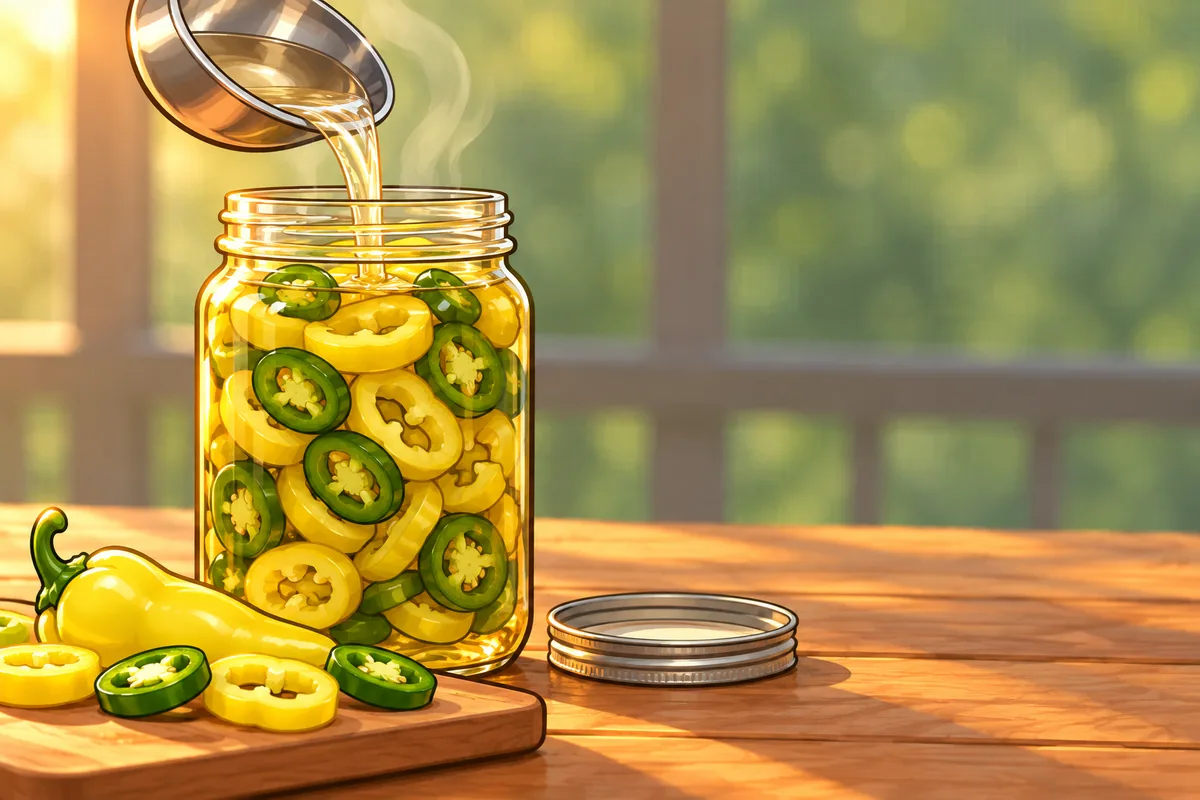
Banana peppers top the list, then Hungarian wax and jalapeño; bell, cherry, cubanelle and biquinho round out the seven.
- Banana runs 0–500 SHU, Hungarian wax 5,000–10,000, jalapeño 2,000–8,000
- Tested jars use 5 % vinegar and 10 minutes in the canner up to 1,000 ft
On this page
- 1What are the best peppers for pickling?
- 2Why do thick, waxy peppers keep their crunch in brine?
- 3Should your jar be sweet or hot?
- 4Why do recipes tell you to slit whole peppers?
- 5How long do pepper jars stay in the canner?
- 6What keeps pickled peppers crisp, and what should you skip?
- 7How long do pickled peppers keep?
- 8Which pepper should you pick for your jar?
What are the best peppers for pickling?
The ones tested recipes keep naming, so you can trust the jar. We scored each pepper by how many extension recipes or pickling guides name it for the jar: the National Center for Home Food Preservation (NCHFP), Penn State, Colorado State, Clemson, UF/IFAS, Oregon State, NMSU and Embrapa. Banana peppers score highest, named by five of them, and seven peppers make the list.
The score counts sources, not quality, so read it as how well-trodden your jar will be. Three tested recipes start from the top three: the NCHFP hot pepper pickle names Hungarian, banana, chile or jalapeño2, and the center has separate tested recipes for jalapeño rings and yellow banana pepper rings38.
Log scale; bars are published ranges.1
The chart shows the indexed ones; banana (0–500 SHU) sits beside the bell and the Hungarian wax (5,000–10,000) just above the jalapeño1. Most of the list sits under 10,000 SHU, so a pickle jar is a mild-to-medium job.
Why do thick, waxy peppers keep their crunch in brine?
Because the wall has to survive hot vinegar and the weeks your jar sits on the shelf. Colorado State says thick-fleshed peppers with firm waxy skins and bright, glossy color, free from defects, make the best pickles4. A thin, papery pepper turns limp; a waxy one keeps its snap.
That's why the wax types lead. Oregon State groups banana, Hungarian wax and pepperoncini as wax peppers, from sweet to quite hot9, and UF/IFAS describes its Hungarian hot wax hybrid Inferno as well suited for pickling7. The cubanelle, the cherry and the bell bring the same thick wall in sweet form.
The little Brazilian biquinho has a 3 mm wall on a 2.6 cm pod, and Embrapa grows it for pickled snacks12.
Should your jar be sweet or hot?
Pick by what you'll eat it with; NCHFP tests both, and the brines differ more than you'd guess.
Sweet jar (pickled bell peppers)
Hot jar (pickled hot peppers)
The sweet jar uses half vinegar and half water and a lot of sugar; the hot jar is mostly vinegar. Penn State says you can swap bell peppers for hot ones in a tested recipe if you keep the total weight the same6, so a hot jar can become a mild one without changing the brine.
Why do recipes tell you to slit whole peppers?
So the brine gets in and the air gets out of every pod you pack. Colorado State says small whole peppers must be slit so the vinegar can reach the hollow inside4, and Penn State adds that the slit lets trapped air escape, which stops the pods from floating to the top of your jar6.
Larger peppers go in cut. NCHFP's hot pepper recipe cuts small peppers two to four times and quarters large ones2, and Clemson cuts two to four slits in small whole peppers5.
How long do pepper jars stay in the canner?
Ten minutes for most pint jars at low altitude, longer as you climb, so check your elevation before you start. These are the boiling-water times from the tested NCHFP recipes:
Use the times that come with the recipe you follow; Clemson's own fact sheet draws its altitude bands differently5. All of them use vinegar of 5 % acidity, and NCHFP warns you not to change the vinegar, food or water proportions or use vinegar of unknown strength13.
What keeps pickled peppers crisp, and what should you skip?
Calcium, cold water and fresh pods help you; alum doesn't. The extension guides agree on most of it, so you can follow this list with any tested recipe:
Use
- Food-grade calcium chloride, sold as Pickle Crisp or Xtra Crunch. It doesn't lower the acidity in your jar.614
- Pickling lime, only in a recipe that calls for it, with every rinse and soak it lists: NCHFP's jalapeño rings soak and drain three times to wash excess lime out.8
- An ice-water soak of four to five hours before pickling, which Clemson calls a safer way to crisp pickles.15
- Canning or pickling salt, not table salt.13
How long do pickled peppers keep?
Up to a year on your shelf, six months in your fridge, a week if the lid never sealed.
Patience pays you back in flavor. Colorado State suggests five to six weeks on the shelf before you open a canned jar4, and Clemson says quick-process pickles taste better after several weeks in the jar15. Don't taste anything from a jar with an unsealed lid or signs of spoilage16.
Which pepper should you pick for your jar?
Start from what you'll eat it with, and you'll know which pepper to buy:
- Rings for sandwiches and pizza: banana, the top scorer, mild at 0 to 500 SHU1, with its own tested ring recipe.
- Nachos and tacos: jalapeño rings, 2,000 to 8,000 SHU1.
- A real kick in an antipasto jar: Hungarian wax, at 5,000 to 10,000 SHU the hottest pick here1.
- Sweet strips for a salad or a relish tray: bell, in the sugar brine above.
- Whole pods to stuff later: cherry or biquinho, slit twice.
Pickling is one job of several. If you have peppers left over, the peppers for hot sauce list ranks the hotter ones for a bottle, and the peppers for drying list covers the ones you'd rather keep as flakes.
Your next step is the jar itself: the step-by-step pickling method walks you through packing, brining and canning one of these peppers today.
More in Pepper Index
The newest from Pepper Index
-
Carolina Reaper Scoville, 1.64 Million SHU
A fruity, sweet superhot from South Carolina, bred from a habanero and a Naga Viper.Oct 18, 2026 · Pepper -
Ghost Pepper Scoville, About 1 Million SHU
The Bhut Jolokia of Assam, India: the first pepper measured at a million SHU.Oct 18, 2026 · Pepper -
Ñora Pepper, Sweet Pimentón Pod Under 480 SHU
The small round sweet pepper behind Murcia's pimentón.Oct 18, 2026 · Pepper -
Pepper X Scoville, 2.69 Million SHU and Record
Ed Currie's record pepper from South Carolina, at an average of 2.69 million SHU.Oct 18, 2026 · Pepper -
Aleppo Pepper, the Halaby Flake Cured With Oil and Salt
A burgundy flake from the old Silk Road city of Aleppo, sweet and fruity first, with a moderate heat behind it.Oct 18, 2026 · Pepper -
Calabrian Chili Heat, 5,000–70,000 SHU by EU Rule
Peperoncino di Calabria: the protected chili of Italy's toe, sold fresh, on strings, as flakes and as powder.Oct 18, 2026 · Pepper
Sources
· 16
- 1University of Florida IFAS Extension HS-859/TR010: Pepper Production in Miami-Dade County, Florida
- 2National Center for Home Food Preservation (University of Georgia) Pickled Hot Peppers
- 3National Center for Home Food Preservation (University of Georgia) Pickled Yellow Pepper Rings
- 4Colorado State University Extension (Fact Sheet 9.314) Making Pickled Peppers (M. Hill and P. Kendall)
- 5Clemson Cooperative Extension, Home & Garden Information Center (HGIC 3440) Pickled Peppers (Schmutz and Hoyle)
- 6Penn State Extension Preserving Those Colorful Garden Peppers (Martha Zepp)
- 7University of Florida IFAS Extension HS732/CV130: Chapter 13. Pepper Production (Vegetable Production Handbook of Florida)
- 8National Center for Home Food Preservation (University of Georgia) Pickled Jalapeño Rings
- 9Oregon State University Extension (EC 1227) Grow your own peppers
- 10National Center for Home Food Preservation, University of Georgia (adapted from the USDA Complete Guide to Home Canning, 2015) Pickled Bell Peppers
- 11New Mexico State University, Chile Pepper Institute (seed shop) Red Cherry Sweet Pepper
- 12Embrapa, Agência de Informação Tecnológica (Ribeiro, Amaro, Carvalho, Reifschneider) BRS Moema
- 13National Center for Home Food Preservation (University of Georgia) General Information on Pickling
- 14Penn State Extension Let's Preserve: Ingredients Used in Home Food Preservation (LaBorde, Zepp, Hirneisen)
- 15Clemson Cooperative Extension, Home & Garden Information Center (HGIC 3100) Pickle Basics (Schmutz, Hoyle, Legette, Barefoot)
- 16National Center for Home Food Preservation (University of Georgia) Storing Home Canned Foods
Your pocket pepper index.
Built from the same index as this site.
- Every entry offline
- Compare any two peppers
- Keep a list of peppers you have tried