
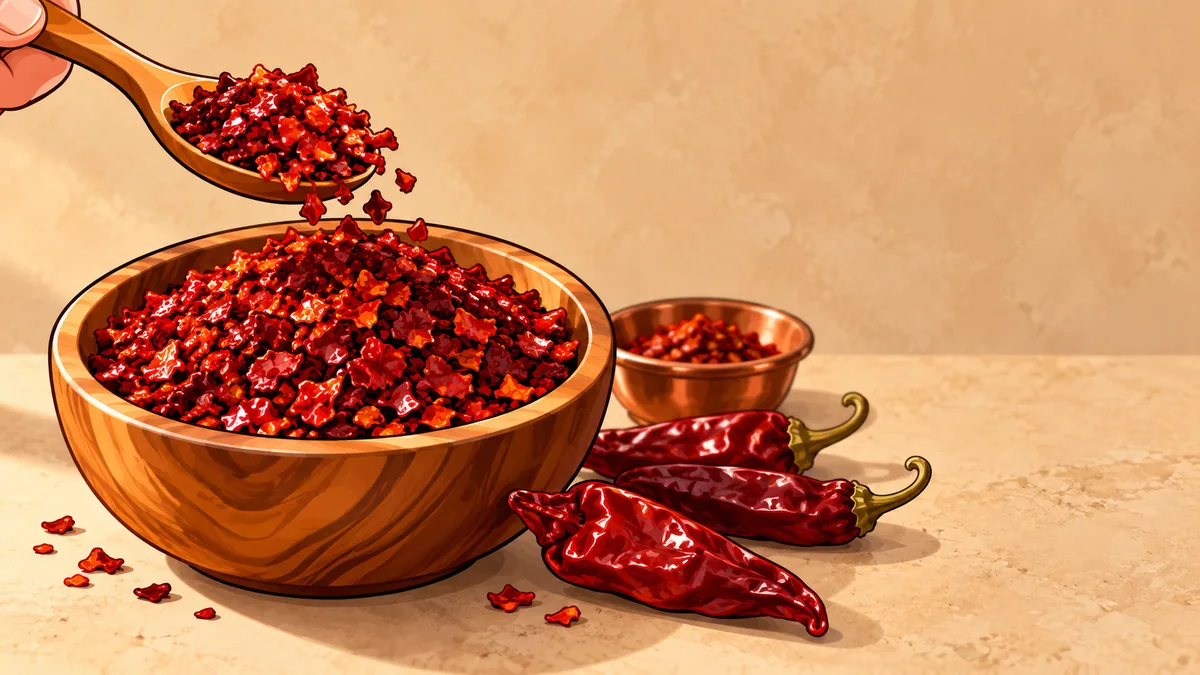
Aleppo Pepper, the Halaby Flake Cured With Oil and Salt
A burgundy flake from the old Silk Road city of Aleppo, sweet and fruity first, with a moderate heat behind it.
Short answer
Moderate heat with a sweet, fruity taste; no lab has published a figure
- Cut, de-seeded, half sun-dried, ground coarse, then mixed with olive oil and salt
- Pods 3.5–4 inches long ripen red to burgundy in late summer on plants up to 4 feet tall
On this page
- 1How hot is Aleppo pepper if nobody has measured it?
- 2Where does the name Halaby come from?
- 3How do sun, oil and salt turn a pod into Aleppo flakes?
- 4What does a fresh Aleppo pepper look like on the plant?
- 5What do Aleppo flakes taste like next to Urfa and Maraş?
- 6Which dishes show off Aleppo pepper best?
- 7Can you grow and cure your own Aleppo-style flakes?
- 8How do you keep a tin of Aleppo flakes red?
- 9Your next jar after Aleppo
How hot is Aleppo pepper if nobody has measured it?
Moderate: warmer than paprika, gentler than crushed red pepper. The Herb Society of America calls it spicy but only moderate on the Scoville scale, and its fact sheet prints the figure as "10,0000 units", a typo with no lab behind it1. No paper we read measured Aleppo flakes, so the index shows no Scoville range for it.
You can still get a sense of scale from its neighbor across the border. A 2005 study ran Turkish Maraş peppers through a lab and found 0.81–1.42 mg of capsaicin per gram, plus 0.38–0.70 mg of dihydrocapsaicin and a trace of a third capsaicinoid4. Added up, that's about 1.2 to 2.2 mg per gram.
Here's the worked conversion. Mexico's dried-chile standard counts 15 Scoville units for every microgram of capsaicinoids per gram of dry chile5. So 1,200 µg/g × 15 = 18,000 SHU, and 2,160 µg/g × 15 = about 32,000 SHU for those Maraş samples.
Treat Maraş's 18,000–32,000 SHU as a neighbor's number for scale, never as Aleppo's own.
What you feel also depends on the oil. The flakes carry olive oil from curing, and fat spreads the heat across your tongue more slowly than a dry chili powder does. A teaspoon on hummus reads as warmth, not a burn.
Where does the name Halaby come from?
From Halab, the Arabic name of the Syrian city of Aleppo1. So "Halaby pepper" and "Aleppo pepper" mean the same thing, and you'll see both on tins in Middle Eastern shops.
The pepper's history in Aleppo runs back centuries, and the Herb Society ties the cultivar to the city's place on the Silk Road1. Today it grows in both Syria and Turkey, for local kitchens and for export. The Turkish peppers hub covers the flakes grown on the Turkish side, which you'll often find shelved right beside it.
The species itself is ordinary. USDA's GRIN taxonomy files it under Capsicum annuum2, the same species as bell peppers, paprika and the jalapeño. What makes Aleppo special is the variety and what happens to it after harvest.
That matters when you shop for seed or plants. Because Aleppo shares a species with so many garden peppers, it crosses with them easily, and seed saved from a plant grown next to your jalapeños may not come true next year. Buy seed sold by name, or keep your own Aleppo plants well apart from other annuums if you plan to save seed.
How do sun, oil and salt turn a pod into Aleppo flakes?
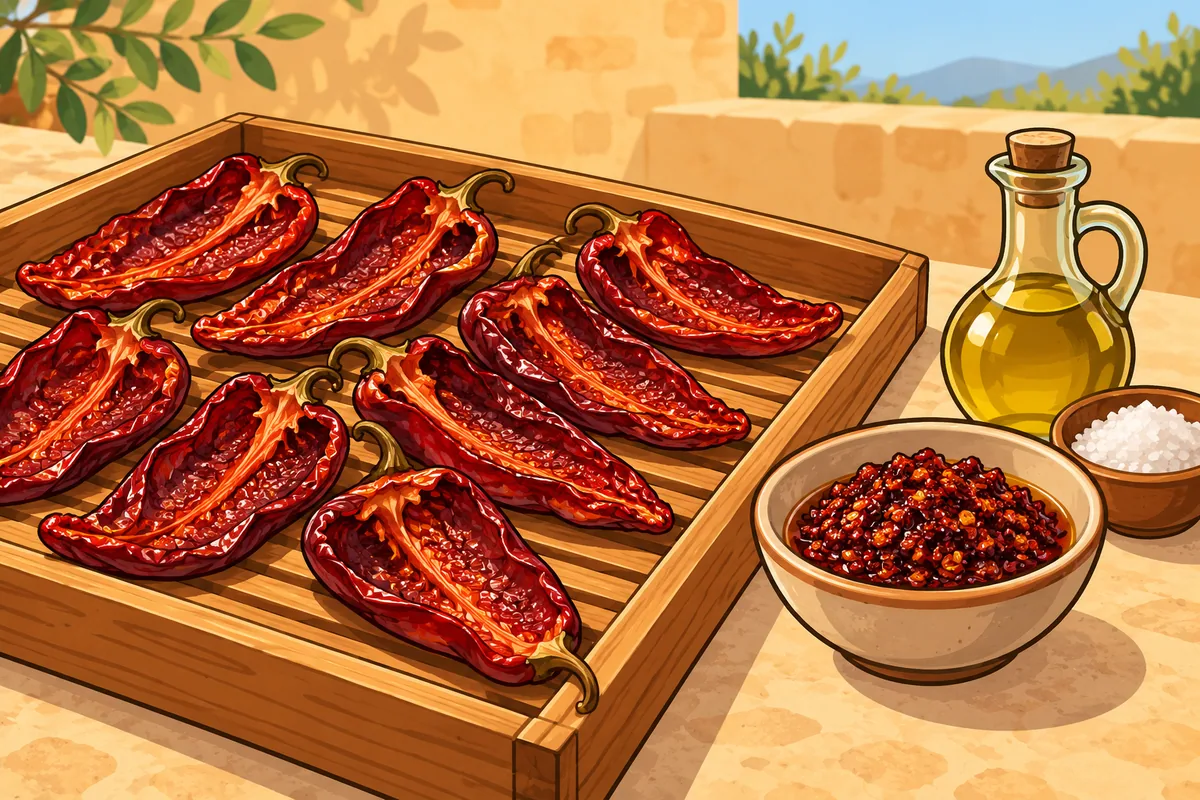
In two drying stages with a cure in between. The Herb Society describes the sequence: growers cut the pods, remove the seeds, dry them partway in the sun, grind them coarsely, mix in olive oil and salt, then let them finish drying1.
- Cut the ripe podsRed to burgundy
- Remove the seeds
- Dry partway in the sun
- Grind coarsely
- Mix in olive oil and salt
- Finish drying, then tin
Each step leaves a mark you can see in your jar. Removing the seeds keeps the heat moderate and the color clean. Grinding the pods while they're still a little soft gives the large, uneven flakes, and the oil makes them glossy and slightly sticky between your fingers.
That's also how you spot an old or fake tin. Real Aleppo flakes clump softly when you pinch them and leave a faint red oil on your skin. Dry, dusty, uniform flakes that pour like sand have either lost their oil or never had any.
What does a fresh Aleppo pepper look like on the plant?
A medium, broad pod on a tall plant. The Herb Society gives these numbers1:
The pods ripen in late summer or early fall to a deep red or burgundy1. That burgundy is the color you're paying for, so pods for flakes stay on the plant until they've turned fully.
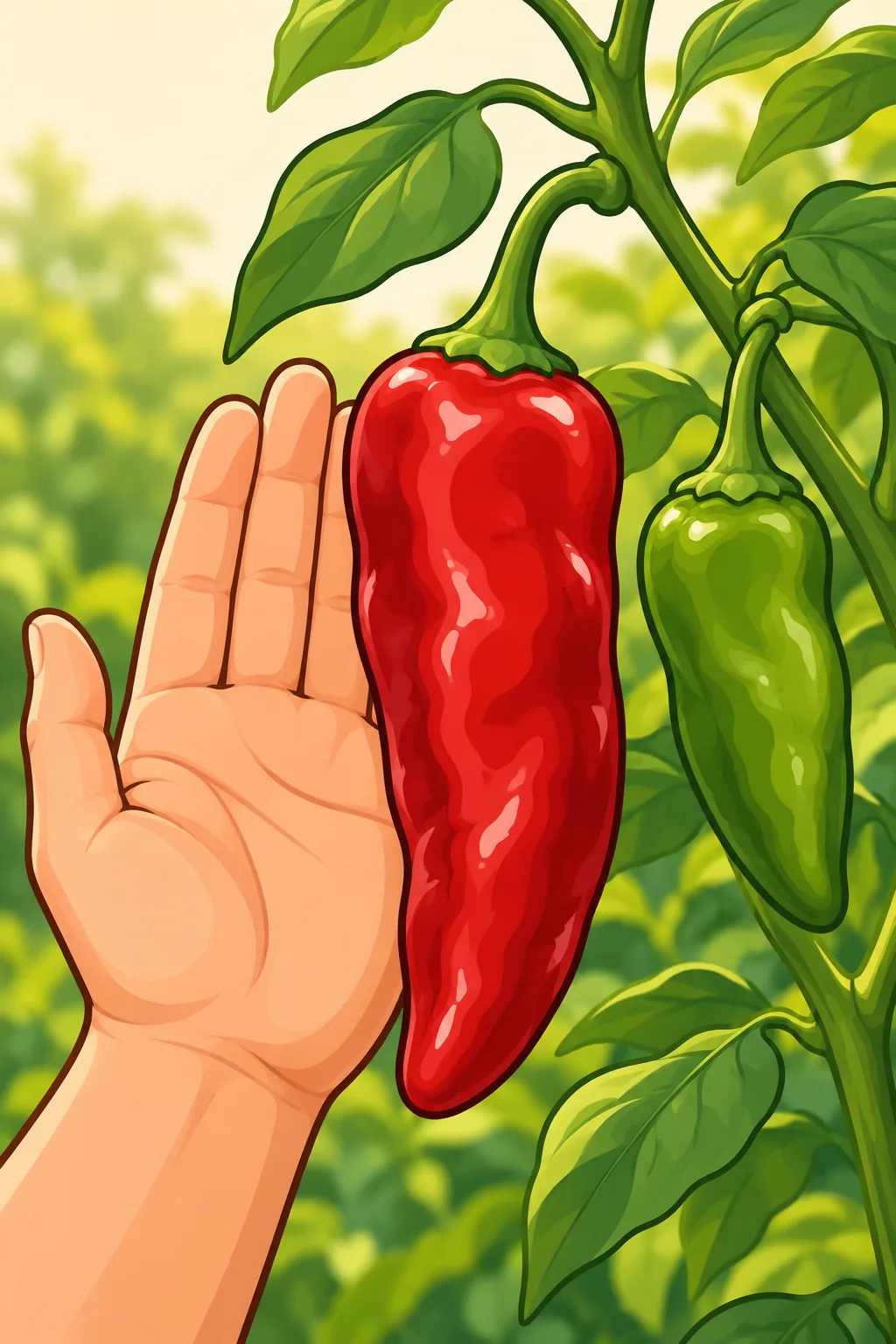
You can use the pepper fresh as well, though you'll rarely find it that way outside the region; most of the crop goes to tins of dried, ground flakes1. If you grow your own, slice a fresh one into a salad or a tomato and onion salsa to taste the fruit before any drying deepens it.
What do Aleppo flakes taste like next to Urfa and Maraş?
Sweet and fruity, with earth and a hint of smoke. The Herb Society describes a sweet heat with earthy, fruity and smoky notes1, and the UC Master Gardeners call it sweet, fruity and slightly tangy3. That tang is the part people miss when they swap in paprika.
TurkSplainer, a small channel, covers where Aleppo pepper comes from, how it is made and how it tastes, so you can take it as one explainer and trust the Herb Society and UC sources on this page wherever they differ.
Turkish spice shops sell three cousins that look alike at a glance. Lab work on two of them helps you tell what you're buying:
| Flake | How it's made | What the lab or source found |
|---|---|---|
| Aleppo (Halaby)1 | Half sun-dried, ground coarse, cured with olive oil and salt | Sweet, fruity, earthy; no published capsaicinoid figure |
| Maraş pepper4 | Turkish red pepper collected in the Maraş region | Capsaicin 0.81–1.42 mg/g, total about 1.2–2.2 mg/g |
| Isot (Urfa style)47 | Traditional isot processing | Total capsaicinoids 0.55 mg/g in the 2005 samples; capsaicinoids rose during traditional processing in 2021 |
| Red pepper flakes (pul biber)7 | The plain red flake method in the 2021 study | Highest carotenoids, best color and least browning of the methods tested |
So if you want Aleppo's bright red and its fruit, the closest Turkish shelf neighbor is the plain red pul biber, which kept the most color in the 2021 study7. If you want depth and a darker, raisin-like flake, that's isot. The Aleppo swaps rank these and three more by texture and color when your tin runs out.
- Sweet
- Fruity
- Earthy
- Tangy
Which dishes show off Aleppo pepper best?
Anything where the flakes stay on top and you can see them. The Herb Society lists spice mixes and rubs for meat and poultry, bean dishes, roasted vegetables, egg dishes, avocado toast and dips1. The timing column below is kitchen practice, not a rule from the sources.
| Dish | When to add the flakes | Starting amount |
|---|---|---|
| Hummus or a yogurt dip | On top, just before serving, over a drizzle of oil | 1 tsp per bowl for four |
| Fried or scrambled eggs | At the table | A pinch per egg |
| Rub for chicken or lamb | In the rub, before roasting | 1 tbsp per kg of meat |
| Roasted vegetables | Half before roasting, half after | 1 tsp per sheet pan |
| White beans or lentils | Stirred in at the end | 1 tsp per 4 servings |
| Avocado toast | On top | A pinch per slice |
Two habits help. Add most of your Aleppo late, because long cooking dulls the fruit you bought it for. And if a recipe calls for crushed red pepper, our starting point is about twice as much Aleppo, then taste; you're trading some heat for a lot more flavor.
If you like a finishing powder with a similar warm, fruity balance, the Basque Espelette pepper plays the same role in French cooking, ground fine instead of flaked.
Can you grow and cure your own Aleppo-style flakes?
Yes, if your summer runs long enough for the pods to turn burgundy, which the Herb Society places in late summer or early fall1. Seed sold as Aleppo grows a plant up to 4 feet tall, so give it a stake or cage.
- 1
Plant into mulched soil
The UC Master Gardeners suggest a 3–4 inch layer of organic mulch and a general 10-10-10 fertilizer; high nitrogen gives you leaves, not fruit.3
- 2
Water deep, not overhead
Deep watering at the base keeps leaves dry, since overhead watering can spread disease.3
- 3
Let the pods ripen fully
For drying, leave hot peppers on the plant until they reach full color.3
- 4
Cut and seed
Slice each pod open and scrape out the seeds and pale ribs, following the traditional order.1
- 5
Dry halfway, then grind
Dry the halves until leathery but still flexible, then pulse them coarse in a spice grinder.1
- 6
Cure and finish
Toss with a little olive oil and salt and spread thin to finish drying; start with about 1 tsp oil and ½ tsp salt per cup of flakes and adjust to taste.1
A 4-foot plant in a pot catches wind like a sail, so a 5-gallon container and a sturdy stake keep it upright through late-summer storms. Pick the pods in batches as they turn; the first ripe ones can dry while the rest finish.
The oil and salt amounts in the last step are our starting point; the Herb Society gives the steps but not the ratios. For the half-drying stage in a cool or humid climate, a low oven or a dehydrator works better than the sun, and the pepper drying guide gives temperatures for both.
How do you keep a tin of Aleppo flakes red?
Keep them dark, cool and closed. Red pepper spices lose color as they brown; in the 2021 study, the method with the most nonenzymatic browning also gave the poorest color7. Heat and light speed that browning in your cupboard too.
Habits that keep Aleppo flakes bright
- Store the tin or jar away from the stove and out of sunlight.
- Close the lid right after you use it, since the oil in the flakes picks up kitchen smells.
- Buy a small tin you'll finish within months, not a big one that sits.
- Use the freezer for fresh pods you can't dry yet; the UC Master Gardeners recommend freezing for long-term storage.3
- Toss a tin whose flakes have turned brown and smell flat, even if they still taste hot.
How long powders and flakes stay good, and how to tell when they've faded, is its own question; the chili powder shelf-life guide answers it for dried red spices in general.
Your next jar after Aleppo
If you liked the fruit, try the bright Turkish pul biber next, then a dark isot, and taste all three on plain yogurt side by side. You'll learn more from that one bowl than from any description.
For a sweet red powder with almost no heat, paprika is the obvious partner; mix it half and half with Aleppo when you want color without extra warmth. And when you want to see where every flake and powder in your cupboard sits, browse the red pepper flakes guide.
Related peppers
Published ranges.Sources for this line8. New Mexico State University9. Molecules 18(11):13471-13486 (MDPI)10. Official Journal of the European Union, C/2026/1101
Related in Peppers
-
Jalapeño Scoville, 2,000–8,000 SHU and Chipotle
The medium-heat chile most heat comparisons start from.6 min read -
Ñora Pepper, Sweet Pimentón Pod Under 480 SHU
The small round sweet pepper behind Murcia's pimentón.5 min read -
Peperoncino Is Italy's Hot Chili, Not the Mild Pepperoncini
The small, thin, red chili Italians dry, crush and stir into oil, and why it isn't the pickled pepperoncini in your sandwich.6 min read -
Habanero Pepper Scoville, 100,000–350,000 SHU
A fruity, floral chile in the extra-hot band.7 min read -
Serrano Pepper Scoville, 10,000–25,000 SHU
A slim, fleshy chile one clear step above the jalapeño.5 min read -
Thai Chili Pepper Scoville, 50,000–100,000 SHU
A small, sharp chile about an inch long, also sold as bird's eye.6 min read
Sources
· 10
- 1The Herb Society of America Did You Know? Aleppo Pepper, Capsicum annuum 'Aleppo'
- 2USDA Agricultural Research Service, GRIN-Global Taxon: Capsicum annuum L.
- 3University of California Agriculture and Natural Resources, UC Master Gardeners of Ventura County Ventura Garden to Table Series: Peppers
- 4Journal of the Science of Food and Agriculture 85(9):1435-1438 Determination of capsaicinoid profile of different chilli peppers grown in Turkey (Poyrazoğlu, Yemiş, Kadakal, Artık)
- 5Secretaría de Economía, Mexico NMX-FF-107/1-SCFI-2014, Productos alimenticios: chiles secos enteros, especificaciones y métodos de prueba
- 6TurkSplainer Aleppo Pepper Explained: The Ancient Chili That Balances Heat, Sweetness, and Depth
- 7Food Chemistry 341:128184 (Elsevier) The effects of production methods on the color characteristics, capsaicinoid content and antioxidant capacity of pepper spices (C. annuum L.) (Korkmaz, Atasoy, Hayaloglu)
- 8New Mexico State University Circular 706: The Chile Cultivars of New Mexico State University, 1913–2022 (Coon, Walker, Lozada, Guzman, Bosland)
- 9Molecules 18(11):13471-13486 (MDPI) Characterization of Different Capsicum Varieties by Evaluation of Their Capsaicinoids Content by High Performance Liquid Chromatography, Determination of Pungency and Effect of High Temperature (González-Zamora et al.)
- 10Official Journal of the European Union, C/2026/1101 Publication of an application for registration of a geographical indication: Peperoncino di Calabria, single document (EU No PGI-IT-03421)