On this page
- 1Does chili powder actually go bad?
- 2How long does each kind of chile product keep?
- 3Which fades first in the jar, color, smell or heat?
- 4Why a drier powder can fade faster
- 5How can you tell if your chili powder has gone off?
- 6Is old chili powder safe to use?
- 7Where should you keep chili powder so it lasts?
- 8Fridge, freezer or cupboard for a big batch?
- 9Should you buy whole pods or ground powder?
- 10Your next step with an old jar
- 11Sources
Does chili powder actually go bad?
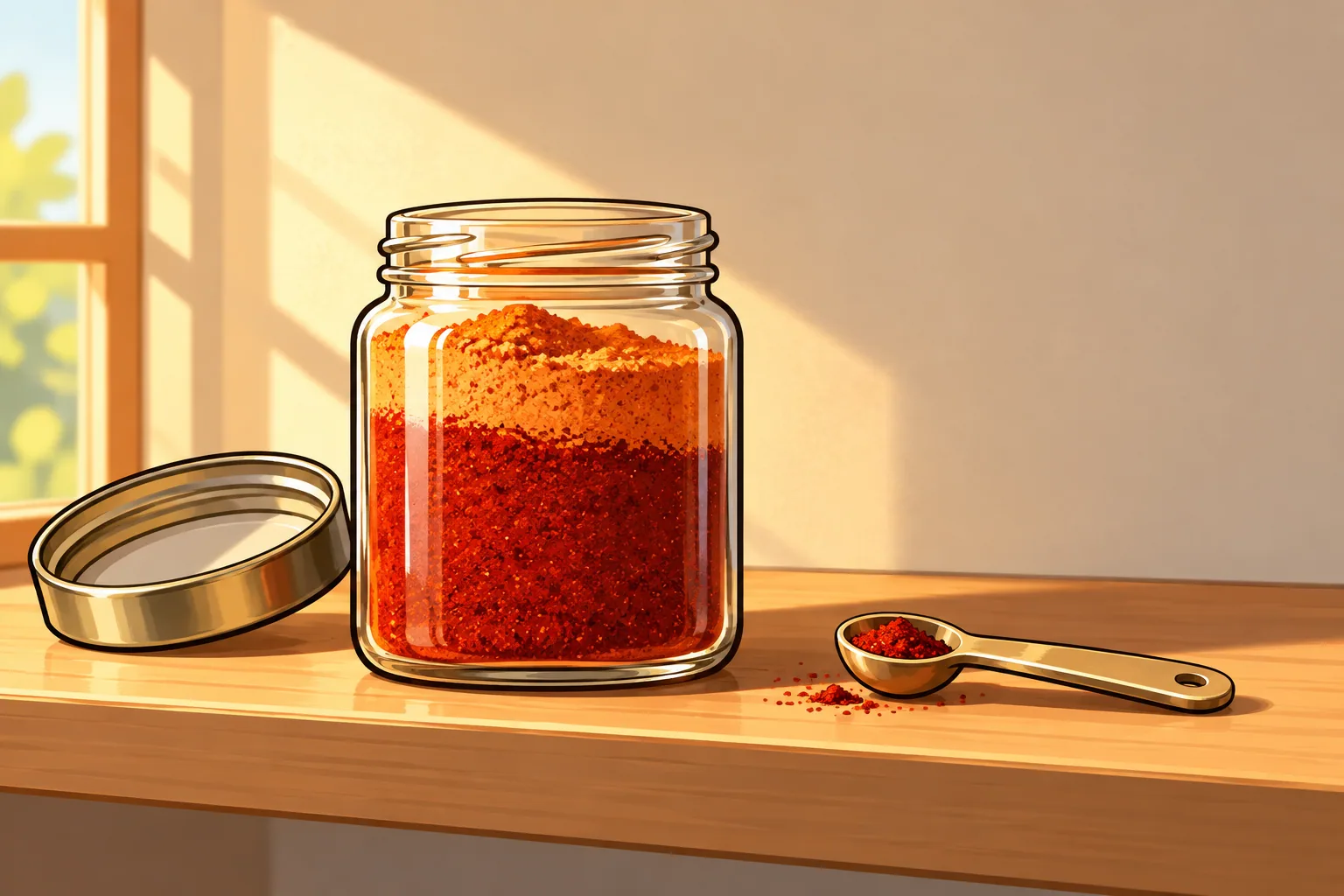
Rarely in the sense of spoiling, often in the sense of going flat. A dry powder gives mold almost nothing to grow on, but its color, smell and heat drift away with time, light and warmth. Kansas State's cupboard chart gives ground spices and spice blends 2 to 3 years at 70°F, and tells you to replace a jar once its aroma has faded1.
The third number is the one that surprises people. Your powder can lose its red long before it reaches the end of its shelf life. A faded jar still works, but you need more of it for the same color and flavor. If you bought your jar for one recipe two summers ago, it may well be fine; run the jar test further down before you decide to throw it out.
How long does each kind of chile product keep?
It depends on the form and on who dried it. Store-bought ground spices get the Kansas State figures; pods and powder you dry yourself follow the National Center for Home Food Preservation, which runs much shorter.
| Form | Cupboard time | Notes |
|---|---|---|
| Chili powder blend13 | 2–3 years at 70°F | Herb and spice blends; McCormick's blend lists chili pepper, spices, salt, silicon dioxide and garlic |
| Single-chile powder (cayenne, ancho, paprika)1 | 2–3 years at 70°F | Ground spices |
| Whole spices1 | 3–4 years at 70°F | Kansas State's whole-spice row |
| Home-dried pods and powder4 | About 6 months at 60°F, about 3 at 80°F | Worked from NCHFP: vegetables keep about half as long as dried fruit |
| Dried peppers, home-packed5 | Several months | Cool, dry, dark place in moisture- and vapor-proof packaging |
The gap between rows one and four is real, and it is the main reason home-dried batches seem to fade so fast. Commercial powders come out of controlled drying and sealed packaging; your homemade jar starts its clock with whatever moisture your dehydrator left behind.
The home-dried figure, worked
NCHFP gives dried foods 4 months to 1 year, says most dried fruit keeps about 1 year at 60°F and 6 months at 80°F, and adds that vegetables keep about half as long as fruit4. NCHFP files its pepper page under vegetables, so half of 1 year is about 6 months at 60°F, and half of 6 months is about 3 months at 80°F.
So a jar of homemade chili powder on a warm shelf near your oven sits closer to the 3-month mark. Move it somewhere cool, or freeze part of the batch, and you push it toward the 6-month end.
What about the date printed on the jar?
Use it to rotate, not as a cliff edge. Kansas State's advice for the whole cupboard is to check dates on packages and use the oldest products first1. Past the date, your nose and eyes decide: the same chart tells you to check the aroma and replace the jar if it has faded1.
Which fades first in the jar, color, smell or heat?
Color, then smell, with heat holding on longest. Two Korean packaging studies on red pepper powder show the order, and the extension chart sets the outer limit.
- Day 0
Bright red
Fresh red pepper powder at 7 % moisture started with a redness (a*) value of 26.1.2
- Within 5 months
Stable in a good pouch
In high-barrier pouches with a moisture absorber and oxygen scavenger at 25 °C, color, capsaicinoids and vitamin C stayed near their starting levels.6
- By day 126
Orange in a thin bag
The same 7 % powder in a thin polyethylene bag or a plastic bottle at 20 °C fell to a redness of 14.2–15.9, a visible shift from red to orange.2
- Over months
Heat slips slowly
Capsaicinoids declined over storage, but the decline did not track moisture or packaging type.2
- 2–3 years
End of the quality window
Kansas State's limit for ground spices at 70°F; check the aroma before you cook.1
The heat result matters for your cooking. Since capsaicinoids fell over time no matter how the powder was packed2, an old jar of cayenne may still carry plenty of bite even after its color dulls. Taste a pinch before you decide to double the amount.
Why a drier powder can fade faster
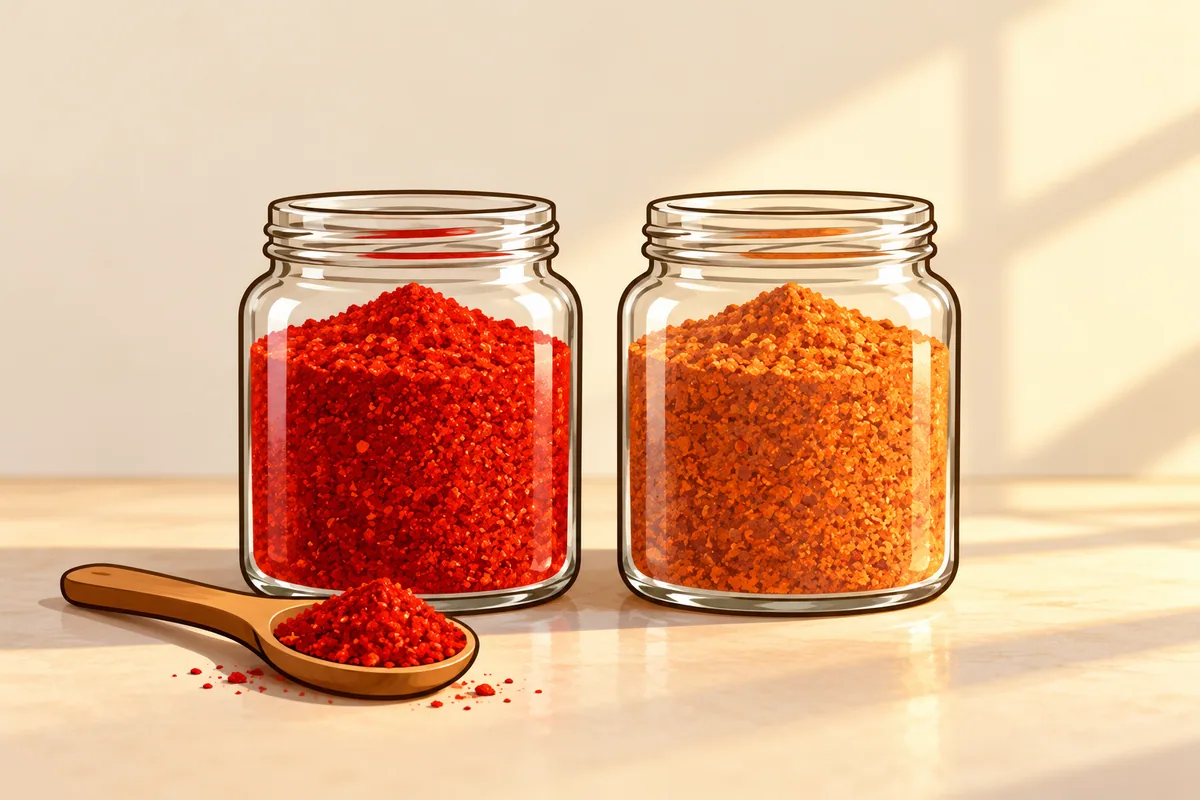
This one runs against instinct. In the 2024 study, the powder dried down to 7 % moisture and kept in a thin bag or a plastic bottle shifted from red to orange, and the authors found that initial moisture and the packaging's gas permeability drove the color change2.
Two ways to store the same red powder
Faded
Held its color
For you, the packaging is the part you can control. Air reaching the powder does the fading, so a well-sealed glass jar beats a twist-tied bag. USDA lists paprika at 11.2 % water and cayenne at 8.05 %78, so the powders on your shelf sit in the same moisture range the studies tested.
How can you tell if your chili powder has gone off?
Open the jar and run through these before it goes in the pot.
The jar test
- Smell it. Little or no aroma means the quality has faded; Kansas State says to replace the jar.1
- Look at the color. Orange or brown where it was red means light and air have reached it.29
- Feel for lumps. Hard clumps mean the powder took on moisture; dried food that reabsorbs water can spoil.4
- Check for fuzz or a musty smell. Moldy dried food goes in the bin.4
- Taste a tiny pinch. Heat fades more slowly than color, so a dull jar may still be hot.2
If your jar passes the smell and mold checks but looks pale, use it in a dish where color matters less, like a stew, and start a fresh jar for anything you want bright red.
Is old chili powder safe to use?
Age is not what the safety research looks at; contamination at the source is. An FDA-led study sampled 299 imported dried capsicum shipments and found Salmonella in 3.3 % of them, mostly at low levels10. The authors stressed that small test samples miss many contaminated shipments, which is a question for importers and inspectors rather than for the date on your jar.
What you can check at home is mold and moisture, because moldy dried food should be discarded4. Chili powder also carries capsaicin whatever its age, and too much hot pepper can cause nausea, vomiting, stomach pain and diarrhea11.
Where should you keep chili powder so it lasts?
Cool, dark, dry and sealed, in that order of importance for most kitchens.
- 1
Move it away from the stove
Kansas State tells you to store spices in airtight containers, in dry places away from sunlight and heat.1
- 2
Keep it in the dark
Light makes dried peppers fade quickly, Penn State notes, so a cupboard beats an open rack by a window.9
- 3
Seal it tight
Air reaching the powder drove the red-to-orange fade in the 2024 study; a tight lid on glass slows it.2
- 4
Spoon, don't shake over the pot
Steam from a pot puts moisture into the jar, and dried food that reabsorbs moisture can spoil.4
- 5
Freeze the spare
Kansas State says the freezer extends spice shelf life; keep a sealed backup jar there.1
Whole dried pods follow the same routine, and Penn State adds that dried peppers keep their color best in the refrigerator or freezer9. The storing dried chiles page goes into jars, bags and freezer packing for pods.
Fridge, freezer or cupboard for a big batch?
The freezer, for anything you will not open for months. Kansas State says freezing extends spice shelf life1, and Penn State says dried peppers stored in the refrigerator or freezer keep their color best9. Your cupboard is fine for the jar you are using this season.
The catch is water. Cold glass pulls condensation out of warm kitchen air, and NCHFP warns that dried food packed "bone dry" can still spoil if it takes moisture back in4. So if you freeze powder, split it into small sealed jars or bags first, and let a jar come to room temperature before you open it, so droplets form on the outside, not on your powder.
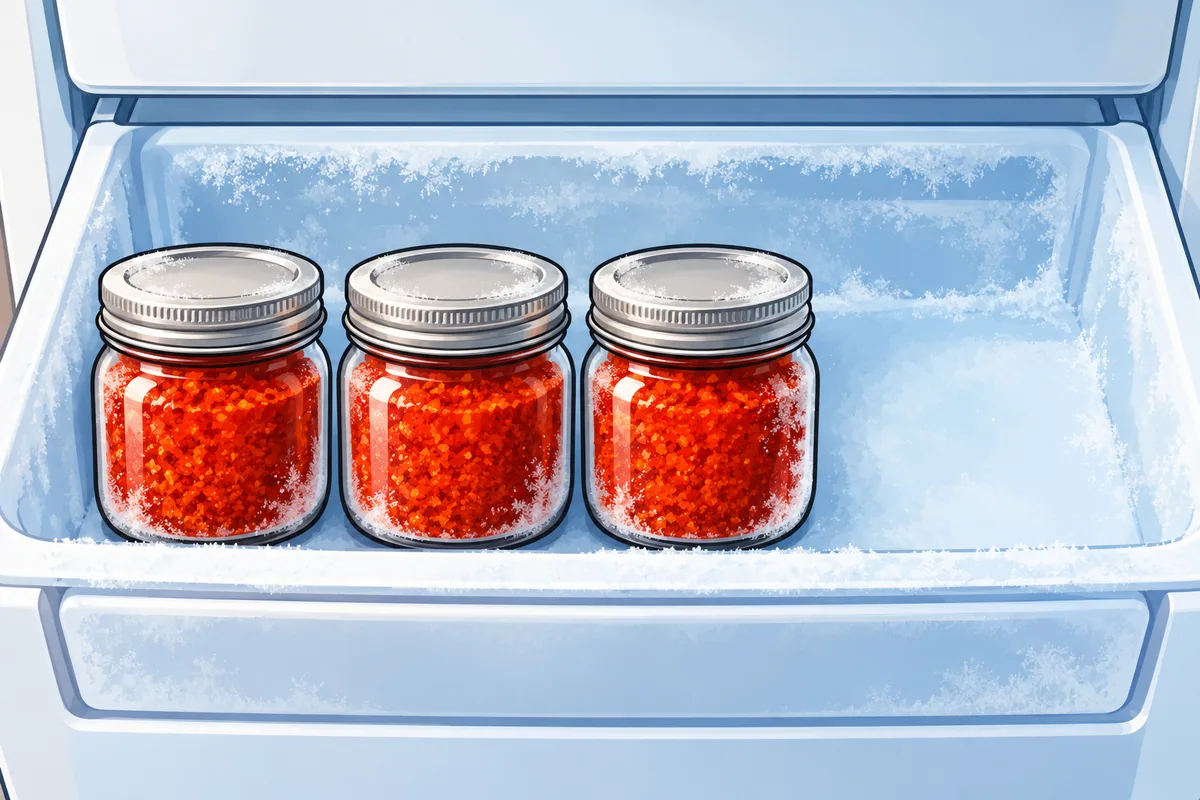
Here is how we would set up a big homemade batch, using only the guidance above:
- One small jar in the cupboard for daily use, sealed and away from the stove1.
- The rest in small freezer containers, each sealed; NCHFP lists home canning jars, freezer containers with tight lids and freezer bags as good options4.
- A look through the glass every few weeks. Glass lets you see moisture collecting inside, and NCHFP tells you to check dried foods often4.
If you spot condensation in a jar of pods, NCHFP's fix for dried food is to dry it again and repackage it4. For powder, that is harder, so use a damp-looking jar soon and keep the others sealed.
Should you buy whole pods or ground powder?
Buy by how fast you use it. Whole spices keep about a year longer than ground ones in Kansas State's chart1, and a pod you grind yourself starts fresh each time.
| You cook with it | Buy | Why |
|---|---|---|
| Every week | Ground powder in a size you finish in months | You use it well inside the 2–3 year window |
| A few times a year | Whole dried pods, ground as needed | Whole spices keep 3–4 years; grinding fresh restores aroma |
| Once, for one recipe | The smallest jar you can find | Any leftover fades on the shelf before you need it again |
| You dry your own | Freeze most of the batch | Home-dried food keeps far less time than store-dried |
Grinding pods takes a blender and a minute; Penn State notes that whole dried hot pepper pods blend to a powder for cayenne or chili powder9. If you buy red pepper flakes instead, the same storage rules apply.
Your next step with an old jar
If your jar failed the smell test, making your own chili powder gets you a fresh batch from whole pods. To pick the right replacement, the types of chili powder page lines up blends and single-chile powders by heat.