
Thai Chili Pepper Scoville, 50,000–100,000 SHU
A small, sharp chile about an inch long, also sold as bird's eye.
 Hot
50,000–100,000 SHU
- About 10 to 20 times the heat of an average jalapeño
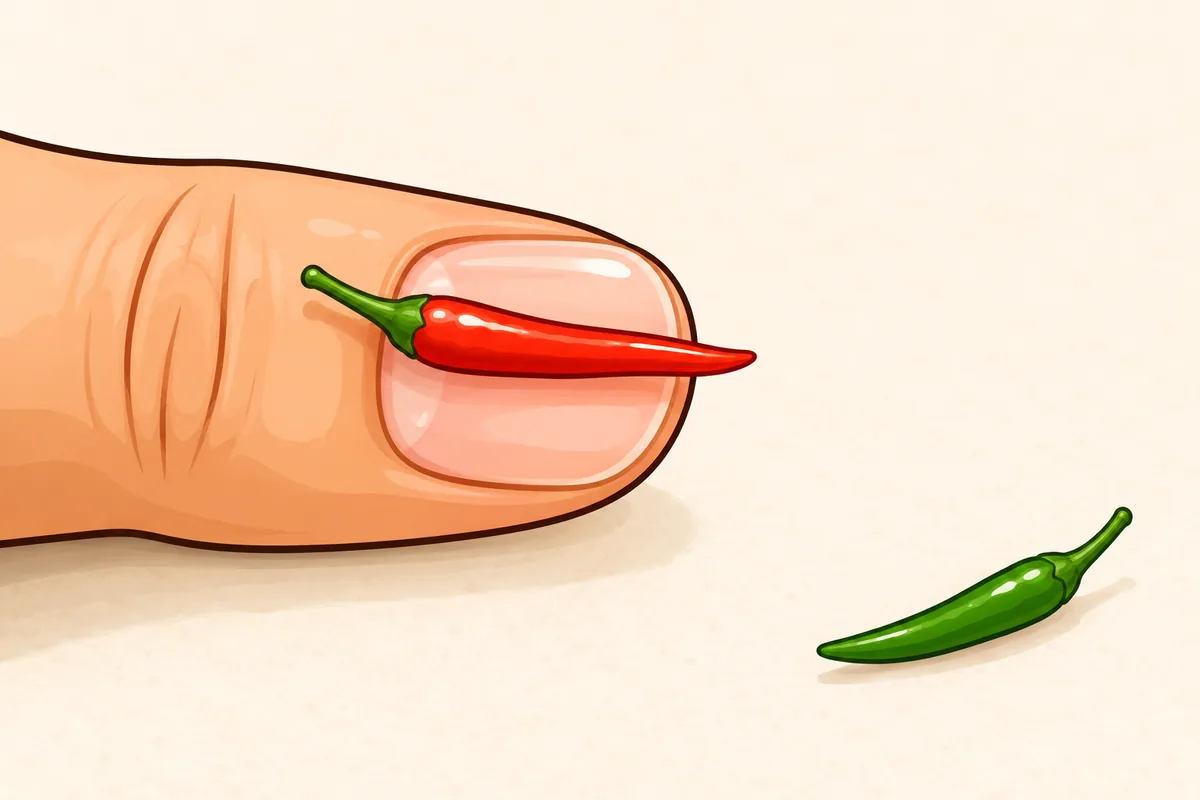
- Pods about 1 inch long and under 1/5 inch wide
On this page
- 1How hot is a Thai chili?
- 2What species is the Thai chili?
- 3How can you tell which species your plant is?
- 4How big is a Thai chili?
- 5What does a Thai chili taste like?
- 6How do you cook with Thai chilies?
- 7Are dried Thai chilies hotter than fresh ones?
- 8How do you store, freeze or grow Thai chilies in a pot?
- 9What goes wrong with Thai chilies?
- 10Where does the Thai chili come from?
- 11Is a Thai chili the same as a bird's eye chili?
- 12Can you grow Thai chilies?
How hot is a Thai chili?
A Thai chili rates 50,000 to 100,000 Scoville heat units, the range UF/IFAS Extension gives1. Its midpoint, 75,000 SHU, puts it in the hot band, and its top end touches the extra-hot line at 100,000.
Log scale; bars are published ranges.1
A pod about an inch long carries 10 to 20 times a jalapeño's heat per gram, so start with less than you think.
How many times hotter than a jalapeño or a cayenne?
All four comparison figures come from the same UF/IFAS publication, so the ratios you see are like for like. The cayenne is the nearest neighbor below it, and the habanero starts where the Thai chili stops.
| Against | Its heat | Thai chili is | How we got it |
|---|---|---|---|
| Jalapeño (average) | about 5,000 SHU | 10–20 times hotter | 50,000 ÷ 5,000 and 100,000 ÷ 5,000 |
| Serrano | 10,000–25,000 SHU | 2–10 times hotter | 50,000 ÷ 25,000 and 100,000 ÷ 10,000 |
| Cayenne | 25,000–50,000 SHU | 1–4 times hotter | 50,000 ÷ 50,000 and 100,000 ÷ 25,000 |
| Habanero | 100,000–350,000 SHU | 1–7 times milder | 100,000 ÷ 100,000 and 350,000 ÷ 50,000 |
If you're cooking a recipe that calls for jalapeño and you only have Thai chilies, start with about a tenth of the weight, then taste and adjust.
The Thai chili and jalapeño side by side goes further, and the top of the range meets the habanero in the Thai chili against habanero comparison.
What species is the Thai chili?
Sources split, and your seed packet may pick any of the three. UF/IFAS calls it a cultivar derived from Capsicum annuum, and warns it is often confused with C. frutescens cultivars because they look alike1. Other extension sources sort it differently.
| Species given | What it says |
|---|---|
| C. annuum | A cultivar derived from C. annuum, often confused with C. frutescens cultivars 1 |
| C. annuum | Listed under C. annuum; also called bird's eye chili or bird's chili 5 |
| C. frutescens | Thai listed with tabasco and malagueta; bird types listed under C. annuum 2 |
| C. chinense | Its botany heading lists habanero and bird's-eye pepper under C. chinense 6 |
| C. frutescens | A fruit-fly study in Thailand tested bird chili as a small chili cultivar of C. frutescens 7 |
Why can't the sources agree?
UF/IFAS gives the reason itself: the Thai pepper and some C. frutescens cultivars look so alike that people mix them up1. A pod alone won't settle it, so we list C. annuum because it is the only answer from a source that describes the Thai pepper itself and names the confusion; the CV130 heading is about bird's-eye peppers in general.
How can you tell which species your plant is?
Check the flowers and the cap on a young pod. The genus monograph gives the marks for each species8:
The cap is the quickest test. If you see a groove ringing the top of the pod, you're holding a C. chinense, whatever the seed packet said.
How big is a Thai chili?
Small pods on a surprisingly big plant, so give yours room.
UF/IFAS Gardening Solutions describes small, tapering fruits about an inch long on plants that can reach six feet5.
What does a Thai chili taste like?
Fruity, sometimes with a touch of citrus, and the heat stays with you. The UC Master Gardeners of Ventura County describe it as very spicy with lingering heat3. That slow fade is worth knowing before you taste a curry and add more.
If you can't find any, the Thai chili swap list gives replacements with amounts.
- Fruity
- Citrus
- Lingering
How do you cook with Thai chilies?
Use them in ones and twos, and decide how much of the pod you want to break. At 50,000 to 100,000 SHU1, one pod can season a dish for two, and the way you cut it decides how much of that heat leaves the pod.
- Whole or bruised, in a soup or curry: crack the pod with the flat of your knife and drop it in. You get the fruity smell and a steady heat, and you can fish it out when the pot tastes right.
- Sliced into thin rings, in a stir-fry or salad: each ring carries its share of the white ribs, where most of the capsaicin sits, so the heat spreads in pockets. Slice them as thin as you can.
- Pounded to a paste with garlic: the most heat per pod, because the ribs break completely. Start with one chili per serving and add more after you taste.
Because the heat lingers3, wait a minute after each taste before you add another pod. A recipe that asks for "two Thai chilies" reflects one cook's batch of pods; treat the number as your starting point, not a rule. Wear gloves when you slice a handful; the food preservation center's rule for hot peppers is rubber gloves and no touching your face9.
Are dried Thai chilies hotter than fresh ones?
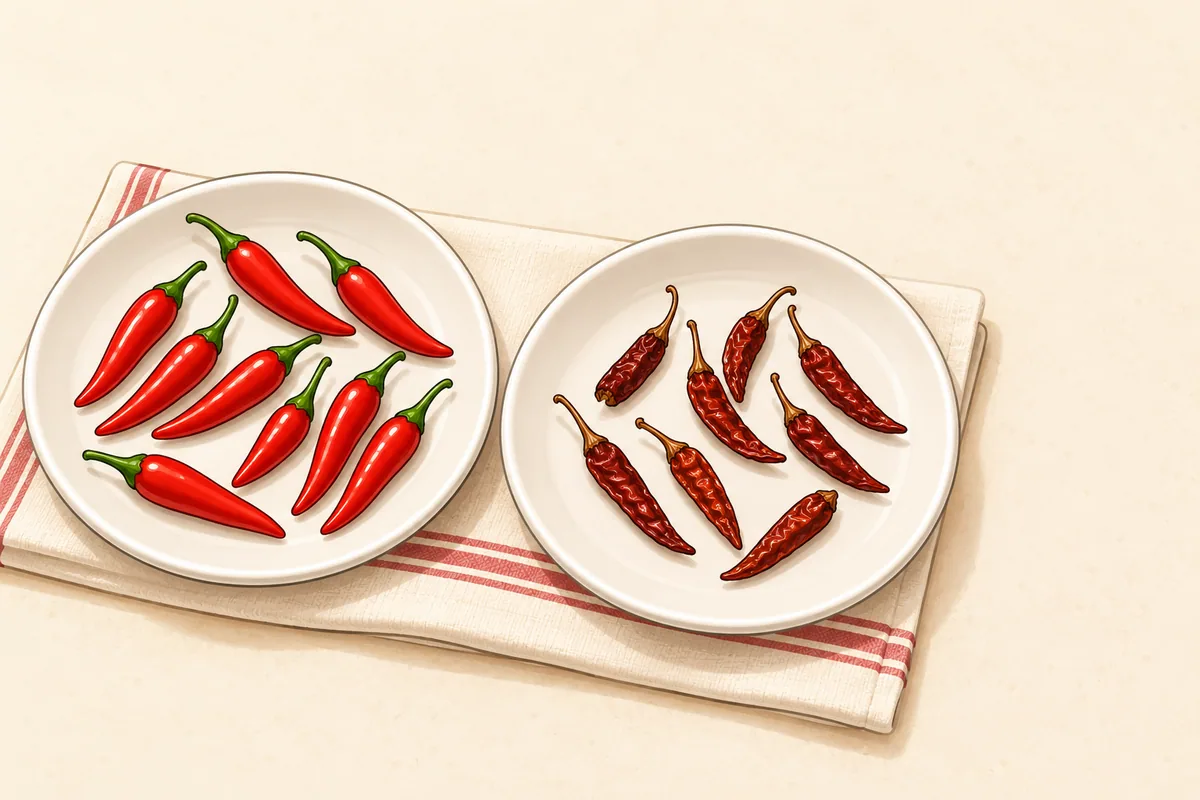
By weight, yes, often by a lot. A Thai lab dried a local chili called 'Super Hot' in a hot-air oven and found the capsaicinoid content rose about six times at 120–160°C compared with the fresh pods10.
Much of that jump likely comes from water leaving the pod: the same heat sits in a much lighter pepper. So when you swap dried for fresh, count pods, not grams, and use fewer dried ones until you know your batch. If you dry your own Thai chilies, expect the same jump in heat per pinch.
How do you store, freeze or grow Thai chilies in a pot?
Small pods dry out and soften fast, because a tiny pod has a lot of skin for its weight, so pick the method by when you'll use them:
- This week: the crisper drawer, dry and in a loose bag. The UC Master Gardeners give 45 to 55°F at 90 to 95 % humidity for fresh peppers and advise keeping them away from apples and bananas, whose ethylene gas harms them3.
- This year: the freezer. New Mexico State University's chile guide says you can freeze chiles whole and unpeeled in flat packs no deeper than 2 inches, for up to 12 months11. Frozen Thai chilies slice cleanly straight from the bag, which is handy for a quick stir-fry.
- Longer: dry them; the heat per gram climbs as the water leaves, as the drying study above shows10.
For a balcony, a pot works well. The UC Master Gardeners note that peppers do well in containers and need at least 6 hours of sun3, and a Thai chili's inch-long pods weigh almost nothing, so even a tall plant rarely needs heavy staking. Bring your pot indoors before frost and it can keep fruiting the next year, since the plant is a perennial in warm climates2. The container growing guide covers pot size and watering, and a pot also lets you chase the sun around your balcony through the day.
What goes wrong with Thai chilies?
The small size fools people more than the heat does. A pod the length of your thumbnail looks harmless next to a jalapeño, and that's exactly when cooks add three where one would do.
Problems and their fixes
- The curry tasted fine, then too hot five minutes later: the heat lingers and builds. Add one pod at a time and wait a minute before you taste again.3
- Your fingertips burn after slicing a handful: capsaicin oil on the skin. Wear rubber gloves and keep your hands away from your eyes.9
- Ripe pods in a warm garden have maggots inside: in a Thai study the solanum fruit fly preferred bird chili above most of the other fruits in the test. Pick pods as they ripen and bin fallen ones.7
- The plant doesn't match the packet: the species gets mislabeled often. Check the cap and flowers with the list above before you save seed.18
Where does the Thai chili come from?
Probably not from Thailand. UF/IFAS says its origin might be Mexico, Central America or South America1. That fits the rest of the genus: the University of Guam notes that hot peppers come from Central and South America in the first place2.
Is a Thai chili the same as a bird's eye chili?
Often, yes, by name. UF/IFAS lists bird's eye chili and bird's chili as other names for the Thai pepper5. The University of Guam's table, though, puts Thai under C. frutescens and bird types under C. annuum2, so the two names don't always mean the same plant. The bird's eye and Thai chili comparison sorts out what each label usually means.
Can you grow Thai chilies?
Yes, and in a warm climate one plant can keep going for years. University of Maryland Extension gives most hot pepper types 70 to 85 days from transplanting4, and no extension source we read gives a separate figure for Thai types.
The University of Guam's hot pepper guide says the plants grow best with days of 75 to 85°F and nights of 50 to 60°F, that seeds usually sprout within 2 weeks, and that in the tropics peppers grow as perennials, while frost kills them in cooler regions2. It advises light, frequent watering that keeps the soil moist but never saturated2. In a cold-winter garden, a pot you can carry indoors lets you keep your plant past the first frost. The Thai chili growing guide takes it from seed to harvest.
Related peppers
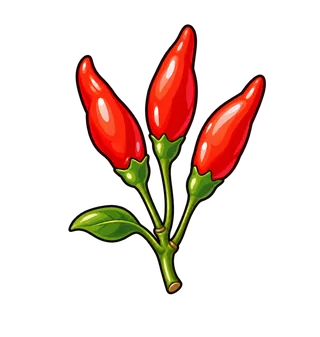
Published ranges.1
Related in Peppers
-
Serrano Pepper Scoville, 10,000–25,000 SHU
A slim, fleshy chile one clear step above the jalapeño.5 min read -
Jwala Pepper, the Indian Cayenne-Type Chile at 85 Days
A long, thin, hot green chile from India that turns red and dries well.5 min read -
Habanero Pepper Scoville, 100,000–350,000 SHU
A fruity, floral chile in the extra-hot band.7 min read -
Jalapeño Scoville, 2,000–8,000 SHU and Chipotle
The medium-heat chile most heat comparisons start from.6 min read -
Cherry Pepper Scoville, 0 SHU Sweet to Hot
A small round pepper, sweet or hot, grown for jars and stuffing.6 min read -
Aji Charapita, the Pea-Sized Amazon Chile at 30K–50K SHU
A tiny yellow chile from Iquitos and Pucallpa with a citrus aroma and a heat seed sellers compare to cayenne.6 min read
Sources
· 11
- 1University of Florida IFAS Extension HS-859/TR010: Pepper Production in Miami-Dade County, Florida
- 2University of Guam, College of Natural and Applied Sciences, Cooperative Extension and Outreach FPP-05: Hot Pepper (Capsicum spp.), Important Crop on Guam (Tuquero, Chargualaf, Marutani)
- 3University of California Agriculture and Natural Resources, UC Master Gardeners of Ventura County Ventura Garden to Table Series: Peppers
- 4University of Maryland Extension Growing Peppers in a Home Garden
- 5UF/IFAS Gardening Solutions Peppers by Scoville Units
- 6University of Florida IFAS Extension HS732/CV130: Chapter 13. Pepper Production (Frey, McAvoy, Desaeger, Vallad, Qureshi, Boyd)
- 7Insects 12(6):482 (MDPI) Host preference of Bactrocera latifrons (Hendel) among fruits of solanaceous plants (Rattanapun, Tarasin, Thitithanakul and Sontikun)
- 8PhytoKeys 200:1-423 (Pensoft) Monograph of wild and cultivated chili peppers (Capsicum L., Solanaceae)
- 9National Center for Home Food Preservation, University of Georgia Ingredients for Salsa Recipes
- 10PeerJ 10:e13423 Influence of hot air drying on capsaicinoids, phenolics, flavonoids and antioxidant activities of 'Super Hot' chilies (Yap, Uthairatanakij, Laohakunjit and Jitareerat)
- 11New Mexico State University Cooperative Extension (Guide E-324) Processing Fresh Chile Peppers (revised by Nancy C. Flores and Cindy Schlenker Davies)