
Bird's Eye Chili Heat and Names, 50,000–100,000 SHU
A tiny upright chile whose name points to the animals that plant it.
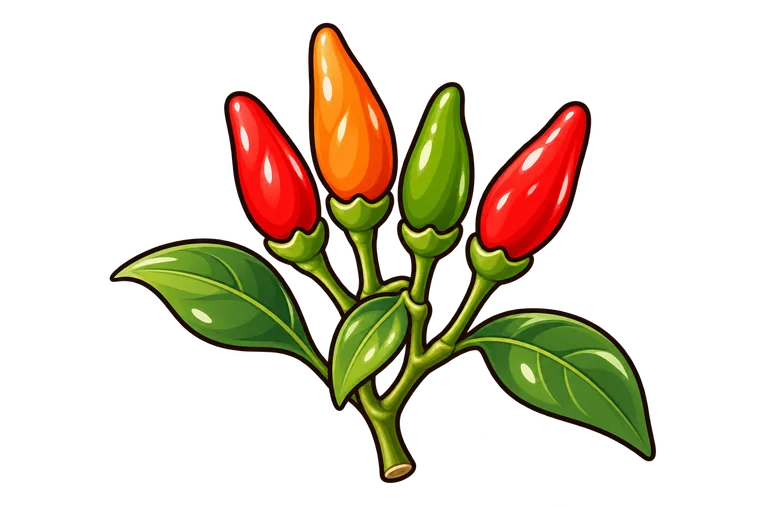 Hot
50,000–100,000 SHU
- 10 to 20 times an average jalapeño, per gram
- Pods about 1 inch long, two or three to a node
On this page
- 1How hot is a bird's eye chili?
- 2Why do people call it a bird's eye chili?
- 3Which plants reach the shop under the bird's eye name?
- 4How do you pick out a true bird's eye at the market?
- 5What does a bird's eye chili taste like?
- 6How do you cook with bird's eye chilies?
- 7Is your bird's eye an annuum or a frutescens?
- 8Can you grow bird's eye chilies at home?
- 9What goes wrong when you handle bird's eye chilies?
- 10What should you do with your first bag of bird's eye chilies?
How hot is a bird's eye chili?
A bird's eye chili rates 50,000 to 100,000 Scoville heat units, the range UF/IFAS Extension gives for the Thai pepper it also calls bird's eye chili or bird's chili1. The midpoint, 75,000 SHU, sits at the top of the hot band, one step below the habanero. If you have cooked with fresh green chiles but never with these, plan for a big jump: your usual handful becomes a pinch.
Log scale; bars are published ranges.1
Per gram, a bird's eye chili carries 10 to 20 times the heat of an average jalapeño, so one pod does the work of a whole green chile.
How much bird's eye replaces a jalapeño or a cayenne?
UF/IFAS puts the average jalapeño near 5,000 SHU and the cayenne at 25,000 to 50,0001. The ratios below divide those numbers; the last column turns them into a starting weight for your recipe. Treat it as an estimate, since pods vary from plant to plant.
| Your recipe calls for | Its heat | Bird's eye is | Start with this much bird's eye |
|---|---|---|---|
| Jalapeño | about 5,000 SHU | 10–20 times hotter | one tenth of the jalapeño weight |
| Cayenne | 25,000–50,000 SHU | 1–4 times hotter | half the cayenne weight |
| Habanero | 100,000–350,000 SHU | 1–7 times milder | the same weight, then taste |
Here is how that plays out in your pot. Say your curry recipe wants 40 g of fresh jalapeño. You'd start with about 4 g of bird's eye instead, which is two or three pods. Add them, let the pot simmer for ten minutes, taste, and only then decide whether your table wants a fourth. Going up later is easy; taking heat back out of a curry is not.
Why do people call it a bird's eye chili?
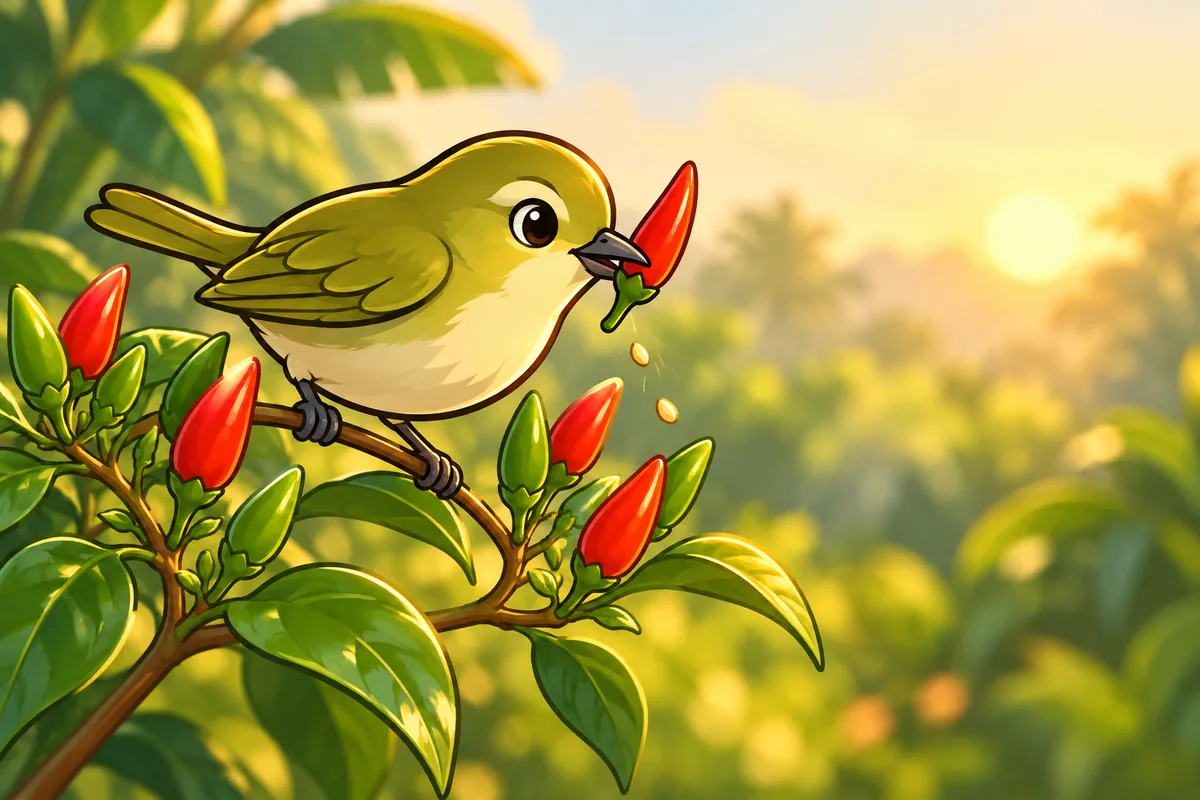
Birds eat the ripe pods and feel nothing, while mammals feel the burn and stay away. Lab work at UC San Francisco showed that the chicken's capsaicin receptor does not respond to capsaicin, so birds act as the seed carriers3. Field studies in the genus monograph found the same pattern with wild upright red chiles in Arizona and Bolivia4.
- Ripe red podSmall, upright, easy to see from above
- A bird eats itIts capsaicin receptor ignores the burn
- Seeds pass throughGut passage raises germination rates
- A new plantFar from the parent bush
- A mouse tastes itCapsaicin repels rodents, so the seeds survive
Tewksbury and Nabhan named the idea directed deterrence: capsaicin discourages the animals that would destroy the seeds without putting off the ones that spread them5. The monograph adds that seeds which pass through a bird's gut germinate at higher rates4. So the name you see on the bag describes the plant's real business partner.
You can watch this in your own yard. A chili bush with upright red pods often loses ripe fruit to birds before you pick it, while the same pods sit untouched by squirrels. If you grow these outdoors, a light net over the plant in the last weeks keeps your harvest for you.
Which plants reach the shop under the bird's eye name?
At least four plants carry the name, and they don't all share a species. The genus monograph lists "bird pepper" as a common name for both a wild C. annuum and for C. frutescens across the Caribbean and Central America4.
| Plant | Species | Where the name is used |
|---|---|---|
| Thai pepper | C. annuum | Shops across South and Southeast Asia and beyond |
| Wild chiltepin | C. annuum var. glabriusculum | 'Bird pepper' in the United States and the Caribbean |
| Wild and village C. frutescens | C. frutescens | 'Bird pepper' in the Antilles, Belize, Trinidad and Tobago |
| Piri piri | Sold as African bird's eye | Africa and Portugal |
In a Thai or Vietnamese grocery, your bag almost always holds the Thai pepper, the one the Thai chili entry covers in depth. That's the pod most recipes mean when they say bird's eye.
The others turn up in other shops. You'll meet the wild pea-sized chiltepin in Mexican markets, and an African pod sold as piri piri.
If you shop at a Filipino store, the small upright chile there is the siling labuyo, which has its own entry.
How do you pick out a true bird's eye at the market?
Look at size, how the pods sit, and the cap. These checks come from the UF/IFAS description and the genus monograph:
Five checks for a bag of small chilies
- Pods about 1 inch long and thinner than 1/5 inch at the shoulder.1
- Two or three pods sprout from one node on a branch you buy still attached.1
- Pods point up rather than hang down, the habit of the wild bird-dispersed chiles.4
- A cup-shaped cap that hugs the base of the pod suggests C. frutescens rather than C. annuum.4
- Glossy red or green skin with no wrinkles; soft or shrivelled pods have lost moisture and aroma.
If your pods are round like peppercorns, you have chiltepin. If they are closer to 2 inches and the label says African, you're holding piri piri, a cousin with its own entry.
What does a bird's eye chili taste like?
UC Master Gardeners in Ventura County describe the Thai pod as fruity, sometimes with a hint of citrus, very spicy, with a heat that lingers2. The linger matters in a recipe: you taste the fruit first, and the burn keeps building for half a minute after you swallow.
Thin walls mean little flesh, so the flavor reads to you as sharp and clean rather than sweet. In a broth it disappears behind lime and fish sauce; in a raw dipping sauce it stays loud. If you want the fruit without the full burn, slice the pod lengthwise and scrape out the seeds and the pale inner ribs before you chop it.
- Fruity
- Citrus
- Lingering
How do you cook with bird's eye chilies?
You'll get the most from them in dishes where a small pod spreads through a lot of liquid. The amounts below are kitchen starting points, not sourced rules, so adjust them to your own taste and to how hot your batch turned out in the test.
- Curries and soups: bruise two or three whole pods with the flat of a knife and simmer them in the pot. Pull them out before serving if a guest is heat-shy.
- Raw dipping sauce: slice one pod into thin rings and stir it into fish sauce or soy sauce with lime juice. Rings release heat fast, so taste after five minutes.
- Stir-fries: smash pods with garlic and fry them in the oil for 20 seconds before the rest goes in. The oil carries the heat to every bite.
- Chili vinegar: drop a handful of split pods into a bottle of rice vinegar and leave it in the fridge for a week. A few drops wake up noodles and fried rice.
If a recipe names a bird's eye and you can't find one, the bird's eye swap list gives other pods with amounts.
Is your bird's eye an annuum or a frutescens?
Most likely an annuum. UF/IFAS describes the Thai bird's eye as a C. annuum cultivar and says people often confuse it with C. frutescens because the two look alike1, while the University of Guam lists Thai under C. frutescens6. The bird's eye against Thai chili page lines up every source and explains the flower and cap checks.
Can you grow bird's eye chilies at home?
Yes, and the plant gets bigger than its pods suggest. It's a perennial that can reach 6 feet in a warm climate1.
The University of Guam notes that hot peppers grow as perennials in the tropics but usually as annuals in places with frost, since frost kills the tender plants6. In a cold-winter garden you can bring a potted plant indoors before the first frost and keep it for a second season. Trim the longest branches so it fits your sill, give it your sunniest window, and water it less while it rests through the short days. The Thai chili grow guide covers seed starting, pots and harvest timing for the same plant.
What goes wrong when you handle bird's eye chilies?
The juice is the problem, not the bite. Small pods mean more cutting per gram, so your fingers pick up more capsaicin than they would from one big chile. You won't feel it while you chop; you'll feel it an hour later when you rub your eye or take out a contact lens.
A curry that came out too hot has two fixes you can make tonight. Add more of the base (coconut milk, stock, vegetables) to dilute it, and serve small sips of milk on the side, which Poison Control mentions for a burning mouth7. Eating far too much hot pepper can bring nausea, vomiting and stomach pain, so a dare with a handful of raw pods is a bad trade7.
What should you do with your first bag of bird's eye chilies?
Use a few fresh, keep the rest whole, and measure your heat on a small dish first. Your first bag teaches you more about this pepper than any chart can, because every batch runs a little hotter or milder.
- 1
Sort the bag
Keep the firm, glossy pods; drop any soft ones.
- 2
Cook one test dish
Use one pod in a dipping sauce so you learn how hot this batch runs.
- 3
Store the rest whole
Keep them dry in a loose bag in the crisper and use them while they stay glossy.
- 4
Freeze the surplus
Freeze whole pods flat in a bag; they slice straight from frozen.
Then put them beside the plants they get mixed up with. The bird's eye and siling labuyo comparison is the next stop if your bag came from a Filipino shop.
Related peppers
Related in Peppers
-
Cayenne Pepper Scoville, 25,000–50,000 SHU
The long red chile behind most ground red pepper and a lot of vinegar hot sauce.6 min read -
Jwala Pepper, the Indian Cayenne-Type Chile at 85 Days
A long, thin, hot green chile from India that turns red and dries well.5 min read -
Tabasco Pepper Heat at 30,000–50,000 SHU, Plant to Mash
The small upright chile behind a Louisiana sauce, and a good one to grow.6 min read -
Habanero Pepper Scoville, 100,000–350,000 SHU
A fruity, floral chile in the extra-hot band.7 min read -
Jalapeño Scoville, 2,000–8,000 SHU and Chipotle
The medium-heat chile most heat comparisons start from.6 min read -
Cherry Pepper Scoville, 0 SHU Sweet to Hot
A small round pepper, sweet or hot, grown for jars and stuffing.6 min read
Sources
· 8
- 1University of Florida IFAS Extension HS-859/TR010: Pepper Production in Miami-Dade County, Florida
- 2University of California Agriculture and Natural Resources, UC Master Gardeners of Ventura County Ventura Garden to Table Series: Peppers
- 3Cell 108(3):421-430 Molecular basis for species-specific sensitivity to "hot" chili peppers (Jordt and Julius)
- 4PhytoKeys 200:1-423 (Pensoft) Monograph of wild and cultivated chili peppers (Capsicum L., Solanaceae)
- 5Nature 412:403-404 Seed dispersal: Directed deterrence by capsaicin in chilies (Tewksbury and Nabhan)
- 6University of Guam, College of Natural and Applied Sciences, Cooperative Extension and Outreach FPP-05: Hot Pepper (Capsicum spp.), Important Crop on Guam (Tuquero, Chargualaf, Marutani)
- 7National Capital Poison Center (Poison Control) Capsaicin: when the chili is too hot
- 8Revista Mexicana de Ingeniería Química 9(2):197-207 (CIAD) Capsaicinoides y color en chiltepín (Capsicum annuum var. aviculare). Efecto del proceso sobre salsas y encurtidos (Montoya-Ballesteros et al.)