
Siling Labuyo, the Philippine Wild Chili Sold at ₱800 a Kilo
The Philippines' everyday wild chili: soaked in cane vinegar, cooked into stews, and even eaten as a leaf.
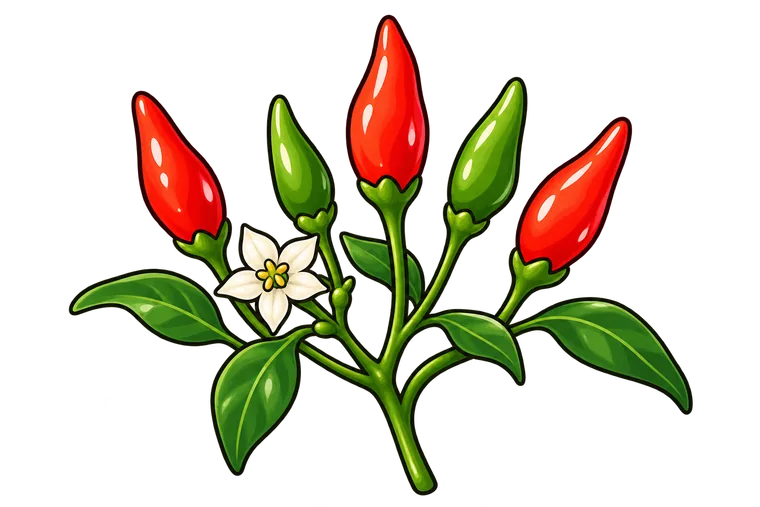 Hot
Very hot, no published lab range
- Capsicum frutescens, the species of the tabasco pepper, with thin-fleshed 3–4 cm pods
- Metro Manila prices rose from ₱548.54 to ₱701.47 a kilo in September 2025
On this page
- 1What is siling labuyo?
- 2How hot is siling labuyo?
- 3Is siling labuyo the same as bird's eye chili?
- 4How do Filipinos cook with siling labuyo?
- 5Can you eat siling labuyo leaves?
- 6Why did siling labuyo prices spike in 2025?
- 7How do you keep siling labuyo when it's cheap?
- 8Can you grow siling labuyo outside the Philippines?
- 9What goes wrong with siling labuyo?
What is siling labuyo?
The small wild chili of the Philippines, Capsicum frutescens. The Philippine food composition tables list it under that species, with the local names sili, labuyo and bunga1. Sili means chili, and labuyo points to the wild: the genus monograph lists the Philippines among places where this species grows as a weed or has escaped from cultivation2.
In practice that means you'll find it in backyards, along fences and at the edge of fields as often as on a farm. Birds help spread it: in a Batanes island study, 34 of 68 people interviewed said birds ate the fruits of this species and left the other peppers alone5.
What does the pod look like?
Small, slim and red when ripe. A seed company that sells it gives these numbers for its Philippine line4:
| Trait | Value |
|---|---|
| Pod | About 1.5 inches long, 0.75 inch wide |
| Color | Green, turning bright red when mature |
| Flesh | Thin |
| Plant height | 48–56 inches |
| Days to harvest | 90+ |
The pod shape follows its species: the same seller compares it to a tabasco pepper. If your chilies are long and curved rather than short, slim and pointed, you're probably holding a Thai type instead.
How hot is siling labuyo?
Very hot, but nobody we could find has published a lab range for it. The seed company calls the peppers very hot4, and the Batanes study groups it with the pungent peppers people use daily5. The 80,000 to 100,000 SHU you'll see online traces back to encyclopedia and blog pages, not to a measurement, so we leave it out.
No primary range exists for siling labuyo itself; tabasco shares its species, C. frutescens. Log scale; bars are published ranges.6
What you can lean on is its species. UF/IFAS puts tabasco, the best-known C. frutescens, at 30,000 to 50,000 SHU6, six to ten times an average jalapeño. Treat a siling labuyo as at least tabasco-hot until you've tasted your own, and cut one pod before you cut ten.
Is siling labuyo the same as bird's eye chili?
Not necessarily, though shops use the names loosely. UF/IFAS notes that the Thai pepper is a cultivar derived from C. annuum and often confused with C. frutescens cultivars6, and that's the confusion you'll meet in a Filipino grocery abroad. The full match-up of species, heat and pod lives on the bird's eye and siling labuyo pair page, and the bird's eye chili has its own entry.
For cooking, the swap works fine heat for heat, so don't skip a recipe just because your shop only has one of the two. The difference is in the pod: siling labuyo is short and thin-walled, so it softens fast in a stew and soaks flavor into vinegar quickly.
How do Filipinos cook with siling labuyo?
As a daily seasoning, which sets it apart from the larger C. annuum peppers in the same households. The Batanes study found people use this species often in everyday food, unlike C. annuum5, and it recorded several ways to do it.
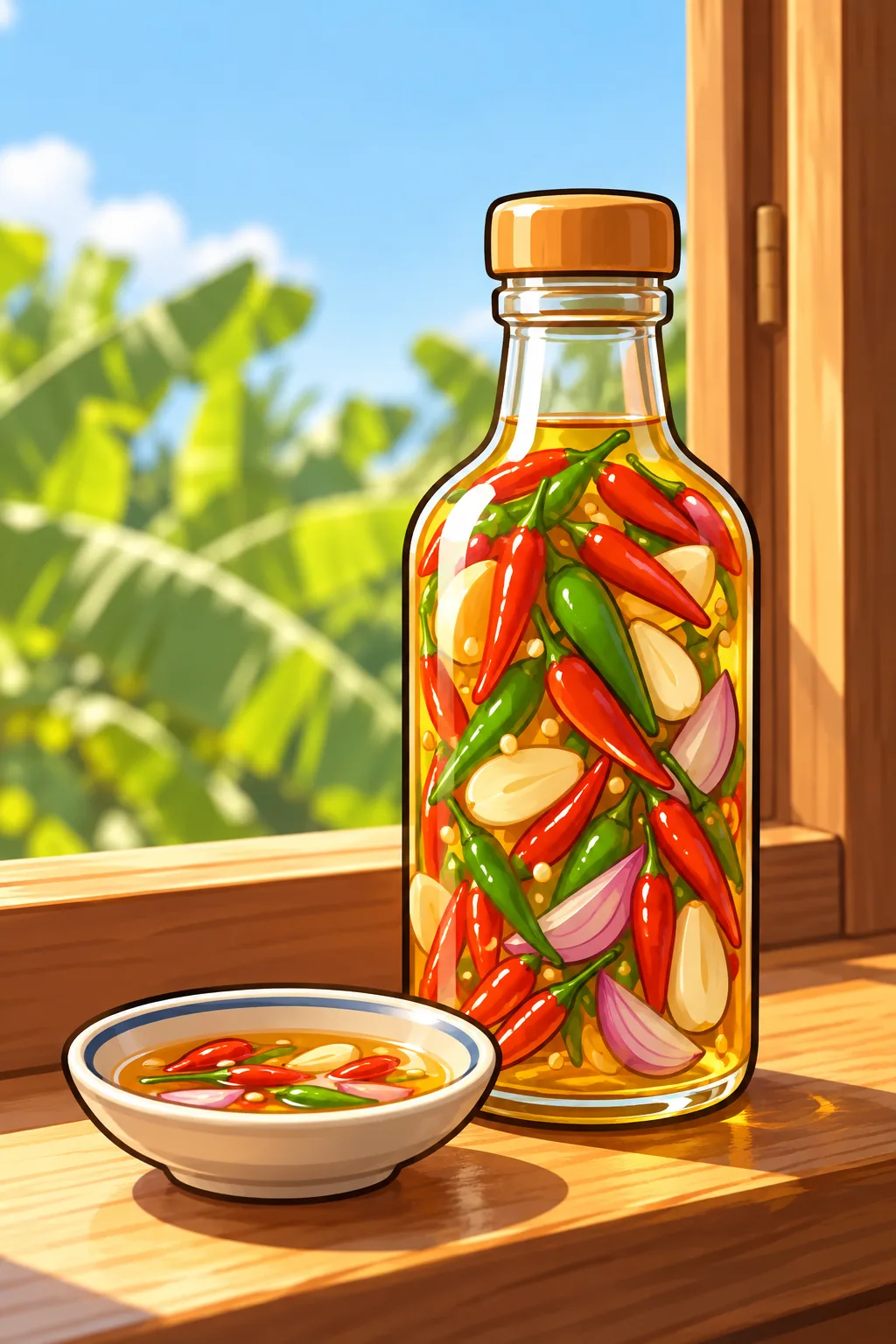
Each form puts the heat somewhere different in your meal. Vinegar pulls the heat into a dip, so every diner chooses how much to add; a pod cooked in a stew spreads its heat through the whole pot; a roasted pod keeps it in one fierce bite. Pick the form by who you're feeding.
- Soaked in cane vinegar. People soak fresh fruits in silam, a vinegar made from sugarcane, for a dip5. You'll see the same idea in bottles of spiced vinegar on Filipino tables.
- Cooked into stews. Cooks add the fresh fruits to dinuguan, the pork-blood stew5.
- Roasted as a snack. Some people wrapped wild fruits in banana or other leaves, cooked them on a fire and ate them as an appetizer5.
- Leaves in soup. The leaves go into a soup the islanders call nilaneg amung5. The study's leaf samples came both from weedy plants and from a store in Basco, the island capital, so on Batanes you can buy chili leaves as well as pick them5.
If you make a chili vinegar at home, slit the pods so the vinegar gets inside and keep the bottle in the fridge. Wear gloves while you slit them; New Mexico's chile guide suggests soaking burning fingers in plain vinegar if you forget7.
Can you eat siling labuyo leaves?
Yes, and the Philippine food tables treat them as a vegetable. The DOST-FNRI tables give separate entries for the fruit and the leaves, so you can compare them per 100 g of the part you eat18.
| Nutrient | Fruit | Leaves |
|---|---|---|
| Energy | 75 kcal | 60 kcal |
| Protein | 4.8 g | 5.8 g |
| Calcium | 65 mg | 274 mg |
| Iron | 2.3 mg | 3.5 mg |
| Beta-carotene | 4,205 µg | 9,495 µg |
| Vitamin C | 69 mg | 41 mg |
| Edible part of what you buy | 89 % | 42 % |
The leaves carry about four times the calcium of the fruit and more than twice the beta-carotene. In a pot of soup you get those nutrients without the heat of the pods, so a plant by your kitchen door gives you two crops. Only 42 % of a leaf bunch counts as edible, so strip the tender leaves from the stems before you weigh them.
The fruit table helps in the other direction too. At 69 mg of vitamin C per 100 g1, a 10 g handful of pods gives you about 7 mg, and because 89 % of what you buy is edible1, you lose little to stems. You won't eat enough chili for that to matter much, but it explains why a spoonful of chili vinegar tastes so bright.
Why did siling labuyo prices spike in 2025?
Bad weather on the farms. PCAARRD tracked Metro Manila chili prices through early September 2025 and found siling labuyo rising from ₱548.54 to ₱701.47 a kilo in four days, up 27.8 %, after weather disrupted the main producing regions of Ilocos, Central Luzon and Bicol3.
The Department of Agriculture's answer was to spread the crop out. It said a kilo of local siling labuyo sold for as much as ₱800 in September because of weather disturbances, and that chili can grow in most parts of the country, not just in Bicol; it now supplies clean planting material for siling labuyo through its Gulayan sa Bayan program9. PCAARRD's own report quoted a reported peak of ₱9003, so the two agencies don't agree on the top figure.
You rarely buy a whole kilo, so here's what those prices meant at the stall: at ₱548.54 a kilo, 100 g cost you about ₱55; four days later the same 100 g cost about ₱70, and at the ₱800 peak about ₱80. If you buy siling labuyo in the Philippines, that history is a reason to dry or freeze some when it's cheap. A small plant in a pot also takes you out of the market entirely.
How do you keep siling labuyo when it's cheap?
Freeze most of it, dry some, and keep a handful fresh. Fresh hot chiles keep 2 to 3 weeks at 45–50 °F and 85–90 % humidity10, so a loose bag in your crisper drawer covers the next fortnight of cooking.
Freezing suits these little pods best, because you'll cook them anyway. NMSU's chile guide says whole chiles freeze fine unpeeled, and that packs deeper than 2 inches freeze too slowly and turn mushy7; spread yours flat in a bag and you can snap off three pods at a time. Thin-walled pods like these also dry quickly in a warm, airy spot, and NCHFP's test for a finished dried vegetable is brittle or crisp at about 10 % moisture11.
Can you grow siling labuyo outside the Philippines?
Yes, in a warm place with a long season. Expect a tall plant and a slow start: the seed company lists 90+ days and plants of 48 to 56 inches4.
- 1
Start early and warm
Sow indoors well before your last frost; the plant needs 90+ days to bear, so a late start leaves you with green pods in autumn.4
- 2
Give it room
Plan for a plant of 48–56 inches. In a pot, pick a large one and a sunny, sheltered spot.4
- 3
Wait for red
The pods turn from green to bright red when mature; pick them red for the full heat and flavor.4
- 4
Net it if birds visit
Birds go for this species' fruit, so a light net over the plant keeps your harvest.5
Indoors, on a bright windowsill, a plant in a big pot can keep producing for you through winter, since the species grows on as a weedy plant where the climate stays warm2. Cut it back if it gets leggy and it will push out fresh shoots, and fresh leaves for your soup too.
What goes wrong with siling labuyo?
Most mistakes come from its size, which hides how hot it is, and from its fans in the garden.
Siling labuyo problems and their fixes
- Your dish came out far too hot: one tiny pod carries a lot of heat. Start with one, slit, and add more after tasting.4
- Birds stripped the plant: they eat this species' fruit. Net the plant once the first pods redden.5
- The plant outgrew its pot: it can reach 48–56 inches. Move it up a pot size or prune it back.4
- Your fingers burn hours later: capsaicin stayed on your skin. Wear gloves to slice pods, and soak burned fingers in vinegar.7
- The store's 'labuyo' looked long and curved: that's likely a Thai C. annuum type, which shops often mix up with C. frutescens.6
Your next step: compare it with the Thai chili you can buy almost anywhere, or open the Pepper Index and filter by species to meet its C. frutescens relatives.
Related peppers
 Thai chiliHot50,000–100,000 SHU
Published ranges.6
Related in Peppers
-
Jalapeño Scoville, 2,000–8,000 SHU and Chipotle
The medium-heat chile most heat comparisons start from.6 min read -
Chiltepin Heat, 70,000–160,000 SHU in a Pea-Sized Wild Pod
The wild bird pepper of Sonora, Arizona and Texas, picked from shrubs that grow under desert trees.6 min read -
Count Dracula Pepper Heat, 25,000–50,000 SHU on Black Leaves
A compact hot pepper grown for its near-black foliage, with pods that ripen from black to blood red.5 min read -
Cayenne Pepper Scoville, 25,000–50,000 SHU
The long red chile behind most ground red pepper and a lot of vinegar hot sauce.6 min read -
Serrano Pepper Scoville, 10,000–25,000 SHU
A slim, fleshy chile one clear step above the jalapeño.5 min read -
Calabrian Chili Heat, 5,000–70,000 SHU by EU Rule
Peperoncino di Calabria: the protected chili of Italy's toe, sold fresh, on strings, as flakes and as powder.7 min read
Sources
· 11
- 1Department of Science and Technology, Food and Nutrition Research Institute (DOST-FNRI), Philippine Food Composition Tables Food ID D164: Pepper, chili fruit (Sili, labuyo, bunga)
- 2PhytoKeys 200:1-423 (Pensoft) Monograph of wild and cultivated chili peppers (Capsicum L., Solanaceae)
- 3DOST, Philippine Council for Agriculture, Aquatic and Natural Resources Research and Development (PCAARRD) Chili Pepper Prices Surge: Weather Disruptions Drive Sharp Price Increases in Metro Manila
- 4Reimer Seeds (seed company, own seed line) Siling Labuyo Pepper Seeds
- 5South Pacific Studies 31(1):43-56 (Kagoshima University) Use of Capsicum Peppers in the Batanes Islands, Philippines (Yamamoto)
- 6University of Florida IFAS Extension HS-859/TR010: Pepper Production in Miami-Dade County, Florida
- 7New Mexico State University Cooperative Extension (Guide E-324) Processing Fresh Chile Peppers (revised by Nancy C. Flores and Cindy Schlenker Davies), revised January 2016
- 8Department of Science and Technology, Food and Nutrition Research Institute (DOST-FNRI), Philippine Food Composition Tables Food ID D165: Pepper, chili leaves (Sili, labuyo, dahon)
- 9Department of Agriculture, Republic of the Philippines DA bets on more sili to cool price spikes
- 10Iowa State University Extension PM 1888(S): Guía de Horticultura, El huerto doméstico, Chiles (Everhart, Haynes, Jauron)
- 11National Center for Home Food Preservation (University of Georgia) Packaging and Storing Dried Foods