
Tabasco Pepper Heat at 30,000–50,000 SHU, Plant to Mash
The small upright chile behind a Louisiana sauce, and a good one to grow.
 Hot
Short answer
30,000–50,000 SHU
- 6 to 10 times an average jalapeño, per gram
- Fully mature fruit about 80 days after germination
On this page
- 1How hot is a tabasco pepper?
- 2Why do tabasco pods grow pointing up?
- 3What colors does a tabasco pass through as it ripens?
- 4Where does the tabasco pepper come from?
- 5What does a fresh tabasco taste like?
- 6What happens to tabasco pods between field and bottle?
- 7How do you cook with fresh tabasco peppers?
- 8Can you grow tabasco peppers in a pot?
- 9What goes wrong with tabasco peppers?
- 10Should you buy tabasco pods, a plant or a packet of seeds?
- 11Is a tabasco the same as a cayenne?
- 12What to do next with tabasco peppers
How hot is a tabasco pepper?
A tabasco pepper rates 30,000 to 50,000 Scoville heat units, the range UF/IFAS Extension gives in its Miami-Dade pepper guide1 and repeats on its Scoville list4. That puts it in the lower half of the hot band, level with a hot cayenne and well below the bird's eye chili.
Log scale; bars are published ranges.1
A fresh tabasco pod is 6 to 10 times hotter than an average jalapeño, gram for gram, so you use it by the pod, not by the handful.
How much hotter than a jalapeño or a cayenne?
All three figures below come from the same UF/IFAS publication1, so you compare like with like. The ratios are per gram of pepper.
| Against | Its heat | Tabasco is | How we got it |
|---|---|---|---|
| Jalapeño (average) | about 5,000 SHU | 6–10 times hotter | 30,000 ÷ 5,000 and 50,000 ÷ 5,000 |
| Cayenne | 25,000–50,000 SHU | about the same, up to 2 times | 30,000 ÷ 25,000 and 50,000 ÷ 25,000 |
| Bird's eye chili | 50,000–100,000 SHU | up to 3 times milder | 100,000 ÷ 30,000 |
So if your salsa recipe asks for one jalapeño and you weigh it at about 20 g, about 2 to 3 g of tabasco pod brings you roughly the same burn (an estimate from the ratio above). The bottle is another matter: vinegar and long aging change what you taste, which the Tabasco sauce page explains.
Why do tabasco pods grow pointing up?
Tabasco fruits stand upright when mature, like every member of Capsicum frutescens1. The genus monograph describes erect fruiting stalks for the species2, which is the habit of the wild chiles that birds spread: a bright red pod held above the leaves is easy to spot from the air.
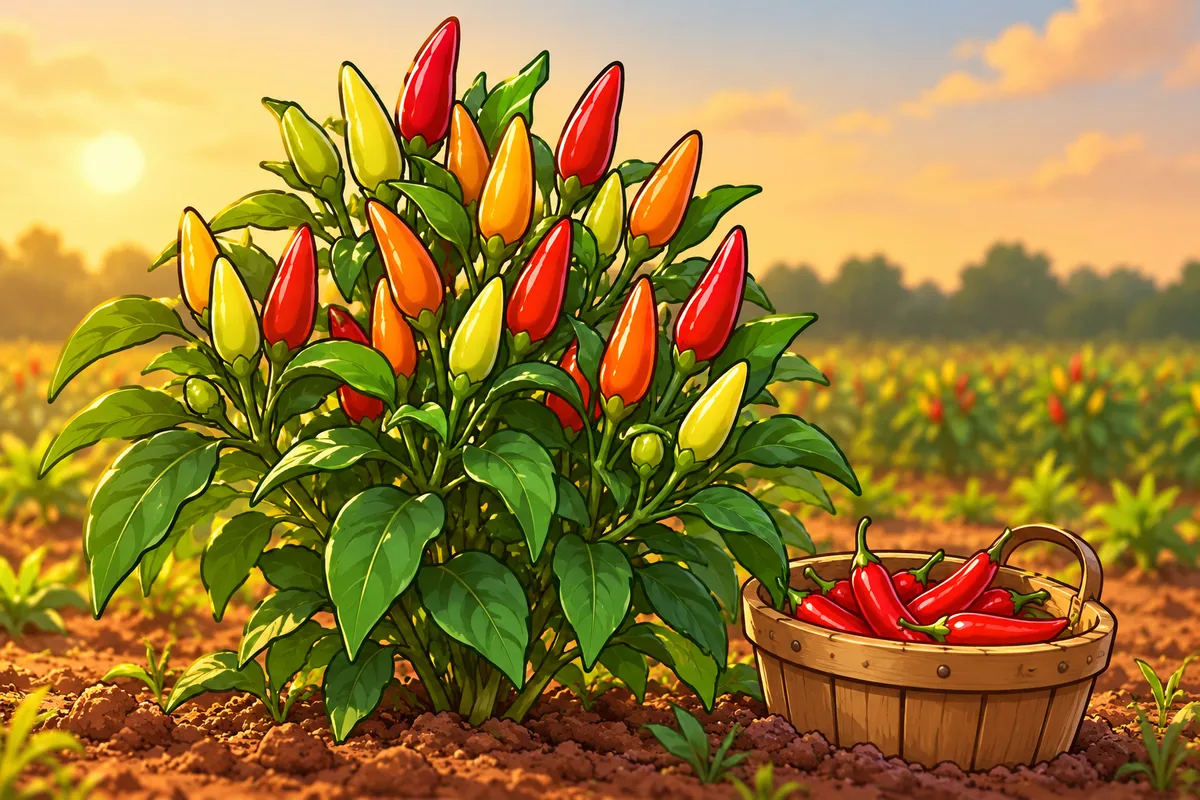
For you as a grower, the upright habit has one practical upside. You can see every ripe pod from above, so picking the red ones and leaving the rest takes a quick pass rather than a search under the leaves. Birds feel no burn from capsaicin5, so in an open garden they may find those red pods before you do.
What colors does a tabasco pass through as it ripens?
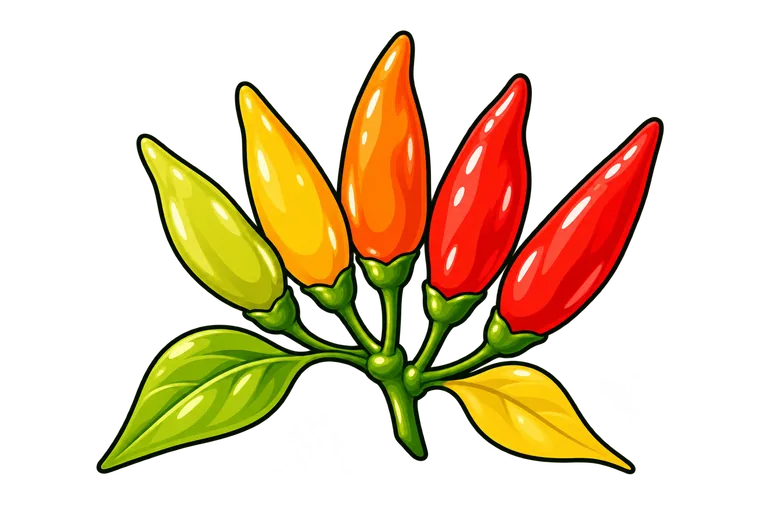
Four, in order. UF/IFAS describes tapered fruits about 1.5 inches long that start pale yellowish-green, turn yellow and orange, and ripen to bright red, with fully mature fruit about 80 days after germination1.
- Day 0
Germination
The seed sprouts; warmth speeds the plant along.1
- Early fruit
Pale yellow-green
Pods set pointing up, tapered, about 1.5 inches long when full size.1
- Turning
Yellow, then orange
Color moves through yellow and orange; the pods are edible but not finished.1
- About day 80
Bright red
Fully mature fruit, the stage that goes into sauce.1
Because pods set over many weeks, one plant shows you all four colors at once. If you want a mash or sauce with an even red color, pick only the red pods and come back every few days for the rest.
Where does the tabasco pepper come from?
The name points to the Mexican state of Tabasco, according to UF/IFAS1. Its species, C. frutescens, ranges through lowland tropical America from Brazil to Central America and the West Indies2.
Today you'll find the cultivar growing commercially in Louisiana, which the monograph singles out alongside Brazil's malagueta as the two best-known frutescens crops2. The malagueta is a close cousin you may meet in Brazilian or Portuguese shops.
What does a fresh tabasco taste like?
UC Master Gardeners in Ventura County describe tabascos as having a distinct smoky flavor and say they're quite hot3. The pods are thin and juicy, so you get the heat almost at once, then a sharp, bright finish.
That juiciness is why the pod suits liquids. Chopped into a dry rub it clumps; steeped in vinegar or blended into a sauce it spreads evenly through every spoonful.
The smoky note pairs well with the foods that already sit next to a bottle of pepper sauce in the South: slow-cooked greens, red beans, oysters, fried fish. If you're building a sauce of your own, a tabasco gives you sharp heat and smoke, so you can leave out liquid smoke and keep the ingredient list short. Taste a thin slice raw before you decide how many pods to use, because one plant's crop can run hotter than the next.
- Smoky
- Sharp
- Hot
What happens to tabasco pods between field and bottle?
The sauce named after the pepper uses three ingredients and a long wait. McIlhenny Company says the pepper mash ages for up to three years in white oak barrels before vinegar goes in6.
- Pick deep red podsOnly ripe fruit goes in
- Mash with saltPeppers and salt, nothing else yet
- Age in oak barrelsUp to three years, tops sealed with salt
- Blend with vinegarDistilled vinegar, 28 days
- Strain and bottleSeeds and skins come out
The company reuses old bourbon barrels and seals each barrel top with salt as a protective layer6. If you want to try a small version of this at home with your own pods, the general method for any pepper, with salt ratios and jar choices, lives on the pepper mash page.
Eater filmed this 2019 tour of the Tabasco factory in Louisiana, so you can watch how the mash, barrels and bottling lines look at full scale, which shows the same steps as the flow above with a company's own equipment.
How do you cook with fresh tabasco peppers?
Treat them as a liquid seasoning, and you'll rarely go wrong. UF/IFAS lists two classic uses, the sauce and peppered vinegar1, and both tell you where the pod shines. The amounts here are kitchen starting points, not sourced rules.
- Pepper vinegar: fill a small bottle a third full with whole pods, top it up with hot vinegar, and let it sit in the fridge for a week. Shake a few drops over greens, beans or rice. The hot pepper vinegar page covers jar choice and how long it keeps.
- Fresh table sauce: blend six or eight red pods with a pinch of salt and enough vinegar to loosen it. Use it the same week.
- Gumbo, beans and stews: drop one or two whole pods into the pot while it simmers, then fish them out before you serve.
- Salsa: one finely minced pod per bowl for four people, tasted after five minutes.
If you only have green or orange pods, cook with them anyway. They're hot; they just lack the full color and some of the depth of a red one. A mix of colors in one jar of vinegar looks good on your table and tastes fine, so an early harvest never goes to waste.
Can you grow tabasco peppers in a pot?
Yes, as long as you give it heat and room. The plant grows bushy and can reach about 60 inches, and it develops fastest between 80°F and 85°F1.
Commercial growers trim the plants to make them sturdier1, and you can do the same on a pot plant: pinch the tips once or twice early in the season so it branches instead of growing tall and floppy. A large pot on your sunniest patio suits it better than a small one on a windowsill. The tabasco grow guide covers seed starting, pot size and how long the season runs in cooler zones.
What goes wrong with tabasco peppers?
Most trouble comes from impatience or bare hands. Here are the problems you're likely to meet in your kitchen and your garden, each with its fix.
Problems and fixes
- Your sauce turned out orange-brown: you used pods that hadn't reached red. Pick only fully red fruit for a red sauce.1
- Your fingers burn after chopping: Poison Control advises rubber, latex or nitrile gloves, and lists warm water, vegetable oil or diluted vinegar soaks for skin.8
- Pepper juice in an eye: rinse with plenty of warm water for 15 minutes.8
- The plant is tall, thin and floppy: pinch the tips early so it branches, as commercial growers do by trimming.1
- Birds take the ripe pods: they don't feel capsaicin, so drape a light net over the plant once fruit turns red.5
If anyone has trouble breathing or chest discomfort after eating hot peppers, call 911; for anything else that doesn't settle, Poison Control in the US is at 1-800-222-12228.
Should you buy tabasco pods, a plant or a packet of seeds?
Pick by how soon you want to cook and how much space you have. Fresh pods are rare in most supermarkets, so many people who want real tabasco end up growing it.
| If you want | Choose | What it takes |
|---|---|---|
| Pepper vinegar this week | Fresh or frozen pods | A specialty grocer, a farmers market in late summer, or a friend's plant |
| Pods this summer with little effort | A nursery plant | A big pot, full sun and 80–85°F days for the fastest growth 1 |
| The cheapest route and the most pods | Seeds | About 80 days from germination to ripe fruit, so start early 1 |
A single healthy plant gives you far more pods than one person can cook with fresh, which is why the vinegar and mash methods exist. If you plan for that surplus from the start, you'll have bottles ready by the time the first cold night arrives. If you only want a taste, ask at a farmers market near the end of summer; growers with a few tabasco plants usually have more red pods than they can sell.
When you do get fresh pods, you'll notice they bruise and soften faster than a thick-walled pepper. Use them within a few days, or freeze them whole on a tray and bag them once they're hard.
Is a tabasco the same as a cayenne?
No. Tabasco is C. frutescens with upright pods, cayenne is C. annuum with long hanging ones, and their heat ranges overlap at 30,000 to 50,000 SHU1. The tabasco and cayenne comparison sets them side by side for sauce and for the garden.
What to do next with tabasco peppers
If you have fresh pods, start a small bottle of pepper vinegar tonight; it's the easiest way to learn how this pepper tastes over a week. If you can't find tabasco pods at all, the tabasco pepper swap list gives you other chiles and the amounts to use in their place.
Related peppers
Published ranges.1
Related in Peppers
-
Count Dracula Pepper Heat, 25,000–50,000 SHU on Black Leaves
A compact hot pepper grown for its near-black foliage, with pods that ripen from black to blood red.5 min read -
Siling Labuyo, the Philippine Wild Chili Sold at ₱800 a Kilo
The Philippines' everyday wild chili: soaked in cane vinegar, cooked into stews, and even eaten as a leaf.6 min read -
Jalapeño Scoville, 2,000–8,000 SHU and Chipotle
The medium-heat chile most heat comparisons start from.6 min read -
Thai Chili Pepper Scoville, 50,000–100,000 SHU
A small, sharp chile about an inch long, also sold as bird's eye.6 min read -
Chiltepin Heat, 70,000–160,000 SHU in a Pea-Sized Wild Pod
The wild bird pepper of Sonora, Arizona and Texas, picked from shrubs that grow under desert trees.6 min read -
Cherry Pepper Scoville, 0 SHU Sweet to Hot
A small round pepper, sweet or hot, grown for jars and stuffing.6 min read
Sources
· 8
- 1University of Florida IFAS Extension HS-859/TR010: Pepper Production in Miami-Dade County, Florida
- 2PhytoKeys 200:1-423 (Pensoft) Monograph of wild and cultivated chili peppers (Capsicum L., Solanaceae)
- 3University of California Agriculture and Natural Resources, UC Master Gardeners of Ventura County Ventura Garden to Table Series: Peppers
- 4UF/IFAS Gardening Solutions Peppers by Scoville Units
- 5Cell 108(3):421-430 Molecular basis for species-specific sensitivity to "hot" chili peppers (Jordt and Julius)
- 6McIlhenny Company (TABASCO brand) About Our Barrels
- 7Eater How the Tabasco Factory Makes 700,000 Bottles of Hot Sauce Per Day (Dan Does)
- 8National Capital Poison Center (Poison Control) Capsaicin: when the chili is too hot