
Tabasco Pepper vs Cayenne, 2 Species, Same 50,000 SHU Top
Two red peppers with the same ceiling and different family trees.
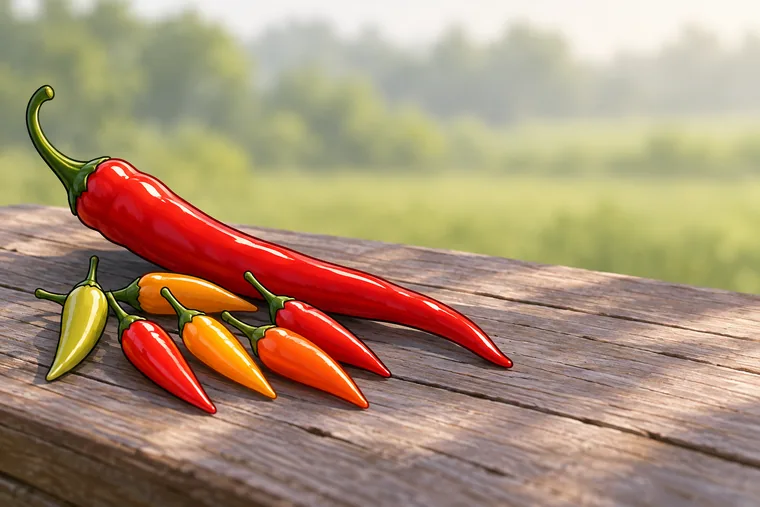
They are different peppers with almost the same heat: tabasco is Capsicum frutescens, cayenne is Capsicum annuum.
- Tabasco 30,000–50,000 SHU; cayenne 25,000–50,000 SHU
- Tabasco pods grow upright and ripen through yellow and orange to red
- TABASCO Original Red sauce rates 2,500–5,000 SHU, about a tenth of the pepper
Log scale; bars are published ranges.1
On this page
- 1Are tabasco peppers and cayenne peppers the same?
- 2Which is hotter, tabasco or cayenne?
- 3How do you tell a tabasco plant from a cayenne plant?
- 4Does a second source agree?
- 5Why is Tabasco sauce so much milder than the pepper?
- 6How is a tabasco pepper turned into Tabasco sauce?
- 7Which cayennes go into hot sauce mash?
- 8How do the two plants grow?
- 9Can you swap tabasco peppers for cayenne?
- 10Can you make peppered vinegar at home?
- 11Why does a fresh tabasco pod burn more than the bottle suggests?
Are tabasco peppers and cayenne peppers the same?
No, but they burn almost alike on your tongue. UF/IFAS puts the tabasco pepper at 30,000 to 50,000 SHU and the cayenne at 25,000 to 50,0001. The plants belong to different species: tabasco is a variety of Capsicum frutescens, cayenne a cultivar of C. annuum.
Tabasco pepper
Cayenne
Log scale; bars are published ranges.1
Same ceiling, different plant: both stop at 50,000 SHU, and only the species and the pods tell them apart1.
Which is hotter, tabasco or cayenne?
Tabasco, by a hair you won't notice. Its midpoint is 40,000 SHU against cayenne's 37,5001, about 7 % more. In a dish you would not taste that difference, and two pods from the same plant can differ by more.
The bigger difference for you is the bottom of the range. A mild cayenne can drop to 25,000 SHU, while UF/IFAS gives no tabasco below 30,0001.
How do you tell a tabasco plant from a cayenne plant?
Look at which way the pods point when you walk up to the plant. UF/IFAS Gardening Solutions says tabasco pods remain upright when they mature instead of hanging down from their stems2, and the genus monograph lists erect fruit stalks as a trait of C. frutescens3.
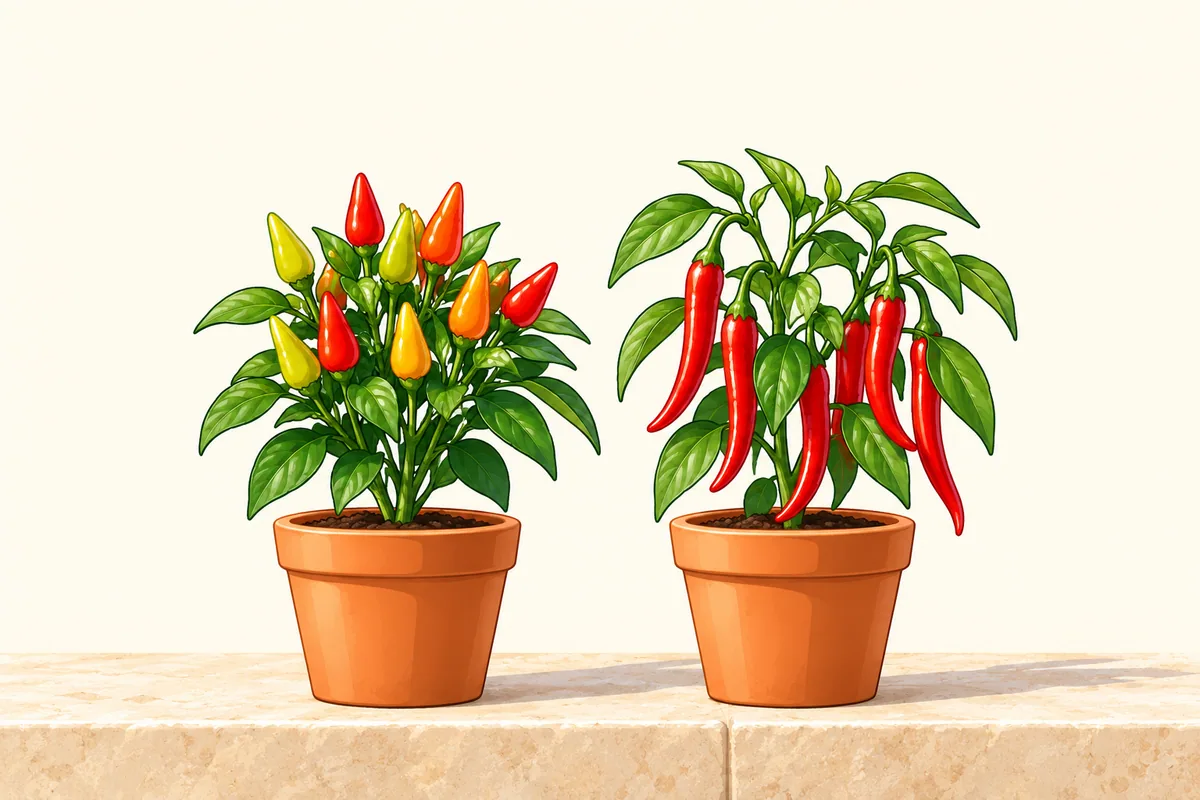
Color helps you too. Tabasco pods pass through pale yellow-green, yellow and orange before they turn bright red, while UF/IFAS describes cayenne simply as red1. If you see a yellow or orange pod on the bush, you are looking at tabasco.
Does a second source agree?
Yes, and it puts them even closer for you. Texas AgriLife lists tabasco at 30,000 to 50,000 SHU, the same as UF/IFAS, and gives cayenne an average of 35,0005. That makes tabasco about 1.1 times cayenne by midpoint (40,000 against 35,000), a gap you will never taste in your food.
So you can treat the two as the same heat and choose by the pod, the plant and the sauce you want.
Why is Tabasco sauce so much milder than the pepper?
Because vinegar and salt dilute the pepper. McIlhenny lists three ingredients and rates the sauce at 2,500 to 5,000 SHU6, about a tenth of the 30,000 to 50,000 SHU of the pepper itself.
| TABASCO Original Red | Frank's RedHot Original | |
|---|---|---|
| Pepper | Aged red peppers (the maker's page names no variety) | Aged cayenne red peppers |
| Other ingredients | Salt from Avery Island, Louisiana; distilled vinegar | Distilled vinegar, water, salt, garlic powder |
| Aging | Mash in white oak barrels for up to three years, then blended with vinegar for 28 days | Not stated |
| Heat on the label | 2,500–5,000 SHU | "Medium heat", no SHU |
The pepper name and the sauce brand share a word, and the genus monograph ties them together: it names tabasco peppers, a varietal of C. frutescens, as the base of the famous sauce, and Louisiana as the place where farms grow the cultivar commercially3.
How is a tabasco pepper turned into Tabasco sauce?
Slowly, far more slowly than you would make a sauce at home. McIlhenny describes a process that takes years, not days, from the field to your table7:
- Pick by handOnly once the peppers reach a deep red
- Mash the same dayMixed with a small amount of salt
- Fill white oak barrelsOn Avery Island, Louisiana; the tops sealed with salt
- Age up to three yearsThe mash matures in the barrel warehouse
- Blend with vinegarDistilled vinegar, blended in for 28 days
- Strain and bottleRated 2,500–5,000 SHU on the label
The aging step is what sets this style apart from a sauce you blend from fresh pods and bottle the same week. A Louisiana-style sauce starts from an aged pepper mash and vinegar, and you can try a small version yourself as a fermented mash in a jar. Frank's RedHot also lists aged cayenne peppers8, so both peppers can make this kind of sauce; the label tells you which one you are tasting.
For scale, UF/IFAS notes the ghost pepper's 1,041,427 SHU record is about 401.5 times the heat of Tabasco sauce1. The bottle is gentle because vinegar dilutes the pepper; the fresh pod you pick still runs 30,000 to 50,000 SHU1.
Which cayennes go into hot sauce mash?
Cultivars bred for the job, and they run milder than you might guess. NMSU released NuMex Nematador in 2003 as a cayenne for hot sauce production, at 15,000 SHU and 5.8 inches long, with resistance to the southern root knot nematode4. NuMex Las Cruces followed in 2010 for the cayenne mash industry, at 17,400 SHU, about 6.7 inches and 1 ounce per pod, with high resistance to beet curly top virus.
That changes the comparison for sauce makers. Against those mash cayennes, a 40,000 SHU tabasco midpoint1 is more than twice as hot, so a tabasco mash and a cayenne mash of the same weight do not give you the same bottle. If you ferment your own, you can use about half as much tabasco to match a Las Cruces mash, or keep the weight and expect a hotter sauce.
The bottled cayenne sauce on most shelves does not help you here, since its maker gives no SHU and calls it medium heat8. The tabasco side is easier to pin down: Texas AgriLife and UF/IFAS both put the fresh pepper at 30,000 to 50,000 SHU15, so you can plan a tabasco mash with more confidence than a cayenne one. With a cayenne, you only learn the heat of your batch once you taste the mash, so you hold back some vinegar and adjust at the end.
How do the two plants grow?
If you grow both, the tabasco plant is the taller and quicker one. UF/IFAS says it can reach about 60 inches, grows fast at 80–85°F, and has fully mature fruit about 80 days after the seed sprouts; the cayenne grows 2 to 4 feet and takes about 100 days1.
The tabasco grows into a bush with cream or light yellow flowers, and commercial growers trim the plants to make that bushy growth stronger1. You can trim your own plant the same way. Because the pods point up, you can also see every color on the bush at once, which makes it easy to pick only the red ones, the way McIlhenny does7.
Can you swap tabasco peppers for cayenne?
You will notice a difference in form more than in heat. Cayenne usually comes dried as powder or flakes1, while tabasco pods are small and fresh, so if your recipe wants cayenne powder you can dry and grind tabasco pods, or simply use the powder. When you want a real step up from either, the habanero runs about six times hotter than cayenne by midpoint1.
Can you make peppered vinegar at home?
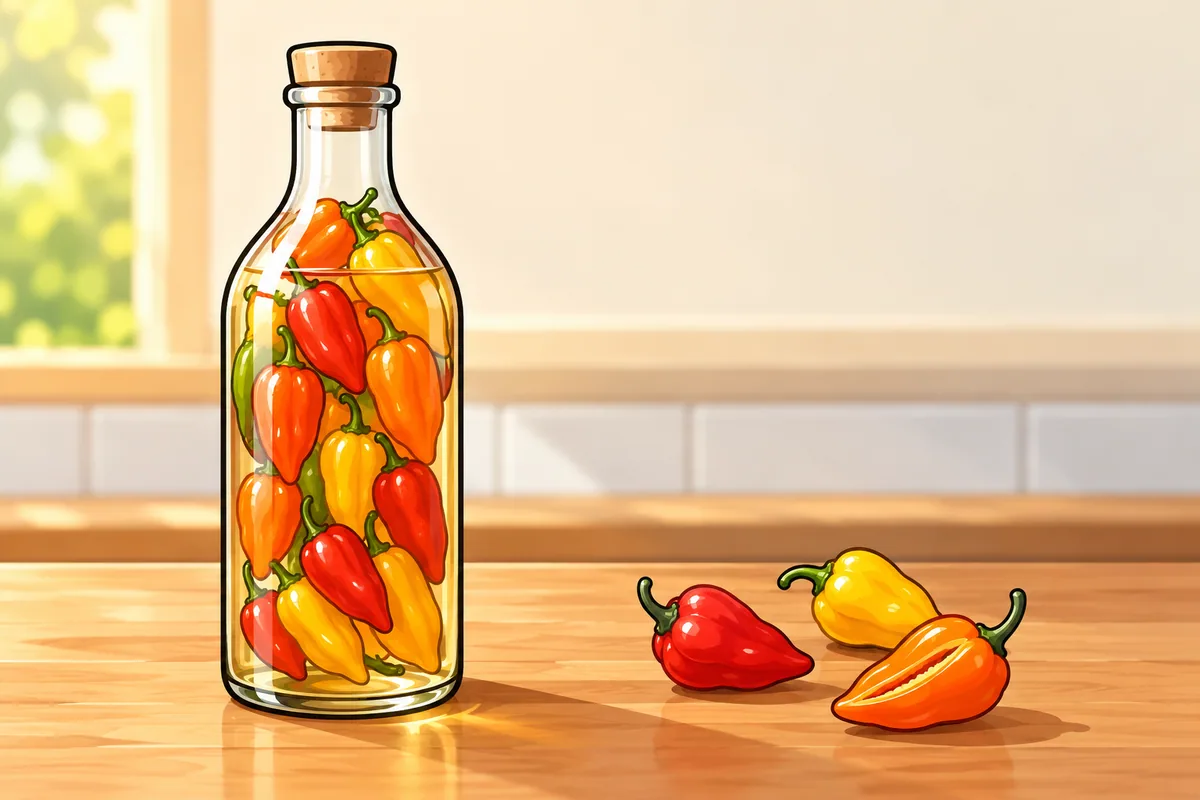
Yes, if you keep it in the fridge. UF/IFAS names peppered vinegar as one of the tabasco pepper's classic uses1: you pack small fresh pods into a bottle and cover them with vinegar, and the vinegar takes on the heat.
Cayenne pods work in a pepper vinegar too, but they are long, so you slice them. A 1.5-inch tabasco pod1 fits through a bottle neck whole, so you skip the knife.
Why does a fresh tabasco pod burn more than the bottle suggests?
Mistakes and the fix
- Judging pepper heat by the sauce. Tabasco sauce runs 2,500–5,000 SHU, about a tenth of the fresh pod, so a fresh tabasco pepper is far hotter than the bottle suggests.16
- Counting pods in a swap. A tabasco pod is about 1.5 inches and NMSU's cayennes run 5.8–6.7 inches; match by weight.14
- Seeding the pods and leaving the ribs. About 89 % of the capsaicin sits in the pale placenta, so cut that out if you want less heat.10
- Cutting a big batch bare-handed. Wear rubber, latex or nitrile gloves and keep your hands away from your eyes.11
Related in Compare
-
Habanero vs Cayenne Pepper, About 6× Hotter
Two different species, and a gap between their ranges.5 min read -
Cayenne vs Jalapeño, 7.5× the Heat and Swaps
One usually ends up in a jar of powder, the other in a fresh salsa.6 min read -
Cayenne vs Thai Chili, Why the Smaller Pod Is 2× Hotter
Same species on most lists, double the heat, a sixth of the length.5 min read -
Cayenne Pepper vs Kashmiri Chilli, Heat and Color Data
A deep red chilli from the north of India against the red pepper in every spice rack.6 min read -
Pimento vs Cherry Pepper, 0 SHU Against Up to 500 or More
Two red peppers people mix up, one always sweet and one that can surprise you.6 min read -
Ghost Pepper vs Habanero, Why the Ghost Is 2.8× Hotter
Same species, very different numbers.6 min read
Sources
· 11
- 1University of Florida IFAS Extension HS-859/TR010: Pepper Production in Miami-Dade County, Florida
- 2UF/IFAS Gardening Solutions Peppers by Scoville Units
- 3PhytoKeys 200:1-423 (Pensoft) Monograph of wild and cultivated chili peppers (Capsicum L., Solanaceae)
- 4New Mexico State University, Agricultural Experiment Station (Research Report 792) The Chile Cultivars of New Mexico State University Released from 1913 to 2016 (Coon and Bosland)
- 5Texas AgriLife Extension Service (Joe Masabni) Jalapeño & Other Hot Peppers
- 6McIlhenny Company (maker of TABASCO, own product) TABASCO Brand Original Red Sauce
- 7McIlhenny Company (maker of TABASCO, own product) About Our Barrels
- 8McCormick (maker of Frank's RedHot, own product) Frank's RedHot Original Cayenne Pepper Hot Sauce
- 9Penn State Extension Preserving Those Colorful Garden Peppers (Martha Zepp)
- 10Heliyon (Cell Press) A comprehensive review of capsaicin: Biosynthesis, industrial productions, processing to applications, and clinical uses
- 11National Capital Poison Center (poison.org) Capsaicin: When the Chili Is Too Hot (Amanda McDaniel-Price, RN)