
Ghost Pepper vs Habanero, Why the Ghost Is 2.8× Hotter
Same species, very different numbers.
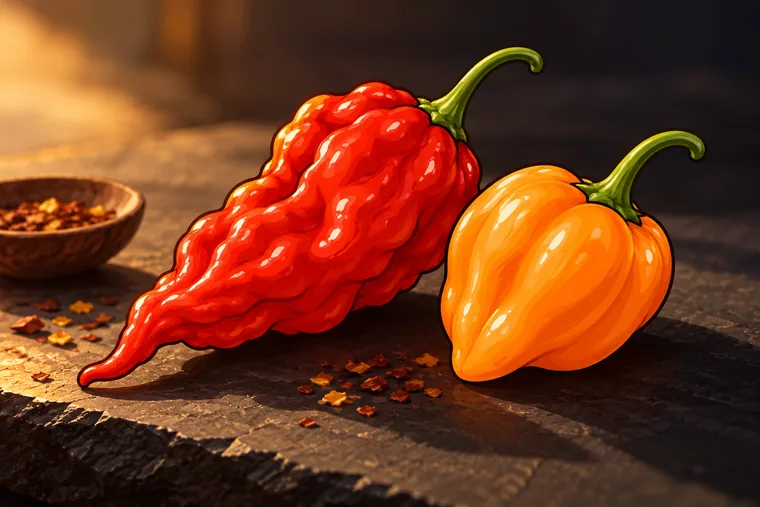
The ghost pepper is hotter: about 2.8 times in a same-field test, 3 to 10 times against the habanero range.
- Ghost pepper 1,001,304 SHU (lab mean); habanero 100,000–350,000 SHU
- Both are Capsicum chinense; the ghost carries a few C. frutescens markers
- Use about a quarter as much ghost pepper when you swap it in
On this page
- 1Is a ghost pepper hotter than a habanero?
- 2How much hotter is a ghost pepper than a habanero?
- 3Why did the record holder test milder than the habanero?
- 4What happens in your mouth when you eat one?
- 5Why do ghost pepper figures differ from lab to lab?
- 6Are ghost peppers and habaneros related?
- 7How do you tell a ghost pepper from a habanero?
- 8How do they taste and what do you cook with them?
- 9How do you handle ghost peppers safely?
- 10Is a ghost pepper harder to grow than a habanero?
- 11How do you cook with a ghost pepper?
- 12Can you use a ghost pepper instead of a habanero?
Is a ghost pepper hotter than a habanero?
Yes, by a wide margin. In a 2005 field trial at Las Cruces, New Mexico, the ghost pepper (Bhut Jolokia) averaged 1,001,304 SHU1. UF/IFAS gives the habanero 100,000 to 350,000 SHU2.
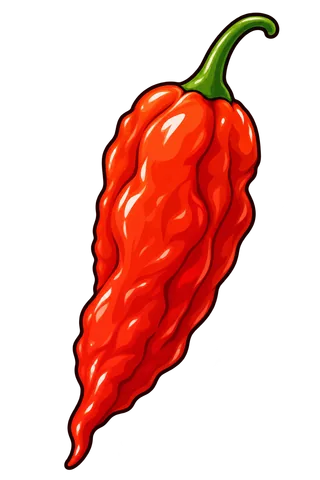
Ghost pepper
Hotter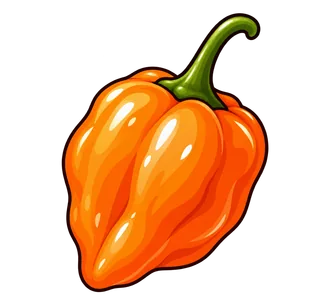
Habanero
Even the hottest habanero on the extension range reaches only about a third of the ghost pepper's lab mean.
How much hotter is a ghost pepper than a habanero?
The fairest answer comes from pods grown in the same field and tested in the same lab. The New Mexico trial ran both side by side, and the ghost pepper came out about 2.8 times hotter than the orange habanero1.
Two commercial labs tested the same ghost pepper powder at 927,199 and 879,953 SHU1. So even the lowest lab reading lands far above any habanero you can buy.
What if you use the habanero range instead?
Against the extension range the gap grows, because the trial habanero ran hotter than the range's top. Here is the arithmetic so you can check it. We use the habanero's midpoint, 225,000 SHU, for the middle row.
| Habanero | Its heat | Ghost pepper is | How we got it |
|---|---|---|---|
| Hot end | 350,000 SHU | about 3 times hotter | 1,001,304 ÷ 350,000 |
| Midpoint | 225,000 SHU | about 4.5 times hotter | 1,001,304 ÷ 225,000 |
| Mild end | 100,000 SHU | about 10 times hotter | 1,001,304 ÷ 100,000 |
You will also see 1,041,427 SHU for the ghost pepper, the figure Guinness certified in 20072, and a rounded 1 million on the NMSU Chile Pepper Institute list3. Any of them gives you roughly the same answer.
Why did the record holder test milder than the habanero?
Because heat depends on where and how your pepper grows. The same 2005 trial included Red Savina, then the Guinness record holder at 577,000 SHU, and in that field it tested 248,556 SHU, below the orange habanero's 357,7291. The authors note that the environment changes a pepper's heat, which is why they grew all three side by side.
That result tells you how to read any ghost-against-habanero number. A record figure comes from the best pod in the best year; your pods come from your plant, your summer and your soil. Compare peppers grown together when you can, and treat a single headline number as the top of what is possible, not what lands on your cutting board.
What happens in your mouth when you eat one?
The same thing you feel with a habanero, only stronger. Capsaicin binds to a pain receptor called TRPV1, calcium floods into the nerve cell, and the cell releases signals your brain reads as burning4.
- Capsaicin reaches the tongueMost of it comes from the pale placenta inside the pod
- It binds TRPV1A receptor on pain-sensing nerve endings
- Calcium rushes inCalcium levels inside the cell rise
- Nerves signal burningThe cell releases neuropeptides
- Milk cools it fastestWhole and skim milk cut the burn most of seven drinks tested
Water does little for you because capsaicin is fat-soluble and does not dissolve in water4. In a 2019 test of seven drinks after a spicy tomato juice, whole milk and skim milk cut the burn the most, which points to milk protein doing the work more than fat5. Pour a glass of milk before you taste either pepper, not after. The science of the burn goes further into why it feels like real heat.
Why do ghost pepper figures differ from lab to lab?
Because each figure comes from a different method, a different batch of pods or both. NMSU's heat guide describes two ways to measure: the old Scoville test, where tasters sip a diluted extract until they can no longer feel heat, which it calls subjective, and HPLC, a lab instrument that costs more but gives an objective reading6. The ghost pepper trial used HPLC like this:
- 1
Harvest a sample
25 random mature fruits from at least 10 plants in each plot, bulked together.1
- 2
- 3
Measure in parts per million
The instrument reports capsaicinoids in parts per million.1
- 4
Convert to Scoville units
The trial multiplied parts per million by 16 to get SHU.1
So when you see 855,000, 879,953, 927,199, 1,001,304 or 1,041,427 SHU for the ghost pepper, you are looking at different labs, samples and years, not a disagreement about which pepper is hotter. Every one of them sits at least 2.4 times above the hottest habanero on the UF/IFAS range, 350,000 SHU2. The 855,000 figure is an earlier Indian report on Naga Jolokia that the NMSU paper cites1.
Are ghost peppers and habaneros related?
Closely. Both belong to Capsicum chinense: the ghost pepper's flowers and the narrow ring under its cap place it there1. Its pods grow 5 to 8 cm long with a wrinkled skin and ripen from green to bright red. The same study found eight C. chinense DNA markers in it and three from C. frutescens, which is why the authors call it a likely natural hybrid.
How do you tell a ghost pepper from a habanero?
Length and skin give it away. A ghost pepper runs about 2.4 to 3.3 inches long and 1 to 1.2 inches wide, with a skin that can be rough, wrinkled, dented or smooth2. A habanero is 0.8 to 2.4 inches long with thin, waxy flesh, so even a big one barely reaches the length of a small ghost.
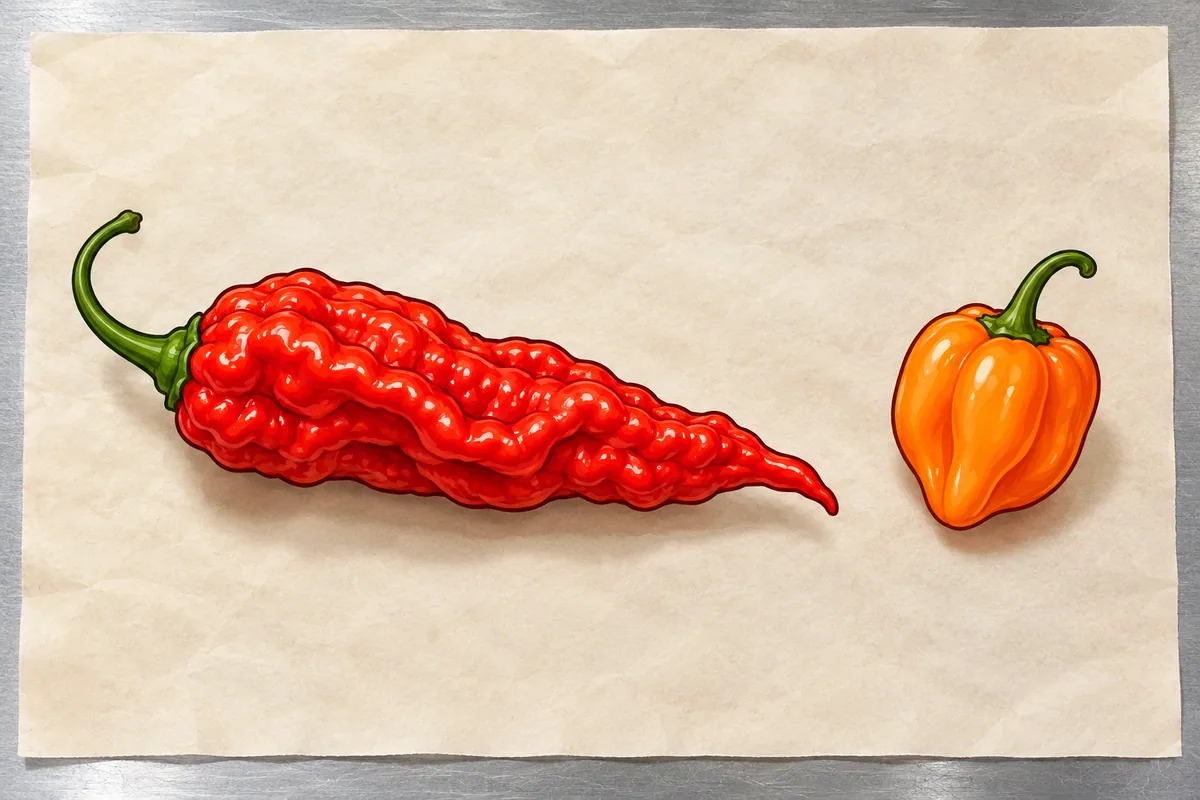
Color will not settle it for you. Ghost peppers ripen red, yellow, orange or chocolate, and habaneros go from green to yellow, orange or red, with white, brown and pink types too2. A wrinkled orange pod could be either, so go by length first.
How do they taste and what do you cook with them?
| Ghost pepper | Habanero | |
|---|---|---|
| Flavor | A unique flavor (no further detail given) | Fruity, citrus-like, with a floral aroma |
| Used for | Spicy food, fresh or dried | Hot sauces and spicy foods |
If you care about flavor, the habanero is the better-documented of the two. If fruit is what you are after in a sauce, that is the one the sources describe, and fruity habanero-type pods are what you taste in Caribbean-style sauces.
How do you handle ghost peppers safely?
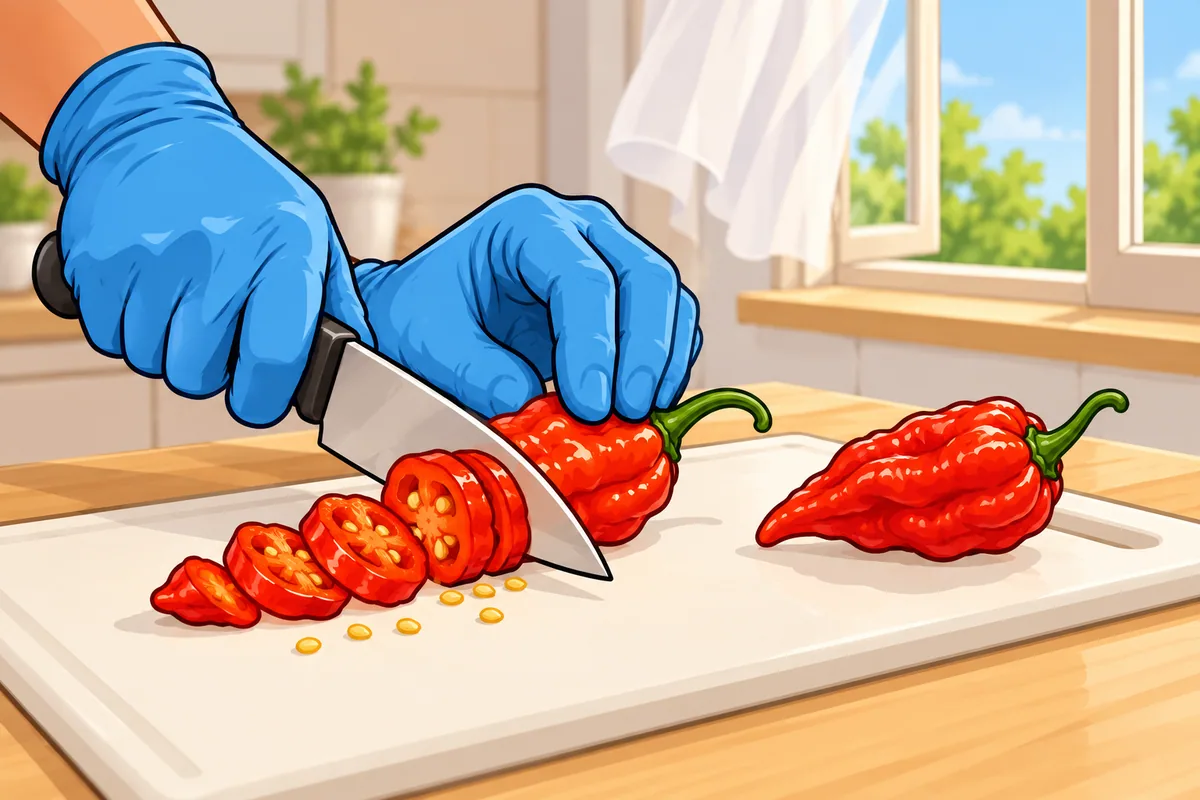
With more care than a habanero, since you are working with about three times the capsaicin. The National Capital Poison Center's advice covers both peppers:
Before and after you cut
- Wear rubber, latex or nitrile gloves, and don't touch your face or eyes until you have taken them off.8
- Open the windows or work with fresh air, since inhaled capsaicin can set off asthma in people who are prone to it.8
- If it gets in your eyes, flush them with plenty of warm water for 15 minutes; cool compresses may help after.8
- If your skin burns, try warm water, vegetable oil, or a soak of diluted vinegar; NMSU also suggests dipping stung hands in vinegar.89
- Call 911 for trouble breathing or chest discomfort, and Poison Control at 1-800-222-1222 for other questions.8
Cut ghost peppers on a board you can wash right away, and clean the knife before you touch anything else. A habanero gives you a little more room for a slip; a ghost pepper gives you less.
Is a ghost pepper harder to grow than a habanero?
Yes. NMSU's Chile Pepper Institute received its first ghost pepper seed in 2001, and poor fruit and seed set meant it took several years to grow enough seed for a field trial1. Habaneros are slow too: Maryland Extension gives habanero types 90 to 120 days from transplanting10.
The NMSU team raised its trial plants like this, and you can copy the numbers at home:
- 1
Start seed warm
Two seeds per cell in a greenhouse at 27°C by day and 18°C at night, with a 12-hour day; thin to one plant per cell after germination.1
- 2
Feed and water
A slow-release fertilizer in each cell, and water twice a day.1
- 3
Transplant at 8 to 10 true leaves
Set the plants 25 cm apart in single rows 1 m apart.1
- 4
Pick when fully ripe
The trial harvested mature fruit once, after the pods had ripened from green to bright red on the plant.1
At home, that means starting your ghost pepper seeds early and warm, and giving the plant the longest, hottest part of your summer. If you have grown a Carolina Reaper, you already know the super-hot timeline; the ghost follows the same slow pace.
How do you cook with a ghost pepper?
In tiny amounts, fresh or dried. UF/IFAS says the ghost pepper goes into spicy food in both forms, has a unique flavor, and that its dried powder is strong enough to be made into pepper spray2. That last fact tells you how to treat a jar of ghost powder in your kitchen.
Dilute it on purpose. Say a habanero salsa uses 6 g of habanero. At about 2.8 times the heat in the same-field trial1, about 2 g of ghost pepper matches it. In a pot of chili for eight, that is a sliver of one pod or a small pinch of powder, so you add it early, stir well, and taste before you add any more.
A habanero is the easier pepper to cook with day to day. Its range gives you a fruity heat that a recipe can carry at a whole pod, while a whole ghost pepper in the same pot takes over the dish.
Can you use a ghost pepper instead of a habanero?
Swapping the other way is easier: about three habaneros stand in for one ghost pepper and bring more fruit with them. If even a habanero is too much for you, a serrano sits about 13 times below it by midpoint2, and the serrano against the habanero shows the swap amounts.
Related in Compare
-
Serrano vs Habanero, the Habanero Is About 13× Hotter
A salsa chile against a hot sauce chile.6 min read -
Habanero vs Thai Chili, Why the Habanero Is 3× Hotter
A tiny hot chili against a fruity extra-hot one.5 min read -
Habanero vs Jalapeño, About 45× the Heat by Midpoint
The pepper you know against the one that scares people.7 min read -
Chile Manzano vs Habanero, Close in Heat at 175,000 SHU
An apple-shaped mountain chile and a lantern-shaped lowland one, about as hot as each other.6 min read -
Scotch Bonnet vs Ghost Pepper, the Ghost Runs 2.9× Hotter
Two Capsicum chinense peppers, a Caribbean staple and an Indian record holder.6 min read -
Scotch Bonnet vs Habanero, Same Range, 1.4× Lab Gap
Two Capsicum chinense pods, one heat band, two different kitchens.5 min read
Sources
· 10
- 1HortScience 42(2):222-224 'Bhut Jolokia', the world's hottest known chile pepper, is a putative naturally occurring interspecific hybrid (Bosland and Baral)
- 2University of Florida IFAS Extension HS-859/TR010: Pepper Production in Miami-Dade County, Florida
- 3New Mexico State University, Chile Pepper Institute Heat
- 4Heliyon (Cell Press) A comprehensive review of capsaicin: Biosynthesis, industrial productions, processing to applications, and clinical uses
- 5Physiology & Behavior 208:112557 Putting out the fire: Efficacy of common beverages in reducing oral burn from capsaicin (Nolden, Lenart, Hayes)
- 6New Mexico State University Cooperative Extension Service (Guide H-237) Measuring Chile Pepper Heat (Bosland, Walker)
- 7UF/IFAS Gardening Solutions Peppers by Scoville Units
- 8National Capital Poison Center (poison.org) Capsaicin: When the Chili Is Too Hot (Amanda McDaniel-Price, RN)
- 9New Mexico State University Cooperative Extension Service (Guide E-324) Processing Fresh Chile Peppers (revised by Nancy C. Flores)
- 10University of Maryland Extension Growing Peppers in a Home Garden