On this page
- 1How long does a Carolina Reaper take to grow?
- 2What do seed sellers say about the Reaper?
- 3When should you start Carolina Reaper seeds?
- 4Does your summer have 120 days left after you plant out?
- 5How do you germinate Carolina Reaper seeds?
- 6What goes wrong in a Reaper seed tray?
- 7Can you grow a Carolina Reaper in a pot?
- 8Should you prune a Carolina Reaper?
- 9Should you grow a Reaper or start with a habanero?
- 10Why is my Reaper flowering but not setting pods?
- 11How hot is a Carolina Reaper, and how do you pick it?
- 12Will your homegrown Reaper reach the record heat?
- 13What do you do when a Reaper burns your skin or eyes?
- 14When is a Reaper pod ripe, and how do you store it?
- 15Can you save seeds from your Reaper?
- 16How does a Reaper season run, start to finish?
- 17Your Reaper season, at a glance
- 18Sources
How long does a Carolina Reaper take to grow?
About 27 to 32 weeks from sowing to your first ripe pod, if you sow 12 weeks before your last frost, as the plan below does. The Carolina Reaper is a Capsicum chinense1, the habanero's species, and UMD Extension gives 90 to 120 days from transplant for habanero types2.
| Stage | The number | Based on |
|---|---|---|
| Species1 | Capsicum chinense | The Reaper by name |
| Bred from3 | Sweet Habanero × Naga Viper, stabilized over ten years by Ed Currie in South Carolina | The Reaper by name |
| Start seeds indoors2 | 8–10 weeks before the last frost; some types need 12 | All peppers |
| Germination45 | Heat mat at 80–90°F until seedlings show; 70–85°F soil is the best range | All peppers |
| Time to come up5 | 8–25 days | All peppers |
| Plant out45 | 2–3 weeks after the last frost, soil at least 60°F, nights above 50°F | All peppers |
| Pot size26 | 5 gallons minimum, 12–18 inches deep | All peppers |
| Transplant to ripe2 | 90–120 days | Habanero types |
| Flower to full color7 | 35–45 days | All peppers |
Only the first two rows name the Reaper, so you are reading mostly species figures. No extension service publishes a Reaper-only grow schedule, so we plan it on the habanero-type numbers, which come from the same species. The "Based on" column tells you which kind of figure each row is.
What do seed sellers say about the Reaper?
They are the only ones who publish Reaper-only numbers for you, and they run a little longer than the habanero-type plan. Each seller below gives figures for its own seed packet, so read them as a seller's promise, not a measured trial.
| Seller | Days to maturity | Plant height | Time to sprout |
|---|---|---|---|
| West Coast Seeds8 | 120 days from transplant | Not given | 10–21 days at 78–85°F soil; may take 21–28 days or longer |
| Pepper Joe's9 | 110–120+ days | Up to 5 feet | Not given |
| Reimer Seeds10 | 110+ days | 36–48 inches | 14–28 days at 80–85°F soil |
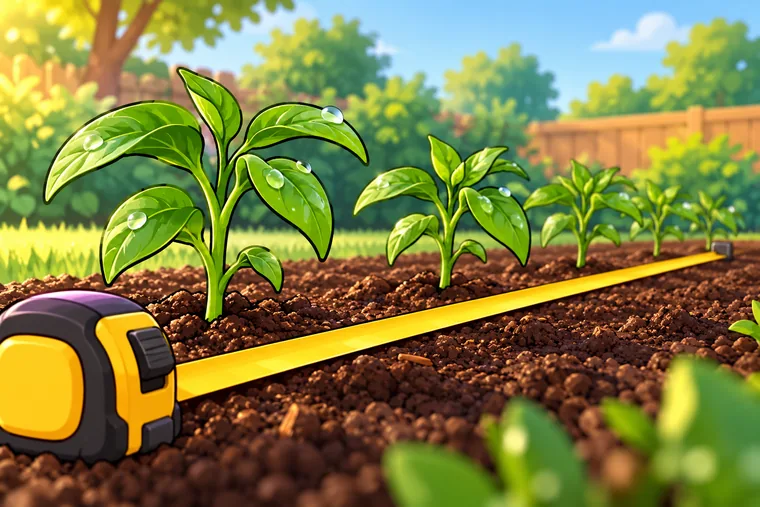
Every seller's figure lands inside or just past the 90–120 day habanero-type range, so the plan below holds; budget for the long end. A 4-foot plant with a heavy load of pods also needs a cage or stake, since UMD Extension says pepper stems turn brittle2. Put the cage in at planting time, while you can still push it in without cutting roots.
When should you start Carolina Reaper seeds?
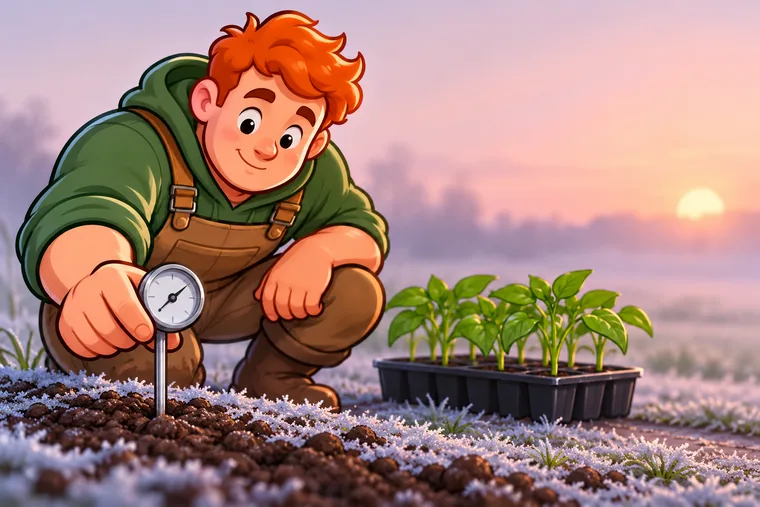
At the long end of the range: about 12 weeks before your last frost. UMD says some types need 12 weeks indoors2; we use that figure for the Reaper because its 90–120 day season leaves you no slack. Here is the plan worked for a last frost on April 20.
- January 26 (12 weeks before)
- Late March to mid-April
Cut back water once plants are 4–5 inches tall and 6–8 weeks old; pinch off any flower buds.4
- Late April to early May
Harden off over a week or two; bring plants in if nights drop below 55°F.4
- May 4–11 (2–3 weeks after)
- August 2 – September 8
First ripe pods, 90–120 days after planting out.2
Compare a jalapeño sown 8 weeks ahead, on February 23. It goes out on the same May dates and gives pods from July 13, 70 to 85 days after transplant2. The Reaper starts four weeks earlier and still finishes three to five weeks later. With a later frost, every date moves with it, and the planting date guide shows the same plan for a May 25 frost.
Does your summer have 120 days left after you plant out?
Count forward from the day you plant out, not from the day you sow. UMD gives 90 to 120 days from transplant for habanero types2, the Reaper's species, so the date your plant goes outside decides the date your pods can turn red. Here is the sum for three plant-out dates, which is our arithmetic from those two numbers:
| You plant out | Earliest ripe pods | Latest ripe pods |
|---|---|---|
| May 15 | August 13 | September 12 |
| May 29 | August 27 | September 26 |
| June 12 | September 10 | October 10 |
Put your own first fall frost date beside the right-hand column. If the frost comes first, you have two moves: gain days, or move the plant. Your growing zone tells you how much room you have. These are the days you can buy, each from an extension source:
Ways to gain days for a slow pepper
- Lay black plastic before planting: it warms the soil 4 to 9°F at 2 inches deep. Press it flat so it touches the ground.1112
- Use bigger transplant cells, 3 to 4 inches, for extra earliness in peppers.11
- Cover young plants with a row cover, which raises daytime air temperature by up to 10°F, and take it off for pollination.12
- Vent slitted covers or open a cold frame on sunny days, because they overheat fast.12
- Ring a young plant with water-filled tubes (Wall O' Water) for frost protection. They cost a lot and take work, so they suit a few plants, which is what a Reaper garden is.12
- Switch to white-on-black plastic from mid-June, because black plastic can pass 140°F at the surface on a hot, clear day and kill stems.13
A Reaper in a pot adds one more move: carry it into the garage the night before a frost, as the pot section says. The plant itself is not the problem. The calendar is, and a 5-gallon pot on a plant caddy gives you the most control over it.
How do you germinate Carolina Reaper seeds?
Sow them shallow, keep them warm and give your seedlings strong light. These steps follow UMN and Utah State Extension, which write them for peppers in general47.
- 1
Sow shallow in sterile mix
Plant seeds one-fourth inch deep in flats of sterile, soilless germination mix.4
- 2
Keep the tray at 80–90°F
Use a heating mat until seedlings come up, and check the mix often: mats dry it out faster.4
- 3
Wait 8 to 25 days
Pepper seedlings come up in that window at a soil temperature of 70–85°F.5
- 4
Move to cooler air and strong light
Grow seedlings on at 65–75°F with lights 2–3 inches above the plants for 14–16 hours a day.7
- 5
Thin at the first true leaves
Space seedlings 2–3 inches apart. Stretched, leaning stems mean the light is too weak or too far away.4
- 6
Feed lightly
Give a half-strength soluble complete fertilizer once a week until planting out.7
Do not give up on your slow tray before day 25. The top of Penn State's range is more than three weeks5, and two Reaper seed sellers quote up to 28 days810.
What goes wrong in a Reaper seed tray?
Mostly heat and light. Your Reaper tray sits for up to four weeks before you know how many seeds took, so small mistakes have a long time to show.
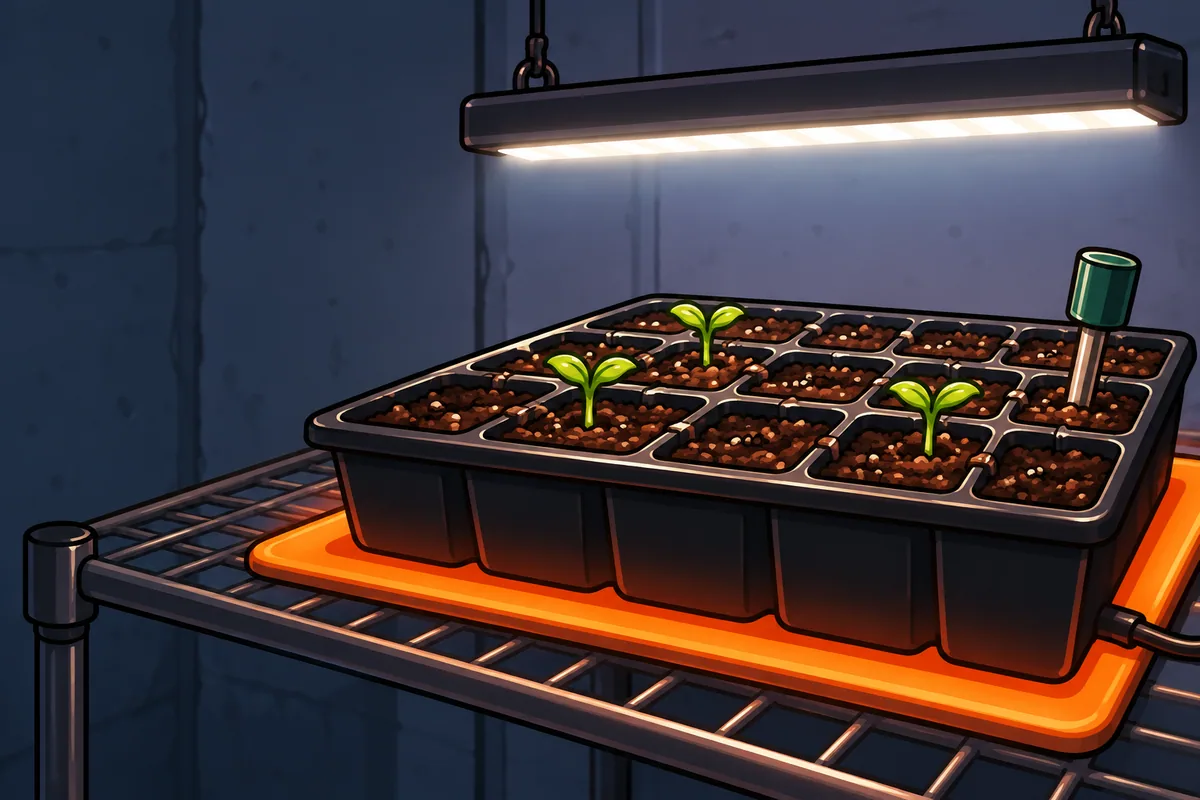
Here are the four problems you are most likely to meet, and the fix for each.
- Nothing up by day 25. Check the mix temperature with a probe. Penn State's best range for pepper germination is 70–85°F5, and the sellers ask for 78–85°F for the Reaper8. A cool windowsill falls short.
- Tall, pale, leaning seedlings. Your light is too far away or too weak. Utah State keeps lights 2 to 3 inches above the plants for 14 to 16 hours a day7.
- Seedlings that fall over at the soil line. That is damping-off. Penn State ties it to cool, wet, poorly draining mix5, and UMD waters only when the top of the mix is nearly dry14.
- Purple leaves on young plants. UMD sees purple leaves on seedlings in cold soil, when small roots cannot take up enough phosphorus, and gives a balanced soluble fertilizer at the root zone15.
Once the first true leaves open, take the tray off the mat. Utah State germinates at 80°F but grows seedlings on at 65 to 75°F7, and a seedling kept hot stretches.
Can you grow a Carolina Reaper in a pot?
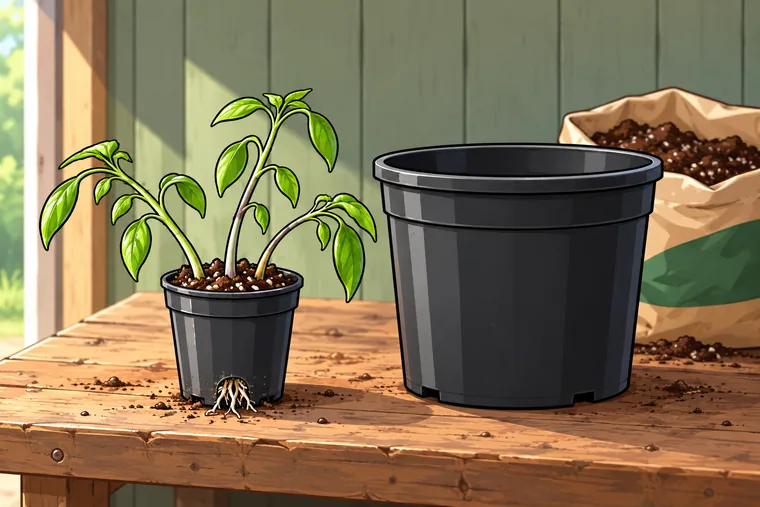
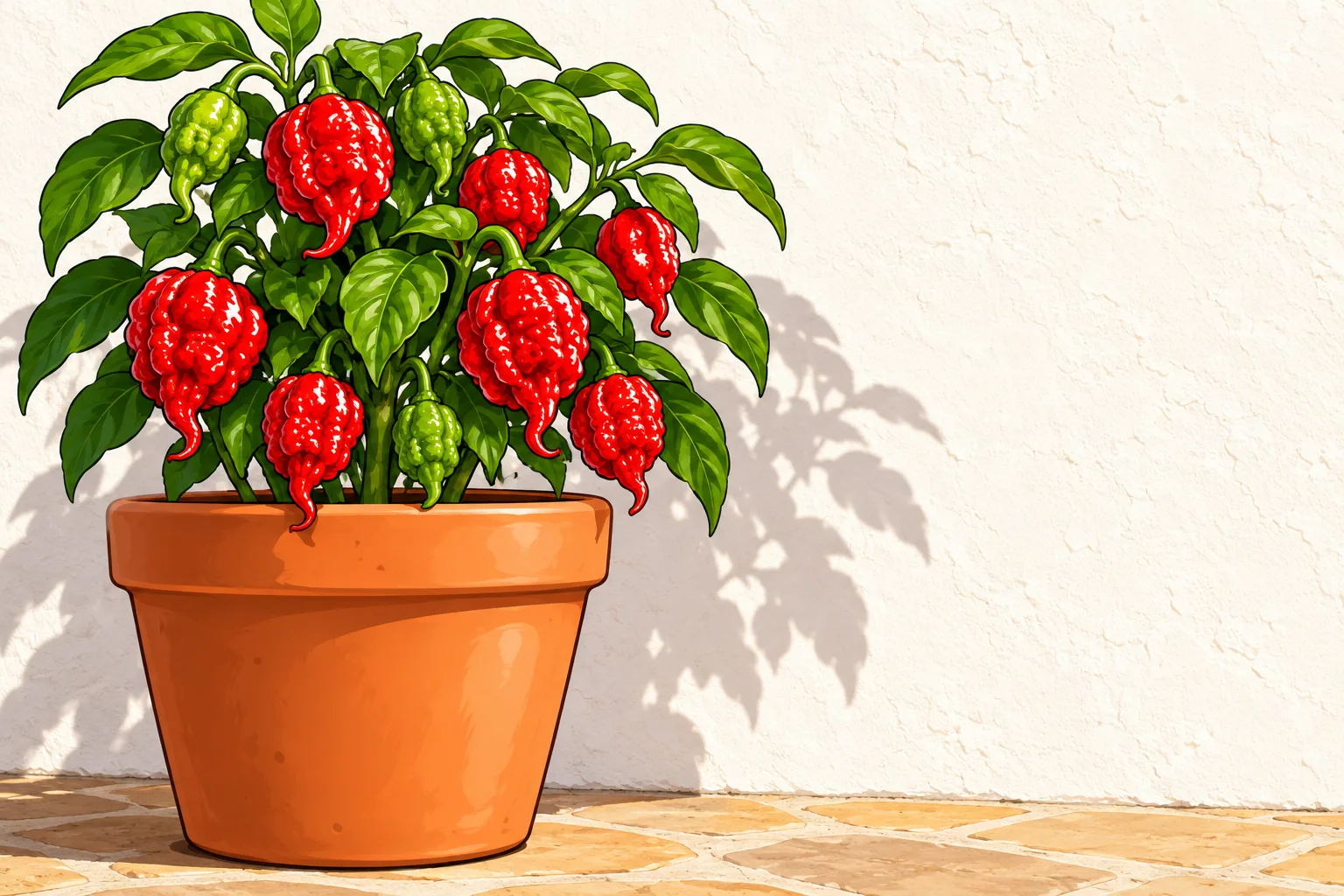
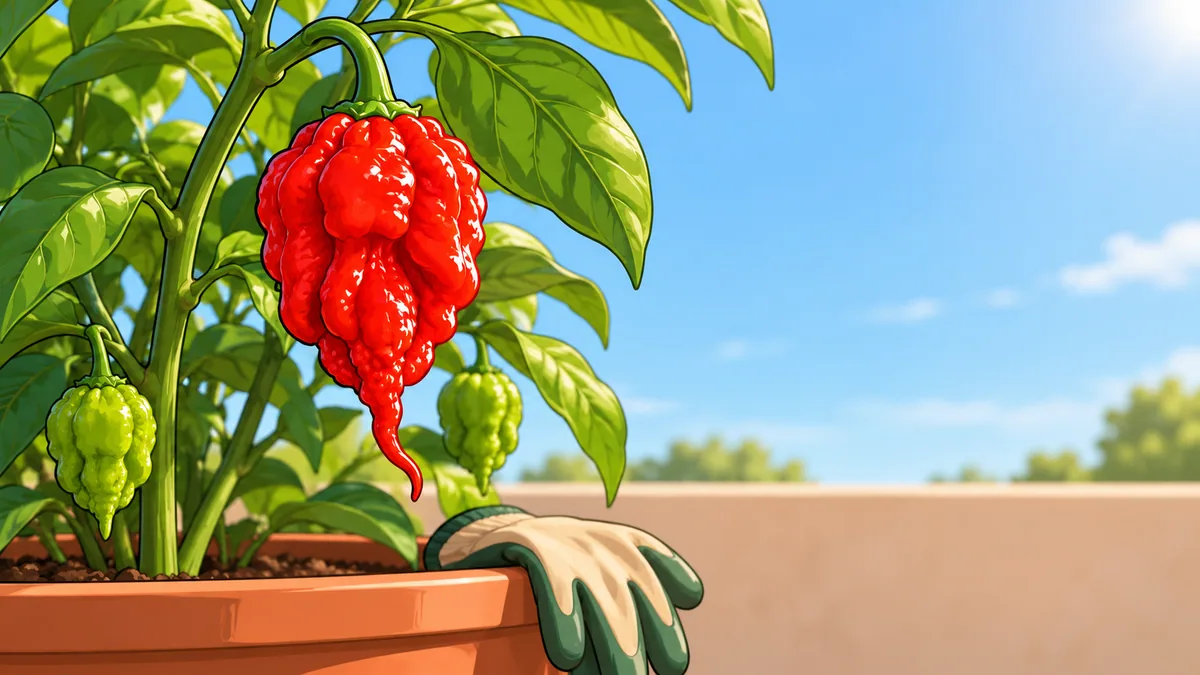
Yes, if you give it at least 5 gallons of potting mix, 12 to 18 inches deep, with a drainage hole26. A pot also lets you carry the plant into the house on a cold spring night, which matters more for a Reaper than for most peppers, because its long season leaves you no week to lose.
Plan on a big plant in your pot. Penn State gives peppers a height of 1.6 to 4.9 feet5, and the Reaper seed sellers quote 36 to 48 inches and up to 5 feet for their own seed910. A tall plant in a light plastic pot tips over in the first summer storm, so a heavier pot or a stake tied to a railing earns its place.
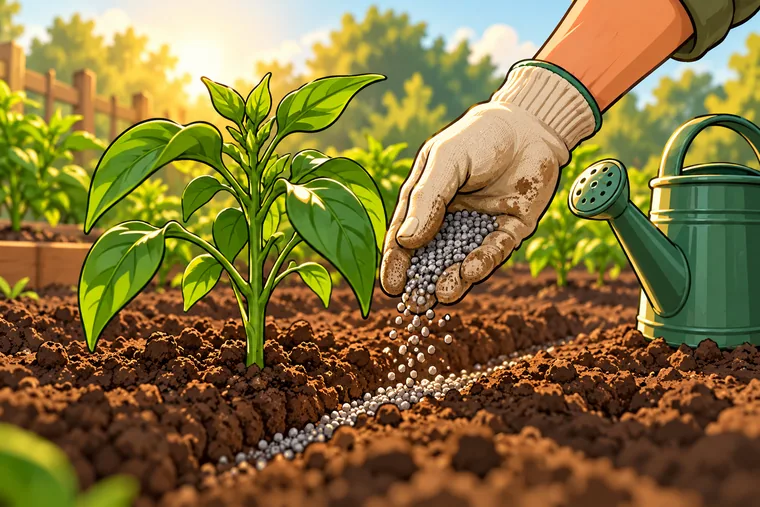
Water is your daily job. UW–Madison says that a container plant needs little water while small, then daily water once it is big and fruiting in summer heat6. Feed matters too: potting mix holds little food, so UW–Madison adds a slow-release fertilizer if the mix has none6, and the fertilizer guide has the amounts for side-dressing.
Ed Currie bred the Carolina Reaper, the record holder until Pepper X passed it in 2023, and in this video he shares his own growing tips, so take it as the breeder's view and keep the extension numbers above as your plan.
- 1
- 2
Fill it with mix all the way down
No layer of rocks or shards in the bottom; research shows layering slows drainage.6
- 3
Set the plant at its old depth
Keep the stem at the soil line where it sat in the small pot, and water it in.4
- 4
Add the stake now
Pepper stems turn brittle; put the stake or cage in before the roots fill the pot.2
The container hub covers mix and drainage for every pepper.
Should you prune a Carolina Reaper?
Lightly, if at all. Illinois Extension's Nick Frillman says bottom pruning is optional for super-hot Capsicum chinense peppers such as habanero, scorpion, ghost and Reaper, and that you should remove only the lowest 6 to 8 inches of foliage, which prolongs good top growth and air circulation17. Strip the foliage below that line and leave everything above it.
Illinois describes topping, cutting a young plant back to its second set of leaves at 12 inches, in its section on the common C. annuum peppers, where it encourages a stout habit and more flowers and fruit17. Its super-hot advice names only the bottom prune, so we do not recommend topping a Reaper. That leaves you with one optional cut: the lowest 6 to 8 inches, once the plant is established, which is when Illinois makes the same cut on the C. annuum types.
Should you grow a Reaper or start with a habanero?
Both run on the same clock, so pick on heat and handling, not on difficulty. The compare below sets them side by side.
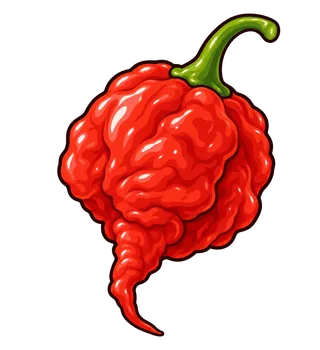
Carolina Reaper
Hotter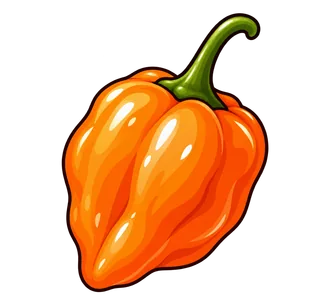
Habanero
- Capsicum chinense1SpeciesCapsicum chinense, the same species1
- Planned on 90–120 days from transplant; sellers quote 110–120 days or moreSources for this line2. University of Maryland Extension8. West Coast Seeds (seed seller, its own product page)9. Pepper Joe's (seed seller, its own product page)Season90–120 days from transplant for habanero types2
- An average of 1,569,300 Scoville heat units at its 2013 record3HeatFar lower than the Reaper, though still hot enough to need care3
- Gloves for picking and for every cut pod4HandlingGloves still advised for all hot peppers24
If your summer is short, the season decides for you. A garden with a late May frost gets ripe habanero-type pods from early September into October2, and only the plants that started early and sit in your sunniest spot get there. A Reaper in a pot that you can move under cover in a cold snap gives you a few more weeks.
Why is my Reaper flowering but not setting pods?
Usually heat or dry soil, the same as any pepper. Check your past week's weather against these.
- Nights above 75°F slow or stop pod production. A spray of water cools plants in hot, dry spells.2
- Days above 100°F cut pollination, fruit set and yield.18
- Dry soil causes blossom drop and small fruit. Keep moisture even, about 1–2 inches of water a week in the ground.27
- A big leafy plant with few flowers may have had too much nitrogen.4
This is not only a southern problem. UMN Extension sees pepper flowers drop in Minnesota when hot days meet hot nights4. The guide to a pepper plant with no fruit sorts the causes by what your plant shows.
How hot is a Carolina Reaper, and how do you pick it?
Guinness confirmed the Reaper in 2013 at an average of 1,569,300 Scoville heat units3; its later figure is an average of 1.64 million19, and the taxonomic monograph quotes the record page at 1,641,1831. Clemson Extension gives the same 1.64 million average and places its breeding in Rock Hill, South Carolina20. In 2023 the record passed to Pepper X, from the same breeder19.
Pick when the pods reach full size and full color but are still firm7; the plant keeps flowering and setting fruit as you harvest4.
Will your homegrown Reaper reach the record heat?
Not by default. The record is an average of lab-tested pods, and New Mexico State's Paul Bosland and Stephanie Walker say heat is the result of the plant's genetics and its interaction with the environment, with temperature and water both influencing it21. The heat science guide explains how labs measure it.
Two lines from that NMSU guide matter to you. A low-heat cultivar becomes hotter when it is exposed to any kind of stress in the field, and a hot cultivar under optimal conditions will become only moderately hot21. So your Reaper's pods will vary with your summer, and steady water and feed do not turn them into record pods.
Do not stress the plant to chase heat. NMSU says predictable heat takes a good cultivar and stress-free growing conditions21, and a stressed Reaper drops its flowers, as the section on pod set shows. Treat the 1.6 million figure as the lab's average for tested pods, not a promise for yours, and treat every pod from your own plant as an unknown heat.
What do you do when a Reaper burns your skin or eyes?
Rinse, and keep your hands off your face until you have. The National Capital Poison Center gives different steps for each place the pepper lands:
| Where | What the poison center says |
|---|---|
| Eyes22 | Irrigate with copious warm water for 15 minutes first; cool compresses may help |
| Skin22 | Warm-water flushes, vegetable oil or diluted vinegar soaks may help, and so may an antacid on the skin |
| Mouth22 | Small sips of milk or water may help |
| Breathing22 | Call 911 for trouble breathing or chest discomfort |
| Any other exposure22 | Call your poison center at 1-800-222-1222 in the US |
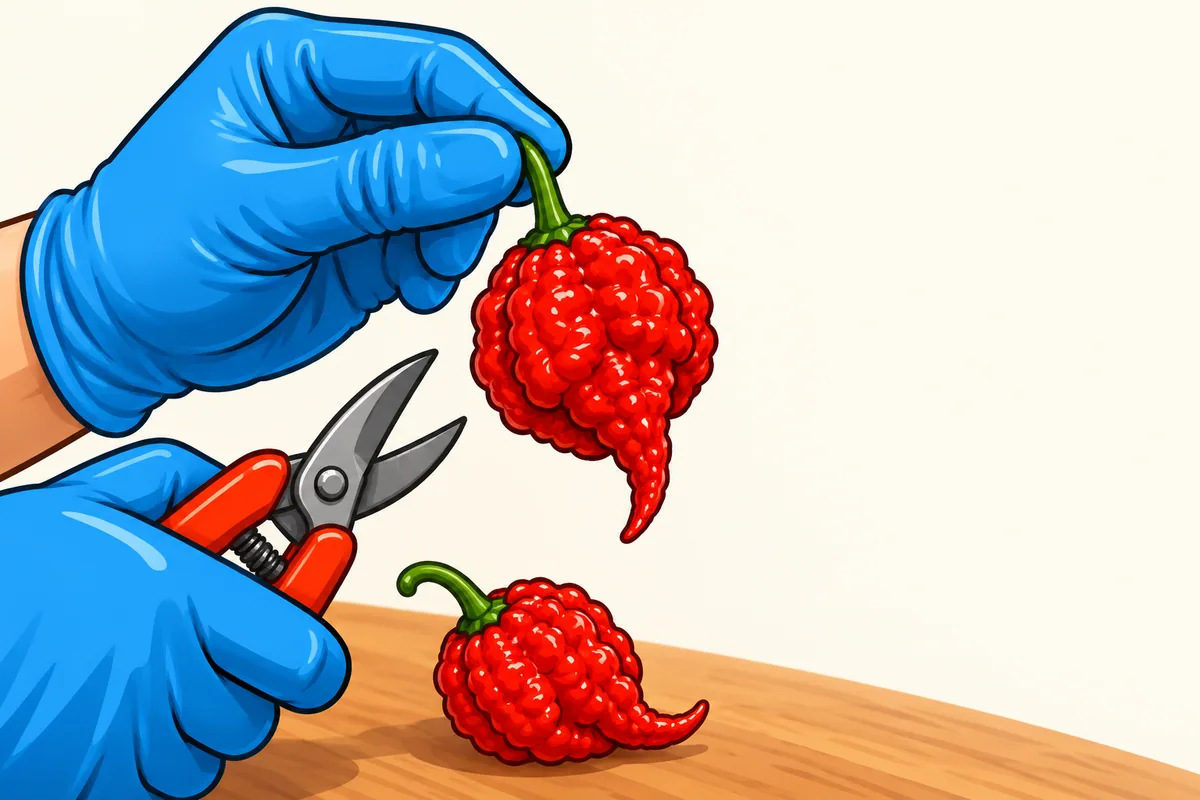
Prevention is cheaper. The poison center says to wear rubber, latex or nitrile gloves with hot peppers and not to touch your face or eyes after you handle them22. Put the gloves on before the shears come out, and keep them on until the pods are washed and bagged.
When is a Reaper pod ripe, and how do you store it?
When it has its full red color and still feels firm in your hand. Utah State gives peppers 35 to 45 days from flowering to full color, depending on temperature and variety7, so a flower you see in early August gives you a red pod in mid-September. UC IPM says you can pick a pepper any time after it reaches the color you want18.
Store your pods cool, not cold. Utah State keeps peppers at 50 to 55°F for 1 to 2 weeks and warns that long fridge storage causes chilling injury7; UMD gives 45 to 50°F at high humidity for 2 to 3 weeks2. Keep your Reapers away from the fruit bowl: UC IPM says ethylene from apples and bananas injures stored peppers.18
Can you save seeds from your Reaper?
You can, but they may not grow true. UMD says peppers are largely self-fertile, yet insects carry pollen between plants, so seed saved from year to year can surprise you2.
Wear gloves for this job too. UMD tells you to wear rubber gloves when you clean seeds from hot peppers2, and a Reaper's seed cavity holds plenty of capsaicin.
How does a Reaper season run, start to finish?
As one long loop, with no part of it you can rush. Your planning starts at the frost date and runs both ways from it. The diagram below puts each stage and its published length in one place.
- Sow on a heat matAbout 12 weeks before the last frost, 80–90°F
- Seedlings come up8–25 days; Reaper sellers quote up to 28
- Grow on under lights65–75°F, lights 2–3 inches above, 14–16 hours
- Harden offA week or two outside, in on nights below 55°F
- Plant out2–3 weeks after the frost, soil 60°F, nights above 50°F
- Flower and set podsNights above 75°F or days above 100°F hold set back
- Ripe red pods90–120 days after planting out; 35–45 days from flower
- Save seedBag the flowers or keep 500 feet from other peppers
- Back to Sow on a heat mat
Sources for this line2. University of Maryland Extension4. University of Minnesota Extension5. PlantVillage, Penn State University7. Utah State University Extension8. West Coast Seeds (seed seller, its own product page)18. UC Statewide IPM Program, University of California
Your Reaper season, at a glance
Tick these off as the season goes.
- Seeds sown about 12 weeks before the last frost, on a heat mat at 80–90°F.24
- Seedlings under lights 2–3 inches above, 14–16 hours a day.7
- Hardened off over a week or two; inside on nights below 55°F.4
- Planted out 2–3 weeks after the frost into 60°F soil, or into a 5-gallon pot.25
- Side-dressed with nitrogen at 4 and 8 weeks.7
- Gloves and shears ready from about 90 days after planting out.24
Your last box goes in at the first ripe pod, usually in August or September for an April frost. From there you pick every week or so, and the plant keeps setting pods until the nights turn cold.