On this page
- 1What is the best fertilizer for peppers?
- 2Which kind of fertilizer should you buy?
- 3When should you fertilize peppers?
- 4What do the numbers on the bag mean?
- 5How much fertilizer does a pepper plant need?
- 6Can you overfeed peppers?
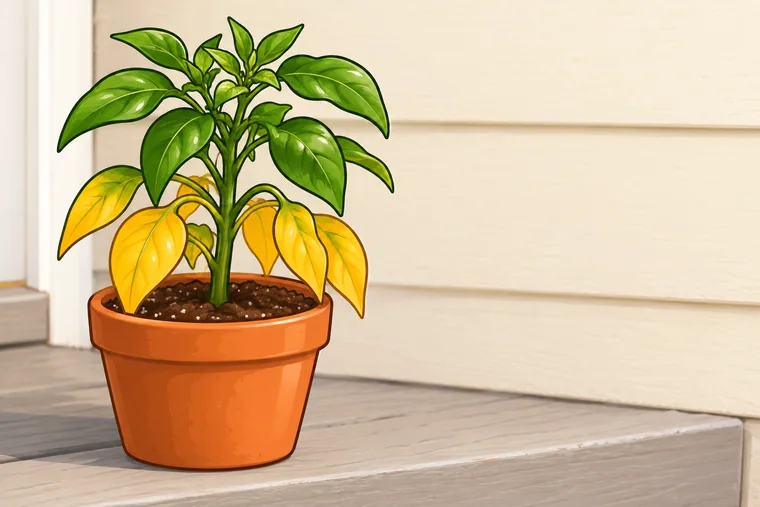
- 7Which deficiency signs matter most?
- 8Does soil pH change what you should feed?
- 9What about compost, manure, organic feeds and pots?
- 10Which organic feeds give peppers nitrogen fast, and which are slow?
- 11Do Epsom salt, eggshells and coffee grounds feed peppers?
- 12How often do you feed a pepper in a pot, and with what?
- 13Your side-dressing day
- 14Sources
What is the best fertilizer for peppers?
The one your soil test asks for. UMN Extension says to test first and add phosphorus and potassium only as the report recommends, because many soils already hold enough phosphorus1. Without a test, most guides start you with a balanced or nitrogen-and-phosphorus mix at planting and add nitrogen alone later in the season2.
That pattern matters more than the brand. Your peppers need nitrogen to build the plant, then less of it once they start making fruit; UF/IFAS tells you to cut nitrogen when fruit appears, because too much leads to fewer peppers3.
Here is how the test result turns into the bag you buy. Each branch follows one of the extension guides on this page.
- Phosphorus lowAdd it before planting, as the report says
- buyA mixed grade at plantingSuch as 5-10-10 or 10-10-10, worked into the top 6 inches
- thenNitrogen only, later21-0-0 or calcium nitrate as side-dressings
- then
- buy
- Phosphorus medium or highSkip it; many soils already hold enough
- buyNitrogen only, later21-0-0 or calcium nitrate as side-dressings
- buy
- pH outside 6.0–6.5Correct pH first, or the feed will not help
- fixLime or sulfur by the reportUF/IFAS: about 2–3 lb dolomitic lime or 1 lb sulfur per 100 sq ft per pH point
- fix
Sources for this line1. University of Minnesota Extension2. UC Statewide IPM Program, University of California4. Clemson Cooperative Extension, Home & Garden Information Center5. Utah State University Extension6. UF/IFAS Extension (EDIS)7. New Mexico State University Cooperative Extension Service
Your county extension office runs the test, and the report tells you how much of each nutrient to add. UMD suggests you repeat it every three years8.
Which kind of fertilizer should you buy?
Pick by what your soil needs and how you like to garden. Each kind below has a place in the extension guides, and none of them is the one right answer for everyone.
- Granular nitrogen, such as 21-0-0 or calcium nitrate. This is the side-dress feed. Utah State uses 21-0-05; Clemson uses calcium nitrate, 15.5-0-04. A small bag lasts you years in a home garden.
- A balanced or mixed grade, such as 10-10-10. This goes down before planting when your soil test calls for phosphorus and potassium, or when you have no test and no compost in the bed26.
- Liquid feeds, synthetic or organic. These work fast, which suits seedlings, transplants and a plant showing a deficiency. UMD names compost tea, seaweed extracts, fish emulsion and store-bought soluble fertilizers as suitable8.
- Slow-release (controlled-release) granules. These suit pots, where the mix holds little food. UF/IFAS names them as a season-long option, and UW–Madison adds them to potting mix that has none39.
Organic or synthetic, your plant takes up the same nutrients. What you change is the speed and the dose: you can measure a granular 21-0-0 to the quarter tablespoon, while manure and compost vary from batch to batch.
Here are the three bags from that list that fit a pepper bed or pot, each with the one job it does for you.
Fertilizer types worth buying for peppers
Three bags cover most pepper beds and pots; pick by where your plant grows.
- Best overall
Granular nitrogen fertilizer, 21-0-0
21-0-0 Ammonium Sulfate Fertilizer (18lbs) (Granular)
$44.99View on Amazon: Granular nitrogen fertilizer, 21-0-0How often: 4 and 8 weeks after transplanting
Where: 6 inches to the side of the plant
Balanced granular vegetable fertilizer
10-10-10 Plant Fertilizer Slow Release - 10 10 10 All Purpose Granular Garden Fertilizer for Vegetables, Tomato, Arborvitae, Shrubs, Rose, Flowers, Fruit, Fig Trees (1/2 Quart)
$14.99View on Amazon: Balanced granular vegetable fertilizerHow often: Once, just before planting
Where: Broadcast over the planting area
Slow-release fertilizer granules for pots
Osmocote Smart-Release Plant Food Plus Outdoor & Indoor1, 8 lb. | For Most Plant Types, In-Ground and Container Plants, Contains 11 Essential Nutrients
$36.18View on Amazon: Slow-release fertilizer granules for potsHow often: Once, when you fill the pot
Where: Mixed into the potting mix


As an Amazon Associate we earn from qualifying purchases. We choose product types from what their labels and extension sources say; the commission does not change what we recommend. Our affiliate disclosure
When should you fertilize peppers?
Before planting, at planting, and two or three light times after. The steps below come from five extension guides, which agree on the order and differ on the exact weeks.
- Before planting
- At transplanting
- Plants 3–4 inches tall
UC IPM starts side-dressing nitrogen here, in narrow bands, then repeats every 3–4 weeks.2
- 3–4 weeks after transplant
Clemson's first side-dress of calcium nitrate, repeated 3–4 weeks later.4
- 4 weeks after transplant
First side-dress of nitrogen, Utah State's schedule.5
- One week after flowering begins
New Mexico State's single side-dress for chiles in the garden.7
- 8 weeks after transplant
- Once fruit is forming
Reduce the nitrogen in what you feed.3
Penn State's PlantVillage goes more often, with a liquid fertilizer every two weeks after planting12, and UF/IFAS feeds two to three times over the season3. Pick one schedule and keep each feed light, because extra nitrogen buys you leaves and not peppers.
Pepper Geek has a complete guide to fertilizing peppers, which lets you watch one grower's routine next to the extension schedules above, while the doses you set still come from the sourced amounts on this page.
What do the numbers on the bag mean?
They are the percentages of nitrogen, phosphorus and potassium, in that order2. A bag of 21-0-0 is 21 % nitrogen with no phosphorus or potassium; a 10-10-10 has 10 % of each.
| Grade | What it is | When |
|---|---|---|
| 10-10-106 | Balanced, common garden grade | Broadcast just before planting |
| 5-10-5, 5-10-10, 8-16-16, 12-12-122 | Mixed N-P-K | Before planting, if no manure or compost went in |
| 0-36-0 (superphosphate)7 | Phosphorus only | Before planting, only if the soil test shows low phosphorus |
| 21-0-05 | Nitrogen only | Side-dress at 4 and 8 weeks |
| 15.5-0-0 (calcium nitrate)4 | Nitrogen with calcium | Side-dress 3–4 weeks after planting, then again |
| High-phosphorus starter8 | Middle number high, for roots | On transplants, mixed with water per the label |
The percentage tells you how much product you need for a pound of nutrient. A pound of nitrogen takes about 4.8 pounds of 21-0-0 (1 ÷ 0.21), and about 6.5 pounds of calcium nitrate (1 ÷ 0.155). So when you swap one bag for another, you use more of the weaker grade, not the same scoop.
How much fertilizer does a pepper plant need?
Less than you think. Utah State Extension side-dresses each plant with 1/4 tablespoon of 21-0-0, twice, 6 inches from the stem5. UC IPM works by the row instead: 0.5 to 1 pound of actual nitrogen per 100 feet, or 1 to 2 pounds of a mixed fertilizer before planting2. Clemson and New Mexico State give their own rates, so here are all four side by side.
What that looks like in your garden
Your home row probably runs closer to 10 feet than 100, so here are the same rates scaled down for you.
| Rate as published | For a 10-foot row | How we got it |
|---|---|---|
| 1–2 lb mixed fertilizer per 100 ft2 | 1.6–3.2 oz (45–91 g) | 1–2 lb ÷ 10 = 0.1–0.2 lb; × 16 oz |
| 0.5–1 lb nitrogen per 100 ft, as 21-0-02 | 3.8–7.6 oz (108–216 g) of product | 0.5–1 lb ÷ 0.21 = 2.4–4.8 lb per 100 ft; ÷ 10 |
| 1/4 tbsp 21-0-0 per plant5 | 1 1/2 tbsp per side-dress | 6 plants at 18 inches × 1/4 tbsp |
| 1/2 lb calcium nitrate per 30 ft of row4 | About 2.7 oz (76 g) per side-dress | 8 oz ÷ 3 |
| 1.5 oz 21-0-0 per 10 ft of row7 | 1.5 oz (43 g), one week after flowering | As published |
The routes sit far apart: Utah State's per-plant dose is much smaller than UC's per-row rate, and Clemson and New Mexico State fall in between. UC spreads its rate over several light feeds every 3 to 4 weeks2, so check your bag's label and split the total. If you are unsure, start at the low end; you can add a second feed, but you cannot take one back.
Can you overfeed peppers?
Yes, and nitrogen is the one to watch. Too much makes the plant bushy and leafy and slow to bear1, and Utah State says it delays fruit set and maturity5. Clemson reads a plant with lots of foliage and few blossoms as a sign of too much nitrogen4.
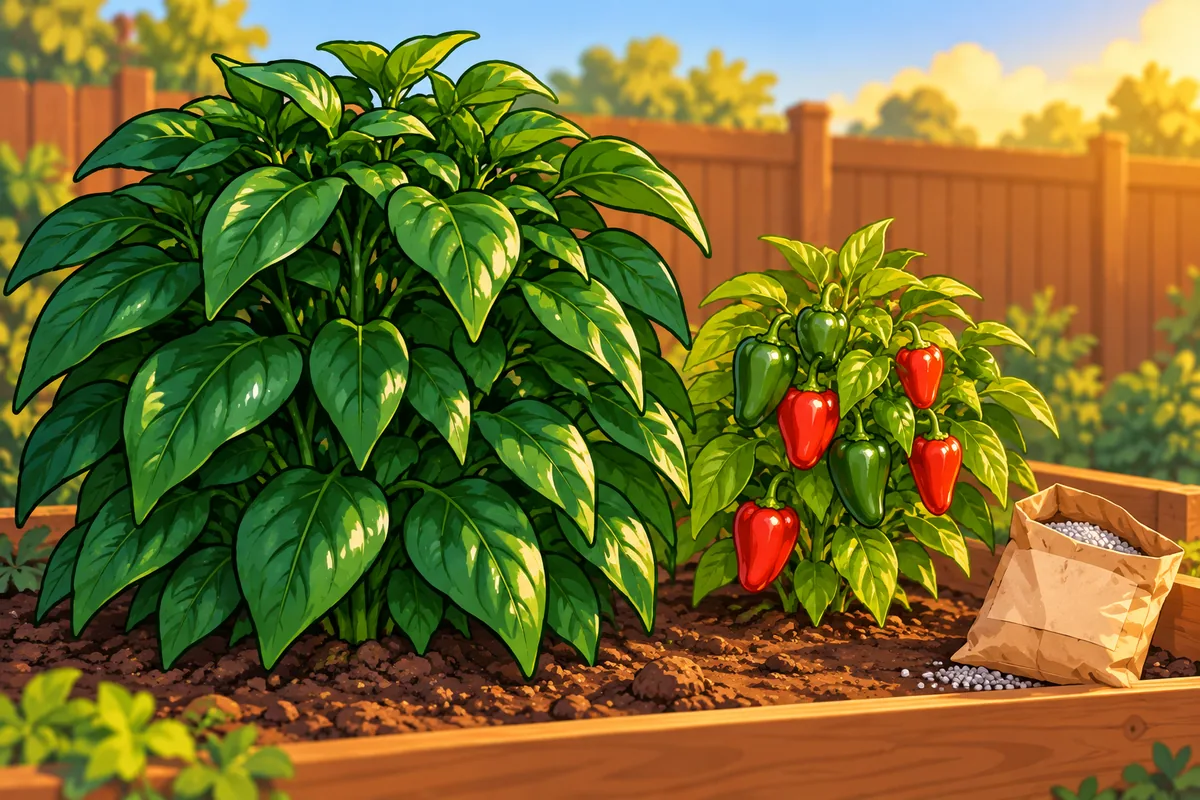
Extra nitrogen has two more costs. UF/IFAS says it makes plants more inviting to aphids and whiteflies6, and Utah State lists excess nitrogen among the causes of blossom-end rot5. The other overfeeding injury is burn: UC IPM keeps fertilizer off the stems for that reason2, and Clemson sets side-dress bands 4 to 6 inches from the plant to avoid root burn4.
If your plant is already a big green bush, stop all nitrogen and wait. A plant that still sets no fruit after that may be waiting out the heat, because hot nights drop flowers too.
Which deficiency signs matter most?
Four signs cover most of your feeding questions, and only two of them mean "feed more". Check your leaf before you reach for the bag.
| What you see | What it means | What fixes it |
|---|---|---|
| Leaves light green or yellow all over, worst early in the season8 | Short of nitrogen | A liquid fertilizer at the base of the plant or on the leaves |
| Purple leaves on seedlings and new transplants in cold spring soil8 | Short of phosphorus while the soil is cold | A balanced soluble fertilizer on the root zone; a high-phosphorus starter at planting |
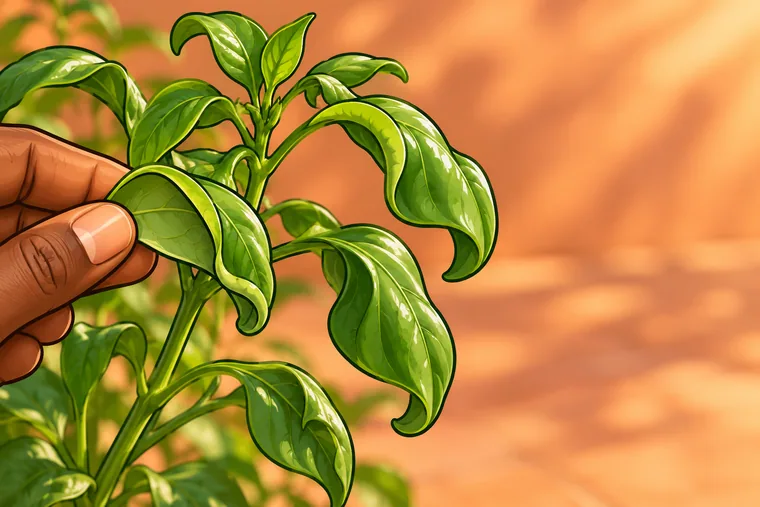
| Yellow between the veins, veins still green814 | Iron held back by soil above pH 7.0 (new leaves) or magnesium short (older leaves first) | A soil test for pH and magnesium, not more nitrogen |
| A dry brown or black patch on the blossom end of the fruit5 | Blossom-end rot: a calcium shortage in the fruit, tied to uneven watering, excess nitrogen or root damage | Even soil moisture in hot weather and mulch, not more fertilizer |
The last row catches people out. Blossom-end rot looks like a feeding problem, but Utah State ties it to watering and to too much nitrogen, so another feed can make it worse. The guide to why leaves turn yellow sorts the leaf colors from pests and root disease.
What about Epsom salt? Iowa State describes magnesium shortage as yellow between the veins on the older leaves first14. A soil test tells you whether your soil is short before you add anything, and the Epsom salt section further down has what NC State says.
If you spray a liquid feed on the leaves, time it. UMD says the best time for a foliar feed is early morning or early evening, when the leaf pores stand open8, so you avoid the midday sun.
Does soil pH change what you should feed?
Yes, because your pH decides whether the plant can use what you give it. UC IPM keeps pepper soil at pH 6.0 to 6.52, Clemson asks for the same range4, and UMD calls 6.5 ideal for vegetables while plants still produce from 6.0 to 7.08.
Above 7.0, iron gets locked up and the newest leaves go yellow between green veins8; feeding more nitrogen will not fix that. Low in calcium, UC IPM adds lime or gypsum to the soil2. UF/IFAS moves pH about one point with 2 to 3 pounds of dolomitic lime per 100 square feet to raise it, or 1 pound of sulfur to lower it6, but your soil test report gives the amount for your soil.
What about compost, manure, organic feeds and pots?
Compost and well-rotted manure feed the soil, and UMN says to work them in during spring or fall and never use fresh manure1. UC IPM applies manure or compost at about 1 pound per 4 or 5 square feet, worked in several weeks before planting, and says a well-amended soil may need only nitrogen, if anything2. Utah State caps compost at about 1 inch per 100 square feet5, so more is not always better.
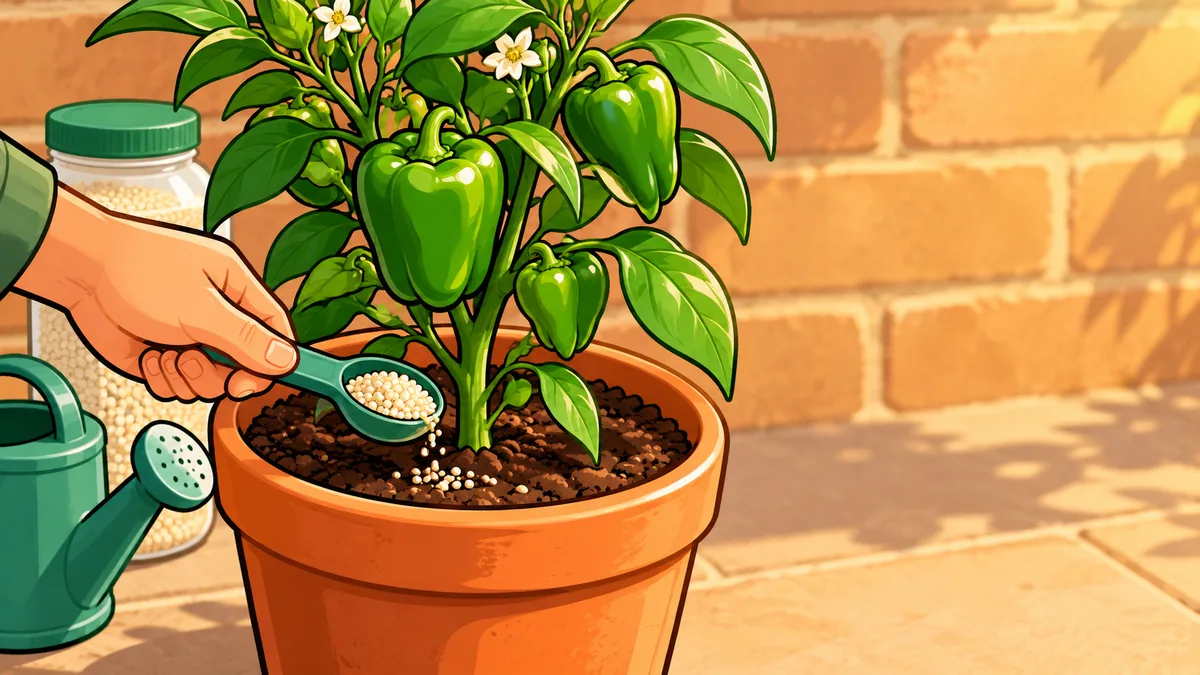
In a pot, the mix is the soil. UW–Madison suggests adding a slow-release fertilizer if the potting mix has none and following the label from there9; UF/IFAS names controlled-release fertilizer as a season-long option3. Because a pot needs daily water once the plant carries fruit9, the water also carries nutrients out of the drainage hole. That is why Penn State's every-two-weeks liquid feed12 suits your potted plants better than your beds; the container hub covers pot size and mix.
Which organic feeds give peppers nitrogen fast, and which are slow?
Blood meal and fish meal carry a lot of nitrogen and release it quickly; compost and manure carry little and take longer. Utah State's table of organic materials gives each one's average nitrogen and how fast it releases15. Divide 1 by the nitrogen percentage and you get the pounds of product that carry 1 pound of nitrogen, the same sum the bag-numbers section does for 21-0-0.
| Material | Nitrogen | Release | Pounds for 1 lb of nitrogen |
|---|---|---|---|
| Blood meal15 | 12% | Rapid | 8.3 |
| Feather meal15 | 12% | Moderate | 8.3 |
| Fish meal15 | 6–12% | Rapid | 8.3–17 |
| Cottonseed meal15 | 6% | Slow | 17 |
| Poultry manure15 | 3–4% | Rapid | 25–33 |
| Cattle manure15 | 2–3% | Moderate | 33–50 |
| Compost15 | 1–3% | Moderate | 33–100 |
| Seaweed extract15 | 1% | Rapid | 100 |
Set those numbers beside the 4.8 pounds of 21-0-0 that carry the same pound of nitrogen. Blood meal needs about 1.7 times as much product, and compost needs 7 to 20 times as much. That is why compost builds your bed and cannot be your side-dressing.
Read the release column as your timing guide, which is our reading of Utah State's numbers. A rapid feed such as blood meal or fish meal fits the 4-week and 8-week side-dressings, because it reaches the roots while the plant is still using it. A slow feed such as cottonseed meal belongs in the soil before planting, so it is working by the time the first side-dress is due. Poultry manure releases quickly too, but UMN says to use manure only after it has rotted, never fresh1.
These are averages. Your bag's label beats the table, and a soil test beats both.
Do Epsom salt, eggshells and coffee grounds feed peppers?
Only Epsom salt does anything for them, and only when your soil is short of magnesium. Amanda Bratcher of NC State Extension says to do a soil test before you put Epsom salts in the garden, because the soil may already hold more than enough magnesium, and that it is better to add too little than too much16. Here is what two extension sources say about the usual kitchen suspects:
| Remedy | What the source says | What you do |
|---|---|---|
| Epsom salt (magnesium sulfate)16 | Supplies magnesium and nothing else; peppers are among the crops that may like it; too much risks magnesium toxicity; it does not balance pH, while dolomitic lime supplies calcium and magnesium and raises pH | Test first, and use it only if the report shows low magnesium |
| Eggshells17 | Add calcium only when ground to a powder and put in an acidic solution; whole shells can last a very long time | Compost them, and fix uneven watering if the pods rot at the blossom end |
| Used coffee grounds17 | Fresh grounds are acidic, used grounds are not | Skip them as a pH fix; compost them |
| Banana peels17 | Breaking them down uses up nitrogen the plants need, and shallow peels can attract rats, skunks and opossums | Compost them first, then spread the compost |
The pattern is the same as on the rest of this page: the plant takes what is in the soil, and a test tells you what is missing. The one calcium problem you can see on the pod, the dark patch at the blossom end, comes from watering in the table above, not from a missing eggshell.
How often do you feed a pepper in a pot, and with what?
Every 2 weeks, lightly. UMD says long-season vegetables such as pepper may need a light feed every 2 weeks, whatever the growing media, and that watering leaches nutrients out of a container10. Water until it runs out of the drainage holes, and the food in the pot goes down the drain with it. You choose between two routes:
Liquid or powder route
Slow-release route
- Water-soluble fertilizer, usually sold as a powder, mixed in water and poured on10How it worksGranules coated in a semi-permeable resin; they release a little each time you water, so the pot feeds itself10
- A light feed about every 2 weeks through the season10TimingMix the pellets into the growing media and follow the label from there910
- Too much burns the plant and builds up salt in the mix10Watch forA mix that already holds fertilizer covers the plant for a few weeks only, then you add more10
Here is a sample season for the liquid route, our arithmetic from UMD's two weeks. You plant on May 20 into a mix that already carries fertilizer, which lasts a few weeks, so call it June 10 for the first feed. Then every 14 days: June 24, July 8, July 22, August 5 and August 19. That is six light feeds, and you ease off the nitrogen once pods form, as the section on when to fertilize says.
Your side-dressing day
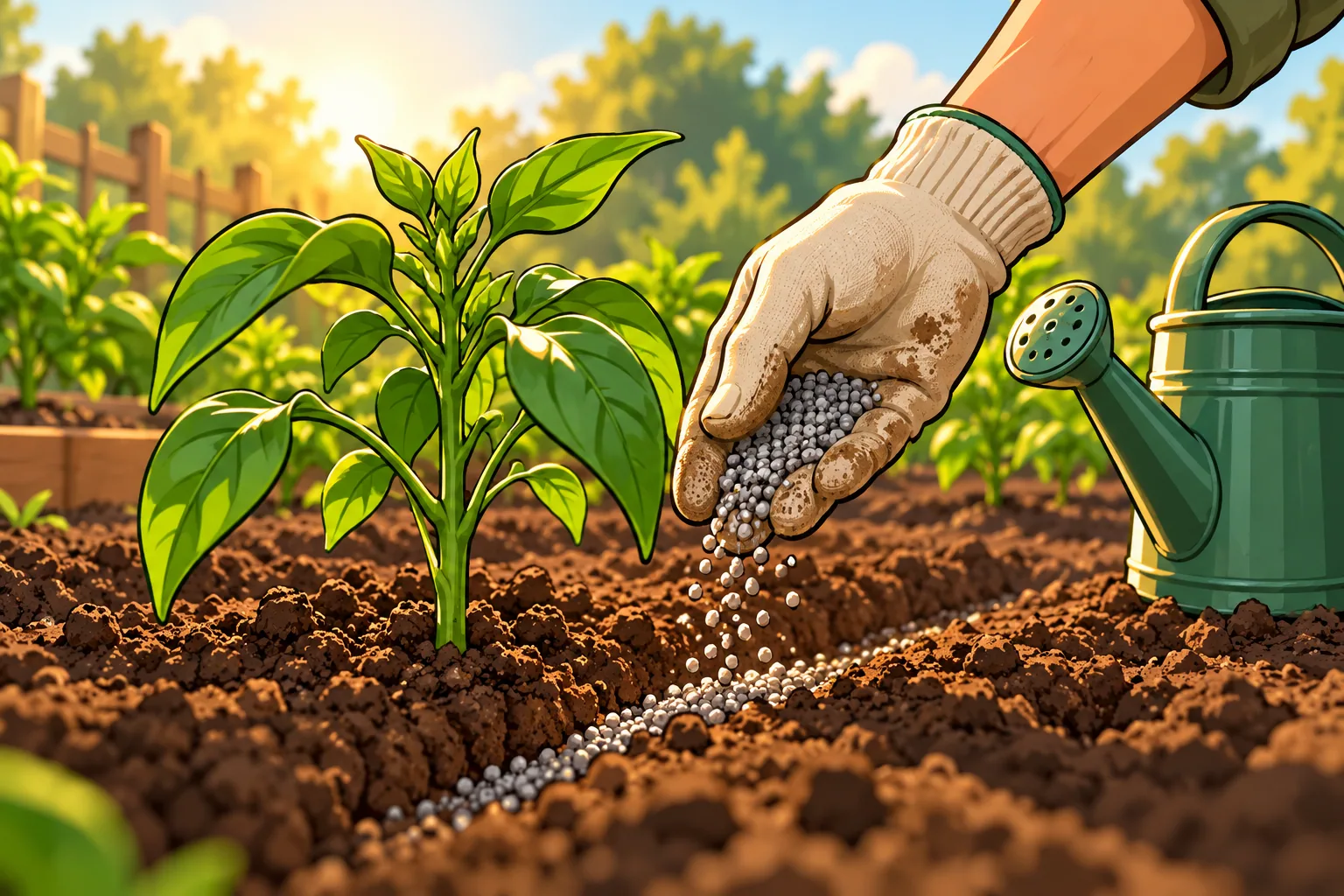
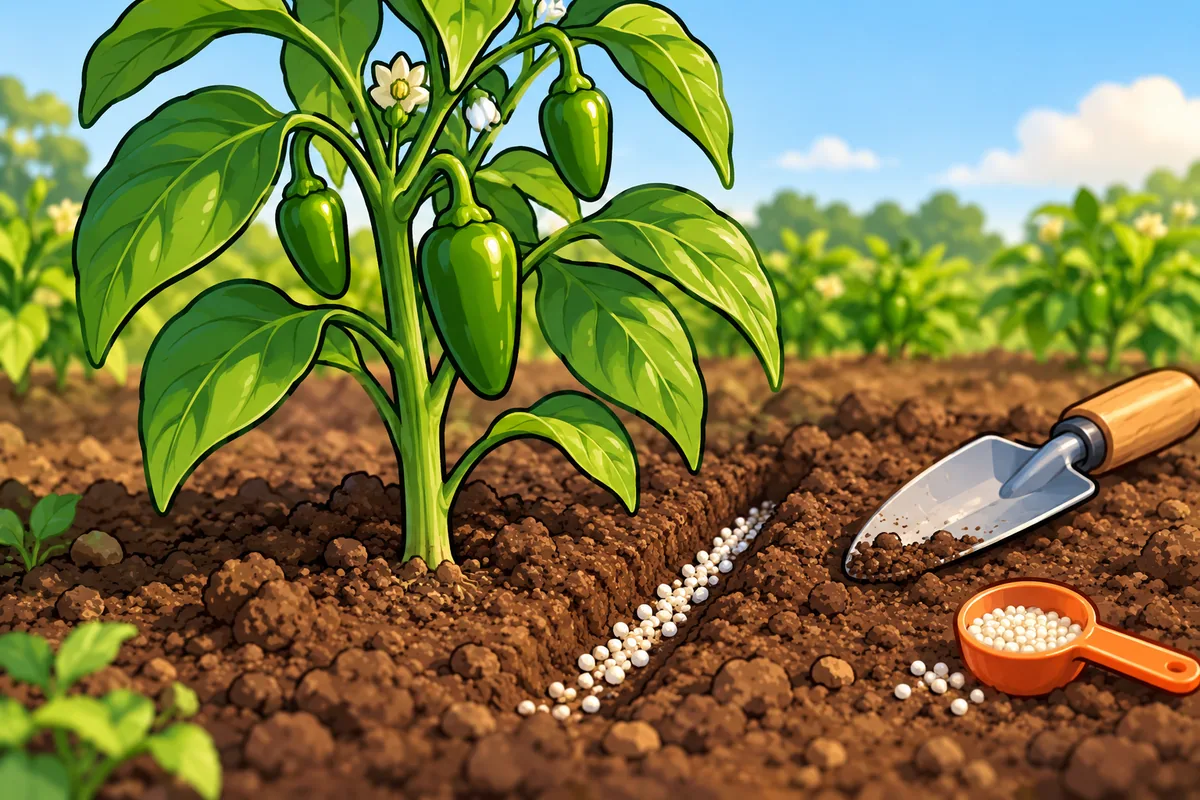
Put the feed down where the roots reach and away from the stem, following Utah State and UC IPM25:
- 1
Measure per plant
Scoop 1/4 tablespoon of 21-0-0 per plant, or follow your bag's label for its grade.5
- 2
Make a shallow groove
Scratch a groove 1 or 2 inches deep, 4 to 6 inches from the row.2
- 3
- 4
Mark the date. The next side-dress comes four weeks later; UMD times it to the first fruit set, so look for small pods under the leaves11. If you planted at 18 inches apart, a row of six plants takes about one heaped tablespoon and a half each time, and the whole season's nitrogen fits in a coffee mug.