On this page
- 1A pepper watering schedule by setting
- 2When in the season pepper plants need water most
- 3How many gallons is 1 inch on a raised bed?
- 4Watering pepper seedlings before they go outside
- 5How long does a soak last in sand, loam and clay?
- 6Does mulch change how often you water peppers?
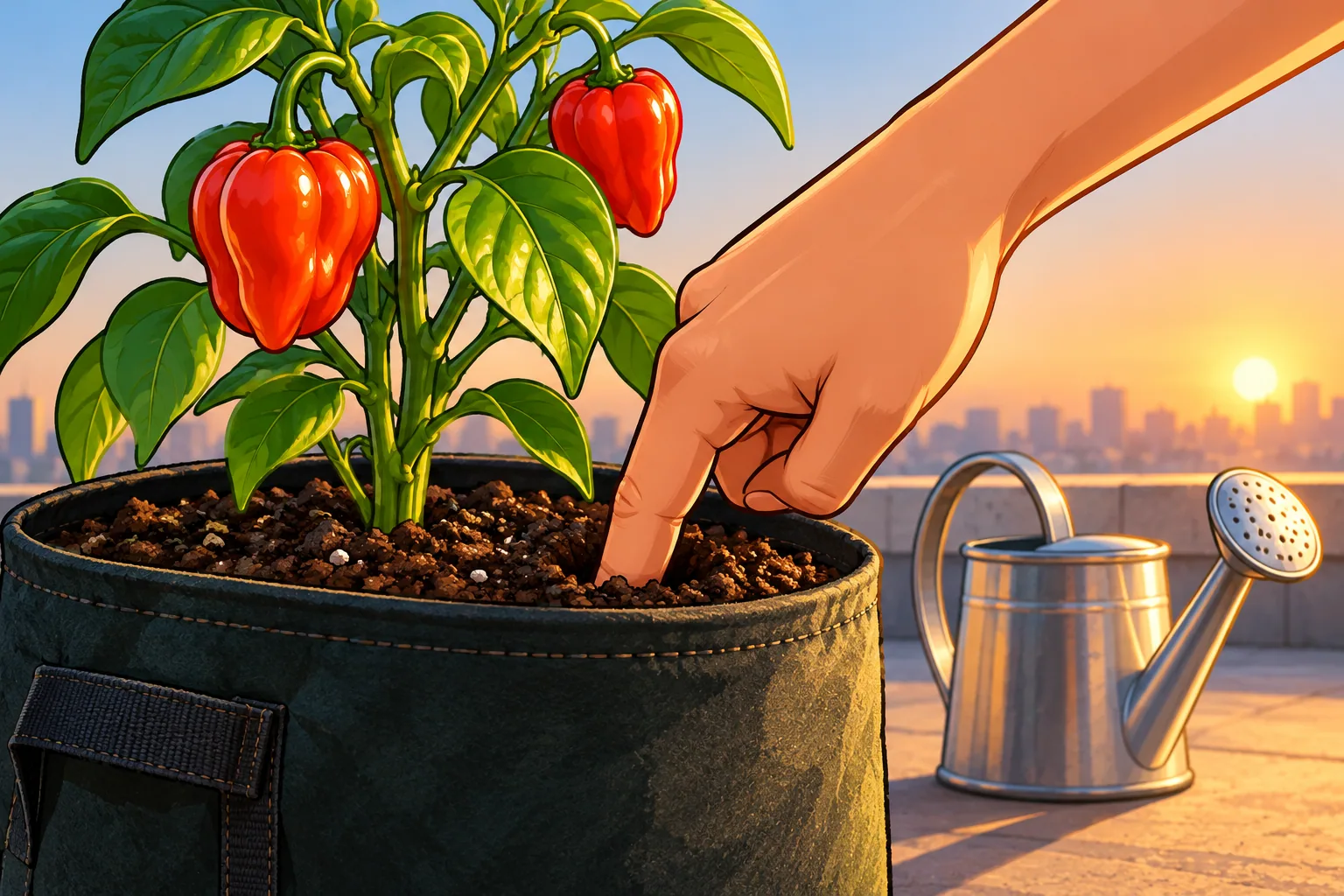
- 7Should you water today? A two-minute test
- 8Drip, soaker hose or watering can?
- 9What to do after a week of heavy rain
- 10How do you keep potted peppers watered for a 10-day trip?
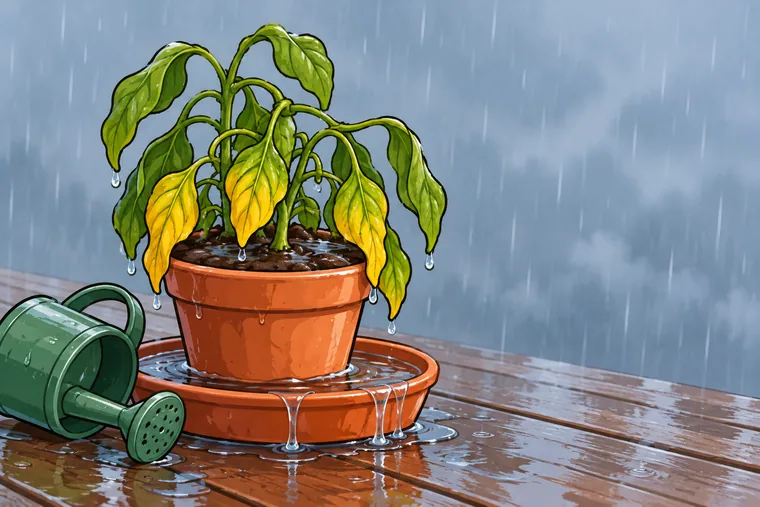
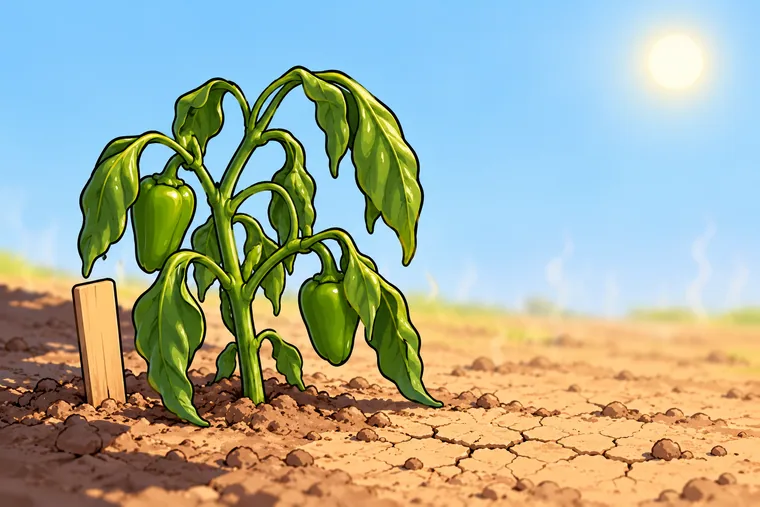
- 11Signs you are watering peppers too much or too little
- 12Watering potted peppers through a heat wave
- 13Sources
A pepper watering schedule by setting
Here are your numbers first. Find your setting, start with that row, and let the soil under your finger adjust it for your garden.
| Setting | How much | How often | How deep |
|---|---|---|---|
| In the ground, loam or claySources for this line1. Utah State University Extension2. University of Minnesota Extension3. Clemson Cooperative Extension, Home & Garden Information Center | 1–2 inches a week, rain included | Deep and not often; at least one thorough soak a week | At least 6 inches each time |
| In the ground, sandy soil23 | The same weekly total | More often than once a week | At least 6 inches |
| Just transplanted4 | Enough to settle the plant | One or two waterings in the first month, root zone kept moist | Down to the deeper layers early |
| Pot, young plant56 | Little | When the top of the mix is dry | Until water runs out of the hole |
| Pot, big plant in fruit, summer56 | Enough to drain through | Daily | Until water runs out of the hole |
| Ornamental pepper in a pot7 | Enough to drain through | When the top 1/2 inch of soil is dry | Whole pot |
| Field drip line (commercial)8 | Set by a tensiometer at 10–15 centibars | Usually twice a week | Root zone |
The rows share one rule: water deep, then wait until the soil asks again. Utah State puts it as "deeply and infrequently"1, and UMN explains why: a light sprinkle that only wets the surface grows shallow roots, which leaves your plant more open to heat and drought2.
UF/IFAS gives the same pattern for the whole garden. Young plants need frequent, light water, and maturing crops need more water less often9, which is why your schedule in June looks different from your schedule in August.
When in the season pepper plants need water most
Your pepper's need for water changes as it grows, and two stages matter more than the rest. The rail below follows one plant from planting day to the last pods.
- Planting day
- First month
Settle the roots
One or two waterings help establish the plant; keep the deep layers moist even while it is small.4
- Bloom
- Fruit set and growth
- Ripening
Why does even water matter so much at fruit set? Clemson explains blossom-end rot: calcium moves into the fruit with water, so when the water supply stops, the calcium stops, and the bottom of the pod rots even in soil with enough calcium3. Your watering rhythm, not a calcium spray, is the fix for that dark spot on the fruit.
New Mexico State sets the goal of the whole season as a uniform soil moisture level that gives uniform growth and fruit set10. Too little water sheds blossoms and gives small fruit, and too much brings root rot.
How many gallons is 1 inch on a raised bed?
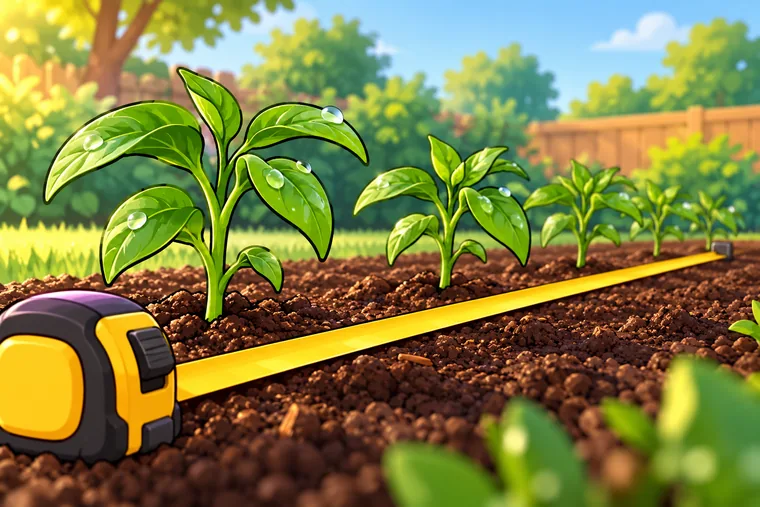
You water with a hose or a can, so turn the inch into gallons for your own bed. One inch of water over one square foot is about 0.62 gallon. A common raised bed of 4 by 8 feet covers 32 square feet, so one inch over it is about 20 gallons, and the rest follows from there.
- 1
Set the weekly target
Utah State's 1–2 inches a week means about 20 to 40 gallons a week for that bed.1
- 2
Credit the rain
If a rain gauge caught half an inch this week, subtract about 10 gallons; the weekly figure includes rain.1
- 3
These are your own sums, so treat them as a starting estimate. A bucket under the hose for one minute tells you how many gallons your hose gives a minute, and from there you know how long to run it.
Then check your work. An hour after watering, dig a narrow hole with a trowel beside a plant: moist soil 6 inches down means you gave enough, and dry soil under a wet crust means you gave a splash, not a soak. UC IPM says pepper roots reach about 2 feet, and deep moisture is hard to put back later in the season without overwatering4.
Watering pepper seedlings before they go outside
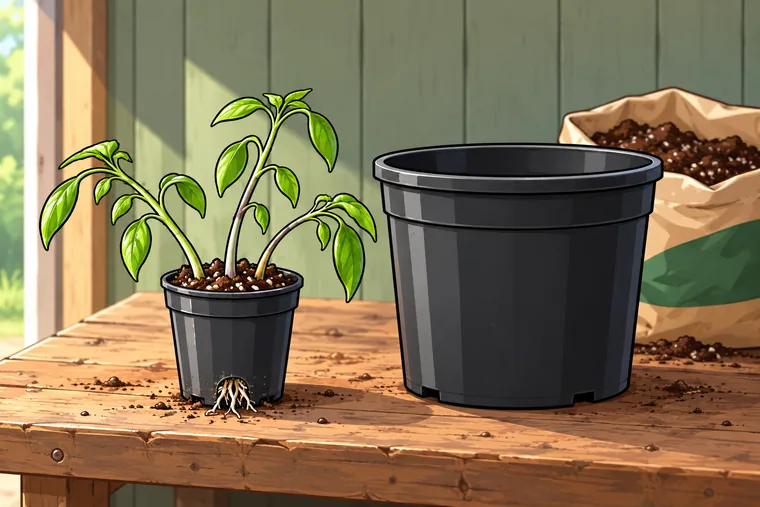
Seedlings play by different rules, because their whole root system fits in a cell. UMN starts pepper seed on a heat mat at 80 to 90°F and warns that the mat dries the mix out faster, so you check moisture often while the seeds come up2. A cell tray can go from damp to dry in a warm room in one day.
Then you ease off on purpose. UMN reduces watering when plants are 4 to 5 inches tall and 6 to 8 weeks old, as part of getting them ready for the garden2. That slight dryness toughens the stems before the first days outside. The seed starting guide covers the trays, light and heat that go with it.
How long does a soak last in sand, loam and clay?
A sandy bed empties in days, and a loam or clay bed holds a soak for much longer. UC ANR measures how much water a soil stores for plants in inches per foot of depth, and says sandier soils need irrigating more often because plants use water at the same rate in any soil and simply run out sooner in sand12.
| Soil | Inches held per foot | In the top 2 feet (our math) | One 1-inch soak fills |
|---|---|---|---|
| Coarse sands, fine sands, loamy sands | 0.75–1.25 | 1.5–2.5 | The top foot, or close to it |
| Sandy loams | 1.25–1.75 | 2.5–3.5 | Most of the top foot |
| Loams and silt loams | 1.50–2.30 | 3.0–4.6 | About half to two thirds of the top foot |
| Clays, silty clays | 1.60–2.50 | 3.2–5.0 | About half to two thirds of the top foot |
Put that next to the weekly target and your routine follows. A 2-inch soak on loamy sand is more than the top foot can store (1.25 inches at most), and the extra drains below your roots. Split the same water into two 1-inch soakings a few days apart. New Mexico State finds that up to 70% of the water a full-canopy chile takes up comes from the top 1 foot13, so the top foot is the part you most want to keep stocked.
In loam or clay you can water once a week with 1 to 2 inches and give the roots time to use it. Heavy soil also holds water longest after rain, so run a drainage test before you soak a clay bed every week.
Does mulch change how often you water peppers?
Yes: it slows how fast your soil dries, so you water a little less often for the same result. Clemson says mulch helps hold consistent soil moisture and saves water3, and UMN uses black plastic mulch partly to keep soil moisture in2.
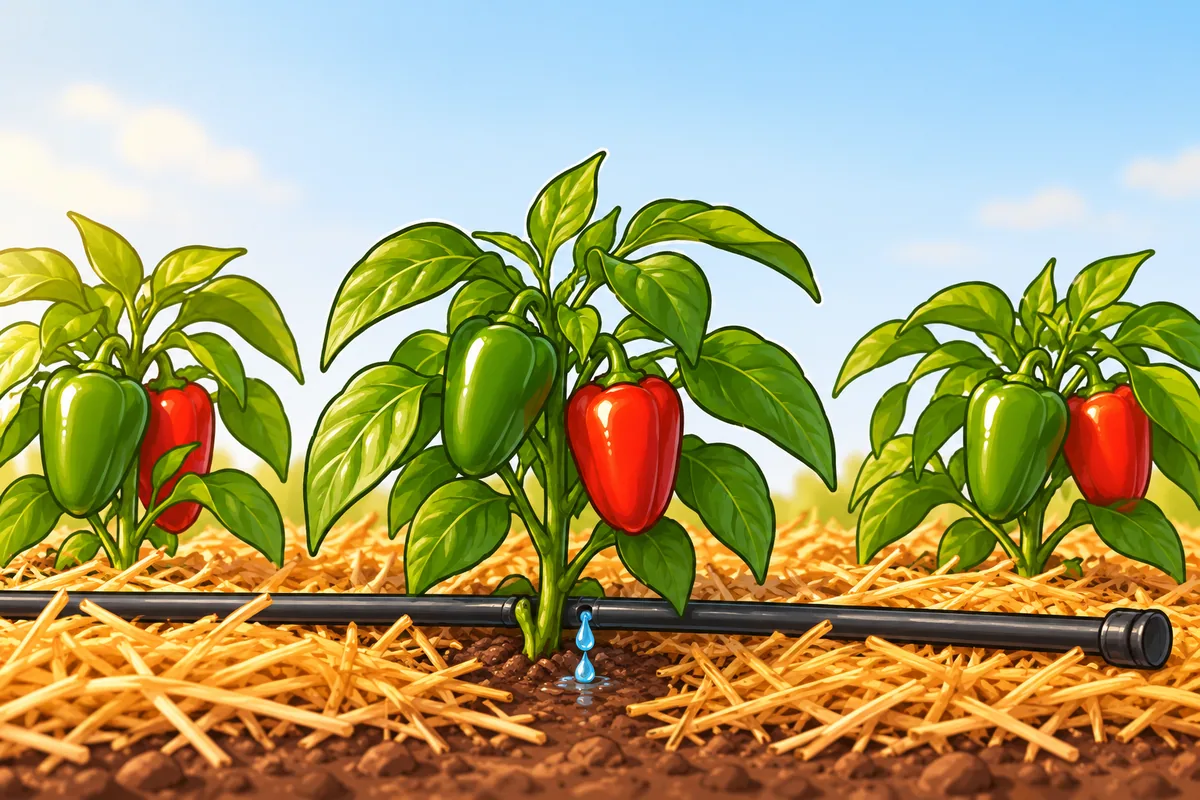
Timing decides which mulch you use. New Mexico State lays black plastic early to warm the soil, then swaps to straw, dry grass clippings or leaves once the weather warms, because organic mulch keeps the soil cooler in hot weather10. Utah State holds organic mulch until the soil reaches 75°F1. A drip line or soaker hose runs under either kind, which keeps your water at the roots and off the surface.
Should you water today? A two-minute test
The calendar gives you a rhythm; your soil makes the call. Run through these before you pick up the hose.
- Push a finger into the soil. Dry means water; still moist means wait a day.6
- Check the rain gauge or the forecast. Peppers that got 1 inch of rain this week may need nothing more.2
- Look at the hour. Water in the morning at the base, not on the leaves; wet leaves catch disease more easily.12
- Note the stage. Plants in bloom or setting fruit should not go dry.34
- For pots by a wall or under a roof, remember they get no rain at all.6
- Sandy bed? It dries sooner; check again tomorrow.2
If your answer is "wait," you lose nothing by checking again in the evening. A dry day turns into a thirsty plant much more slowly than a wet day turns into a rotting root.
Drip, soaker hose or watering can?
Drip lines and soaker hoses win for peppers in the ground. Maryland calls them excellent methods for watering peppers11, Penn State prefers drip or soaker irrigation to overhead watering14, and New Mexico State calls drip the most efficient way to water chile10.
Drip line or soaker hose
Sprinkler or overhead can
- Straight to the root zone, leaves stay dry1011Where the water goesOver the leaves and the paths as well as the roots2
- With raised beds, keeps soil drained and helps protect against root rot4DiseaseWet leaves are more disease prone, and splashed soil can carry spores2
- With mulch, saves a lot of water while giving the crop enough10Water useWater and disease management are harder10
A drip kit and a soaker hose both put water at the roots, so here is what to look for in each.
Ways to water a pepper bed
Both put the water at the roots and keep the leaves dry.
- Best overall
Drip irrigation kit
Vego Garden Irrigation Kit - Drip Irrigation System for Raised Garden Beds, Efficient Watering Solution for Vegetables, Flowers, and Plants, Easy DIY Installation (Large)
$109.95View on Amazon: Drip irrigation kitBest for: Rows and raised beds
Where: At the root zone
Soaker hose
MHMHM Heavy Duty Soaker Hose 150FT 1/2 Inch Rubber Garden Drip Irrigation Hose with Solid Brass Connector Water Saving Linkable Soaker Hose for Garden Bed Flower Vegetable Lawn
$36.29View on Amazon: Soaker hoseBest for: Rows and raised beds
Where: At the root zone

As an Amazon Associate we earn from qualifying purchases. We choose product types from what their labels and extension sources say; the commission does not change what we recommend. Our affiliate disclosure
A watering can is fine for you with a few pots and a small bed. Pour slowly at the base, and give each plant one long drink instead of a quick pass. For a bed of more than a handful of plants, a soaker hose under straw is the setup that does the work for you.
What to do after a week of heavy rain
Skip your watering and look at the drainage instead. Peppers like moist soil but are sensitive to flooding, and in Miami-Dade, where summer brings torrential rain, growers raise their pepper beds about 3 feet wide with drip lines under plastic mulch8. A bed that holds puddles for hours after a storm is the one to raise next season.
Count the rain toward your weekly total, as Utah State's figure does1. An inch that fell on Tuesday covers your bed for most of the week, so your next soak waits until the finger test says dry. Wet spells are also when leaf diseases spread, so this is a week to keep water off the leaves entirely.
How do you keep potted peppers watered for a 10-day trip?
For a weekend, soak your pots the day before you leave and you are done. For 10 days or more, Washington State Extension says you need a bigger plan, and the plan starts the same way: soak every pot well, and for a pot or hanging basket that means standing it in a bucket of water so the moisture reaches the center15. Then pick one of these, from free to a one-time buy.
Free or cheap
A one-time buy
- Group the pots in afternoon shade, sorted by water needs, to cut water loss15ShadeNot needed once a drip line waters on a timer15
- A strip of cotton or t-shirt from a bucket of water, with the other end about 3 inches deep in the soil; test it for several weeks before you leave15WickSelf-watering pot kits with a built-in reservoir15
- Soaker or drip lines you run by hand1516DripA faucet timer that waters from every 6 hours to every 7 days1516
- Dig a small hole to see the water went at least 6 inches down1516CheckRun the system once and watch every pot, because one blocked emitter dries one plant1516
Colorado State's Pueblo extension office describes patio drip kits with 1 to 2 gallons-per-hour heads, and a pot ring made of tubing with four 1 gph heads spaced around the pot16. One 1 gph emitter delivers 0.25 gallon in 15 minutes, so four of them give a pot a full gallon in that time. That is our arithmetic, so run a trial and see what your pot takes. The author's own advice is the same: do a trial run before you leave and look at every pot16.
A small pot is the weak point. WSU notes that the smaller the pot, the more often you must water, even with a reservoir15, which is one more reason a pepper wants the 5 gallons or more most extension guides set. Do not repot or plant anything new in the 4 to 6 weeks before you go, because a young root system dries out first15.
Signs you are watering peppers too much or too little
Both mistakes look alike to you from a distance: wilting, dropped flowers, blossom-end rot. Utah State says irregular watering, too much or too little, can cause both flower drop and blossom-end rot1. The difference is in the soil, and the overwatered pepper plants page walks through every sign side by side.
For a plant that droops and you cannot tell why, the pepper wilting guide runs the checks in order, from soil to stem.
Watering potted peppers through a heat wave
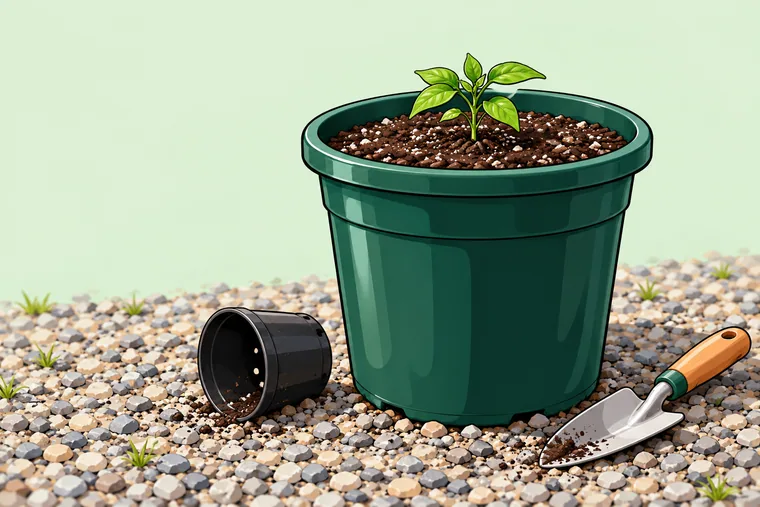
A pot is a small tank, and in July a big pepper empties it in a day. UW–Madison says container peppers need little water while small, but daily water once they grow, the weather warms and fruit sets5. Maryland adds that bigger volumes of mix hold more water and need watering less often than small pots6, so the size of your pepper pot sets how often you water.
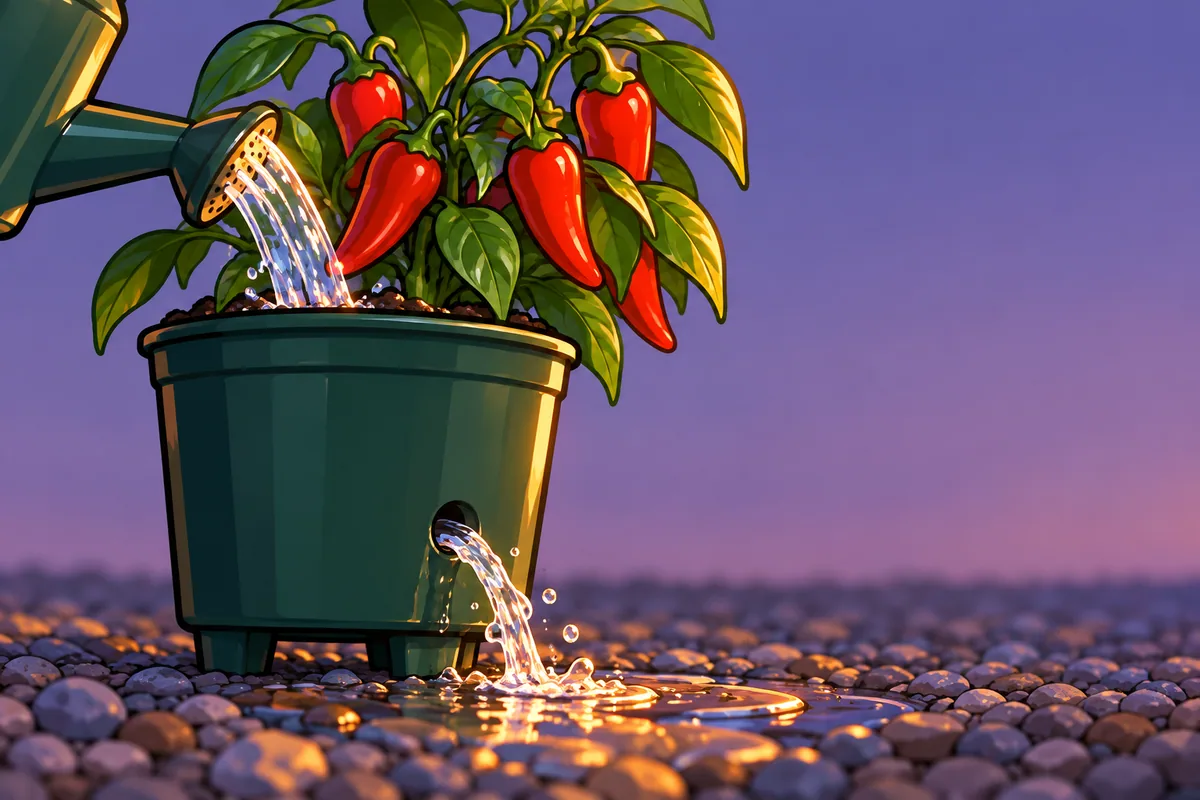
Maryland's container rules are short. Check by pressing a finger into the mix, water until water starts to run out of the drainage holes, water at the base and not the leaves, and empty the saucer after watering or rain6. Several shallow waterings, the same page says, do much less than one long one.
If your pot dried out hard, watch for the gap. Dry mix shrinks away from the side, and water then runs down the gap and out while the root ball stays dry; Maryland sets the pot halfway into a bucket of water until the surface is moist6.
Every watering also washes some food out of your pot. Maryland says watering leaches nutrients from containers, so long-season crops such as peppers may need a light feed every 2 weeks6. If your daily-watered pepper starts to pale, your feeding schedule is the next thing to check.
Your next step is to set your rhythm by the table above and log the first two weeks: the date, the rain, how much you gave and how the soil felt the next morning. After two weeks you know your own garden's number. Pair the watering with the feeding and mulching jobs in the pepper care calendar, so one walk to the garden covers all three.