On this page
- 1How far apart should you plant peppers?
- 2Which gap should you pick?
- 3Can you plant peppers closer together?
- 4How do you space peppers in a raised bed?
- 5How many pepper plants fit in a square foot?
- 6Does wider spacing keep pepper leaves healthier?
- 7What goes wrong when the spacing is off?
- 8How tall do pepper plants grow?
- 9Does closer spacing give you more peppers?
- 10How far apart should different pepper varieties be?
- 11What about peppers in pots?
- 12Marking out your row
- 13Sources
How far apart should you plant peppers?
Plant your peppers about 18 inches apart, in rows 30 to 36 inches apart. That is UMN Extension's figure1, and most other extension guides land within a few inches of it. The table shows each one, so you can pick the source closest to your climate.
| Between plants | Between rows | Notes |
|---|---|---|
| 18 inches | 30–36 inches | Closer if temperatures run below 60°F 1 |
| 12–24 inches | 30–36 inches | Double staggered rows in 2-foot beds also work well 2 |
| 12–18 inches | 24–30 inches | 3 |
| 18 inches | 18–24 inches | Transplants 4 |
| 12 inches; pimentos 18–24 inches | 3 feet; pimentos 42 inches | 5 |
| 8–14 inches | Rows 24–30 inches wide | Transplants in home gardens 6 |
| 18–24 inches | 3–5 feet | Transplants; seeded plants thinned to 2 feet 7 |
| 9–15 inches (8–13 plants per 10 feet) | 15 inches minimum | Rows can shrink or go if plants are spaced right 8 |
Eighteen inches between plants is the one figure most of the eight guides allow, so start there unless you have a reason to move. UF/IFAS Gardening Solutions adds that the right gap depends on the variety, so check your seed packet too9.
The spread has a pattern you can use. The tightest gaps come from New Mexico and Florida, where long, hot seasons and small-podded chiles are common, and the widest from California, where UC IPM grows plants in rows 3 to 5 feet apart7. Your own bed sits somewhere in between.
How many pepper plants fit in a row?
Divide your row length by the gap. UF/IFAS counts plants per 10 feet of row the same way: 8 to 13 plants at 9 to 15 inches8.
| Gap between plants | Plants per 10 feet | How we got it |
|---|---|---|
| 12 inches | 10 | 120 ÷ 12 = 10 |
| 18 inches | 6 | 120 ÷ 18 = 6.7, rounded down |
| 24 inches | 5 | 120 ÷ 24 = 5 |
So a flat of six transplants fills one 10-foot row at 18 inches, and a 12-foot row takes eight (144 ÷ 18 = 8).
Which gap should you pick?
Ask yourself three questions about your garden, in this order. The tree below gives the gap each answer leads to.
- Summers below about 60°F?UMN plants closer in cool weather
- yesGo closer, feed moreFertilizer at planting and again in summer
- yes
- A narrow raised bed?About 2 feet wide
- yesTwo staggered rows12–24 inches apart in each row (UMD)
- yes
- A tall type?Serrano, tabasco, Thai chili, superhots
- yes24 inches and a cageThe wide end of UMD's range
- yes
- none of these18 inches, rows 30–36 inchesUMN's figure
Sources for this line1. University of Minnesota Extension2. University of Maryland Extension10. University of Florida IFAS Extension
Small and compact varieties let you go the other way. UC IPM says peppers suit a small garden if you grow compact varieties7, and ornamental peppers stay at 10 to 20 inches tall9, so the 12-inch end of the range fits them.
Clemson is one of the few guides that sizes the gap to the plant. It gives most peppers 12 inches in rows 3 feet apart, but pimentos 18 to 24 inches in rows 42 inches apart5. If your seed packet says the plant spreads wide, follow the packet over any general figure.
Can you plant peppers closer together?
Yes, in a cool summer, if you feed them for it. UMN Extension says to set plants closer together when temperatures run below 60°F, and notes that closer spacing calls for fertilizer at planting and again during the summer1. The light side-dressings in the fertilizer guide cover that second feed.
Leaf cover matters at any spacing. Sunscald hits pods on small plants and under gaps in the leaf canopy, leaving flat tan patches1, so plants set so far apart that they stay sparse leave more fruit in the sun. Utah State also ties sunscald to fruit exposed to hot, dry sun and keeps good leaf cover to prevent it4.
How do you space peppers in a raised bed?
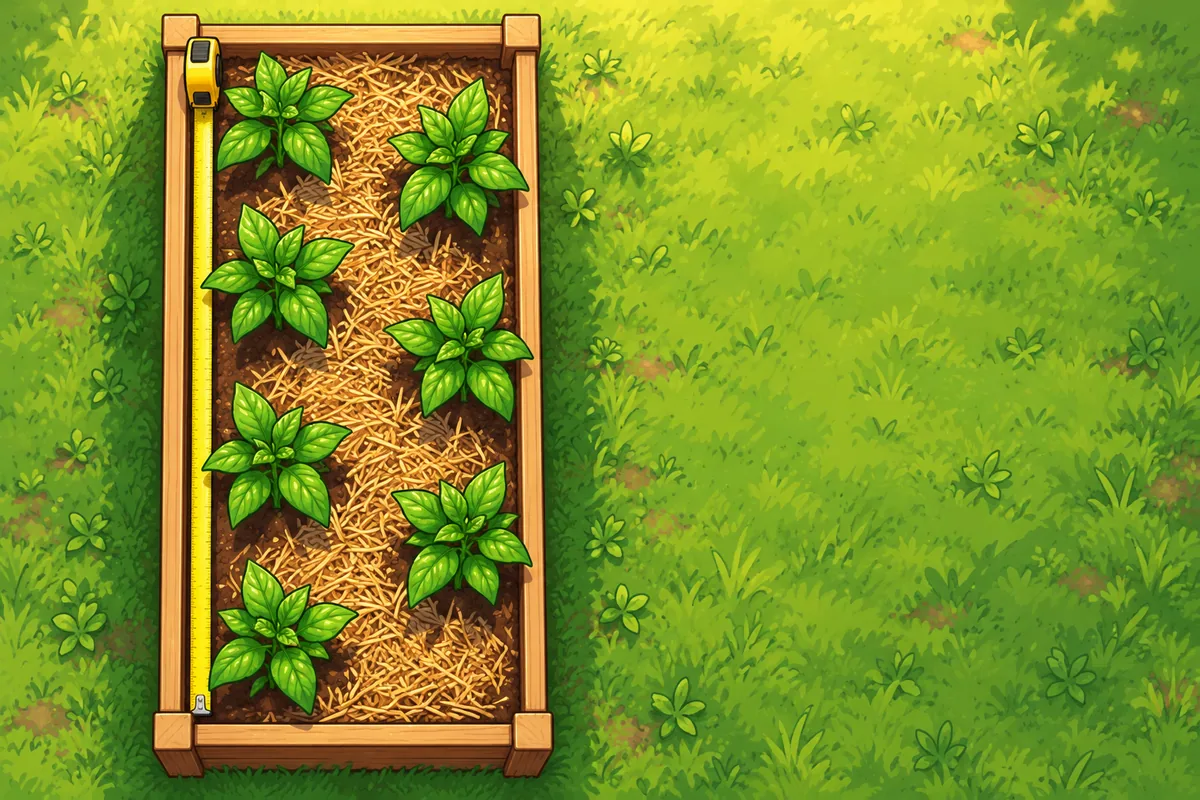
Run two staggered rows down a bed about 2 feet wide. UMD Extension says double, staggered rows in 2-foot beds work very well2; each plant sits across from a gap in the other row, so your plants get room without a wide path between them.
A worked 4-by-8 bed
Many home beds measure 4 by 8 feet, which is 48 by 96 inches. Utah State sets transplants 18 inches apart in rows 18 to 24 inches apart4. Two rows 24 inches apart, each 12 inches in from the long edges, fit across the 48 inches.
Along the 96 inches, plants at 18 inches give 5 per row (96 ÷ 18 = 5.3, rounded down). That makes 10 plants in the bed. Stagger the second row by 9 inches and each plant faces a gap, the same zigzag UMD uses in its narrow beds2.
How many pepper plants fit in a square foot?
One. The University of Wisconsin-Madison Extension notes on square foot gardening list peppers at 1 plant per square, and they tell you to set a bell pepper in the center of its 1-foot square11. That is far tighter than the row figures above, so check what each method gives one plant:
| Method | Layout | Square feet per plant |
|---|---|---|
| Square foot bed11 | 12 × 12 inches | 1.0 |
| Utah State rows4 | 18 × 18–24 inches | 2.25–3.0 |
| UMN rows1 | 18 × 30–36 inches | 3.75–4.5 |
| UC IPM rows7 | 18–24 × 36–60 inches | 4.5–10 |
Put that on the 4-by-8 bed above and the difference shows. At 32 square feet, a square-foot layout holds 32 plants, and Utah State's rows hold 10. The UF/IFAS yield figure we used earlier, about 5 pounds from 10 feet of row, gives you no sign that 3 times the plants give 3 times the pounds8.
So should you copy the square-foot grid? Only with a plan to feed and water for it. UMN pairs closer spacing with fertilizer at planting and again in summer1, and the Wisconsin notes say fruit crops such as peppers like deep, less frequent watering, not light daily sprinkles11. In a bed you can reach from both sides, the grid works. In a bed with a tall type like a serrano, give the plant two squares and a cage.
Does wider spacing keep pepper leaves healthier?
It helps, because dry leaves get sick less often, but no extension guide we read puts a number on it. The University of Kentucky plant pathology team tells growers to space plants for maximum air circulation, to prune to keep air moving through the canopy in early summer, and to rotate out of peppers for at least 3 years12. It also says to stay out of the planting when the foliage is wet, because you carry disease on your hands and tools12.
Here is what that means in your garden:
- Start from 18 inches between plants, and go wider if your summers run warm and wet, when leaf disease spreads fastest.112
- Pick one or two crossing branches in the middle of a bushy plant so air passes through. Keep the leaves that shade the pods.112
- Do your picking and tying after the dew dries, not while the leaves are wet.12
- Rotate away from peppers for 3 years; UMN also counts tomatoes, potatoes, eggplants and tomatillos.112
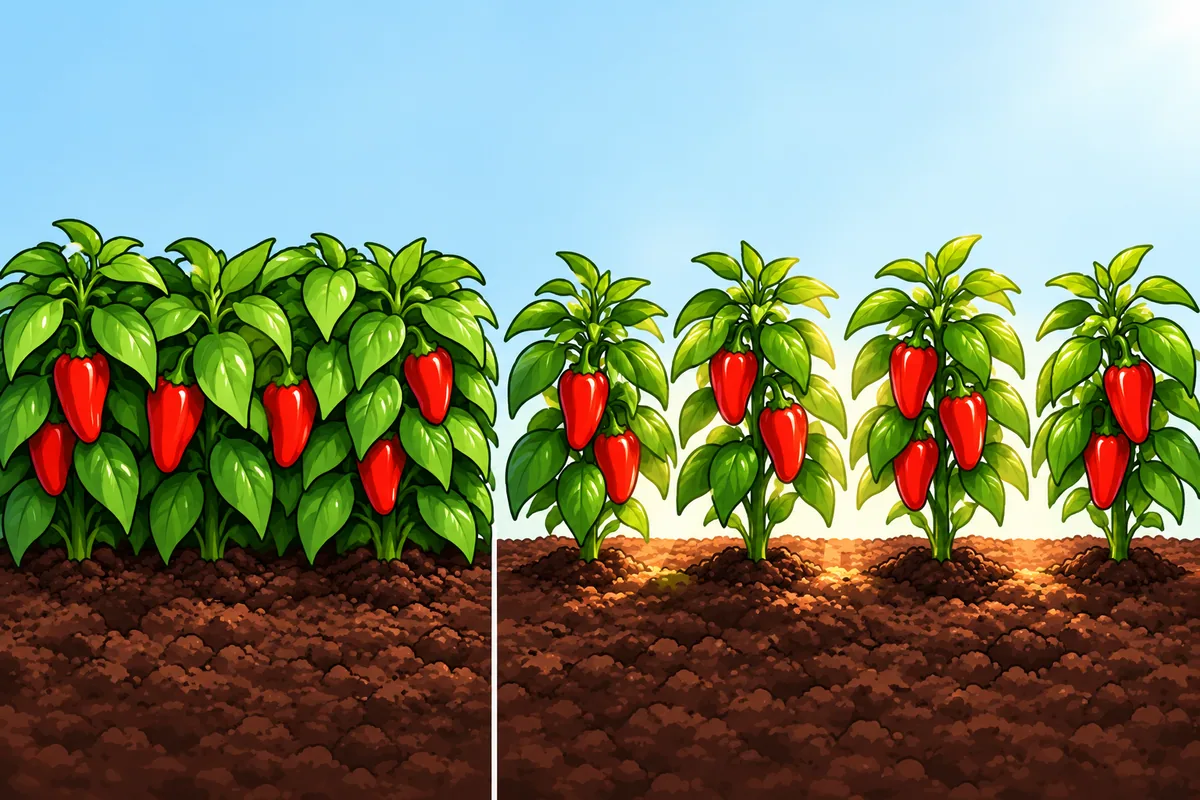
Keep the sunscald trade in mind. Wide gaps and heavy pruning open the canopy and leave pods in the sun1, so in a hot, dry climate you keep the leaves and in a damp one you open the center a little.
What goes wrong when the spacing is off?
You see it by midsummer, in your pods and in your paths. Here are the signs and what each one tells you about next year's gap.
- Pale, tan, flat patches on the sunny side of pods. That is sunscald, and it hits fruit under gaps in the leaf cover1. Your plants sit too far apart, or they stayed small; next year close the gap a few inches.
- Tall plants leaning or splitting under fruit. Pepper stems turn brittle, and UMD supports the plants with cages or short trellises2. A crowded row leaves you no room to add a cage once the plants are big, so staking belongs at planting time.
- Plants in a cool garden that never fill the row. UMN plants closer when temperatures run below 60°F1; your 24-inch gap may be too wide for your summer.
- Peppers struggling where tomatoes grew last year. That one is a spot problem, not a gap problem. UMN keeps peppers off ground that grew tomatoes, potatoes, peppers, eggplants or tomatillos for three or four years1.
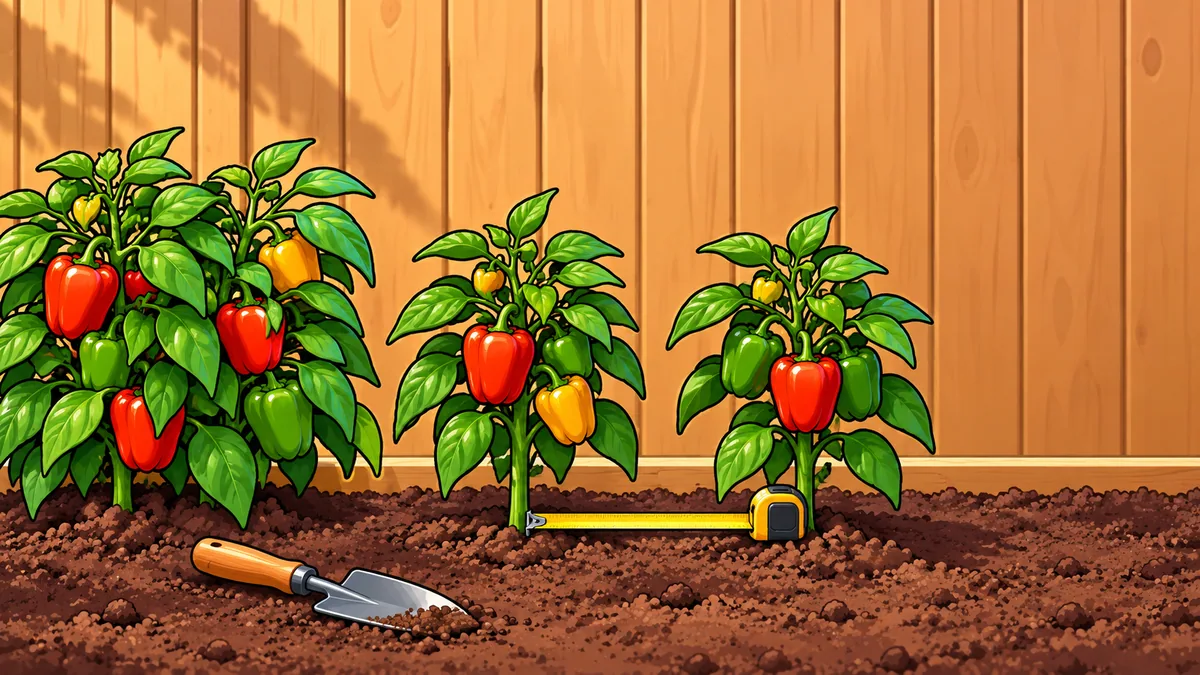
Pepper Geek shows what happens when pepper plants stand too close together, which gives you a grower's view of the crowding problems above before you mark out your own row.
How tall do pepper plants grow?
Most of the peppers you grow will reach 2 to 4 feet tall. UMD Extension says peppers grow on bushy plants that can reach 3 to 4 feet, with stems that turn brittle, so it supports them with cages or short trellises2. Penn State gives a wider range for peppers in general, 1.6 to 4.9 feet3, and some chiles go much taller where the season never ends.
| Pepper | Height | Where the figure comes from |
|---|---|---|
| Peppers in general | Up to 3–4 feet | UMD Extension, Maryland gardens 2 |
| Peppers in general | 1.6–4.9 feet | Penn State PlantVillage 3 |
| Jalapeño ('Early Jalapeño') | Taller than 24 inches | The seed seller, for its own variety 14 |
| Cayenne | 2–4 feet | UF/IFAS, Miami-Dade plantings 10 |
| Serrano | Up to 5 feet | UF/IFAS, Miami-Dade plantings 10 |
| Tabasco | About 60 inches | UF/IFAS, Miami-Dade plantings 10 |
| Thai chili | Up to 6 feet, as a perennial | UF/IFAS, Miami-Dade plantings 10 |
| Carolina Reaper | 36–48 inches | The seed seller, for its own seed 15 |
| Ornamental peppers | 10–20 inches | UF/IFAS Gardening Solutions 9 |
The Florida heights come from plants that keep growing through a frost-free year, so a summer-only garden farther north usually ends shorter. Give the tall types the wide end of the range, 24 inches, and a cage at planting time, before the roots fill the spot.
How tall does a jalapeño grow? No extension page read for this guide gives a figure, but the seed seller puts its Early Jalapeño at over 24 inches14, inside the general pepper ranges above, so 18 inches apart suits it. The guide to growing jalapeños covers that plant's own size and season.
Superhots sit at the tall end. If you grow one, the Carolina Reaper plan works from seller heights of 36 to 48 inches and up to 5 feet15, so you give each plant 24 inches and a stake from the first day.
Does closer spacing give you more peppers?
Per row, a little; per plant, no, and your wallet notices the difference first. UF/IFAS expects about 5 pounds from 10 feet of row at 8 to 13 plants8, and UMD gives 2 to 8 pounds per 10-foot row2. Neither guide promises you more pounds for more plants.
Work out the UF/IFAS figure per plant and you get about 0.4 to 0.6 pounds each (5 ÷ 13 to 5 ÷ 8). Plant the same row at 18 inches with 6 plants, and each one has more room to carry its share. You save money on transplants and lose little or nothing in the harvest, which is why we treat 18 inches as the default.
How far apart should different pepper varieties be?
Next to each other is fine for eating. The distance matters only if you save seed. Maryland says peppers are largely self-fertile, but insects carry pollen between plants, so seed saved from year to year can come out different2.
To keep seed true, Maryland screens plants from insects or separates varieties by 500 feet2. In a home garden that distance is rarely possible, so you bag a few flower buds on the plant you want seed from before they open. The pods on your sweet bell will not turn hot from a habanero next door this year; only the seeds inside carry the cross. Next year's plants grown from those seeds are where you would see it, in pod shape, color or heat.
What about peppers in pots?
In a pot, the pot does the spacing. UMD Extension sets 5 gallons as the minimum container for a pepper2, and UW–Madison adds a depth of 12 to 18 inches16. One plant per pot is the rule both use.
Your pots still need space between them. Set them far enough apart that the leaves do not shade each other's pods, for the same sunscald reason as in the ground1. The hub on growing peppers in pots covers depth, mix and watering.
Marking out your row
Mark the spots before the plants leave their pots, so you are not guessing with a root ball in your hand.
- 1
Pick a fresh spot
Choose ground that has not grown tomatoes, potatoes, peppers, eggplants or tomatillos for three or four years.1
- 2
- 3
Mark each plant
Push a stake or stick in every 18 inches along the row.1
- 4
Add cages for the tall types
Set cages or short trellises now; pepper stems turn brittle as they grow.2
- 5
Dig and plant
Dig each hole the size of the root ball, set the plant at its old depth, firm the soil and water it in.1
Your plants will fill the gaps by midsummer. If you are still waiting on warm soil, the planting date guide gives the day to aim for, and the first feed comes about 4 weeks after the plants go in4.