


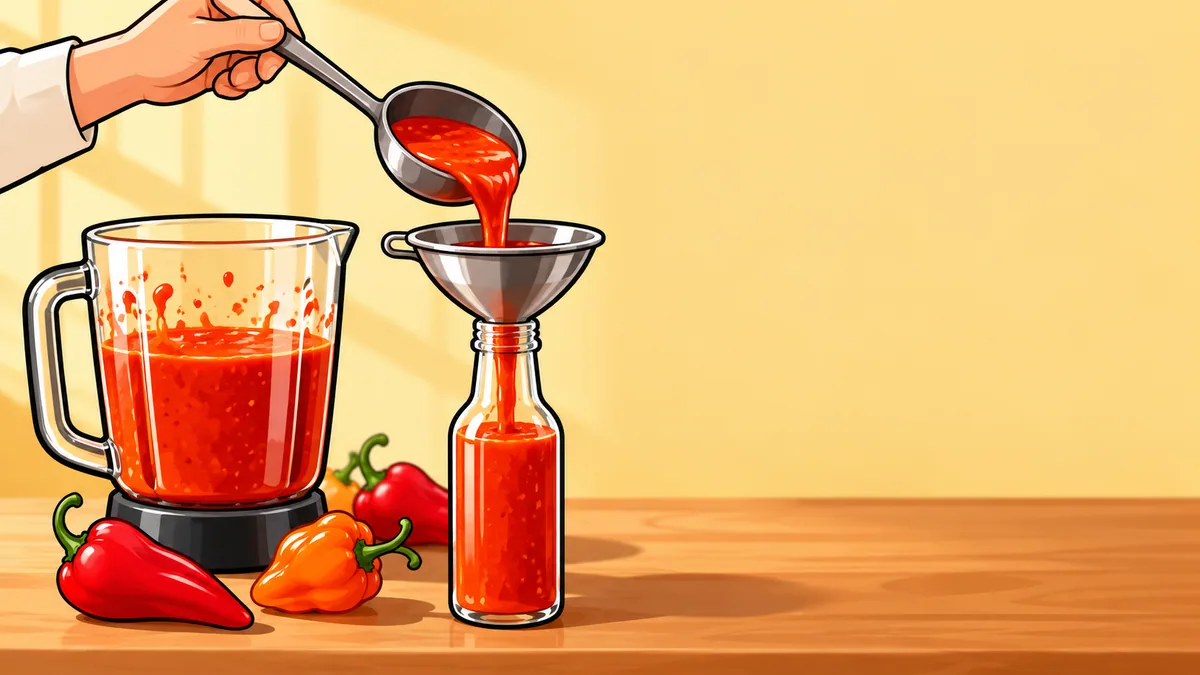
How to Make Hot Sauce at Home, 3 Safe Routes
Pick a route by how long you want the bottle to last.
Short answer
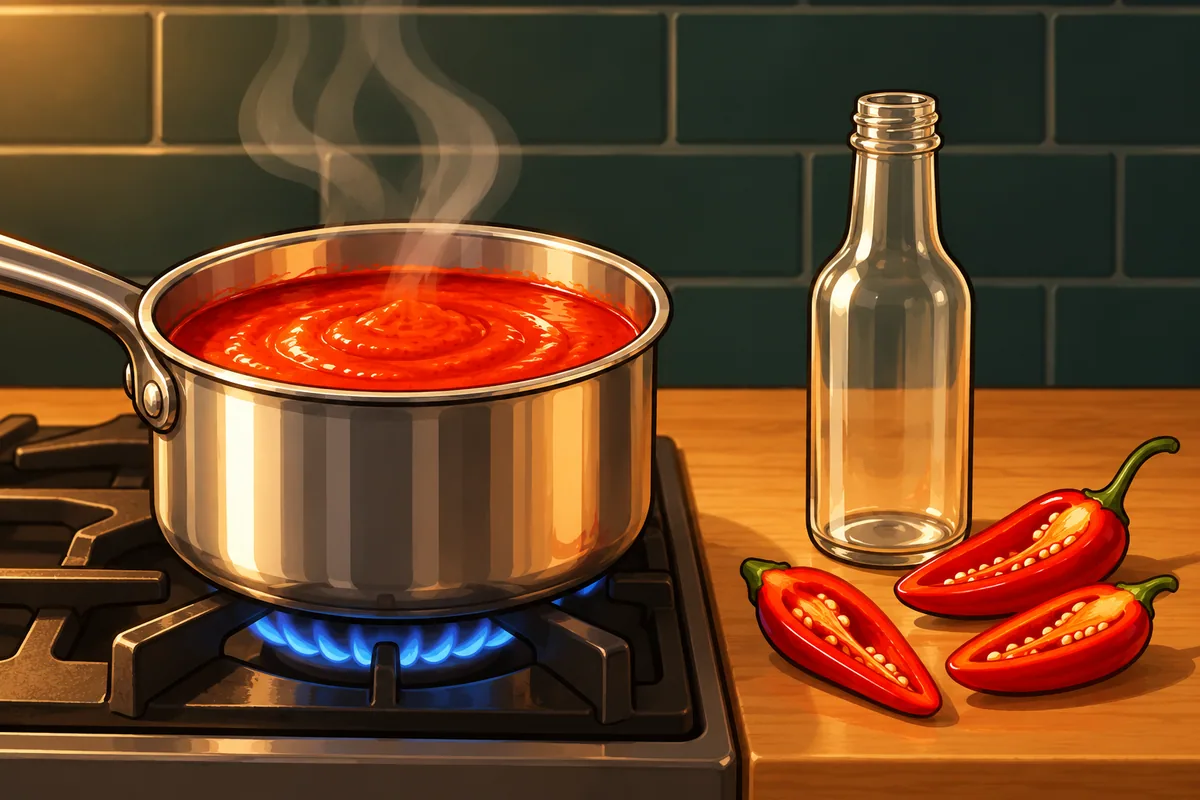
Blend peppers with an acid until the sauce sits at pH 4.6 or below, bring it to a boil, then refrigerate, freeze or can it by a tested recipe.
- Use vinegar of at least 5 % acidity
- A canned sauce needs a tested recipe and 10 minutes in a boiling-water canner up to 1,000 feet
- A sauce you do not can goes in the fridge or freezer
Pick your route
What are the ways to make hot sauce?
All three end at the same line: a finished sauce at pH 4.6 or below.4 Pick by how long you want the bottle to last.
How long should it last?
-
 Fresh vinegar sauce
Fridge sauce
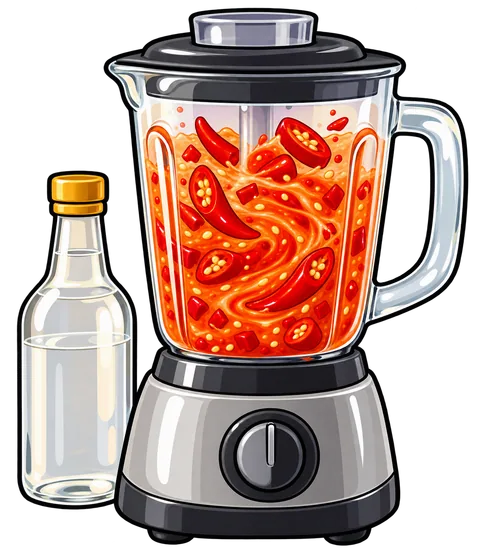
Blend the peppers with vinegar or lime juice and bring the sauce to a boil.14
- Acid
- Vinegar or lime juice added to the peppers
- Heat step
- Bring to a boil
- Time
- One cooking session
- Keeps
- Fridge or freezer; use it relatively quickly
-
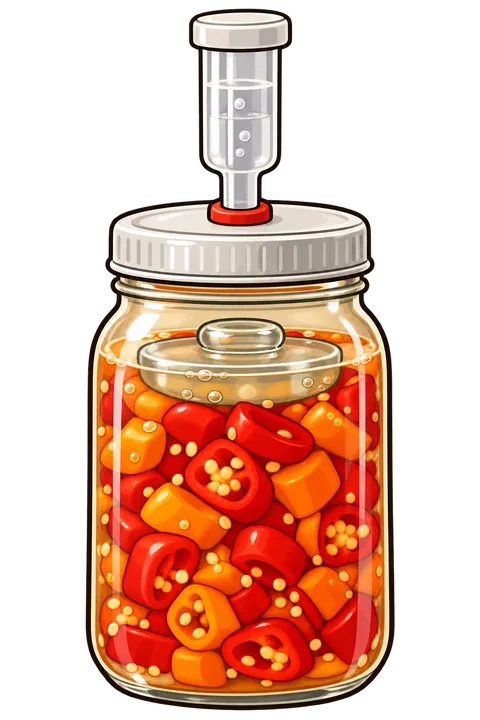 Fermented
Ferment
Salt sours the chiles for you: bacteria in the brine make lactic acid.79
- Acid
- Lactic acid from bacteria in a salt brine
- Heat step
- None
- Time
- 3–6 weeks at 65–72°F
- Keeps
- Fridge; fermented vegetables keep many months there
-
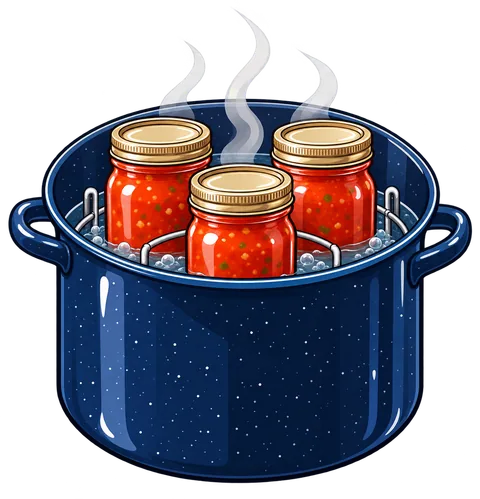 Cooked and canned
Canned tested recipe
Cook a tested recipe and process the jars in a boiling-water canner.1
- Acid
- 5 % vinegar in the amounts the recipe sets
- Heat step
- Boiling-water canner, 10–20 minutes by altitude
- Time
- 35 minutes on the stove, then the canner
- Keeps
- Sealed jars; follow the recipe exactly
Nothing matches this filter yet.
From pepper to bottle
How long does each route take?
Each lane runs in order; the lanes are not drawn to one time scale.
Fridge sauce
Ferment
The brine ratio
How much salt goes in a ferment?
Weigh it: salt is a percentage of the chile weight for a mash and of the water for a brine.
- Pepper mash2–2.5 %of the chile weight, no water500 g chiles take 10–12.5 g salt9
- Brine, chopped chiles3 %of the water weight1 quart water takes 27 g salt6
- Brine, whole pods5 %of the water weight1 quart water takes 45 g salt6
The mash grams are our arithmetic on the review's 2.0–2.5 %. Do not cut the salt: in some low-salt ferments the pH climbed back above 4.6.9
On this page
How do you make hot sauce from fresh peppers?
You simmer your peppers with vinegar and salt, push the mix through a food mill, then bottle and either chill it or can it. The tested version below comes from Ohio State University Extension, which drew it from the National Center for Home Food Preservation1.
If you want a jar for the pantry, use a tested recipe and keep its amounts exactly as written. Ohio State warns that recipes from elsewhere may not be appropriate for canning1. The ferment route has its own step-by-step fermented hot sauce page with the salt math.
What goes in
| Ingredient | Amount | Note |
|---|---|---|
| Canned diced tomatoes, with liquid1 | 8 cups | The base and part of the acid |
| Serrano peppers, seeded and chopped12 | 1½ cups | The heat; serranos run 10,000–25,000 SHU |
| Distilled white vinegar, 5 % acidity1 | 4 cups | Do not use weaker vinegar |
| Canning salt1 | 2 teaspoons | |
| Mixed pickling spices, whole1 | 2 tablespoons | Tied in a spice bag |
Past the ingredients, the Ohio State recipe asks for three pieces of gear, and here is what to look for in each.
Gear for the tested hot sauce recipe
The Ohio State recipe needs a food mill, half-pint jars and a boiling-water canner.
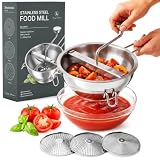
Food mill
You push the cooked pepper mix through it to leave skins and seeds behind, as the Ohio State recipe directs.
- How often: One pass per batch, after the first simmer
- View on Amazon: Half-pint canning jars with two-piece lined metal lids
Half-pint canning jars with two-piece lined metal lids
You fill clean, hot jars with the finished sauce and close them with two-piece lined metal lids.
- View on Amazon: Boiling-water canner
Boiling-water canner
You process the filled jars in it so a pantry jar stays safe.
1 source
As an Amazon Associate we earn from qualifying purchases. We choose product types from what their labels and extension sources say; the commission does not change what we recommend. Our affiliate disclosure
The steps
- 1
Heat the jars
Wash and rinse canning jars and keep them hot. Prepare the lids as their maker directs.1
- 2
Boil, then simmer
Put the pickling spices in a spice bag, add everything to a pot and bring it to a boil. Simmer about 20 minutes, stirring often, until the tomatoes are soft.1
- 3
Mill and cook again
Take out the spice bag. Press the mix through a food mill, then return it to the heat for 15 more minutes.1
- 4
Fill the jars
Fill the hot jars, leaving ¼ inch of headspace. Wipe the rims with a damp clean paper towel and put on two-piece lids.1
- 5
Process or chill
Process in a boiling-water canner for the time in the table below. If you skip canning, cool the sauce and freeze or refrigerate it instead.1
- 6
Check the seals
Let the jars cool undisturbed for 12 to 24 hours, then check that each lid has sealed.1
How long to process at your altitude
Want a thinner, pepper-forward sauce without tomato? That changes the acid balance, so it stops being this tested recipe. Keep it in the fridge rather than the pantry.
The UF/IFAS Extension office in Hillsborough County, Florida, shows how to make hot sauce in about three minutes, so you can watch the blending first, while the tested Ohio State amounts above stay the recipe for any jar you can.
What makes homemade hot sauce safe?
Acid does most of the work for you. Below pH 4.6 the botulism bacteria cannot grow, and federal rules use that same line to define an acidified food45.
- Use vinegar of at least 5 % acidity.1
- Bring a fresh sauce to a boil. Boiling kills Salmonella and Listeria cells, but botulism spores survive, so the acid still has to be there.4
- Can only from a tested recipe, such as those from the National Center for Home Food Preservation, and keep its amounts as written.14
- Wear gloves while you cut hot peppers if they irritate your skin.1
- Planning to sell? You have to follow state and federal rules for acidified foods, and South Dakota, for one, wants the recipe reviewed and the sauce pH-tested.14
Which peppers make the best hot sauce?
The one whose heat you like eating. A jalapeño runs 2,000–8,000 SHU and a serrano 10,000–25,0002, which is why the Ohio State recipe above, built on serranos, comes out with a real bite.
A habanero runs 100,000–350,000 SHU and brings a fruity, citrus-like flavor2, so the same recipe made with it lands somewhere else entirely. Keep the pepper a tested canning recipe names, though; habaneros get their own habanero hot sauce recipe for that reason.
The peppers ranked for hot sauce list heat and flavor side by side, so you can pick before you shop.
Can you change a tested recipe?
Only if the jars go in your fridge or freezer instead of the pantry. Ohio State says you follow a canning recipe as written so the finished sauce cannot support the growth of C. botulinum, and warns that recipes from elsewhere may not be safe to can1.
The reason is the acid balance. Tomatoes, vinegar and lemon juice raise the acidity, and overripe tomatoes may be less acidic1, so even a swap of produce quality moves the number your safety depends on. Extra garlic, onion or a different pepper changes it too.
What goes wrong in a first batch?
Most problems in a first batch are small and fixable, and you can spot each one before anyone tastes the sauce. The table lists the common ones with the move you make.
| What you notice | What to do |
|---|---|
| Your fingers or eyes sting after cutting peppers1 | Wear gloves next time, wash your hands with soap and water, and keep your hands away from your eyes |
| A jar lid still flexes after 12–24 hours of cooling1 | That jar did not seal; it does not count as canned, so keep it cold and use it first |
| The sauce runs thinner than you hoped1 | For an untested fridge sauce, simmer it down; Ohio State thickens its barbecue sauce by simmering, but leave a tested canning recipe as written |
| Fuzzy mold or a rotten smell on a ferment6 | Throw the whole batch out |
| The ferment keeps getting more sour7 | Blend it once the taste suits you and move it to the fridge |
Our habit for every batch: write the date, the route and the recipe on a strip of tape on each bottle. When you open it in three months, you know whether it is a fridge sauce to use up or a canned jar from a tested process.
Can you make a Louisiana-style sauce at home?
Yes, as a ferment with vinegar added at the end. TABASCO, the classic of the style, ages a salted pepper mash in white oak barrels for up to three years, then blends it with distilled vinegar for 28 days8.
At home the same idea takes weeks: blend red chiles with 2.0–2.5 % salt by weight, ferment the mash until its pH falls below 4.69, then blend in 5 % vinegar to taste1. A worked batch: 500 g of chiles takes 10–12.5 g of salt. The Louisiana-style page covers the bottles that define it.
Your first batch, start to finish
Buy the five ingredients in the table and decide before you start whether your jars go in the canner or the fridge. The pot needs about 20 minutes of simmering, then 15 more after the food mill1.
A batch you do not can goes in the fridge or freezer once it cools. Wondering how long a bottle keeps after that? Whether hot sauce goes bad depends on which of the three routes made it.
More in Hot Sauce
The newest from Hot Sauce
-
Fermented Hot Sauce in 7 Steps, With a 3 % Salt Brine
Salt ratio, timing and the signs it is done.Oct 18, 2026 · Guide -
Louisiana-Style Hot Sauce, 3 Ingredients
Three ingredients, a long wait and a thin, sharp pour.Oct 18, 2026 · Guide -
Mexican Hot Sauce, 5 Bottles by Chile and Heat
The bottle on every taquería table, read off its makers' own pages.Oct 18, 2026 · Guide -
Peri Peri Sauce, What It Is and a 10-Chilli Base Recipe
Bird's eye chillies, lemon and garlic, brushed on over the coals.Oct 18, 2026 · Guide -
Does Hot Sauce Go Bad? Shelf Life for 7 Kinds of Sauce
What changes in the bottle, how fast, and when to let it go.Oct 18, 2026 · Guide -
Caribbean Hot Sauce and the 350,000 SHU Scotch Bonnet
Scotch bonnet heat, softened with vinegar, onion and island herbs.Oct 18, 2026 · Guide
Sources
· 9
- 1Ohio State University Extension (CFAES) HYG-5365: Food Preservation: Making and Preserving Barbecue and Hot Sauces (Snyder; revised by Arnold)
- 2University of Florida IFAS Extension HS-859/TR010: Pepper Production in Miami-Dade County, Florida
- 3UF/IFAS Extension Hillsborough County Plant Your Plate: Peppers - Hot Sauce 101 | Homegrown Hillsborough
- 4SDSU Extension How to Make a Safe Hot Sauce (Curtis Braun)
- 5U.S. Code of Federal Regulations, 21 CFR 114.3 (via Cornell LII) Acidified foods: definitions
- 6University of Illinois Extension Fill Your Pantry: Fermenting Foods
- 7K-State Research and Extension MF3491: Taking a New Look at Fermented Foods (Donna Krug)
- 8McIlhenny Company (manufacturer, own product) About Our Barrels
- 9Food Protection Trends 40(4):251-263 (peer-reviewed) Manufacture of Traditionally Fermented Vegetable Products: Best Practice for Small Businesses and Retail Food Establishments (Snyder, Breidt, Andress, Ingham)


Coming soon
Your pocket pepper index.
Built from the same index as this site.
- Every entry offline
- Compare any two peppers
- Keep a list of peppers you have tried