On this page
- 1How long does hot sauce last?
- 2Why do some sauces keep longer than others?
- 3Does hot sauce need to be refrigerated?
- 4Does sriracha need to be refrigerated?
- 5What about chili garlic sauce, sweet chili sauce and chili paste?
- 6Can you freeze hot sauce?
- 7Why does hot sauce turn dark?
- 8How can you tell hot sauce has gone bad?
- 9Does hot sauce expire?
- 10How long does home-canned hot sauce keep?
- 11What do you do with a jar that looks wrong?
- 12Is the fridge door cold enough for hot sauce?
- 13Sorting the bottles in your fridge door
- 14Sources
How long does hot sauce last?
It depends on who made it and how. A bought vinegar sauce lasts until its Best By date and fades slowly after you open it; a homemade sauce lasts as long as its acid and your fridge let it.
| Kind of sauce | Sealed | Once opened | Where to keep it |
|---|---|---|---|
| Bought vinegar sauce (example: Cholula Original)1 | Until the Best By date on the bottle | Best within 6 months; still fine after that if inside the Best By date | Cupboard; the maker says no fridge needed |
| Bought vinegar sauce (example: Frank's RedHot)2 | 24 months from the day it was made | Use by the date on the bottle; good flavor for a few weeks past it if refrigerated | Either; the maker says the fridge helps flavor but is not necessary |
| Bought sauce sold chilled, or labeled "refrigerate after opening"34 | Follow the label | Follow the label | Fridge |
| Homemade fermented sauce5 | Not sealed; it keeps fermenting at room temperature | Many months | Fridge |
| Homemade fresh sauce, not canned6 | Not sealed | Use it relatively quickly | Fridge or freezer |
| Homemade sauce canned by a tested recipe6 | Sealed jar from a boiling-water canner | Treat like a fresh sauce once open | Cupboard until opened |
| Homemade chiles or garlic in oil7 | Not sealed | No more than 4 days at 40°F or colder | Fridge, or the freezer for several months |
A bottle from the shelf at the store goes back on a shelf at home; a sauce you made yourself goes in the fridge unless you canned it from a tested recipe. The storage notes in the canned row are our reading; Ohio State gives no keeping time for its canned sauce, sealed or open6.
The oil row is the one to take seriously. NCHFP warns that garlic in oil left at room temperature risks botulism, and it gives you 4 days in the fridge at 40°F or colder before you freeze or toss it7. We apply the same limit to a homemade chili paste that sits under oil.
Why do some sauces keep longer than others?
Four things in the bottle decide how long it lasts. Once you know them, you can read any label and make a good guess.
- Acid. A sauce at pH 4.6 or below stops botulism from growing8. Vinegar does most of that work in bought sauces; Ohio State asks for vinegar with at least 5 % acetic acid and notes that tomatoes and lemon juice raise the acidity too6.
- A heat step and a seal. A sauce you boil and seal in a canner by a tested recipe can wait in the cupboard; one you only cook and bottle cannot6.
- Live cultures. A finished ferment sits at a low pH with its sugars used up, so the review sees no safety risk at room temperature, only softer texture, and still advises the fridge9.
- Oil. Oil does not preserve anything. It is why your homemade chili oil gets the shortest window on this page7.
Does hot sauce need to be refrigerated?
A bought vinegar sauce does not, for safety. A safe hot sauce sits below pH 4.6, where botulism bacteria cannot grow8, and federal rules use the same 4.6 line to define an acidified food10.
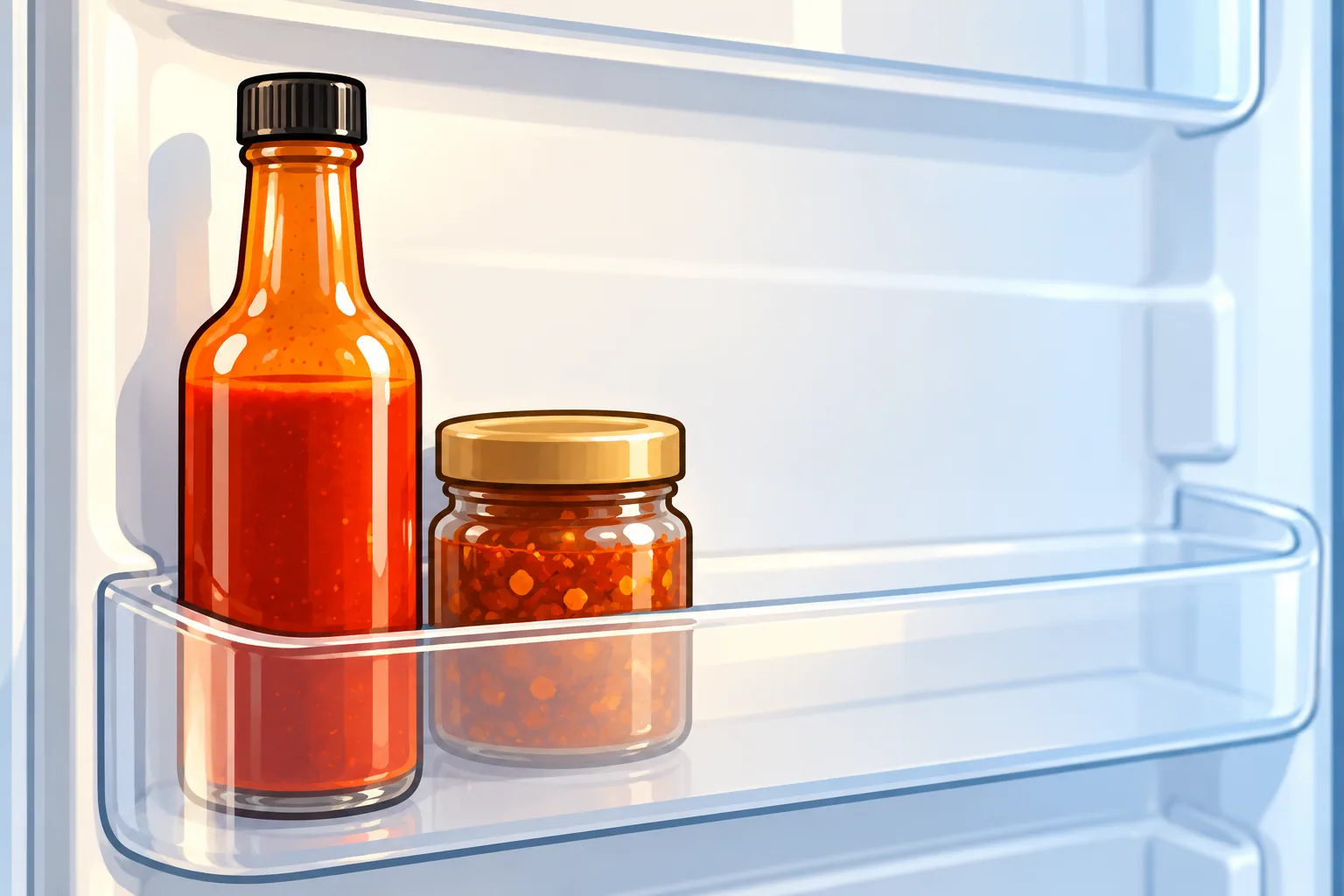
The fridge still helps with quality. UGA Extension's Carla Schwan says a "refrigerate after opening" notice may concern quality more than health, and that sauces darken and fiery flavors fade more slowly in the cold3. Frank's says the same of its own bottle: the fridge helps the flavor, and you can skip it if you like your sauce at room temperature2.
Fine in the cupboard
Needs the fridge
- What it is
- Anything bought chilled, any fermented sauce, any fresh homemade sauce you did not canSources for this line3. University of Georgia (UGA Today), quoting Carla Schwan, Extension food safety specialist5. K-State Research and Extension6. Ohio State University Extension (CFAES)
- What happens if you skip it
- A ferment turns very sour and ripens past palatability and safety5
So can you leave hot sauce out on the table through dinner? A shelf-stable bottle, yes; that is where it lives anyway. Your own fresh or fermented sauce goes back in the fridge when you clear the plates.
Does sriracha need to be refrigerated?
Huy Fong's own website does not say either way. Here is what the maker's site does and does not tell you about its sriracha11:
- It warns that its bottles may build up gas, and asks you to open the cap and seal with care, facing the bottle away from yourself and others.
- It gives no storage instruction, no shelf-life figure and no fridge advice for Sriracha, Chili Garlic or Sambal Oelek.
So read the label on your bottle, and go by the rule above: a sauce you bought off a room-temperature shelf can sit on one at home. If you like it bright red, the fridge slows the darkening3.
How long does sriracha last, then? Until the date printed on your bottle, the same way Cholula and Frank's date theirs12. After that, you judge it by the spoilage signs below, never by color alone.
What about chili garlic sauce, sweet chili sauce and chili paste?
Go by the label, because most makers' pages we read say nothing on storage. The one exception in our reading is Thai Kitchen, which prints "Refrigerate after opening" on its sweet red chili sauce page4.
| Product | What the maker's page says | Where to keep it once open |
|---|---|---|
| Huy Fong Chili Garlic and Sambal Oelek11 | No storage line; the site warns the bottles may build gas | Follow the label on your jar |
| Lee Kum Kee Chili Garlic Sauce12 | Lists rice vinegar and acetic acid; no storage line | Follow the label on your jar |
| Thai Kitchen Sweet Red Chili Sauce4 | "Shake well before using. Refrigerate after opening." | Fridge |
| Any jar bought from the chilled shelf3 | Varies | Fridge |
| Homemade chili or garlic paste in oil7 | Not a bought product | Fridge, 4 days at most, or freeze |
UGA Extension's rule of thumb covers the rest: if you bought it from the refrigerated section, keep it in the fridge at home3. A jar of sweet chili sauce or gochujang that says "refrigerate after opening" goes in the fridge once you break the seal.
Can you leave chili garlic sauce or chili paste out? If your label says to refrigerate after opening, the answer is no. If it says nothing, use a clean, dry spoon each time and keep the lid tight, because fingers and wet utensils bring in bacteria and moisture3.
Can you freeze hot sauce?
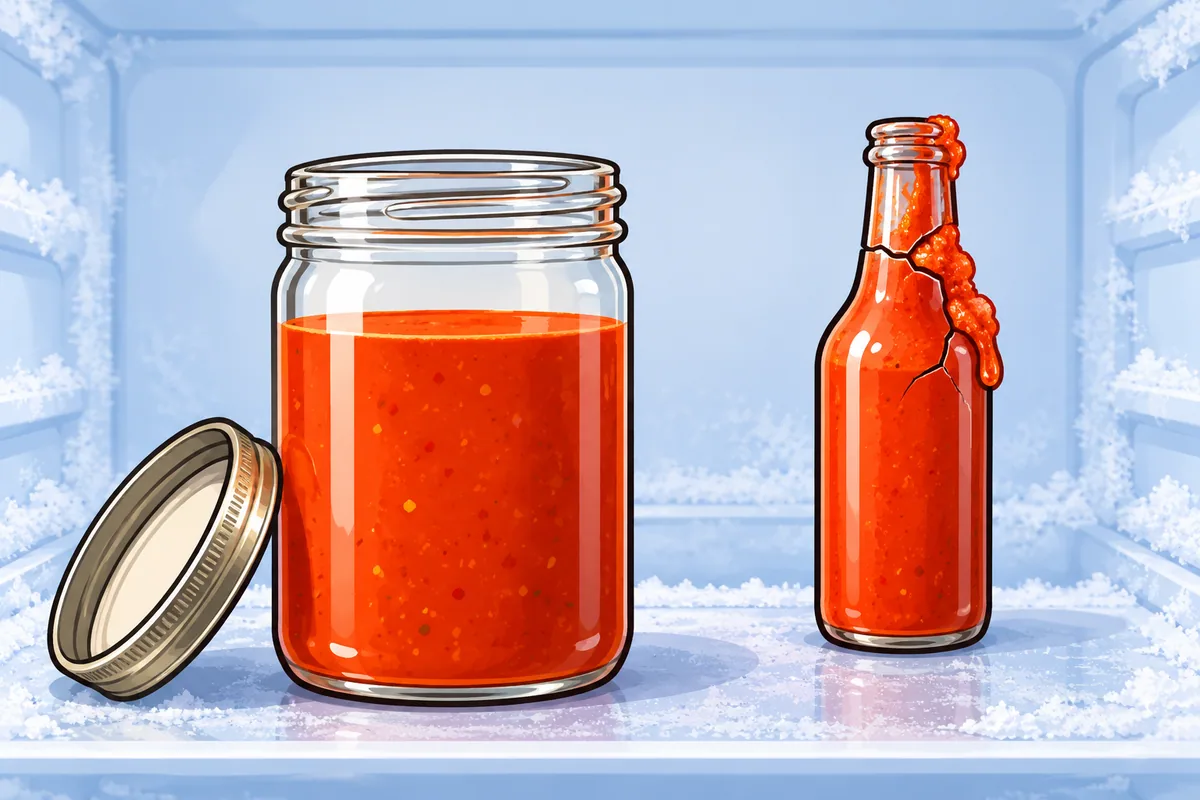
You can, and Ohio State lists freezing as one way to keep a homemade sauce you did not can6. The bottle is the problem: regular glass jars break easily in the freezer, and expanding liquid can crack them at the neck13.
- 1
Move it out of the bottle
Pour your sauce into a wide-mouth jar made for both freezing and canning; those jars are tempered for the cold. A rigid plastic tub works too.13
- 2
Leave room to expand
Leave ½ inch of headspace in a wide-mouth pint and 1 inch in a quart. A narrow-mouth jar needs more: ¾ inch for a pint, 1½ inches for a quart.14
- 3
Freeze at 0°F or below
Past the suggested storage time, frozen food is still safe, only lower in quality.15
Freezing suits a big harvest batch you will not finish in a few weeks, and it is the only long-term option NCHFP gives for homemade garlic in oil7. Label each jar with the date, because NCHFP gives no frozen keeping time for sauces.
Why does hot sauce turn dark?
Air and light. Once you open a bottle, oxygen gets in and speeds up the loss of color and flavor; Cholula calls it a quality change with no health risk1.
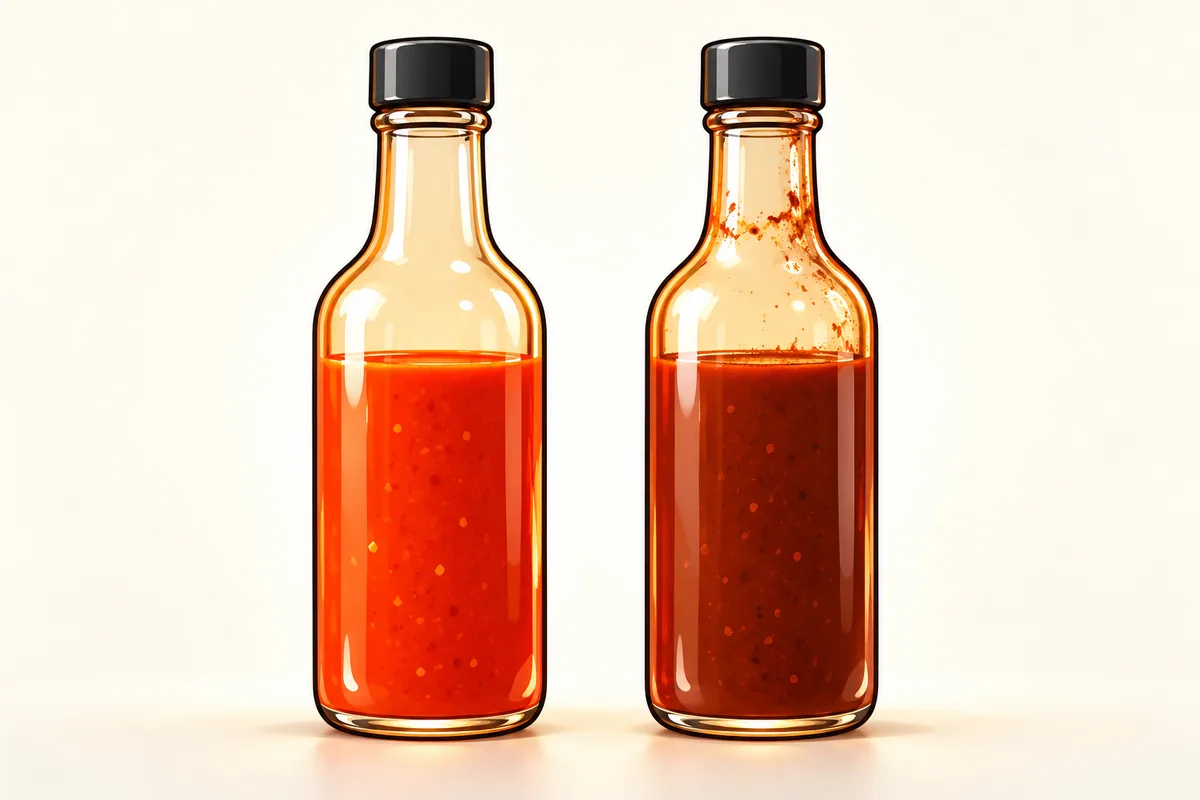
Heat and light speed it up, which is why UGA Extension suggests a cool, dark, dry spot for shelf-stable bottles3. A cupboard away from the stove beats the rack above it.
How can you tell hot sauce has gone bad?
Look, smell, then decide. Darker color alone does not count; these signs do.
- You see mold growing on the sauce, at the neck or under the cap.16
- The sauce feels slimy or slippery in a way it did not before.1617
- You smell something spoiled or rotten, as opposed to sour or vinegary.17
- Your bought bottle is past its Best By date, or has no date at all; Cholula advises against eating either.1
Two signs look bad but are not. A flat white scum on a fermenting jar is a layer of yeast, and NC State Extension calls it harmless16; the fermented hot sauce steps show how you tell it from mold.
A hiss when you open the cap is the other one. Huy Fong warns that its bottles may build gas11, and a homemade ferment you did not heat keeps making a little gas and acid in the fridge9. Gas together with mold, slime or a rotten smell, though, means the bottle goes.
Does hot sauce expire?
A bought bottle has a date, and the maker sets it. Here are the two makers' figures we read on their own pages:
Cholula has printed a Best By date on every bottle since mid-2018 and does not recommend eating its sauce past that date1. Frank's treats its printed date as a use-by and says the sauce generally keeps good flavor for a few weeks past it if you refrigerate it2.
Your homemade sauce has no printed date, so your own label is the date. Write the day you made it on the bottle; the table above tells you how far to count.
How long does home-canned hot sauce keep?
About a year on your shelf, for best quality. NCHFP advises canning no more than you will use within a year unless a specific tested recipe says otherwise, and storing the jars between 50 and 70°F18.
Where you keep the jars matters as much as the date. NCHFP's storage rules read like a checklist for a pantry:
- Keep jars below 95°F, away from hot pipes, the range, the furnace, an uninsulated attic and direct sun.18
- Keep them dry: damp corrodes metal lids, breaks seals and lets the food spoil.18
- Take the ring bands off for storage, so a lid that lost its seal shows itself.18
- Label and date every jar, and open the oldest first.18
A jar that froze by accident in a cold garage has not spoiled for that reason alone; NCHFP says freezing only causes trouble if the jar comes unsealed and gets recontaminated18. Check the lid before you use it.
What do you do with a jar that looks wrong?
Leave it closed and do not taste it. NCHFP lists the signs to look for before and as you open a home-canned jar: a lid without its vacuum, streaks of dried food running from the top, rising bubbles, an unnatural color or smell, liquid that spurts out, and cotton-like mold in white, blue, black or green19.
- 1
Do not taste it
Not even a drop from the lid. NCHFP says never to taste food from an unsealed jar or one that shows spoilage.19
- 2
Bag it and throw it out
Wear gloves while you handle a leaking or open jar, and follow NCHFP's disposal steps for one that is not sealed.19
- 3
Clean everything it touched
Wipe counters and tools with 1 part unscented household bleach to 5 parts water, and let it stand for 30 minutes.19
A sealed jar with no warning sign can still be unsafe if the recipe was untested, so the recipe is your first check, not your last. NCHFP notes that spoiled low-acid foods, tomatoes included, may show very little evidence at all19.
Is the fridge door cold enough for hot sauce?
For bottles, yes, as long as your fridge holds the right number. The FDA asks for a fridge at 40°F or below and a freezer at 0°F, and suggests a cheap appliance thermometer checked about once a week20.
The door runs warmer than the shelves; the FDA moves eggs off it for that reason20. Shelf-stable bottles do fine there, since the cold only protects their color and flavor. Your homemade ferments and fresh sauces sit better on a shelf at the back, where the temperature swings less each time you open the door.
Sorting the bottles in your fridge door
Pull every bottle out and walk each one down this tree. Two or three questions settle where it lives.
- Mold, slime or a rotten smell?Darker color alone does not count
- yesThrow it outWhen in doubt, throw it out
- noDid you make it yourself?No printed date, no factory seal
- yesChiles or garlic under oil?At room temperature it risks botulism
- yesFridge, 4 days at mostAt 40°F or colder; freeze it for longer
- noFridgeFermented: many months; fresh: use it soon
- yes
- no, boughtBought chilled, or says refrigerate after opening?Thai Kitchen sweet chili does
- yesFridgeFollow the label
- noCupboard is fineCool, dark, away from the stove; the fridge keeps color longer
- yes
- yes
- yes
Where does this bottle belong? Sources for this line1. Cholula (manufacturer, own product)3. University of Georgia (UGA Today), quoting Carla Schwan, Extension food safety specialist4. McCormick (maker of Thai Kitchen, own product)5. K-State Research and Extension6. Ohio State University Extension (CFAES)7. National Center for Home Food Preservation (University of Georgia)
Bought bottles that came off a room-temperature shelf can move to the cupboard if your fridge door has no room left. Your own ferments and fresh sauces stay cold.
Screw each cap back on tight, and use a clean, dry spoon for jars of paste. UGA Extension's Carla Schwan says fingers and wet utensils plant bacteria and the moisture condiments crave3.