
Why Are Peppers Spicy? Capsaicin and the 43 °C Sensor
One molecule, one nerve sensor, and a plant that only wanted birds to eat it.

Short answer
Peppers are spicy because capsaicin switches on TRPV1, the same nerve sensor that fires when something is painfully hot.
- About 89 % of a chile's capsaicin sits in the pale placenta, only 5–6 % in the red wall
- Capsaicin and dihydrocapsaicin make up over 90 % of the heat compounds in a pod
- Milk cut the burn the most in a 72-person drink test
From bite to burn
What capsaicin does to a nerve.
-
 Heat science
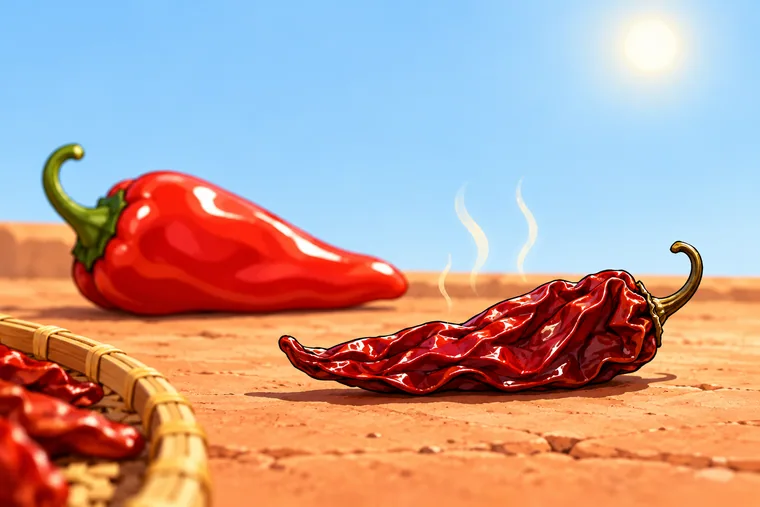
Are Dried Peppers Hotter? About 10× per Gram, Not per Pod
Water leaves, heat mostly stays. Here is the arithmetic, and what it means for your spoon.6 min read -
 Heat science
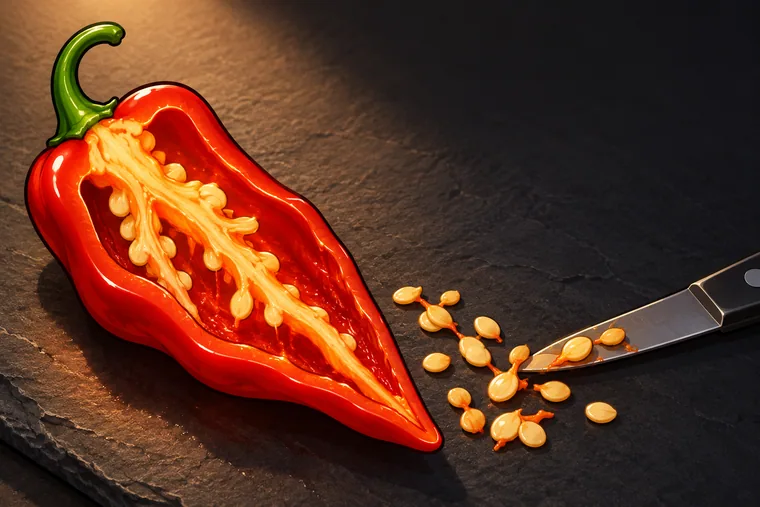
Are Pepper Seeds Hot? Seeds Hold 3.5× Less Than the Ribs
The seeds borrow their heat from the pale ribs. Here is how much, and what that means on your cutting board.6 min read
Nothing matches this filter yet.
The heat compounds
Not every pod burns with the same mix.
Share of each capsaicinoid in three dried Mexican chiles (plants grown without heat stress)
Chile de árbol
Chiltepín
Guajillo
- Capsaicin
- Dihydrocapsaicin
- Nordihydrocapsaicin
- Homodihydrocapsaicin
- Homocapsaicin
Shares of total capsaicinoids by dry weight; rows do not sum to exactly 100 because of rounding in the paper. Segments under 9 % carry no number; the key gives every compound.7
If it goes too far
What calms the burn.
Milk, most of the time: in a test with 72 people, whole and skim milk cut the burn of spicy tomato juice the most of the drinks tried14.
On this page
- 1Why are peppers spicy?
- 2Where in the pepper does the heat come from?
- 3What are capsaicinoids?
- 4Does capsaicin actually burn you?
- 5Why does the same pepper feel milder the tenth time?
- 6Why do peppers make capsaicin at all?
- 7What calms the burn, and when do you need help?
- 8What goes wrong when you try to cool it down?
- 9Which burn question do you have next?
Why are peppers spicy?
Because of capsaicin. It is the main heat compound in chiles, and it causes a burning pain by switching on the nerve cells that report harmful stimuli to your brain1. In 1997 David Julius's lab found the sensor it switches on, an ion channel later named TRPV1, and it turned out to be a heat sensor too2.
Your mouth has no separate sensor for chile, so it borrows the one for scalding heat. That is why a pepper you eat on a snowy porch still makes you flush. The Nobel committee gave Julius the 2021 prize in Physiology or Medicine for this work, shared with Ardem Patapoutian for touch2.
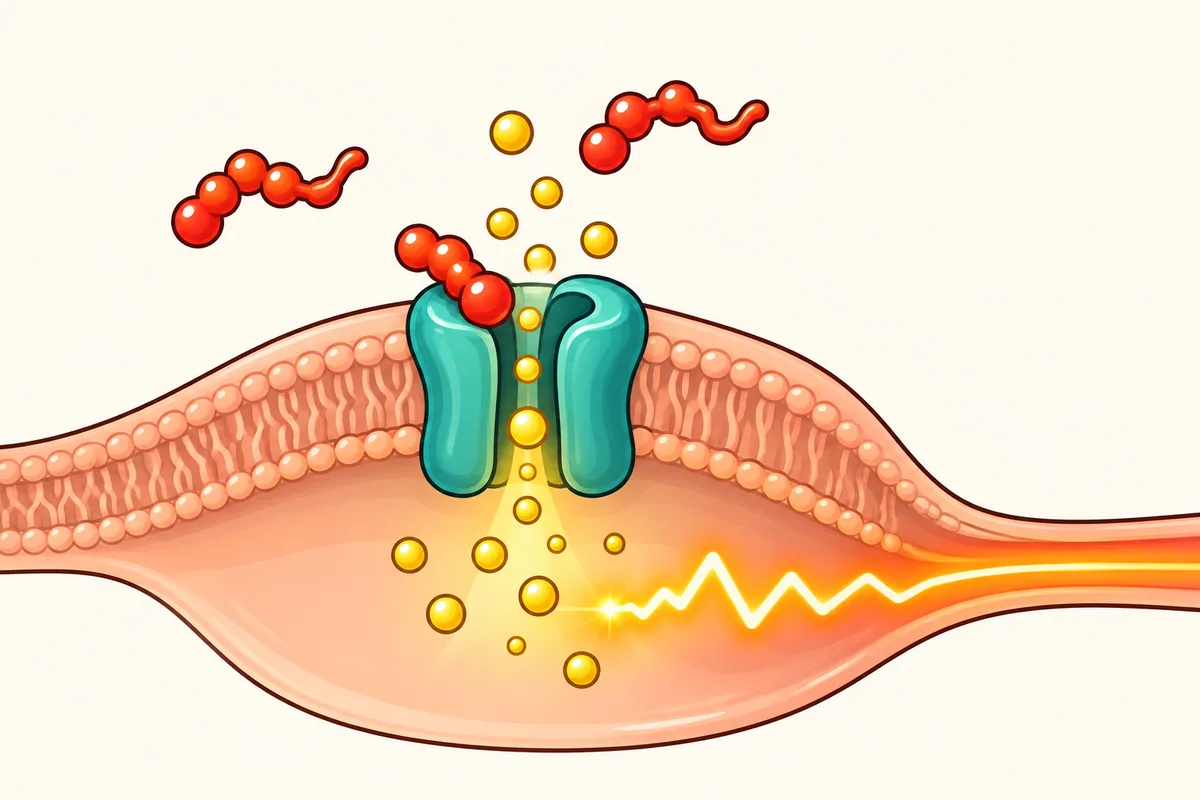
Here is the whole chain, from the moment the pod touches your tongue to the moment you reach for a drink.
- CapsaicinLeaves the cut pod and reaches the nerve endings in your mouth
- TRPV1 opensCapsaicin binds the channel on pain-sensing nerves
- Calcium flows inThe channel lets calcium and sodium into the nerve cell
- The nerve firesA pain signal runs along the nerve toward your brain
- Your brain reads heatThe same channel also opens above about 43 °C, so the signal arrives as burning
- Your body reactsWith a large dose: nausea, vomiting, stomach pain; in some people a racing heart
The last box only lights up when you take in a lot. For a normal plate of chili, the chain stops at your brain reading heat, and the feeling fades as the capsaicin leaves your mouth.
Where in the pepper does the heat come from?
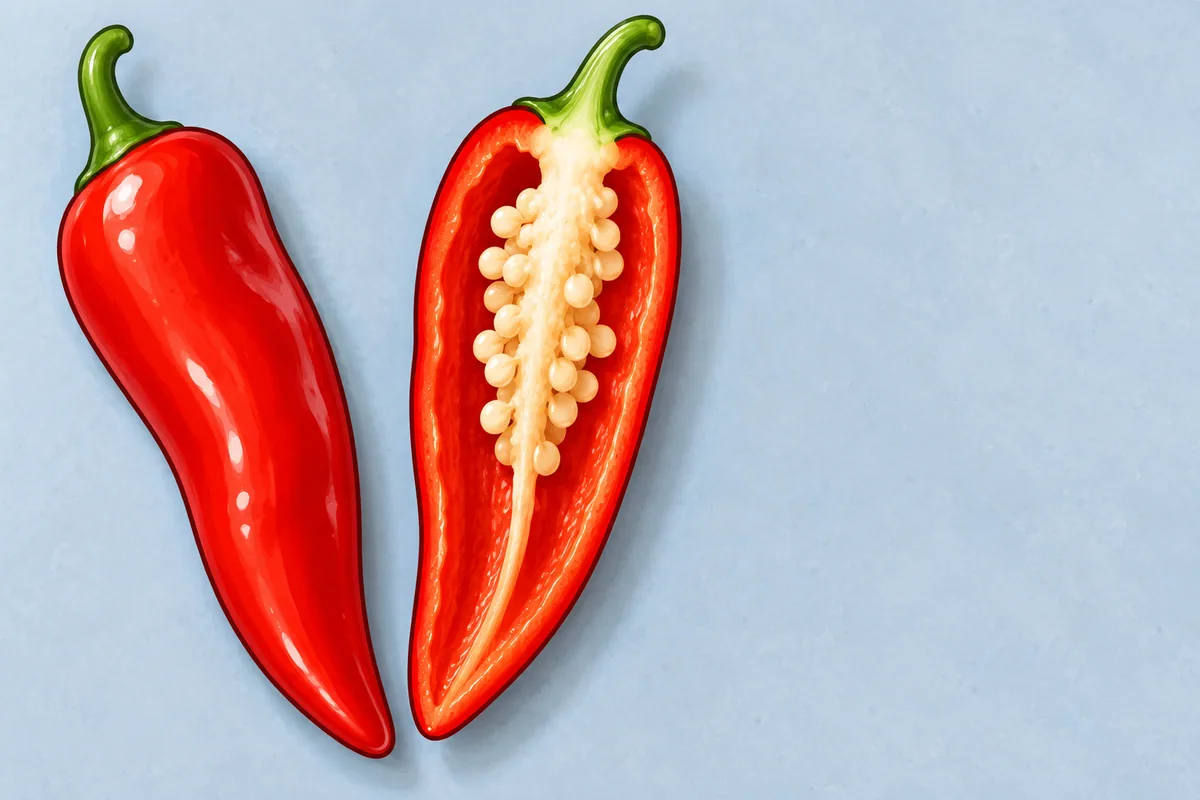
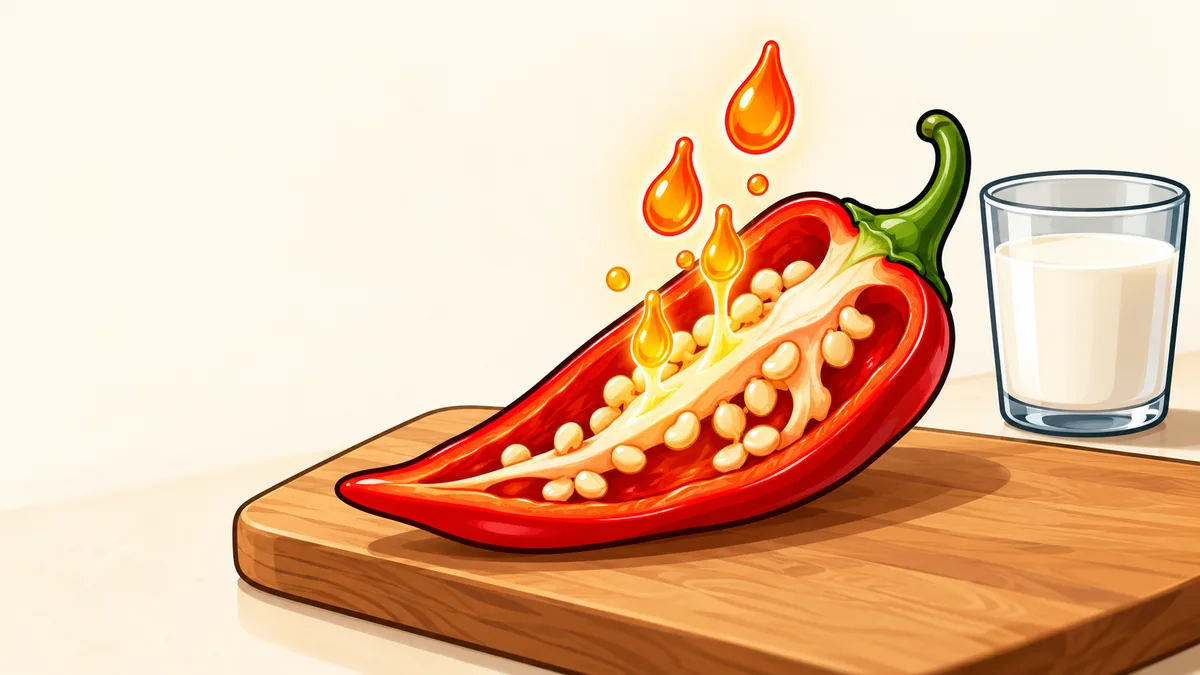
The pale tissue in the middle, not the red flesh. A 2024 review puts about 89 % of a chile's capsaicin in the placenta, the spongy ridge that holds the seeds, and only 5–6 % in the outer wall3.
Seeds taste hot because they sit against the placenta, which Usman's team names as the tissue where capsaicinoids occur4. Guinness makes the same point in its Pepper X announcement: the heat sits in the tissue that holds the seeds, not in the seeds themselves5.
So if you want the flavor of a jalapeño with less bite, run a teaspoon down the inside of each half and scrape out the pale ridge with the seeds. Most of the heat goes with it. Wear gloves while you do it, because that ridge is exactly the part that ends up on your fingers. The pepper seeds page takes the seed question further.
What are capsaicinoids?
They are the family of heat compounds, and capsaicin is only the best known one. Capsaicin and dihydrocapsaicin together make up over 90 % of the capsaicinoids in a fruit4, and a Danish study of 15 cultivars found capsaicin alone ranging from 31 % to 71 % of the total6.
The mix changes from pepper to pepper. One HPLC study measured all five in dried chiles from northern Mexico, and the mix chart on this page shows how far apart three of them sit7.
In that study, dihydrocapsaicin outweighed capsaicin in every variety tested7. The guajillo stands out: more than a third of its heat compounds are homodihydrocapsaicin. You can taste a chile de árbol and a guajillo side by side and feel two different burns, even before you think about how much heat each one has.
Does the mix change the Scoville number?
Labs add the capsaicinoids up and convert the total into SHU, so the number tracks how much of the family a pod holds. Pure capsaicin sits at the top of the scale at 16 million SHU4. The capsaicin page covers how each compound gets counted.
Does capsaicin actually burn you?
Not the way a stove does. Capsaicin raises no temperature. It opens the same channel that painful heat opens, and in cells studied in the lab that channel opens for heat at about 43 °C8. It also responds to acid, so even mildly acidic conditions can switch it on at room temperature9.
That does not make capsaicin harmless on your skin. The poison center calls it intensely irritating to skin, eyes and the gut, and describes a cook who got pain and blistering after handling hot chiles10. Gloves and the pepper burn on hands page handle that side.
TED-Ed made this short animation on the science of spiciness, so you can watch the nerve channel and the burn explained in motion after reading the steps in words.
Why does the same pepper feel milder the tenth time?
Part of the answer sits in the channel itself. In lab studies, once capsaicin has switched TRPV1 on, the channel goes into a long refractory state, a stretch where it stops answering8.
That finding comes from nerve cells in a dish, so treat it as a clue to why your fifth bite of a hot curry hurts less than your first, not as proof of how tolerance builds over months. The spice tolerance page looks at what repeated eating does.
Why do peppers make capsaicin at all?
To pick who eats the fruit. Tewksbury and Nabhan found that capsaicin discourages the animals that destroy chile seeds without putting off the birds that spread them12. Birds simply do not feel it: their TRPV1 still senses heat, but it ignores capsaicin13.
The same chile, two animals
Mammals
Birds
The plant gets a burn that works on the animals it wants to keep away. You, as a mammal, sit on the wrong side of that deal.
What calms the burn, and when do you need help?
Milk, most of the time. In the test, 72 adults swallowed 30 mL of spicy tomato juice and then drank 40 mL of one of seven drinks. Every drink lowered the burn, and whole milk, skim milk and cherry Kool-Aid cut it the most14.
Skim milk did as well as whole, so the authors point to the protein in milk more than the fat. The sweet drink did well too, and they name sugar as one possible reason without testing it14. The mouth burn page compares the options in more detail.
What you do first depends on where the capsaicin landed. The poison center gives a different first move for each place10.
- 1
In your mouth or stomach
Take small sips of milk or water. The poison center also suggested ice cream or an antacid for one teenager with a stomach ache after a hot pepper.10
- 2
On your skin
Get away from the source first, then try warm water flushes, vegetable oil, or soaks in vinegar diluted with water. A liquid antacid spread on the skin may help.10
- 3
In your eyes
Rinse with plenty of warm water for 15 minutes. Cool compresses afterwards may ease the pain.10
If the problem is a pot of chili rather than your tongue, the fixes live with the cooking techniques for taming heat in a dish.
What goes wrong when you try to cool it down?
Most of the trouble comes from moving the capsaicin somewhere new, not from the first bite. These are the mistakes the sources describe, with what they suggest instead.
- Rubbing your eyes after you cut chiles. The poison center tells you not to touch your face or eyes after you prepare hot peppers, and to wear rubber, latex or nitrile gloves while you work10.
- Leaning over the pan. Breathing in capsaicin can set off an asthma attack or breathing trouble in people prone to it10, so open a window when you dry-toast or fry very hot chiles.
- Gulping water and expecting a cure. Water did lower the burn in the drink test, just less than milk14. France's food safety agency goes further and tells you to skip water and fizzy drinks and reach for dairy or a fatty food15.
- Waiting out a bad reaction. ANSES reports that large amounts can raise blood pressure, cause palpitations or loss of consciousness in some people, and that children and people with heart or gut conditions react more strongly15.
Which burn question do you have next?
Capsaicin itself has more chemistry than this page can hold, from its four cousins to how labs count it. If you wonder whether the burn does you any good, the health studies sort what research shows from what it does not.
If you got juice in your eyes, the pepper in your eyes page walks you through the rinse.
More in Scoville & Heat
The newest from Scoville & Heat
-
Scoville Heat Units (SHU), Why 5,000 Means 1 in 5,000
One number, two ways to get it, and what it says about your pepper.Oct 18, 2026 · Guide -
Are Dried Peppers Hotter? About 10× per Gram, Not per Pod
Water leaves, heat mostly stays. Here is the arithmetic, and what it means for your spoon.Oct 18, 2026 · Guide -
Are Pepper Seeds Hot? Seeds Hold 3.5× Less Than the Ribs
The seeds borrow their heat from the pale ribs. Here is how much, and what that means on your cutting board.Oct 18, 2026 · Guide -
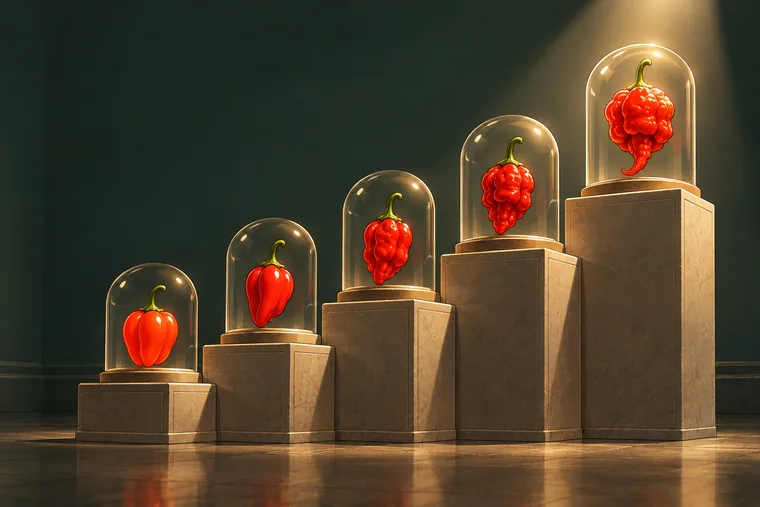
Hottest Pepper World Record History, 5 Holders Since 2006
Five holders, seventeen years, and a number that grew almost fivefold.Oct 18, 2026 · Guide -
Second Hottest Pepper in the World, the Reaper at 1.64M
Second place depends on whose count you read. Here are both counts, and how far behind number one each contender sits.Oct 18, 2026 · Guide
Sources
· 15
- 1Nature 389:816-824 The capsaicin receptor: a heat-activated ion channel in the pain pathway (Caterina, Schumacher, Tominaga, Rosen, Levine, Julius)
- 2The Nobel Assembly at Karolinska Institutet Press release: The Nobel Prize in Physiology or Medicine 2021 (David Julius and Ardem Patapoutian)
- 3Heliyon (Cell Press) A comprehensive review of capsaicin: Biosynthesis, industrial productions, processing to applications, and clinical uses
- 4Molecules 19(5):6474 (MDPI) Capsaicin and Dihydrocapsaicin Determination in Chili Pepper Genotypes Using Ultra-Fast Liquid Chromatography (Usman et al.)
- 5Guinness World Records Pepper X dethrones Carolina Reaper as world's hottest chilli pepper
- 6Food Chemistry (Elsevier) Contents of capsaicinoids in chillies grown in Denmark (Duelund and Mouritsen)
- 7Molecules 18(11):13471 (MDPI) Characterization of different Capsicum varieties by evaluation of their capsaicinoids content by high performance liquid chromatography, determination of pungency and effect of high temperature (González-Zamora et al.)
- 8Molecules 21(6):797 (MDPI) Capsaicin, Nociception and Pain (Frias and Merighi)
- 9Neuron 21:531-543 The cloned capsaicin receptor integrates multiple pain-producing stimuli (Tominaga et al.)
- 10National Capital Poison Center (poison.org) Capsaicin: When the Chili Is Too Hot (Amanda McDaniel-Price, RN)
- 11TED-Ed The science of spiciness - Rose Eveleth
- 12Nature Seed dispersal. Directed deterrence by capsaicin in chilies (Tewksbury and Nabhan)
- 13Cell Molecular basis for species-specific sensitivity to "hot" chili peppers (Jordt and Julius)
- 14Physiology & Behavior 208:112557 Putting out the fire: Efficacy of common beverages in reducing oral burn from capsaicin (Nolden, Lenart, Hayes)
- 15ANSES, French Agency for Food, Environmental and Occupational Health and Safety Hot pepper challenges: a dangerous trend
Coming soon
Your pocket pepper index.
Built from the same index as this site.
- Every entry offline
- Compare any two peppers
- Keep a list of peppers you have tried