On this page
- 1Is a dried pepper hotter than the fresh one it came from?
- 2How much more concentrated is a dried chile, gram for gram?
- 3Does drying destroy any of the capsaicin?
- 4What happens to the heat between the fresh pod and the powder jar?
- 5Why the SHU on a chart already describes dried pepper
- 6Should you cook with fresh, dried or ground chile for steady heat?
- 7Does cooking make peppers hotter or milder?
- 8How do you swap dried chile for fresh without overdoing it?
- 9Is dried chile dust riskier to handle than fresh pods?
- 10Where a dried-for-fresh swap goes wrong
- 11What to do with your dried pods next
- 12Sources
Is a dried pepper hotter than the fresh one it came from?
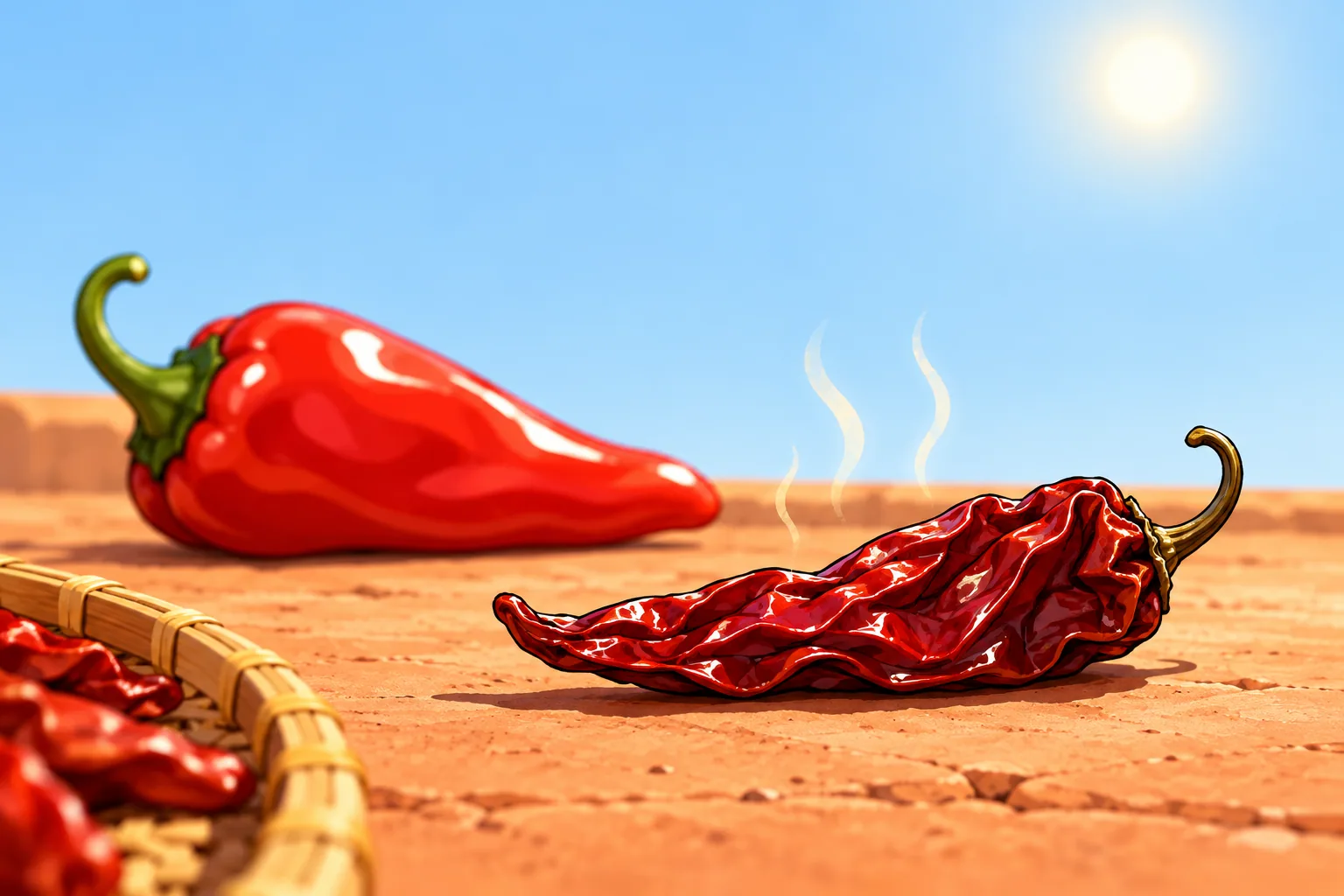
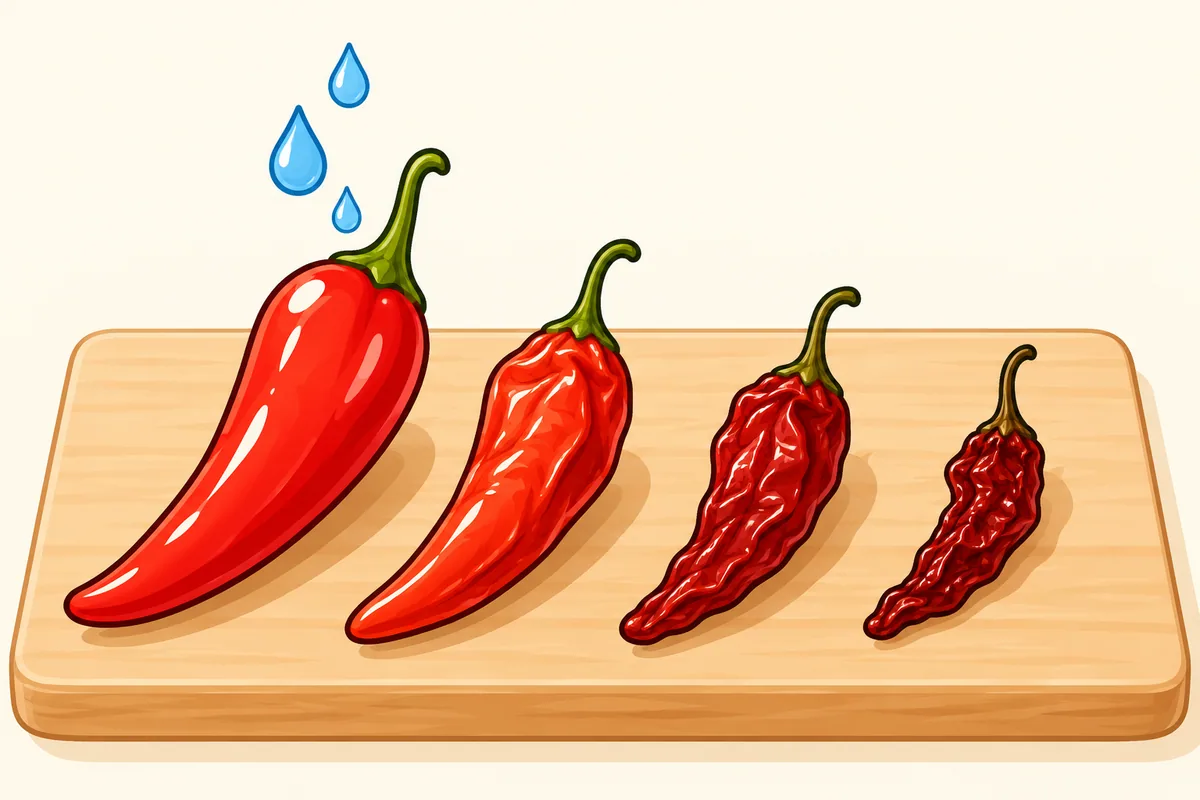
Per gram, yes, by a lot; per pod, no. Drying takes the water out and leaves almost everything else, so the capsaicin that filled a plump fresh chile ends up packed into a light, leathery one. USDA lists a fresh red hot chili at 88 % water1 and a sun-dried hot chile at 7.15 %2.
So if you hold a fresh pod in one hand and its dried twin in the other, they carry about the same heat. The dried one just weighs a fraction as much. Drying moves the heat into fewer grams; it adds none. That one idea explains every surprise you get when you swap a teaspoon of ground chile for a chopped fresh one.
How much more concentrated is a dried chile, gram for gram?
Somewhere around 7 to 11 times, depending on how wet the fresh pod started and how dry the dried one ended. We worked these factors from USDA FoodData Central water figures, assuming the drying lost no heat, which the next section shows is close but not exact.
| Fresh form | Water | Dried form | Water | Solids per dried gram |
|---|---|---|---|---|
| Red hot chili, raw | 88.0 % | Hot chile, sun-dried | 7.15 % | about 7.7× |
| Poblano, raw | 92.8 % | Ancho, dried | 22.6 % | about 10.7× |
| Red hot chili, raw | 88.0 % | Cayenne, ground spice | 8.05 % | about 7.7× |
UF/IFAS confirms the middle row's pairing: a poblano that has ripened and dried takes the name ancho6. So a gram of ancho holds the solids of roughly 10.7 grams of fresh poblano, and with them the heat.
The formula, worked once
Divide the dried form's solids by the fresh form's solids. Solids are what is left after water: 100 minus the water percentage.
For poblano and ancho that is (100 − 22.6) ÷ (100 − 92.8), or 77.4 ÷ 7.2, which comes to about 10.734. You can run the same sum on any pair with published water figures. A fresh jalapeño, for instance, is 91.7 % water7, so it has only 8.3 grams of solids in every 100.
What the table cannot tell you
It tells you about concentration, not about the pod in your bag. Two harvests of one chile can differ in heat before anyone dries them: a Mexican lab study found that heat stress during growing raised the capsaicinoids of some varieties and lowered others8. The factor tells you how much a gram changes when water leaves; the pod still brings its own starting heat.
Does drying destroy any of the capsaicin?
Some, depending on how you dry. A 2025 study dried two chili varieties three ways and found that hot-air drying kept capsaicin and dihydrocapsaicin best, while sun-drying and shade-drying left lower levels9. The authors put it down to time: slower, cooler drying gave enzymes and oxidation longer to break the compounds down.
What drying keeps, and what it costs
Drying keeps
- Heat
- Most capsaicinoids, best with hot-air drying9
The vitamin C row shows how uneven drying is. Concentration alone should have pushed vitamin C up about 7.7 times per gram; instead it fell from 144 to 31.4 mg per 100 g12. Capsaicin holds up far better than that, which is why a dried pod still burns.
If you dry your own, University of California's guide keeps a dehydrator or oven at or below 140 °F and has you remove seeds, stems and membranes from large peppers first10. Taking out the membranes also takes out the hottest strip, as the pepper seeds page shows, so your home-dried peppers can come out milder than store pods dried whole.
What happens to the heat between the fresh pod and the powder jar?
Each step either removes water or risks a small loss of heat. Follow the arrows and you can see where your batch gains strength per gram and where it can slip.
- Fresh podAbout 88 % water for a red hot chili
- DryingWater leaves; slow sun or shade drying loses some capsaicinoids
- Dried podAbout 7 % water when sun-dried
- GrindingSame heat per gram as the dried pod
- PowderCayenne spice: 8.05 % water
Sources for this line1. USDA FoodData Central (SR Legacy)2. USDA FoodData Central (SR Legacy)5. USDA FoodData Central (SR Legacy)9. Food Chemistry: X 29:102757
Grinding changes the form, not the concentration: USDA's cayenne spice sits at 8.05 % water5, close to the sun-dried pod. Your dried chiles and the powder made from them therefore start at about the same heat per spoonful by weight.
Why the SHU on a chart already describes dried pepper
Because labs measure dried, ground fruit. The 2014 Molecules study oven-dried its chiles at 60 °C for 2 to 5 days and ground them in a laboratory mill before extracting the heat11. The Scoville heat units you read on our charts come from samples like that.
That flips the question around. Your dried pod is not "hotter than its SHU"; it matches it. Your fresh pod is the one that tastes milder, gram for gram, than its number, because around nine-tenths of each bite is water. When a chart says a jalapeño runs 2,000 to 8,000 SHU6, read that as the heat in the solids of a jalapeño, not in a slice of the wet green pod.
Should you cook with fresh, dried or ground chile for steady heat?
Pick the form by how precisely you need to set the heat, not by which one is "hotter." Each one behaves differently in your pot because of the water it still holds.
- Fresh pods, when you want to taste as you go. About nine-tenths of a fresh pod is water17, so each piece you add moves the heat in small steps. You also see the ribs and can cut them out.
- Whole dried pods, for sauces you soak and blend. Soaking puts water back, so a soaked ancho behaves much like the poblano it came from, with deeper flavor. Count pods rather than grams.
- Ground chile, when you need the same heat every time. A level teaspoon of powder carries a known weight of solids, about 92 % of it for cayenne spice5, so it repeats well batch to batch once you know your jar.
- Avoid swapping one for another mid-recipe. If you started with fresh and run out, switch to dried by weight with the steps above, never spoon for spoon.
We lean on ground chile for anything you plan to cook again, because you can write down the amount and get the same pot next time.
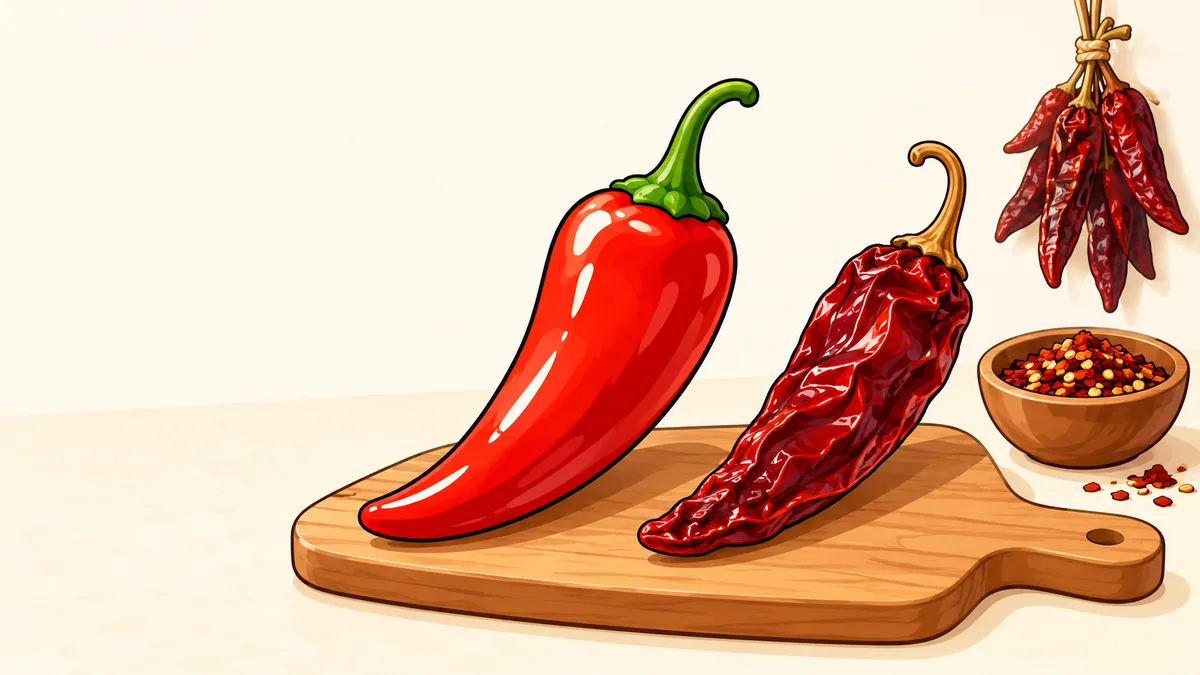
Masienda, a Mexican ingredients company, made this one-minute short on fresh and dried chile, so you can see both forms of the same pepper side by side before you choose one for your pot.
Does cooking make peppers hotter or milder?
Usually a little milder, and the results vary by method and by pepper. A 2019 study roasted several Capsicum annuum cultivars and found capsaicin and dihydrocapsaicin dropped in most of them, though a few held steady13. The same paper reviews earlier work with mixed results.
| Method | Finding |
|---|---|
| Roasting, green and red stage13 | Capsaicinoids reduced in most cultivars tested |
| Cooking, Indian Thai peppers (earlier study)13 | Loss of 0 to 30 % of capsaicinoids |
| Boiling, Mexican peppers (earlier study)13 | Moderate loss |
| Grilling, Mexican peppers (earlier study)13 | Capsaicinoid levels went up |
The review's explanation for the grilling result: heat breaks down the pepper's cell walls, which can change how much capsaicin the test pulls out13. In your mouth the effect works the same way, since a softened, broken pod releases its heat more easily than a crisp raw slice.
Then there is the pot itself. If you simmer a sauce from 4 cups down to 2, the capsaicin stays while half the water boils off, so every spoonful carries about twice the heat it had at the start. Cooking rarely makes the pepper hotter; reducing your sauce often makes the sauce hotter.
How do you swap dried chile for fresh without overdoing it?
Work it out by weight, then start below your answer. These steps use the sun-dried figures above; treat the result as an estimate, since your pods differ from USDA's samples.
- 1
Weigh what the recipe asks for
Say it calls for 30 g of chopped fresh red chili.1
- 2
Find the solids
At 88 % water, 30 g of fresh chili holds about 3.6 g of solids.1
- 3
Convert to dried weight
Sun-dried chile is 92.85 % solids, so 3.6 g of solids is about 3.9 g of dried chile.2
- 4
Start with half
Add about 2 g, simmer a few minutes and taste, because slow-dried pods may have lost some heat and fresh pods vary.9
- 5
Top up in small pinches
Add the rest a little at a time until the heat matches what you want.
For a soaked dried pod, your swap runs closer to one for one by pod, because you have added the water back. Weigh only when you grind or crumble a dry chile straight into the pot.
Is dried chile dust riskier to handle than fresh pods?
It reaches more places. Crumbling or grinding dried pods puts fine dust in the air and on your hands, and capsaicin irritates skin and eyes whether it comes from a fresh slice or a dry flake14. For eyes, the poison center's first step is rinsing with plenty of warm water for 15 minutes14.
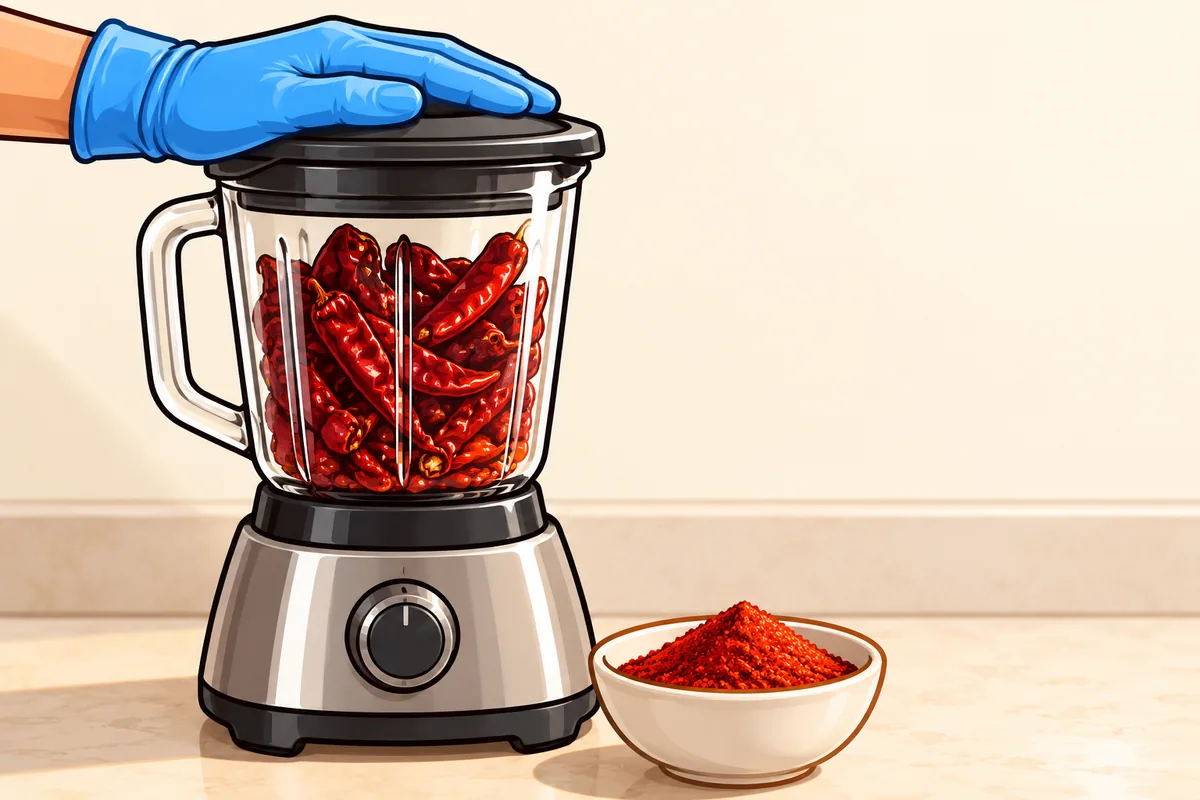
Wear gloves and grind with the lid on. If your eyes do catch dust, the pepper in your eyes page walks through the rinse step by step.
Where a dried-for-fresh swap goes wrong
Run through these when the pot comes out hotter or milder than you planned.
Before you blame the recipe
- You swapped by spoon, not by weight. A spoon of dried chile holds roughly 7 to 11 times the solids of a spoon of fresh.Sources for this line1. USDA FoodData Central (SR Legacy)2. USDA FoodData Central (SR Legacy)3. USDA FoodData Central4. USDA FoodData Central (SR Legacy)
- Your dried pods came out milder than expected. Slow sun or shade drying loses more capsaicinoids than hot-air drying.9
- You dried pods with the membranes out. That strip holds most of the heat, so your batch runs mild.10
- The sauce got hotter as it simmered. Reduction concentrates the capsaicin in less liquid.
- Two bags of the same chile tasted different. Growing heat can raise or lower capsaicinoids before drying.8
What to do with your dried pods next
If your pot is already too hot, cooling down a dish lists the fixes by type of dish. To make your own, drying peppers at home covers the dehydrator, oven and air-drying methods with their times.