
Poblano Pepper Scoville, 1,000–2,000 SHU
A big, thick-walled, mild chile from the valley of Puebla.
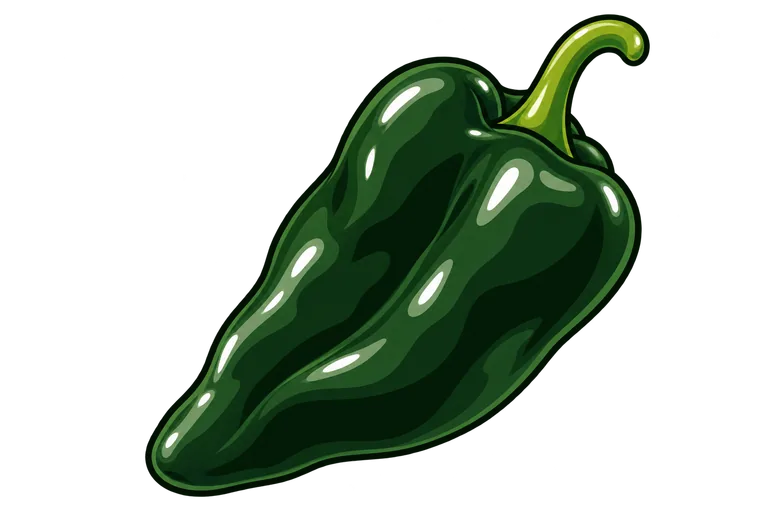 Mild
1,000–2,000 SHU
- An average jalapeño is 2.5 to 5 times hotter
- Ripened red and dried, a poblano is sold as an ancho
On this page
- 1How hot is a poblano?
- 2Is a poblano the same as an ancho?
- 3What does a poblano taste like?
- 4How do you roast and peel a poblano?
- 5How do you stuff a poblano?
- 6Should you buy green, red or dried ancho?
- 7How do you store fresh and roasted poblanos?
- 8Can you can poblanos at home?
- 9What goes wrong with poblanos?
- 10Can you eat a poblano raw?
- 11Where does the poblano come from?
- 12Are poblano and Anaheim peppers the same?
- 13Can you grow a poblano or swap it?
How hot is a poblano?
A poblano rates 1,000 to 2,000 Scoville heat units, mildly hot by UF/IFAS Extension's own description1. Most people you cook for will call it flavorful rather than spicy. The extension's Scoville list gives you the same range4.
An average jalapeño, at about 5,000 SHU, carries 2.5 to 5 times the heat of a poblano. The math is 5,000 ÷ 2,000 and 5,000 ÷ 1,000, both from the UF/IFAS figures1.
Is a poblano the same as an ancho?
Yes, at a different stage of the same pod you hold in your hand. You can eat a poblano green or ripe red, and once it ripens red and dries, stores sell it as an ancho1. The NMSU Chile Pepper Institute puts it the other way round: in U.S. markets, a poblano is a green ancho or mulato sold fresh3.
| Name | What it is |
|---|---|
| Poblano | The fresh pod, usually sold green |
| Red poblano | The same pod left to ripen red |
| Ancho | A pre-Columbian Mexican pod type, ripened red and dried |
| Mulato | Like the ancho, but brown at maturity |
| Pasilla | A dried chilaca, not a poblano |
So your bag of dried anchos and a crate of green poblanos can come from the same kind of plant. A bag marked pasilla is the odd one out, because a pasilla is a dried chilaca5. The pasilla and poblano comparison sets the two side by side.
If you're buying the dried pod for a mole or a red sauce, it has its own entry with its heat and uses: what an ancho is.
Why do stores and regions use different names?
The fresh-for-poblano, dried-for-ancho split is how U.S. produce markets label it for you3. In Mexico the word "ancho" also covers the plant: the genus monograph records "Chile ancho" as a common name of C. annuum var. annuum from collections in Guanajuato and Tamaulipas2.
If your recipe from Mexico asks for "chile ancho" and the pods in it are fresh, it probably means what a U.S. store calls a poblano, so you can buy poblanos with confidence. The ancho and poblano side by side covers heat and flavor after drying.
What does a poblano taste like?
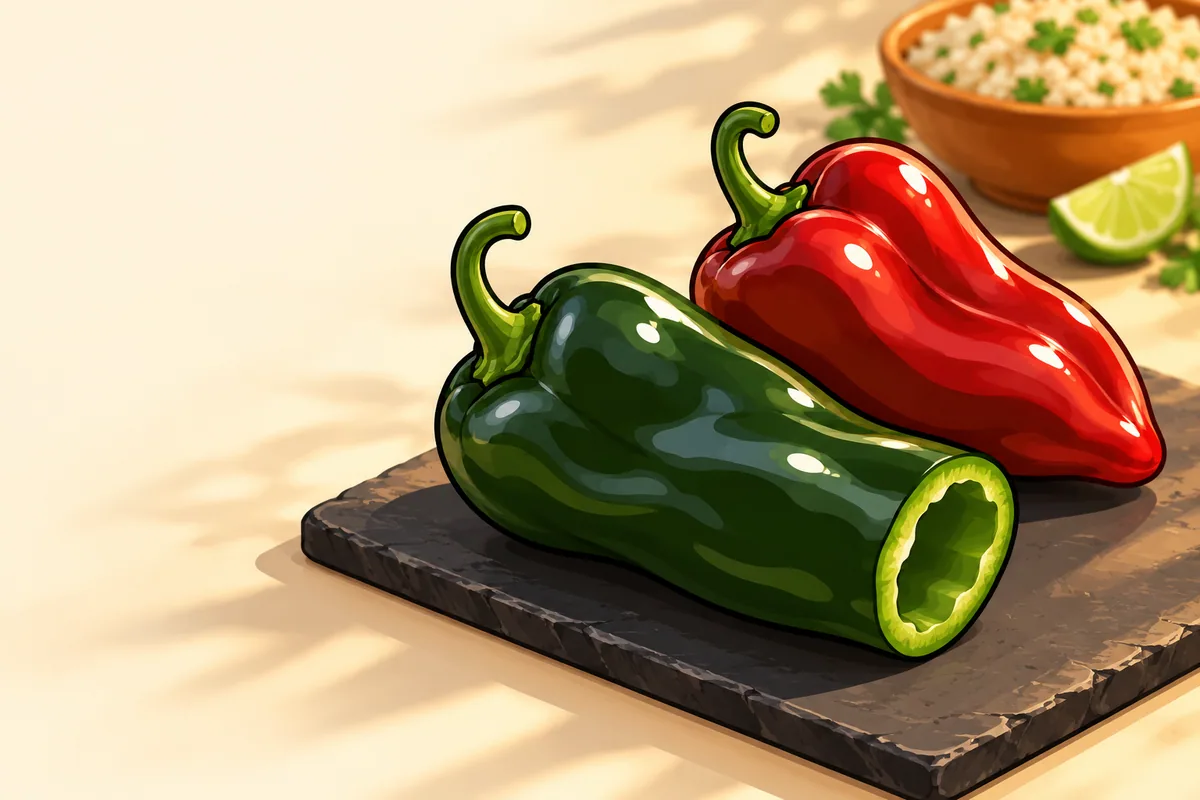
UF/IFAS describes a rich melon flavor in a thick-walled, mildly hot pod1. The UC Master Gardeners of Ventura County call it earthy, smoky and fruity5. Most recipes you'll find roast it first, which brings the smoky side forward.
- Mild
- Rich
- Melon
How do you roast and peel a poblano?
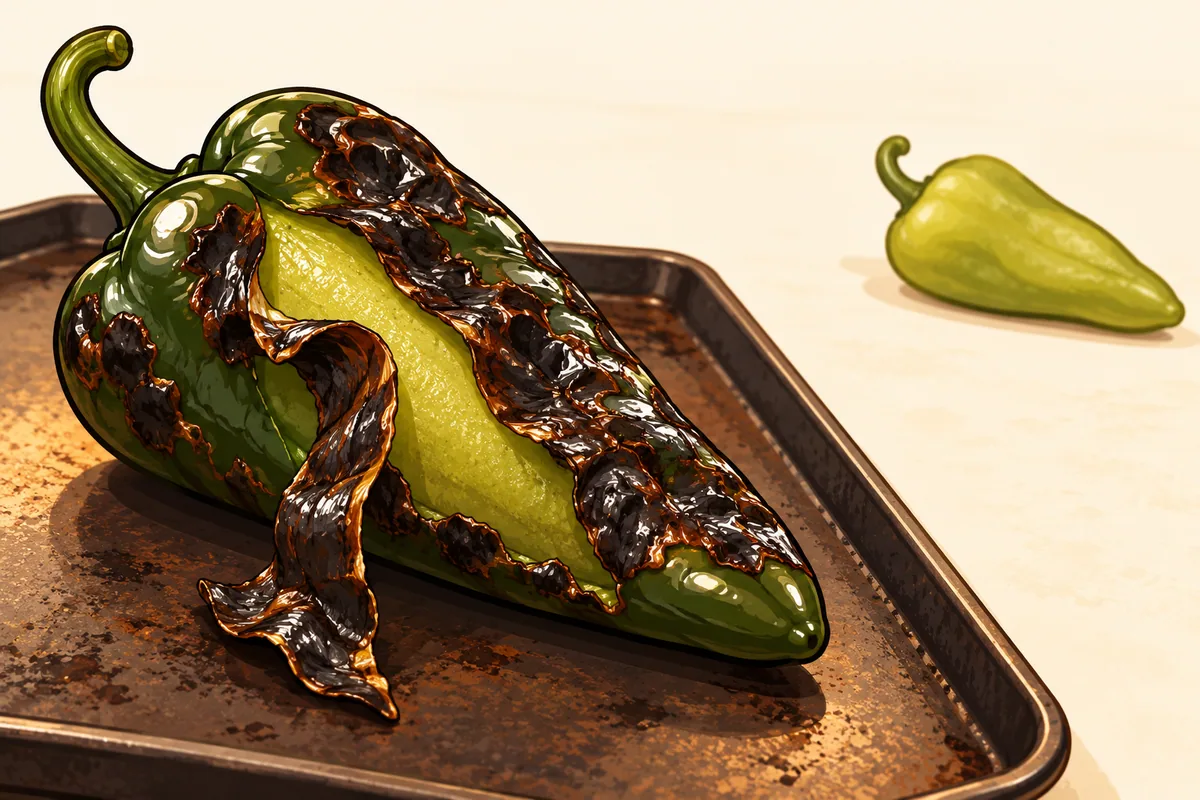
Blister the skin over high heat, trap the steam, then pull the skin off. New Mexico State University's extension guide for fresh chiles gives the method, and it suits a poblano's thick wall well6.
- 1
Pick heavy, smooth pods
Choose pods that are heavy for their size, smooth, glossy and crisp; skip any with shriveled skin, soft spots or mold.6
- 2
Wash, dry and slit
Cut a small slit in the side of each pod so steam can escape and the pepper doesn't burst.6
- 3
Blister for 6 to 8 minutes
Under a broiler or in an oven at 400–450°F, on a grill, or on a burner covered with heavy wire mesh. Turn the pods often so the skin blisters evenly without scorching.6
- 4
Trap the steam
Put the hot pods in a covered heat-safe container or a food-grade bag. Once they cool, the skin pulls off with a gentle tug and a rinse.6
- 5
Scrape what's left
Where the skin didn't blister, scrape it off with a sharp knife or a vegetable peeler.6
The guide warns that chile can burn your hands and eyes. Wear rubber gloves, or coat your hands with a thin layer of solid fat, and if your hands still sting, soak them in plain vinegar6. For a crisper pod, dip it in ice water as it comes off the heat; for softer flesh, cover the pan with a damp towel for a few minutes6.
How do you stuff a poblano?
Roast and peel it first, then slit one side and lift out the seed core, so you keep a single pocket. The broad shape, about 4 inches long and 2 wide, and the thick wall1 are why the poblano is the usual pepper for chiles rellenos: it holds a filling and stays in one piece in the pan.
Keep the stem on while you roast: it holds your pocket closed and gives you a handle. If you plan to bake the stuffed pods rather than fry them, pull them off the heat a minute early, since they cook again in the oven.
Should you buy green, red or dried ancho?
Buy green for roasting and stuffing, red if you find it and want it sweeter, and dried anchos for sauces. They're the same pepper at three stages13.
| Your dish | Buy | Why |
|---|---|---|
| Chiles rellenos or stuffed peppers | Fresh green poblano | Broad, thick-walled pod, 1,000–2,000 SHU 1 |
| Rajas (roasted strips) or a creamy soup | Fresh green poblano | Roasts and peels cleanly 6 |
| A sweeter roasted pepper | Red poblano | The same pod left to ripen red 1 |
| Mole or a red chile sauce | Dried ancho | The ripe red pod, dried 3 |
How do you store fresh and roasted poblanos?
Keep fresh pods cool and away from fruit. The UC Master Gardeners advise 45 to 55°F at 90 to 95 % humidity and keeping peppers away from apples and bananas, whose ethylene gas harms them5. Roasted pods follow stricter food-safety rules6.
You can also freeze poblanos whole and unpeeled; the guide notes they peel more easily after freezing6.
Can you can poblanos at home?
Yes, but only in a pressure canner. The National Center for Home Food Preservation gives pressure-canner times for plain peppers and no boiling-water times at all7. If you want a shelf-stable jar without a pressure canner, freeze your roasted poblanos instead, or pickle them with a tested vinegar recipe.
The prep is the same roast-and-peel you'd do for dinner: core and seed the pods, cut two or four slits, blister them at 400°F for 6 to 8 minutes, cover with a damp cloth, peel and flatten7. Salt is optional, half a teaspoon per pint if you want it7.
What goes wrong with poblanos?
Most poblano problems you'll meet happen between your roaster and your freezer.
Problems and their fixes
- One pod in the batch is surprisingly hot: heat varies with the growing conditions, though a poblano still tops out around 2,000 SHU. Taste a sliver from each pod before you fill them for children.18
- The skin won't come off: the pod didn't blister evenly or skipped the steaming step. Put it back under the heat, then cover it while it cools, and scrape any patches with a peeler.6
- Frozen poblanos thaw mushy: the container was too deep, so they froze slowly and grew ice crystals. Pack them flat, no more than 2 inches deep, with the air pressed out.6
- Your hands burn after peeling a dozen: rubber gloves next time, and a soak in vinegar now.6
Can you eat a poblano raw?
Yes. UF/IFAS says you can eat it green or ripe red1, and at 1,000 to 2,000 SHU a raw slice is mild enough for most people. Most recipes still roast and peel it, and the reason is the skin: New Mexico State University's chile guide calls the outer skin of chile hard to chew and digest, and says it can spoil the texture of a dish6.
If you want it raw, slice it thin for a salad or a taco topping, so the skin stays in small pieces. For anything you'll blend or stuff, the 6-to-8-minute blister and peel above gives you a softer, smokier pod and a smoother sauce.
Where does the poblano come from?
The name you see on the sign comes from the valley of Puebla, south of Mexico City, where it was widely grown1. NMSU traces the ancho pod type to Mexico before Columbus3.
Are poblano and Anaheim peppers the same?
No, and you can tell them apart at a glance. The Anaheim differs in shape first: a poblano is broad, about 4 by 2 inches, while an heirloom Anaheim is long and skinny, up to 7 inches by 1.51. The Anaheim usually sits around 1,000 SHU but some reach 5,0001.
The Anaheim and poblano side by side shows both ranges, sizes and flavors.
Can you grow a poblano or swap it?
A poblano matures in about 75 to 80 days and keeps producing through most of your summer1. Texas AgriLife gives hot peppers like it a sweet spot of 85 to 95°F days with 65 to 70°F nights, and warns that excessive heat shrinks the fruit and makes the flowers drop9, so a July heat wave can pause your plants for a few weeks. Texas AgriLife lists San Ardo and Tiburon as ancho/poblano varieties for Texas growers9. Spacing and care are in the guide to growing poblano plants.
No poblanos at your store? An Anaheim is the closest by heat. More options with amounts are in the poblano swap list.
Related peppers
Related in Peppers
-
Pasilla Chile, the Dried Chilaca at 1,000–2,000 SHU
A long, nearly black dried chile with a raisin skin and a smoky, fruity taste.6 min read -
Cubanelle Pepper Scoville, About 1,000 SHU
A long, thin-walled sweet pepper made for the frying pan.5 min read -
Hatch Chile Heat, 300–9,000 SHU Across NuMex Types
The long green chile of southern New Mexico, named after the town where it first grew for market.6 min read -
Serrano Pepper Scoville, 10,000–25,000 SHU
A slim, fleshy chile one clear step above the jalapeño.5 min read -
Aji Panca Heat, 500–1,500 SHU, Peru's Great Dried Ají
Peru's dark, mild, berry-scented dried pepper: almost never eaten fresh, always there for color.6 min read -
Mirasol Chile, 2,500–5,000 SHU Before It Dries to Guajillo
The fresh name of the chile that Mexico dries into guajillo, and two namesakes from Peru and New Mexico.5 min read
Sources
· 9
- 1University of Florida IFAS Extension HS-859/TR010: Pepper Production in Miami-Dade County, Florida
- 2PhytoKeys 200:1-423 (Pensoft) Monograph of wild and cultivated chili peppers (Capsicum L., Solanaceae)
- 3New Mexico State University, Chile Pepper Institute Chile Terminology
- 4UF/IFAS Gardening Solutions Peppers by Scoville Units
- 5University of California Agriculture and Natural Resources, UC Master Gardeners of Ventura County Ventura Garden to Table Series: Peppers
- 6New Mexico State University Cooperative Extension (Guide E-324) Processing Fresh Chile Peppers (revised by Nancy C. Flores and Cindy Schlenker Davies)
- 7National Center for Home Food Preservation, University of Georgia Peppers (canning)
- 8HortScience 42(2):222-224 'Bhut Jolokia', the world's hottest known chile pepper, is a putative naturally occurring interspecific hybrid (Bosland and Baral)
- 9Texas AgriLife Extension Service (Joe Masabni) Jalapeño & Other Hot Peppers