
Anaheim Pepper Scoville, 1,000–5,000 SHU
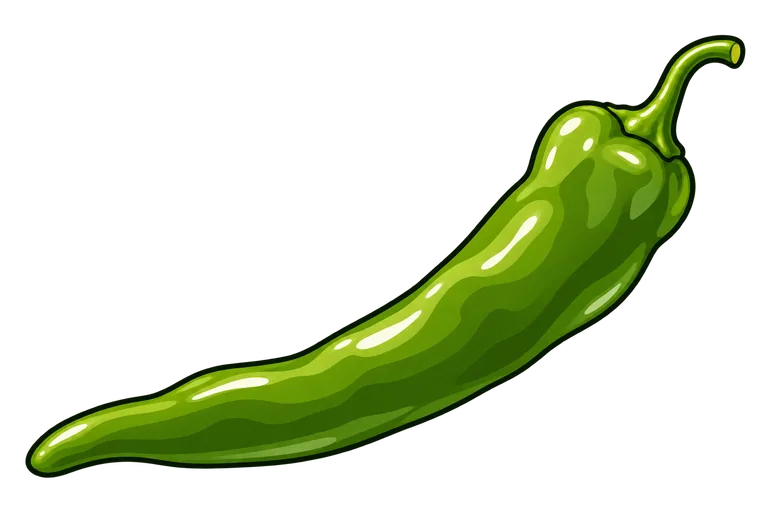
A long, mild green chile with a New Mexican family tree.
 Medium
1,000–5,000 SHU
- Usually about 1,000 SHU; a few varieties reach 5,000
- Green and usable in about 80 days, red after more than 120
- Roast 6–8 minutes at 400–450 °F until the skin blisters, then steam and peel
On this page
How hot is an Anaheim?
An Anaheim rates 1,000 to 5,000 Scoville heat units on the UF/IFAS Scoville list1. Most pods you buy sit at the bottom of that: UF/IFAS Extension calls it mild, usually about 1,000 SHU, with some varieties as hot as 5,0004.
The tier chip reads medium because we rate every entry by the midpoint of its published range, here 3,000 SHU. Expect most Anaheims to taste as mild as a poblano, and treat the odd hot one as the top of the range.
Why does one Anaheim taste hotter than the next?
Because heat is not fixed in the seed alone. NMSU's cultivar report says genes, weather, growing conditions and fruit age all change a chile's capsaicinoid content, and that growers who stress their plants get hotter pods5. Its own heat figures are averages that shift by year and by field5.
So two Anaheims from the same bag can differ, and a pod from a dry, hot August can bite more than you expect. You can still steer the heat in your pan:
How to keep an Anaheim dish at the heat you want
- Taste a thin strip from each batch before you add the whole lot.
- Pull the white ribs and seeds for a milder dish; the ribs hold about 89 % of a pod's capsaicin.
- Leave the ribs in, or add one jalapeño, when you want more bite.
- Buy a named mild cultivar, such as NuMex Joe E. Parker at 800–900 SHU, when you cook for children.
Is an Anaheim the same as a New Mexico chile?
It is one branch of that family. The NMSU Chile Pepper Institute defines the Anaheim as a cultivar of the New Mexican pod type, and notes that people often mislabel New Mexican chiles as "Anaheim"2.
- 1907
Fabián García starts breeding a new, more uniform chile pod type at the New Mexico agricultural college.3
- 1913
García becomes director of the New Mexico Agricultural Experiment Station.3
- 1921
He releases New Mexico No. 9, the first New Mexican variety with a dependable pod size and heat level.3
- Today
Every New Mexican type grown, the Anaheim included, owes its genetic base to New Mexico No. 9.3
The two NMSU pages date the start differently. The terminology page says García developed the pod type in the 1880s2, while the institute's own biography of him gives 1907 for the start of breeding and 1921 for the release3. NMSU's own cultivar list gives 1913 for New Mexico No. 9 and explains that a release date can differ from the date of the bulletin, which came out in 19215. We follow the biography because it gives you year-by-year dates.
Why is it called Anaheim?
After the California city where the seed settled. NMSU's cultivar report says Anaheim seed came from New Mexico and went to Anaheim, California, where growers have kept it in wide cultivation ever since5. So the California name sits on a New Mexican pepper, which is why you see the two labels blur on store shelves.
The old Anaheim pods had deep folds near the stem. NMSU bred Sandia partly to get rid of those severe folds5, and you can still see a wrinkled shoulder on many Anaheims you buy today4.
Which names belong to the same pod type?
| Name on the label | What NMSU says it is |
|---|---|
| Anaheim | A cultivar of the New Mexican pod type |
| New Mexican | The pod type itself, sometimes mislabeled Anaheim |
| Long green | Another name for the pod type; cultivars include NuMex Big Jim, NuMex Joe E. Parker and Sandia |
Texas AgriLife lists NuMex Joe E. Parker as its Anaheim pick for Texas gardens6, so the seed you buy can carry either name. NMSU publishes the heat of each one it bred, and they stay mild:
| Cultivar | Released | Heat | Note |
|---|---|---|---|
| New Mexico No. 9 | 1913 | 1,000–1,500 SHU | The genetic base of every New Mexican type |
| Sandia | 1956 | 1,500–2,000 SHU | Bred without the deep folds of old Anaheims |
| NuMex Big Jim | 1975 | 500–2,000 SHU | Green pods average 7.68 by 1.89 inches; once listed by Guinness as the largest chile |
| NuMex Joe E. Parker | 1990 | 800–900 SHU | Mild, from a single-plant selection |
The chiles grown around Hatch, New Mexico have their own entry: what makes a Hatch chile.
Should you pick it green or red?
Either works; you trade time for color. The plant is a vigorous bush whose green fruit turns deep red when ripe4, or maroon in the words of the extension's Scoville list1.
Green Anaheim
Red Anaheim
The extra 40 days or more is the cost of red. In a short summer, those extra weeks can run past your first frost before the pods turn. Fruit age also changes heat5, so a red pod from the same plant may taste a little different from the green one you picked in August.
When you shop for green pods, NMSU's guide says to look for chiles that feel heavy for their size, smooth, crisp and bright green, and to skip shriveled, soft or bruised ones7.
How do you roast and peel an Anaheim?
Blister the skin over high heat, trap the steam, then slip the skin off. NMSU's chile processing guide gives you the times and temperatures, and they work for any long green chile you bring home7.
- Wash and slitLets steam escape
- Roast6–8 min at 400–450 °F
- SteamCovered bowl or food bag
- PeelSkin pulls off with a tug
- ChillBelow 40 °F within 2 hours
- FreezeUp to 12 months
- 1
Slit each pod
Wash and dry the chiles, then cut a small slit in the side of each one so steam can escape and the pod doesn't burst.7
- 2
Roast on high heat
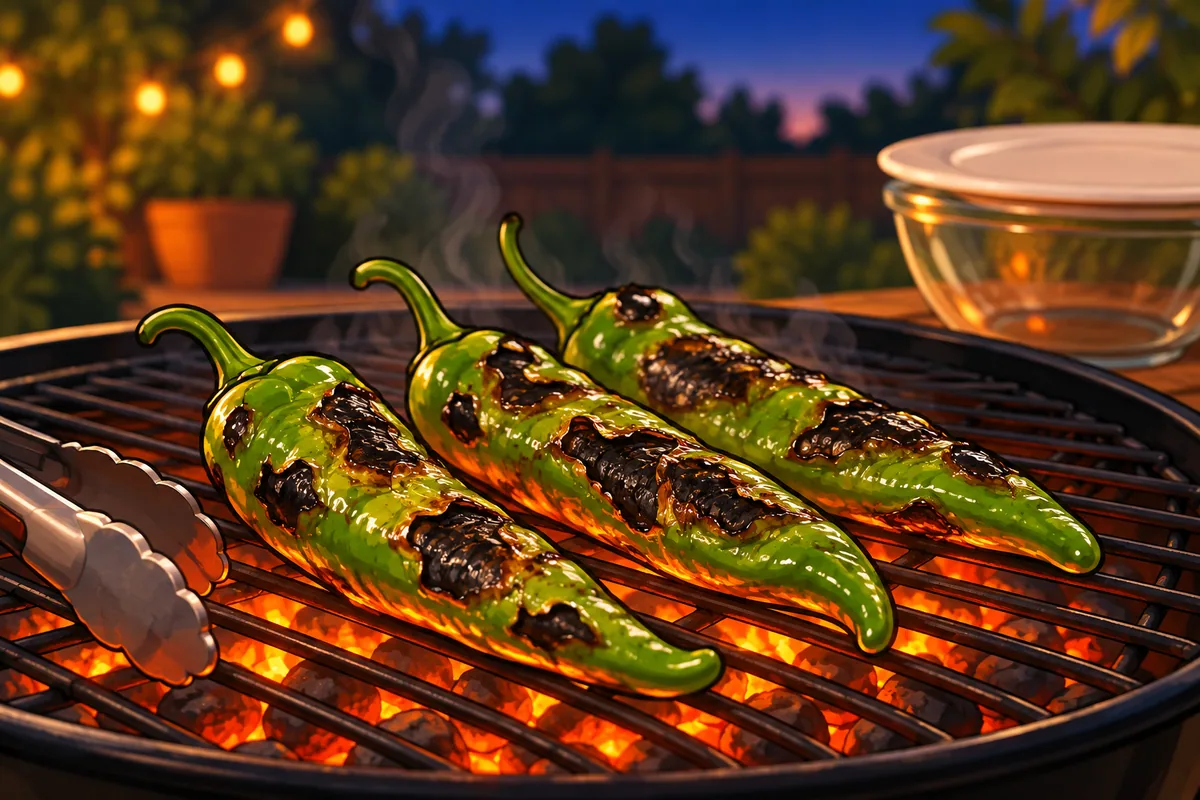
Use an oven or broiler at 400 to 450 °F, a grill 5 to 6 inches above glowing charcoal, or a burner under heavy wire mesh. Turn the pods often for 6 to 8 minutes, until the skin blisters and pulls away.7
- 3
Steam them
Put the hot chiles in a covered heat-safe bowl or a food-grade bag so the steam loosens the skins. Never use a garbage bag, since its plastic can leach into hot food.7
- 4
Peel
Once they cool, pull the skin off with a gentle tug and a quick rinse. Scrape any patch that didn't blister with a knife or a vegetable peeler.7
- 5
Chill or freeze
Get the peeled chiles into the fridge within 2 hours. Use them within 3 days, or chill them below 40 °F and freeze them.7
A microwave works too, but you won't see the blisters: NMSU gives 7 to 8 minutes in a covered dish, plus 1 to 2 minutes of standing steam, and warns the skin turns tougher7. If you want a crisper pod for rellenos, dip the chiles in ice water as they come off the heat.
| Where | How long | What to watch |
|---|---|---|
| Counter after roasting7 | Under 2 hours | Move them to the fridge inside that window |
| Fridge7 | Up to 3 days | Freeze sooner for the best texture |
| Freezer, at 0 °F or below7 | Up to 12 months | Packs no deeper than 2 inches, air pressed out |
You can also freeze the pods whole and unpeeled; NMSU notes they peel more easily after freezing7. That saves you an evening when a whole case comes home at once.
If you buy a sack roasted at a market drum, NMSU's advice for commercial roasting applies to you too: carry the hot chiles in a food-safe container inside a chilled ice chest, split them into small packs as soon as you get home, and have them in the fridge or freezer within 2 hours of roasting7.
How do you cook with an Anaheim?
Use mature green or ripe red pods fresh, or dry them for powder4. The UC Master Gardeners of Ventura County describe the flavor as mild, sweet and slightly smoky8. Here's how the pod type shows up in your kitchen:
- Rellenos. New Mexico's stuffed fresh chiles2. A roasted, peeled pod holds cheese well, and heirloom pods up to 7 inches long give you room for a real filling4.
- Green chile. Chop roasted pods into stews, eggs, burgers and sauces. Mild pods let you add a whole cup without making the dish too hot for the table.
- Red chile powder. Dry ripe red pods and grind them4; NMSU points you to its Guide E-322 for drying times7.
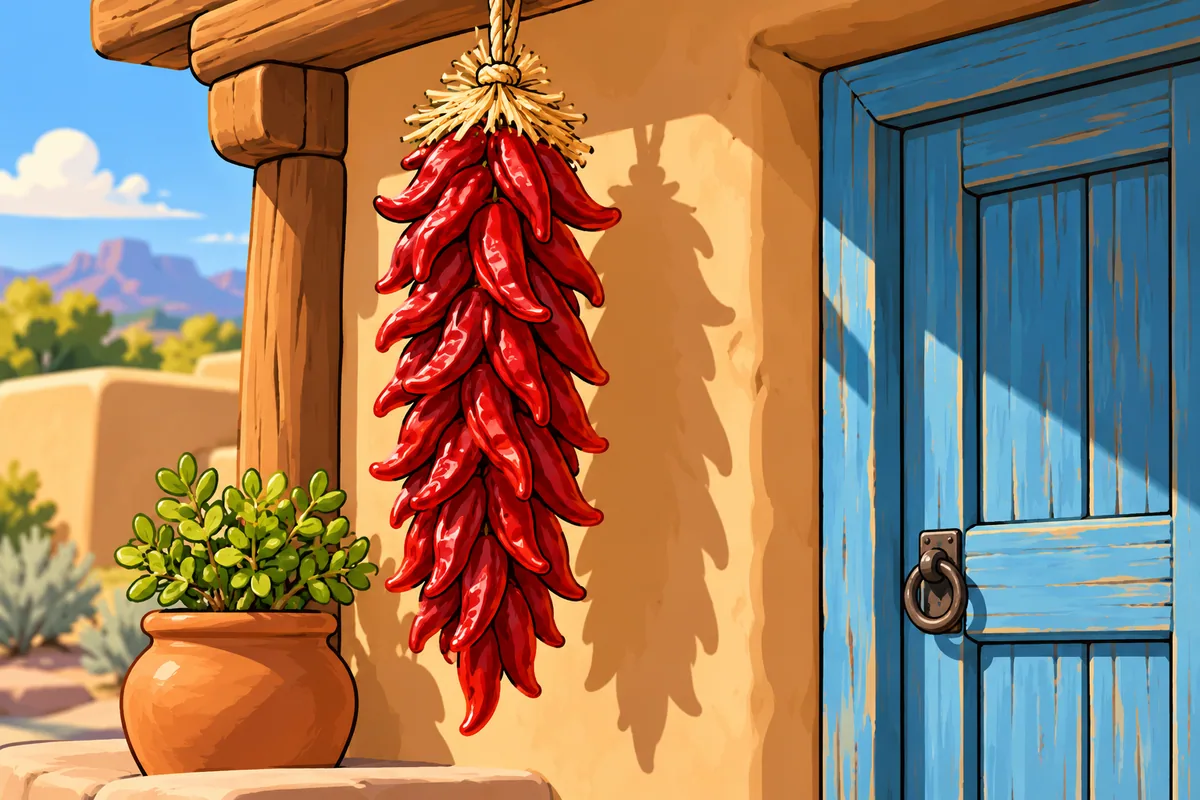
- The ristra. A long string of red chiles hung to store and decorate2.
What goes wrong with roasted Anaheims?
Most trouble you'll hit comes from heat that is too low, steam that escapes, or packs that freeze too slowly:
- The skin won't come off. The fire wasn't hot enough or the pods cooled uncovered. NMSU wants a very hot heat source and a covered container right after roasting; scrape stubborn patches with a peeler7.
- Burned, bitter spots. You left the pods in one position. Turn them often through the 6 to 8 minutes7.
- Mushy chile after thawing. Deep containers freeze slowly. Keep packs under 2 inches deep and lay them flat7.
- Your hands sting for hours. Wear rubber gloves or rub on a thin layer of solid fat before you peel a big batch, and soak stinging hands in plain vinegar7. Wash before you touch your eyes, or a baby.
- One pod is much hotter than the rest. That's the normal spread from weather and stress5. Mix the batch before you portion it, so no single bag gets all the hot ones.
Is an Anaheim hotter than a jalapeño or a poblano?
A jalapeño is usually hotter: 2,000 to 8,000 SHU against the Anaheim's typical 1,0004, and you can work out the ratio between the two from those figures.
Against a poblano at 1,000 to 2,000 SHU it is a close match, close enough that you can swap a poblano for an Anaheim in most dishes without anyone noticing the heat.
So which one should you pick? Let the dish decide:
| Your dish | Pick | Why |
|---|---|---|
| Rellenos for a mixed crowd45 | Anaheim or Big Jim | Long pod, usually about 1,000 SHU; Big Jim pods average 7.68 inches |
| Stuffed pepper with a wide cavity4 | Poblano | Similar heat, 1,000–2,000 SHU, and a broader pod |
| Salsa that should bite4 | Jalapeño | 2,000–8,000 SHU, so one pod does the work of several Anaheims |
| Green chile stew for children5 | NuMex Joe E. Parker | 800–900 SHU, at the low end of the type |
If your store is out of Anaheims, a poblano gives you the closest match by heat; other options are in the Anaheim swap list.
Can you grow Anaheims?
Yes, if your season is long enough for the color you want. UF/IFAS gives about 80 days to mature green pods and more than 120 to ripe red4. Clemson spaces pepper plants 12 inches apart in rows 3 feet apart, and sets them out only after the last frost9.
In a short northern summer, plan on green chile and treat red as a bonus if your plants get there. Texas gardeners get a long enough run for both, and Texas AgriLife recommends NuMex Joe E. Parker for them6. The Anaheim growing guide takes it from seed to harvest.
Related peppers
Related in Peppers
-
Cubanelle Pepper Scoville, About 1,000 SHU
A long, thin-walled sweet pepper made for the frying pan.5 min read -
Cayenne Pepper Scoville, 25,000–50,000 SHU
The long red chile behind most ground red pepper and a lot of vinegar hot sauce.6 min read -
Serrano Pepper Scoville, 10,000–25,000 SHU
A slim, fleshy chile one clear step above the jalapeño.5 min read -
Aji Panca Heat, 500–1,500 SHU, Peru's Great Dried Ají
Peru's dark, mild, berry-scented dried pepper: almost never eaten fresh, always there for color.6 min read -
Mirasol Chile, 2,500–5,000 SHU Before It Dries to Guajillo
The fresh name of the chile that Mexico dries into guajillo, and two namesakes from Peru and New Mexico.5 min read -
Pasilla Chile, the Dried Chilaca at 1,000–2,000 SHU
A long, nearly black dried chile with a raisin skin and a smoky, fruity taste.6 min read
Sources
· 9
- 1UF/IFAS Gardening Solutions Peppers by Scoville Units
- 2New Mexico State University, Chile Pepper Institute Chile Terminology
- 3New Mexico State University, Chile Pepper Institute Fabián García: The Man Behind the Legend, 1871-1948
- 4University of Florida IFAS Extension HS-859/TR010: Pepper Production in Miami-Dade County, Florida
- 5New Mexico State University, Agricultural Experiment Station (Research Report 792) The Chile Cultivars of New Mexico State University Released from 1913 to 2016 (Coon and Bosland)
- 6Texas AgriLife Extension Service (Joe Masabni) Jalapeño & Other Hot Peppers
- 7New Mexico State University, Cooperative Extension Service (Guide E-324, Nancy C. Flores) Processing Fresh Chile Peppers
- 8University of California Agriculture and Natural Resources, UC Master Gardeners of Ventura County Ventura Garden to Table Series: Peppers
- 9Clemson Cooperative Extension, Home & Garden Information Center HGIC 1316: Pepper