
Pasilla Chile, the Dried Chilaca at 1,000–2,000 SHU
A long, nearly black dried chile with a raisin skin and a smoky, fruity taste.
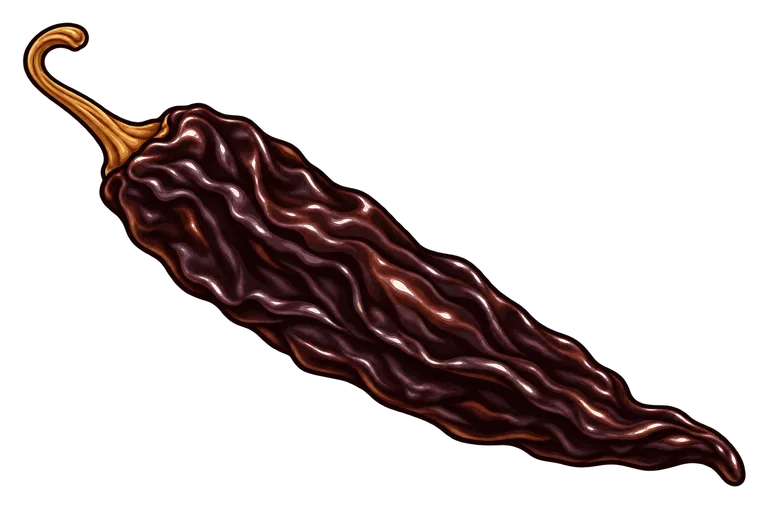 Mild
1,000–2,000 SHU, mild
- The dried form of the chilaca, a pod up to 10 inches long and 1 inch wide
- About as hot as a poblano, but half as wide and twice as long
On this page
- 1What fresh chile becomes a pasilla?
- 2How hot is a pasilla?
- 3How is a pasilla different from the poblanos sold under its name?
- 4What does a pasilla taste like?
- 5How do you cook with dried pasillas?
- 6Where does the pasilla sit among Mexico's dried chiles?
- 7How do you pick and store good pasillas?
- 8Can you grow your own chilacas to dry?
- 9What goes wrong with pasillas?
- 10What to cook with your first bag of pasillas
What fresh chile becomes a pasilla?
The chilaca. UC Master Gardeners in Ventura County describe pasilla as dried chilaca3, and the seed company that sells the Pasilla Bajio chilaca describes the same thing: a narrow, dark green pod up to 10 inches long and 1 inch wide that matures to dark brown and dries into the wrinkled pasilla1. In Mexico, the genus monograph records both "chile pasilla" and "chile chilaca" as local names within Capsicum annuum2.
- Green chilacaNarrow pod up to 10 in long
- Ripe on the plantTurns dark brown
- DriedWrinkles like a raisin
- PasillaLong, nearly black, smokyMild
Bars show published heat ranges. 1
The seed company says the name means "little raisin" in Spanish, after the dark, wrinkled skin of the dried pod1. Hold one up to the light and you'll see why: the skin is so dark it reads as black until light shines through it. The fresh pod has its own entry, the chilaca, if you're cooking it green.
How hot is a pasilla?
Mild. The Pasilla Bajio seed packet gives 1,000 to 2,000 Scoville heat units1, the same range UF/IFAS gives for the poblano4. You'd need a lot of pasilla to make a dish truly hot, so cooks use it for flavor and color first.
Log scale; bars are published ranges.Sources for this line1. Botanical Interests (seed company's product page for its own seed)4. University of Florida IFAS Extension5. UF/IFAS Gardening Solutions
That range comes from a seed company describing its own cultivar, not from a lab study, and we didn't find a university measurement for the dried pod. Treat it as a guide: a pasilla warms a sauce gently, about like a mild poblano, and far below a jalapeño.
How is a pasilla different from the poblanos sold under its name?
By shape, before anything else. A chilaca is long and narrow, up to 10 inches by 1 inch1; a poblano is about 4 inches long and 2 inches wide4. So if a bin of fresh, wide, heart-shaped green chiles carries a "pasilla" sign, you're looking at poblanos, and the dried pods they become are anchos, which UF/IFAS gives as the name for a ripe, dried poblano4.
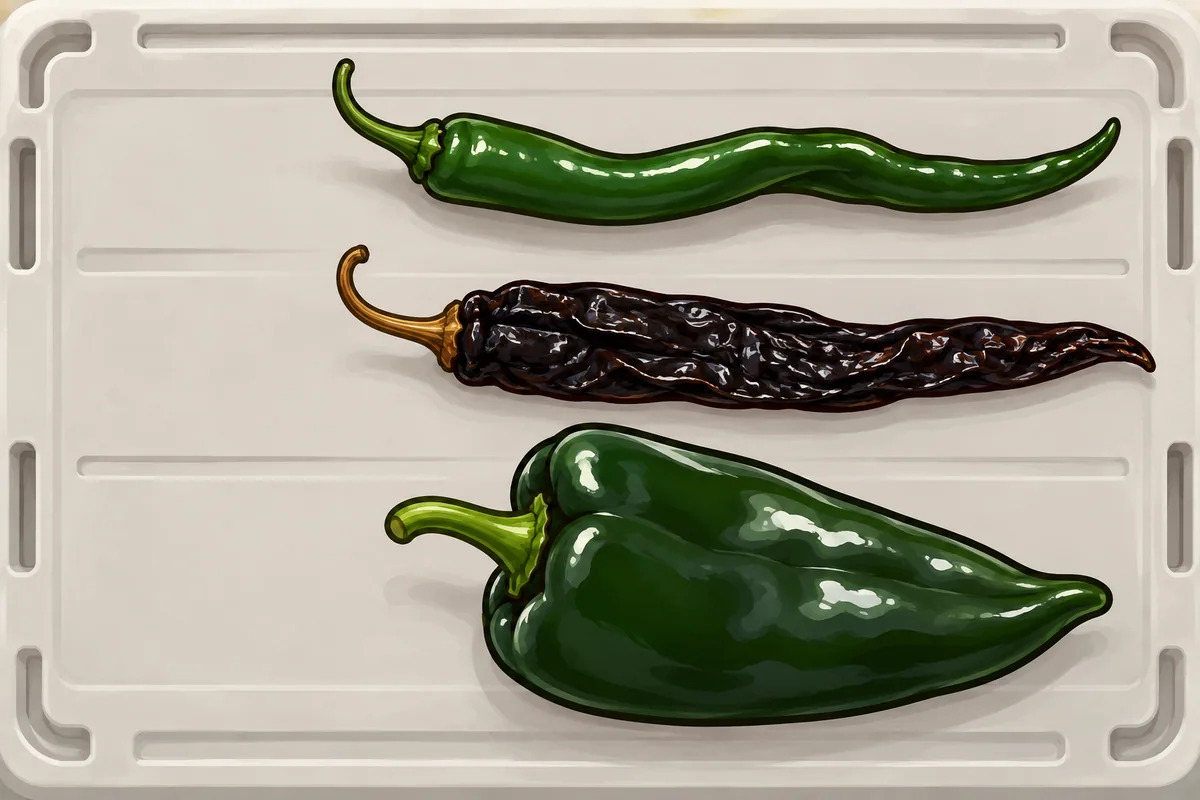 Fresh chilaca: up to 10 in long, 1 in wide1Dried pasilla: the same slim pod, wrinkled and nearly black3Poblano: about 4 in long and 2 in wide; dried, it is an ancho4
- Fresh chilaca: up to 10 in long, 1 in wide1
- Dried pasilla: the same slim pod, wrinkled and nearly black3
- Poblano: about 4 in long and 2 in wide; dried, it is an ancho4
| Trait | Chilaca (fresh) | Pasilla (dried chilaca) | Poblano (fresh) |
|---|---|---|---|
| Size | Up to 10 × 1 in 1 | Long and slim, like the chilaca | About 4 × 2 in 4 |
| Color | Dark green, ripening dark brown 1 | Nearly black, wrinkled | Green, ripening red 4 |
| Heat | 1,000–2,000 SHU 1 | 1,000–2,000 SHU 1 | 1,000–2,000 SHU 4 |
| Dried name | Pasilla | Already dried | Ancho 4 |
If your recipe means the dried Mexican chile, buy a bag of long black pods. If it says fresh pasilla and comes from a California cookbook, it may well mean a poblano, so read the recipe's description of the pepper before you shop. The pasilla and poblano comparison goes deeper into the naming mix-up.
What does a pasilla taste like?
Dark and rich, and different from what most people expect from a chile. UC Master Gardeners list smoky, earthy and fruity flavors with notes of chocolate, raisins and sometimes tobacco3, and the seed company calls it rich and smoky1.
You taste that depth most in a slow sauce. Toasted and blended, a pasilla gives a mole its bitter-chocolate backbone; raw and ground into a rub, it reads more like dried fruit. If you like the flavor of a good ancho but want something less sweet and more savory, you'll probably reach for pasillas more often.
- Smoky
- Raisin
- Chocolate
- Earthy
How do you cook with dried pasillas?
Toast, soak, blend. UC Master Gardeners name sauces, rubs and stews as its uses3, and the seed company points to mole and adobo1. The steps below are kitchen practice, so adjust times to your pods.
- 1
Wipe and stem
Wipe the pods with a damp cloth, snap off the stems and shake out most of the seeds.
- 2
Toast briefly
Press each pod flat in a dry pan over medium heat until it smells sweet and turns a shade lighter, a few seconds per side.
- 3
Soak
Cover the toasted pods with hot water or stock and leave them until soft and pliable.
- 4
Blend
Blend the soft pods with garlic, onion and some soaking liquid into a smooth paste.
- 5
Fry the paste
Cook the paste in a little oil until it darkens, then thin it into your sauce or stew.
For a pot of sauce for four, start with three or four pods and taste before adding more. You can always soak one more pod while the sauce simmers, so there's no need to guess high on your first try. Wear gloves if you seed a big batch; even mild chiles leave capsaicin on your skin, and Poison Control lists warm water, vegetable oil or a diluted vinegar soak for skin that stings6.
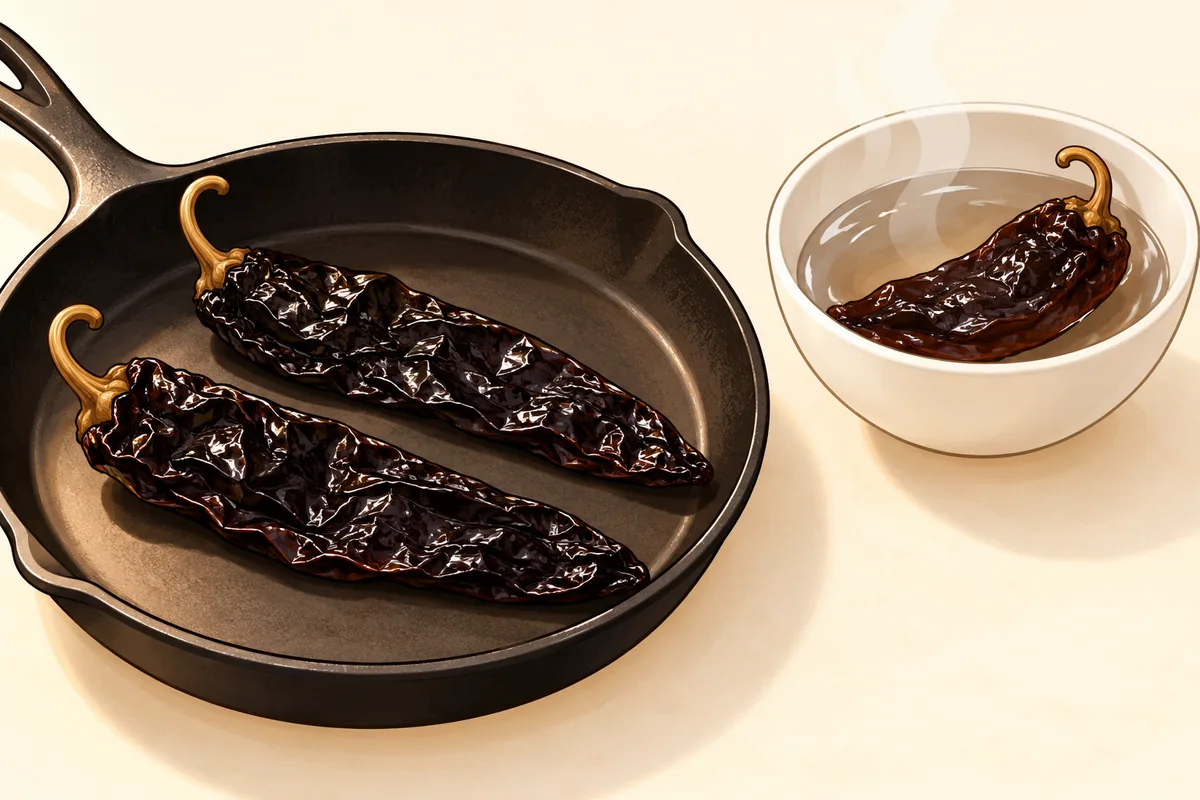
A worked example: a quick pasilla table salsa
Here's how those steps play out in a small batch you can make tonight. Toast and soak three pasillas, then blend them with two roasted tomatoes, one clove of garlic, a quarter of an onion, a pinch of salt and about half a cup of the soaking water. Taste it. If you want it brighter, add a squeeze of lime; if you want more heat, blend in a small piece of a hotter dried chile, since the pasillas alone stay mild.
You'll end up with about a cup and a half of dark, smoky salsa that keeps a few days in your fridge. Spoon it over eggs, grilled meat or beans. These quantities are a kitchen starting point rather than a tested recipe, so adjust them to your pods and your taste; older, drier pasillas need a longer soak and give a slightly more bitter salsa.
Where does the pasilla sit among Mexico's dried chiles?
Next to the ancho and the guajillo, the three you'll see together in many Mexican recipes. Each brings a different job to the pot.
Many cooks blend two or three of them, using pasilla for depth, guajillo for brightness and ancho for sweetness. The ancho and guajillo entries give each one's own data.
For head-to-heads, the ancho against pasilla page and the guajillo against pasilla page set them side by side.
Don't confuse any of these with the pasilla de Oaxaca, a different chile despite the shared name; it has its own pasilla de Oaxaca entry. If a recipe from Oaxaca asks for pasilla, check which one it means before you buy, because swapping one for the other changes the dish.
How do you pick and store good pasillas?
Choose pods you can bend. A good dried pasilla should flex like a soft leather strap rather than crack, smell of dried fruit when you open the bag, and show no pale fuzzy patches. If you're buying fresh chilacas to cook or dry yourself, NMSU's chile guide gives the same rules it uses for green chile: pick mature pods that feel heavy for their size, smooth and crisp, and skip any with shriveled skin, mold, soft spots or bruises7.
At home, keep dried pods in a sealed jar or a zip bag with the air pressed out, away from the stove and out of the sun. Heat and light fade the color and dull the smell over the months. If your pods start to feel brittle, use them soon in a long-simmered sauce, where soaking brings them back. Buying a smaller bag more often gives you better pods than one big bag that sits in your cupboard for a year.
Can you grow your own chilacas to dry?
Yes, with a long warm season and some patience at the end. The Pasilla Bajio seed packet gives these numbers1:
Leave the pods on the plant until they turn dark brown, then dry them somewhere warm, dry and airy. A tall plant loaded with 10-inch pods leans, so a stake saves you a broken stem in late summer. For seed starting and transplanting step by step, the poblano grow guide walks you through a similar long, warm season.
What goes wrong with pasillas?
Most problems you'll hit come from heat in your pan, not heat in the pod.
Problems and fixes
- Your sauce tastes bitter: you toasted the pods too long. Toast for seconds, until fragrant, and throw out any pod that blackens.
- Pods snap and crumble: they're old and over-dry. Soak them anyway; they'll still flavor a sauce, but buy pliable pods next time.
- The dish is milder than expected: pasilla runs 1,000–2,000 SHU, so add a hotter dried chile for heat.1
- You came home with wide fresh peppers: those are poblanos sold as pasilla. Use them fresh, or dry ripe ones into anchos.4
What to cook with your first bag of pasillas
Make a small pot of sauce this week: toast and soak four pods, blend them with garlic and stock, and simmer it with chicken or beans. If your shop is out of pasillas, the pasilla swap list gives you other dried chiles and how much of each to use.
Related peppers
Related in Peppers
-
Mirasol Chile, 2,500–5,000 SHU Before It Dries to Guajillo
The fresh name of the chile that Mexico dries into guajillo, and two namesakes from Peru and New Mexico.5 min read -
Jalapeño Scoville, 2,000–8,000 SHU and Chipotle
The medium-heat chile most heat comparisons start from.6 min read -
Cascabel Chile, Two Official Heat Scores for One Round Pod
A reddish-brown dried globe with a nutty, woody taste, named for the little bell it sounds like.6 min read -
Anaheim Pepper Scoville, 1,000–5,000 SHU
A long, mild green chile with a New Mexican family tree.6 min read -
Serrano Pepper Scoville, 10,000–25,000 SHU
A slim, fleshy chile one clear step above the jalapeño.5 min read -
Aji Panca Heat, 500–1,500 SHU, Peru's Great Dried Ají
Peru's dark, mild, berry-scented dried pepper: almost never eaten fresh, always there for color.6 min read
Sources
· 8
- 1Botanical Interests (seed company's product page for its own seed) Pasilla Bajio Chile Pepper Seeds
- 2PhytoKeys 200:1-423 (Pensoft) Monograph of wild and cultivated chili peppers (Capsicum L., Solanaceae)
- 3University of California Agriculture and Natural Resources, UC Master Gardeners of Ventura County Ventura Garden to Table Series: Peppers
- 4University of Florida IFAS Extension HS-859/TR010: Pepper Production in Miami-Dade County, Florida
- 5UF/IFAS Gardening Solutions Peppers by Scoville Units
- 6National Capital Poison Center (Poison Control) Capsaicin: when the chili is too hot
- 7New Mexico State University Cooperative Extension (Guide E-324) Processing Fresh Chile Peppers (revised by Nancy C. Flores and Cindy Schlenker Davies)
- 8Molecules 18(11):13471-13486 (MDPI) Characterization of Different Capsicum Varieties by Evaluation of Their Capsaicinoids Content by High Performance Liquid Chromatography, Determination of Pungency and Effect of High Temperature (González-Zamora et al.)