On this page
- 1What can you use instead of an Anaheim?
- 2Which Anaheim swap should you pick?
- 3Which New Mexican green chiles stand in for an Anaheim?
- 4Is a Hatch chile the same as an Anaheim?
- 5What heat number do these Anaheim swaps start from?
- 6How much poblano or jalapeño do you use?
- 7Can you use canned green chiles instead?
- 8Which swap holds a relleno stuffing?
- 9How do you roast, peel and keep the swap?
- 10Poblano or a New Mexican long green?
- 11Why did your Anaheim stand-in stew come out too hot or mushy?
- 12Test one pod before the whole tray
- 13Sources
What can you use instead of an Anaheim?
Any New Mexican long green chile swaps one for one, because an Anaheim is one of them1. After that comes the poblano, which fills the same role at about half the heat, then cubanelle for frying and jalapeño when you want more bite.
Each row gives you two amounts where they differ: the pod swap, which keeps the look of your dish, and the heat swap, which keeps the burn.
| Swap | Heat vs Anaheim | How much for 100 g Anaheim | Best for | Flavor note |
|---|---|---|---|---|
| New Mexican long green2 | Same family: cultivar averages from 900 to 9,500 SHU | 100 g by pod; 46 g of a 6,500 SHU Big Jim for the same heat | Rellenos, roasting, stew | Not described by the source |
| Poblano3 | Milder: 1,000–2,000 SHU, about 0.5 × | 100 g by pod; 200 g for the same heat | Rellenos, roasting | Rich melon flavor |
| Cubanelle3 | Milder: about 1,000 SHU, about 0.3 × | 100 g by pod, milder | Frying in strips | Sweet, very mild flesh with a rich flavor |
| Jalapeño3 | Hotter: 2,000–8,000 SHU, about 1.7 × | 60 g | Raw salsa, or a stew blended with poblano | Spicy but not overwhelming |
| Hungarian wax3 | Hotter: 5,000–10,000 SHU, about 2.5 × | 40 g | Raw salsa, pickles | Not described by the source |
| Canned green chiles4 | Not known: no heat figure, pepper not named | About ¾ cup (100 g), drained, then taste | Stew, casserole, enchilada sauce | Not described by the source |
| Ancho, for dried Anaheim5 | Milder: poblano 1,000–2,000 SHU, about 0.5 × | 1 dried pod (about 17 g6) per dried pod, an estimate | Red chile sauce, ground chile | Not described for the dried form |
| Bell pepper plus jalapeño3 | Bell 0 SHU; the jalapeño carries the heat | 40 g bell + 60 g jalapeño | Body and color in a pot | Not described by the source |
For rellenos or roasting, swap by pod and accept a change in heat; for a stew or sauce, swap by heat and use the gram column. Pod-shaped jobs need the pod, while a pot of stew only cares about the total heat.
New Mexican long green, the same pepper family
NMSU calls the Anaheim a cultivar of the New Mexican pod type, the "long green"1. So any long green swaps by pod, with one catch: NMSU's cultivar averages run from 900 SHU for NuMex Joe E. Parker to 6,500 for Big Jim and Sandia2. If your bag names a hot cultivar, use about half the weight in a stew.
Poblano, the easiest one to find
A poblano runs 1,000–2,000 SHU with a rich melon flavor3, about half an Anaheim's heat by midpoint. Swap it pod for pod in rellenos and you get a milder, shorter, wider pod. In a stew, use twice the weight or blend it with jalapeño, as the worked example further down shows.
Cubanelle, for strips in a pan
UF/IFAS describes the cubanelle as sweet, very mild and rich, at about 1,000 SHU3. Slice it into strips for eggs, fajitas or fried peppers, using the same 100 g. Its flesh is thin, so you skip it for stuffing.
Jalapeño, for more bite with less pepper
A jalapeño's midpoint of 5,000 SHU3 is about 1.7 times the Anaheim's 3,000, so 60 g brings the heat of 100 g. It works best raw in salsa, or chopped fine next to poblano in a pot. You get a smaller, thicker pod, so it does not stuff well.
Hungarian wax, if you want it hotter still
At 5,000–10,000 SHU3, a Hungarian wax needs only 40 g to match 100 g of Anaheim, an estimate. Chop it into salsa or pickle it. No source we read describes how it tastes.
Canned green chiles, for the pot
USDA weighs one cup of canned green chiles at 139 g4, so 100 g is about three quarters of a cup. The record names no pepper and gives no heat, so you add most of it, taste, then the rest. Keep cans for stews and sauces, since the pods are already soft.
Ancho, when the recipe wants dried Anaheim
UF/IFAS says Anaheims are also dried and ground into powder, and that the dried poblano is the ancho5. USDA weighs one dried ancho at about 17 g6. Swap pod for pod in a red chile sauce and expect it a little milder; we found no source that describes the dried flavor.
Bell pepper plus jalapeño, for body without guesswork
A bell rates 0 SHU3, so on its own it only gives your pot green body. Pair 40 g of bell with 60 g of jalapeño and you match the 300,000 heat units in 100 g of Anaheim, by midpoints. You lose the long-green look, so save it for chopped dishes.
Which Anaheim swap should you pick?
Start with the job the Anaheim does in your recipe. You stuff it, chop it into a pot, slice it into a hot pan or eat it nearly raw, and each of those jobs points to a different swap.
- whole podYou stuff whole podsRellenos, baked stuffed chiles
- keep the shapeNew Mexican long greenOne for one by pod; poblano if you can't find it
- keep the shape
- choppedYou chop it into a potStew, sauce, chili, soup
- keep the heatPoblano plus jalapeño300 g plus 200 g for 500 g Anaheim
- keep the heat
- stripsYou slice it into a panStrips with eggs, fajitas, fried peppers
- keep the textureCubanelleThinner flesh than a bell, about 1,000 SHUMild
- keep the texture
- rawYou eat it nearly rawSalsa, salad, sandwich
- keep the biteJalapeño, less of it60 g for each 100 g AnaheimMedium
- keep the bite
- driedThe recipe wants dried podsRed chile sauce, ground chile
- dried for driedAnchoPod for pod, a little milder
- dried for dried
Bars show published heat ranges. Sources for this line2. New Mexico State University3. University of Florida IFAS Extension5. UF/IFAS Gardening Solutions
The raw branch is the one where a jalapeño beats a poblano. Raw poblano tastes green and mild, while your salsa wants bite, and 60 g of jalapeño brings the heat of 100 g of Anaheim3.
Which New Mexican green chiles stand in for an Anaheim?
Any New Mexican green chile can, because the Anaheim belongs to that family. NMSU's Chile Pepper Institute defines the Anaheim as a cultivar of the New Mexican pod type1, and says the seed came from New Mexico and was taken to Anaheim, California2. NMSU also notes that the whole New Mexican pod type is often mistakenly called Anaheim2.
The same glossary calls the type "long green" and names NuMex Big Jim, NuMex Joe E. Parker and Sandia as its cultivars1. Kentucky's extension lists Anaheims as New Mexican chiles that run mild to hot and grow considerably longer than jalapeños7.
That makes any New Mexican green chile a close swap, with one catch: the cultivars differ a lot in heat. These are NMSU's own averages, which change by year and growing location2:
| Cultivar | Average heat |
|---|---|
| NuMex Joe E. Parker2 | 900 SHU |
| New Mexico 6-42 | 900 SHU |
| NuMex Heritage 6-42 | 1,500 SHU |
| Española Improved2 | 2,500 SHU |
| NuMex Big Jim2 | 6,500 SHU |
| Sandia2 | 6,500 SHU |
| NuMex Heritage Big Jim2 | 9,500 SHU |
If the bag at the store names the cultivar, read across this table. If it just says "green chile", treat it as the Anaheim range and taste a strip first.
Is a Hatch chile the same as an Anaheim?
Often, but not by definition. NMSU's Chile Pepper Institute says there is no chile variety named Hatch: the name marks the Hatch Valley area where the chiles grow, and stores may put it on any New Mexican pod-type variety, Anaheim included8. To carry the Hatch label, a chile has to come from a New Mexico field8.
So a bag of Hatch green chile swaps one for one for an Anaheim, with the heat set by whichever cultivar is inside. If the store names it, the table above gives its average; if you have Hatch chiles and need a stand-in, the Hatch chile swaps start from the same family.
What heat number do these Anaheim swaps start from?
An Anaheim rates 1,000 to 5,000 SHU on UF/IFAS's Scoville list5. UF/IFAS's production guide puts it at about 1,000, with some varieties reaching 5,0003, so most pods sit at the low end.
The seed behind your pod moves that number. Texas AgriLife names NuMex Joe E. Parker as its Anaheim variety9, a cultivar NMSU averages at 900 SHU2, so a Texas-grown pod from that seed sits near the bottom of the range. We use the 3,000 SHU midpoint of the UF/IFAS range for the math below, because you rarely know the cultivar.
How much poblano or jalapeño do you use?
Divide the Anaheim midpoint by the swap's midpoint and multiply by the weight in the recipe. The Anaheim midpoint is (1,000 + 5,000) ÷ 2 = 3,000 SHU; a poblano's is 1,500, so 3,000 ÷ 1,500 = 2, twice the weight for the same heat.
Twice the poblano rarely fits the pot. A blend of poblano and jalapeño keeps the volume and the heat.
A worked example for a 500 g green chile stew
The recipe calls for 500 g of roasted Anaheim. That is 500 × 3,000 = 1,500,000 heat units to match, using midpoints from the table above35.
| Swap | Weight | Heat units | Against 1,500,000 |
|---|---|---|---|
| Poblano only | 500 g × 1,500 | 750,000 | half the heat |
| Poblano + jalapeño | 300 g × 1,500 + 200 g × 5,000 | 1,450,000 | about the same |
| Cubanelle + jalapeño | 300 g × 1,000 + 200 g × 5,000 | 1,300,000 | a little milder |
| NuMex Big Jim only | 500 g × 6,500 | 3,250,000 | about twice as hot |
Read the second row as your default. You keep 500 g of green pepper in the pot, so the stew stays as thick as the recipe meant, and the 200 g of jalapeño adds the heat the poblano lacks. Roast the jalapeños with the poblanos and chop them finer, since a large jalapeño chunk in one spoonful hits harder than the same heat spread through the pot.
Can you use canned green chiles instead?
Yes, in a pot. USDA weighs one cup of canned green chiles at 139 g4, so a recipe that asks for 500 g of roasted Anaheim takes 500 ÷ 139 = about 3½ cups. A whole canned green hot chile weighs about 73 g in USDA's record10, which makes the same 500 g about 7 pods.
Neither USDA record names the pepper inside the can or gives its heat. Add three cups, taste, and add the last half cup only if your stew needs it.
Which swap holds a relleno stuffing?
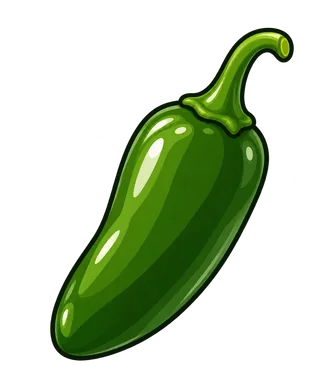
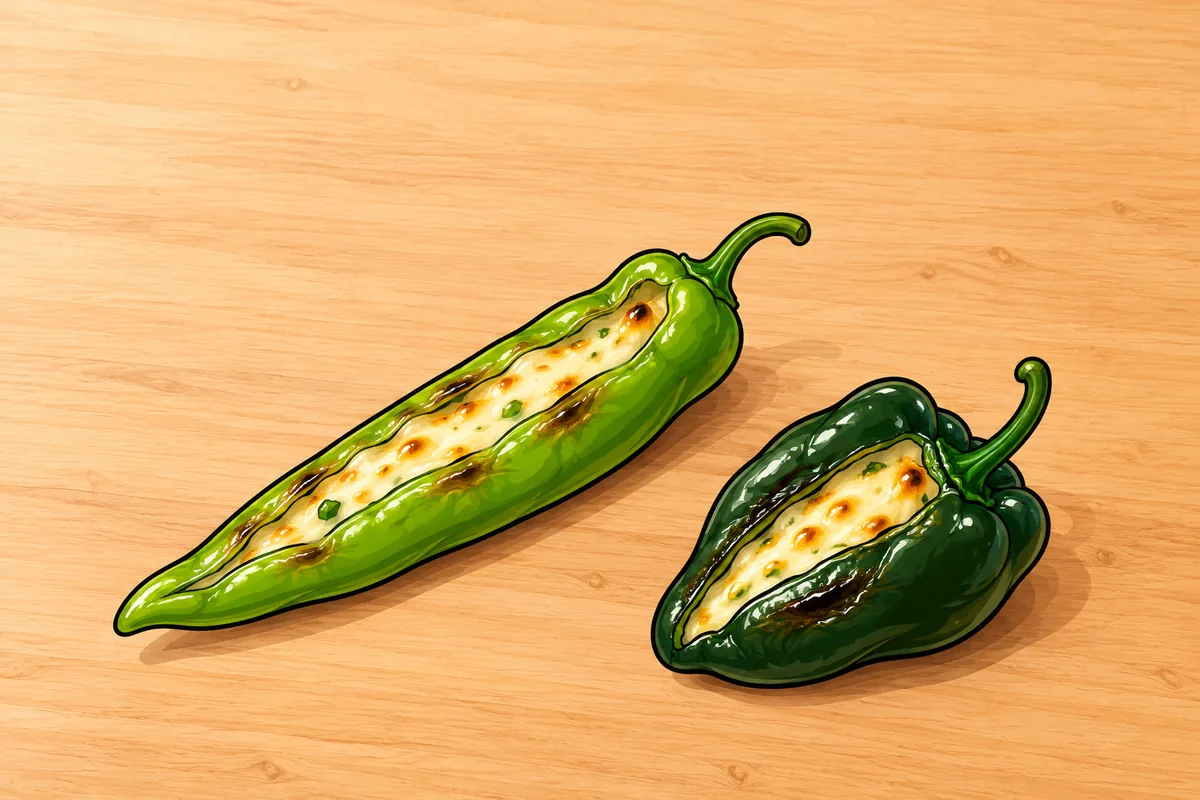
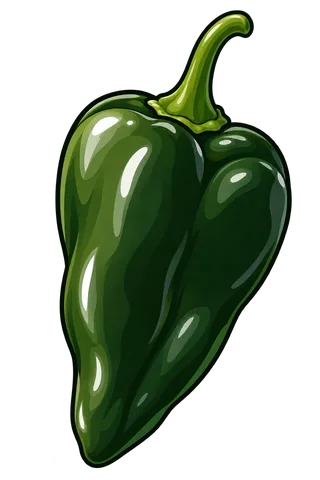
A long green chile, then a poblano. UF/IFAS gives these pod sizes for the two, and they decide how much filling each pod takes3:
A poblano is shorter and wider, so you fill it like a pocket instead of a tube, and its thick wall holds up under a batter. NMSU tells you to leave the stems on when the chiles are going into rellenos13, which gives you a handle when you dip them. A cubanelle has thinner flesh than a bell3 and tears more easily, so keep it for strips. The chiles rellenos recipe takes it from there.
How do you roast, peel and keep the swap?
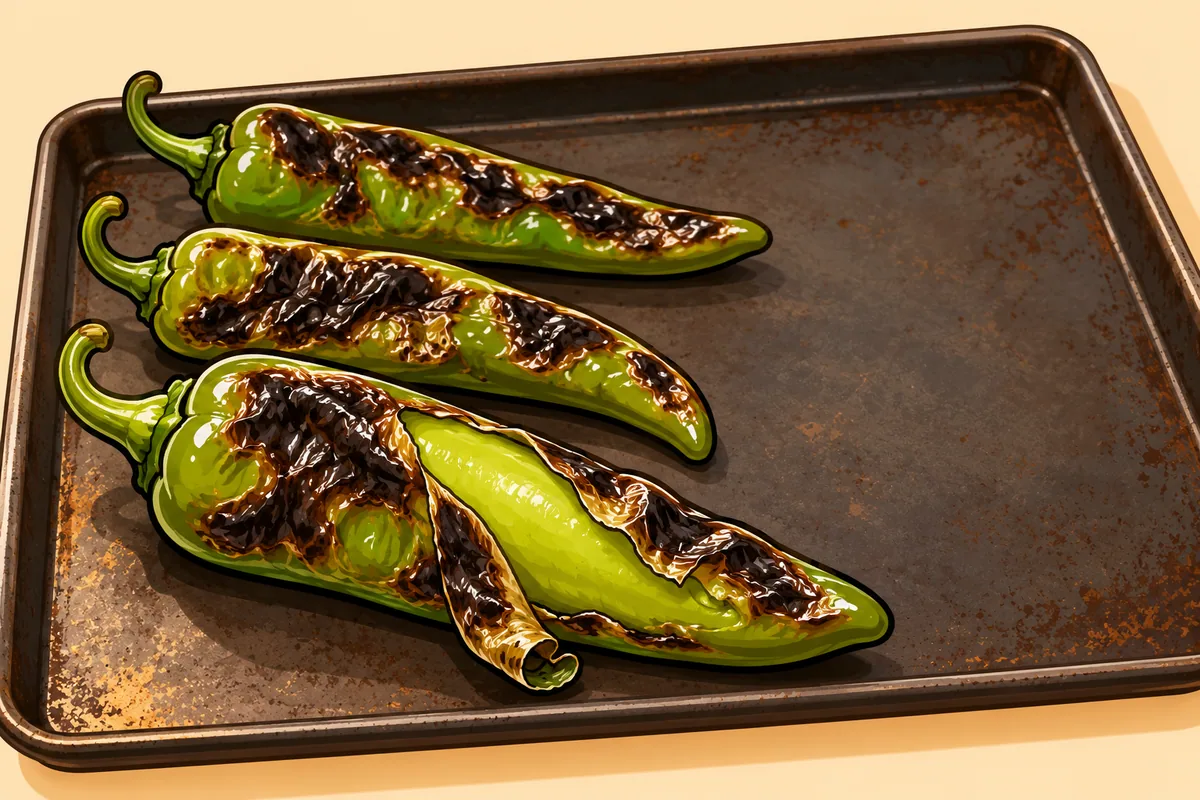
The same way you would an Anaheim. NMSU's processing guide covers every New Mexican chile, and the steps work for poblanos too12:
- 1
Slit and blister
Cut a small slit in each pod so steam can escape. Roast at 400–450°F in the oven or under the broiler, or 5–6 inches above glowing coals, for 6–8 minutes, turning often, until the skin blisters and pulls away from the flesh.12
- 2
Trap the steam
Put the hot chiles in a covered heat-safe container or a food-grade bag. Once they cool, the skin comes off with a gentle tug; scrape any spot that did not blister with a knife or a peeler.12
- 3
Chill fast
Refrigerate roasted, peeled chiles within 2 hours of roasting, and use or freeze them within 3 days.12
- 4
Freeze flat
Pack them in containers no deeper than 2 inches, press out the air and stack the packs flat. They keep safely for up to 12 months.12
NMSU also says the skin comes off more easily after freezing, so you can freeze blistered pods whole and peel them as you thaw them13. The roasting steps cover a gas flame and a grill in more detail.
Poblano or a New Mexican long green?
Take the long green if you can find it; take the poblano if your dish can live with less heat. Both roast the same way: Penn State roasts slashed peppers at 400°F for 6 to 8 minutes, until the skins blister11.
Poblano
If your recipe asks for dried Anaheim or New Mexico chile powder, swap dried for dried. UF/IFAS says Anaheims are also dried and ground into powder5, and the dried poblano is the ancho, so an ancho pod is the closest dried swap you can buy in most stores.
Why did your Anaheim stand-in stew come out too hot or mushy?
Most problems come from heat that lands off target or from the roasting. Here is what you can do about each one:
- The stew came out too hot. Serve it with milk: in a 2019 Penn State study, whole and skim milk cut the burn of a spicy drink more than water, cola or seltzer, and carbonated drinks did worst. For the next pot, add 100 g more poblano and drop one jalapeño.14
- The pot tastes flat and mild. Stir in finely chopped jalapeño 20 g at a time; each 20 g adds about 100,000 heat units, roughly 7 % of the 1,500,000 a 500 g Anaheim pot carries.3
- The skins will not come off. You took the pods out before the skin blistered, or skipped the steam. Cover them while they cool, then scrape the patches that stayed flat.12
- Your frozen chile thawed mushy. The container was too deep and froze slowly; keep packs under 2 inches deep and freeze them within 3 days of roasting.12
- Your hands burn after peeling. Soak them in plain vinegar to ease the sting, and next time wear rubber gloves or rub on a thin layer of solid fat first; keep your hands away from your eyes.12
Test one pod before the whole tray
Roast one pod of your swap, peel it and taste a strip before you commit the tray. If it bites harder than you expected, you know right away to move toward the poblano rows; if it tastes like nothing, you have room for the jalapeño blend.
The Anaheim entry and the poblano entry hold both full profiles, so you can check heat, origin and uses side by side before you shop.
If you're out of poblanos too, the poblano swaps start from the same mild end of this table. When you want the opposite, a hotter green chile for salsa, the serrano swaps pick up where this table ends.