On this page
- 1Which pepper is the second hottest in the world?
- 2How far behind Pepper X is each contender for second?
- 3Do you mean the Guinness count or the lab count?
- 4When did the Reaper lose first place?
- 5Why does the Reaper carry two different averages?
- 6Could a Moruga Scorpion pod beat a Reaper pod?
- 7How does second place feel next to peppers you already know?
- 8How did anyone measure these second-place numbers?
- 9What would a new pepper need to take second place?
- 10Can you grow or buy the runner-up?
- 11What eating the second hottest pepper can do to you
- 12Which second-place figure should you quote?
- 13Where to look after second place
- 14Sources
Which pepper is the second hottest in the world?
The Carolina Reaper, the pepper that held the Guinness record for ten years. It kept that title until October 2023, when Pepper X took the title at an average of 2,693,000 SHU; in the same announcement Guinness gave the Reaper's average as 1.64 million1. Both peppers come from one grower, Ed Currie of PuckerButt Pepper Company1.
That gap is wider than the whole heat of a ghost pepper, which averaged 1,001,304 SHU in New Mexico's 2005 trial3. Second place in this race still sits a full super-hot behind first.
How far behind Pepper X is each contender for second?
Between about 1.3 and 2.2 times, depending on which figure you pick. We worked each gap by dividing Pepper X's 2,693,000 SHU average by the contender's figure, and labelled what kind of number each one is.
| Contender | Figure | Kind of figure | Pepper X is |
|---|---|---|---|
| Carolina Reaper | 1,641,183 SHU | Guinness record average | about 1.64× |
| Carolina Reaper | 1,569,300 SHU | Guinness average, 2013 announcement | about 1.72× |
| Trinidad Moruga Scorpion | more than 2,000,000 SHU | Two single plants, 2012 NMSU trial | about 1.35× |
| Trinidad Moruga Scorpion | about 2,000,000 SHU | Rounded NMSU lab figure | about 1.35× |
| Trinidad Moruga Scorpion | more than 1,200,000 SHU | Field-trial mean, 2012 NMSU trial | about 2.2× |
Log scale; bars are published ranges.Sources for this line1. Guinness World Records2. PhytoKeys 200:1-423 (Pensoft)3. HortScience 42(2):222-2246. New Mexico State University News Center
The ratios, worked
Take the Reaper's record average: 2,693,000 ÷ 1,641,183 is about 1.64, the same figure the 2022 monograph on the genus quotes from Guinness2. Flip it and the Reaper carries about 61 % of Pepper X's average heat.
The Moruga Scorpion's rows swing more because its figures come from a field trial. Its mean of more than 1.2 million puts it well behind the Reaper, while its best two plants, at more than 2 million, would sit about 1.35 times below Pepper X6. A plant is not a variety average, though, so the table keeps those rows apart.
Do you mean the Guinness count or the lab count?
Two different rankings exist, and each gives a different runner-up. The Guinness count lists record holders in order. The lab count ranks every pepper a university has measured, by its published figure.
Two ways to rank second place
Guinness record count
University lab count
Ask yourself which second place you need. If someone asks what came before Pepper X, the answer is the Reaper. If someone asks which other pepper has tested hottest in a university field, the answer is the Trinidad Moruga Scorpion, which New Mexico's researchers called the first confirmed chile above two million SHU5.
When did the Reaper lose first place?
In October 2023. Guinness confirmed the Reaper as the record holder in November 2013, at an average of 1,569,300 SHU4, and Pepper X replaced it ten years later1.
You will still find pages that call the Reaper the hottest. Clemson Extension's pepper fact sheet, for example, names it the hottest pepper in the world "as of 2020" with an average of 1.64 million SHU8. That was true when the sheet went up; check the date on any page before you repeat its ranking. The record history page lines up every holder since 2006.
SC Living Magazine filmed this 2014 clip of Ed Currie biting a Carolina Reaper while it held the Guinness record, so you can see the pod up close, but its record claim ended when Pepper X took the title in October 2023.

Why does the Reaper carry two different averages?
Because Guinness published two. Its 2013 announcement gave 1,569,300 SHU4, and the figure on its record page later read 1,641,183, as the 2022 PhytoKeys monograph quotes it2. When Pepper X won in 2023, Guinness rounded the Reaper to 1.64 million1.
The two numbers sit about 5 % apart, so either one keeps the Reaper in second place by a wide margin. We use 1,641,183 on our charts because it is the later Guinness figure, and we show the 2013 one in the table so you can match older articles.
Could a Moruga Scorpion pod beat a Reaper pod?
On a single pod, it could. New Mexico State's 2012 trial found that chiles of one variety often vary in heat even in the same field or on the same plant, and two individual Moruga Scorpion plants passed 2 million SHU, almost twice an average Bhut Jolokia6. That top end sits above the Reaper's 1.64 million average.
So if you lined up one pod of each from random plants, the Reaper would usually win, since its average beats the Moruga's mean. The researchers saw a large range of heat between field plots and pointed to strong environmental effects5, which means your own grow can land anywhere in that span.
How does second place feel next to peppers you already know?
Huge, even at second. Divide the Reaper's 1,641,183 SHU average by a pepper from your own kitchen and you get a sense of what one sliver carries210.
| Pepper you know | Its range | The Reaper is |
|---|---|---|
| Jalapeño | 2,000–8,000 SHU | about 205–820× hotter |
| Serrano | 10,000–25,000 SHU | about 66–164× hotter |
| Cayenne | 25,000–50,000 SHU | about 33–66× hotter |
| Habanero | 100,000–350,000 SHU | about 4.7–16× hotter |
Read the habanero row closely, because it is the one that catches people out. If you can handle a whole habanero in a salsa, a piece of Reaper a fifth of that size can already match it, and a piece the same size can carry up to sixteen times the heat. We always start with the smallest piece you can cut.
How did anyone measure these second-place numbers?
In labs, from many pods, never from a single taste. Guinness says Winthrop University in South Carolina tested Pepper X specimens from the past four years before it confirmed the record1, and the Reaper's figure is likewise an average Guinness certified4.
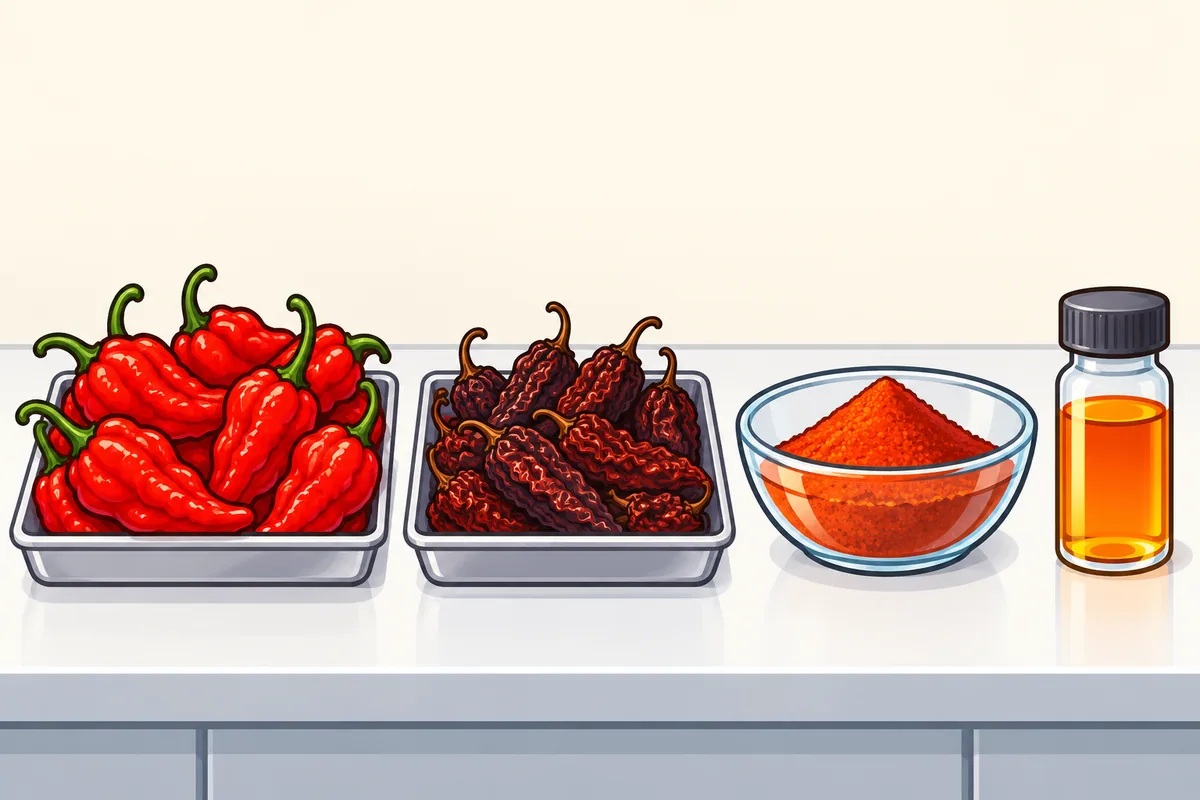
New Mexico State's team worked the same way for the Moruga Scorpion. They picked mature fruit from several plants of each variety, dried it, ground it to powder and extracted the capsaicinoids before measuring them6. So when you compare the Reaper's average with the Moruga's mean, you compare two lab averages from two different growing seasons and places.
That is also why you should not read too much into a single "hottest pod ever" claim you see online. The NMSU researchers said rigorous scientific testing is needed to get super-hot heat levels right6, and a lone pod, tested once, tells you about that pod only.
What would a new pepper need to take second place?
It would need to beat the Reaper's average under Guinness's rules. Those rules judge the heat of a single chilli pepper someone has grown, measured in SHU and in American Spice Trade Association pungency units, and they do not accept seeds11. A seed packet with a big number on it, in other words, never counts.
If you see a pepper sold as "the new number two," you can check three things before you believe it: a Guinness announcement or a university paper with a measured figure, a figure averaged over many pods the way the Reaper's and Pepper X's were1, and a date you can verify. If you find none of the three, treat the claim as the seller's word and keep the Reaper in your second place.
We will move this page the day Guinness names a new holder or a peer-reviewed study puts another pepper between Pepper X and the Reaper.
Can you grow or buy the runner-up?
Yes. On 18 October 2026, the breeder's own seed shop listed Red Smokin' Ed's Carolina Reaper seed, alongside Orange Butch T and red Bhut Jolokia, and no Pepper X seed at all12. So the runner-up is the hottest Guinness record pepper you can buy from its breeder as seed. Clemson Extension notes that the Reaper was bred in Rock Hill, South Carolina8, the same state where Winthrop University later ran the Pepper X tests1.
That makes second place the practical choice if you want a record pepper of your own. The Reaper's own index entry has its season length, flavor notes and every published figure in one place.
What eating the second hottest pepper can do to you
It can hurt for hours, and sometimes it sends people to hospital. The poison center describes mouth pain, burning and gut discomfort from very hot peppers, with more serious effects such as shortness of breath, chest pain and heart palpitations in some cases; symptoms can last several hours and, for some people, days13.
One case it lists involves this very pepper: a 15-year-old boy ate a Carolina Reaper on a dare and needed hospital care, then made a full recovery13. If your mouth burns, small sips of milk or water may help14. The spicy challenges page collects the other published cases.
Which second-place figure should you quote?
Match the figure to what you are writing or deciding, so your number fits your question.
- You are naming the runner-up to Pepper X. Say the Carolina Reaper, at an average of 1.64 million SHU, the previous Guinness record1.
- You are comparing older articles. Use 1,569,300 SHU, the average in Guinness's 2013 announcement4.
- You are talking about university testing. Say the Trinidad Moruga Scorpion, with a field mean above 1.2 million and two plants above 2 million6.
- You want a number for a kitchen comparison. Divide by a pepper you know. At about 5,000 SHU on average10, a jalapeño is roughly 330 times milder than the Reaper's average.
Where to look after second place
The full top ten, with each figure's kind and source, sits on the hottest peppers list.
For the whole band above one million SHU, sorted by heat, open super-hot peppers. If you would rather taste these pods in a bottle than raw, the hottest hot sauces list shows which sauces use them.