On this page
- 1What does an overwatered pepper plant look like?
- 2Can you overwater pepper plants?
- 3How do you check before you water?
- 4How do you fix overwatered peppers?
- 5Should you repot an overwatered pepper?
- 6How often should you water peppers?
- 7Does your bed drain fast enough for peppers?
- 8What should you do after days of heavy rain?
- 9Does a moisture meter beat the finger test?
- 10Does mulch help or hurt?
- 11Can an overwatered pepper plant recover?
- 12Sources
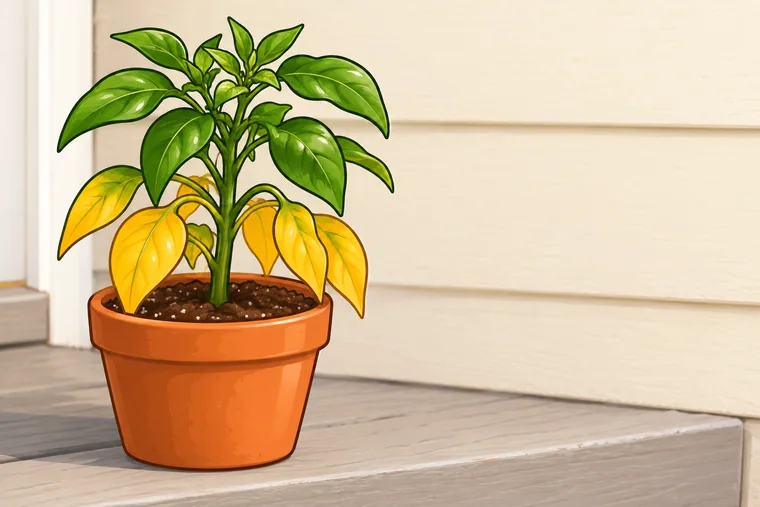
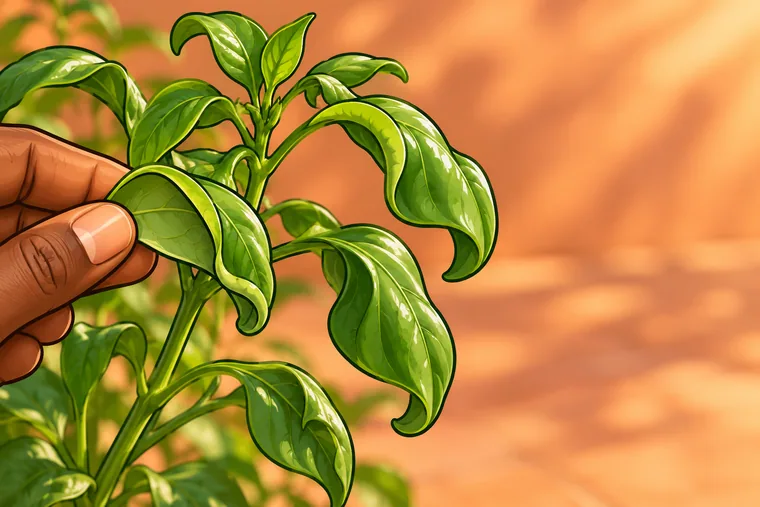
What does an overwatered pepper plant look like?
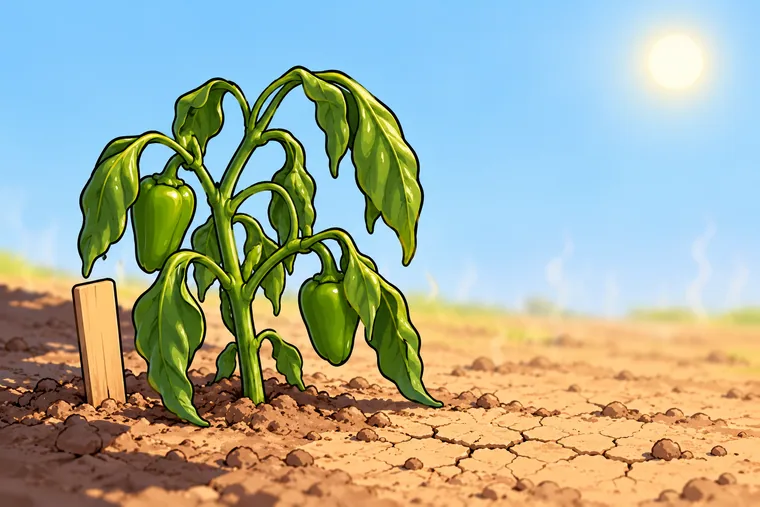
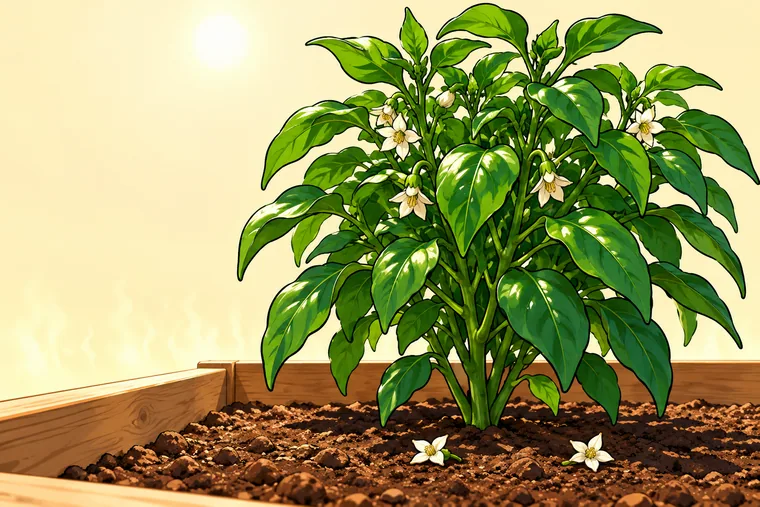
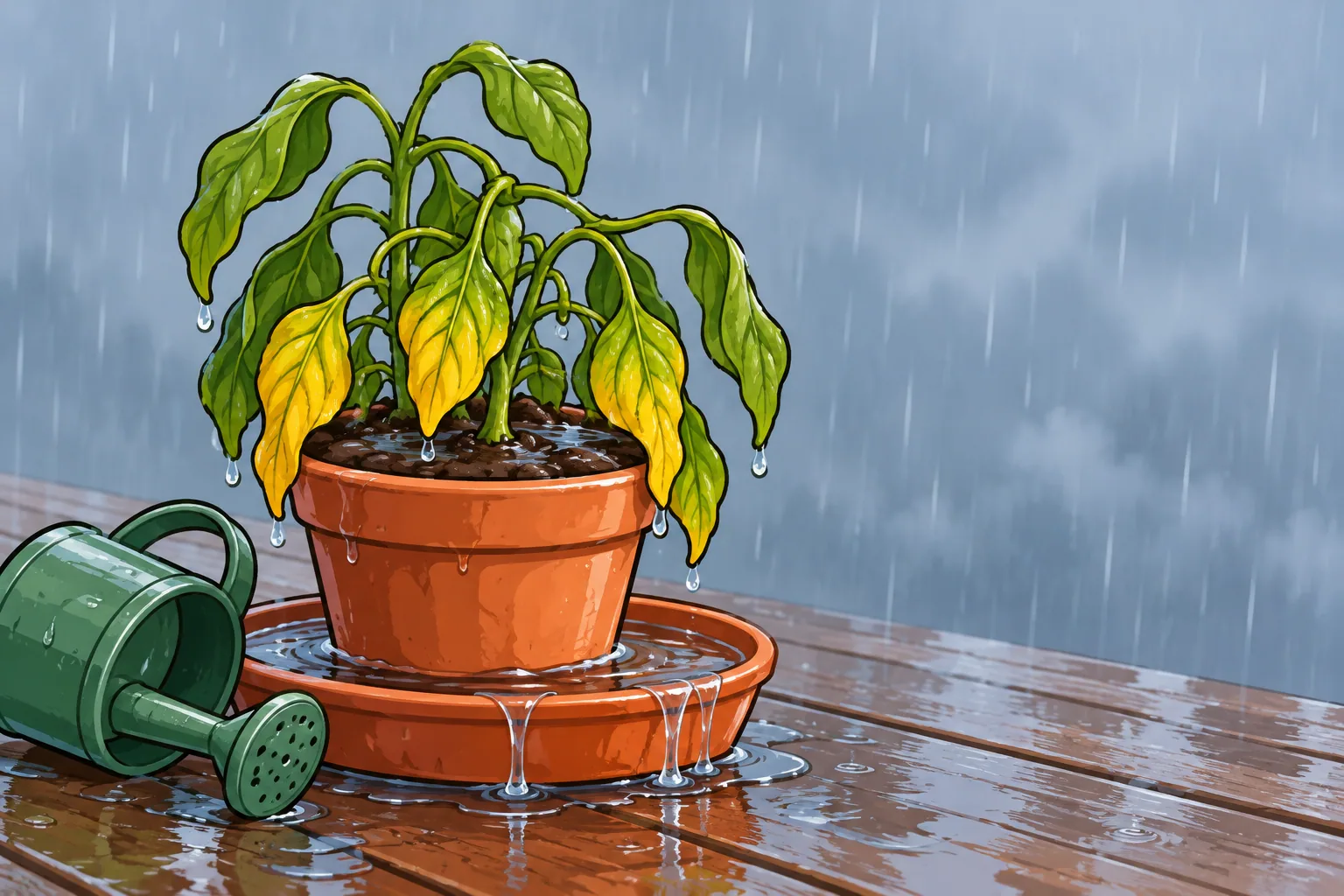
It wilts, yellows and drops leaves while the soil is still wet. That last part is your giveaway, because a dry plant shows many of the same signs. Utah State notes that irregular watering, too much or too little, can drop flowers and cause blossom-end rot either way1.
Too much water
- Soil
- Wet or soggy, sometimes with water standing on top2
- Leaves
- Yellowing, wilting, scorched edges, leaves dropping3
- Roots
- Water-soaked, very dark brown, few side roots left2
- Flowers and fruit
- Flower drop and blossom-end rot, the same as with too little1
- Worst case
- Phytophthora root rot: the plant wilts and dies suddenly4
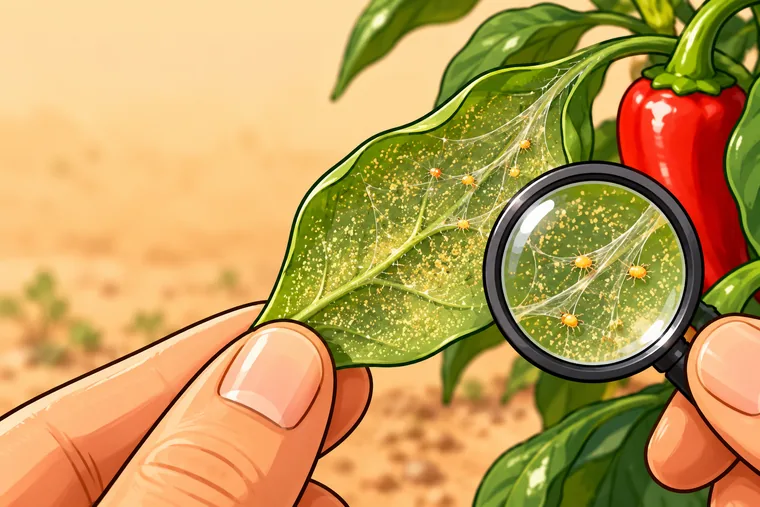
So feel the soil before you decide. A wilted pepper standing in wet soil is short of air at the roots, and another watering makes it worse. Leaves can also turn yellow from nitrogen or pests, and those need a different fix from yours.
Time of day helps you read your plant too. A pepper that droops at 3 p.m. on a hot day in dry soil and perks up by evening has simply lost water faster than its roots could replace it. A pepper that droops in the cool morning with wet soil around it has roots that no longer work.
Can you overwater pepper plants?
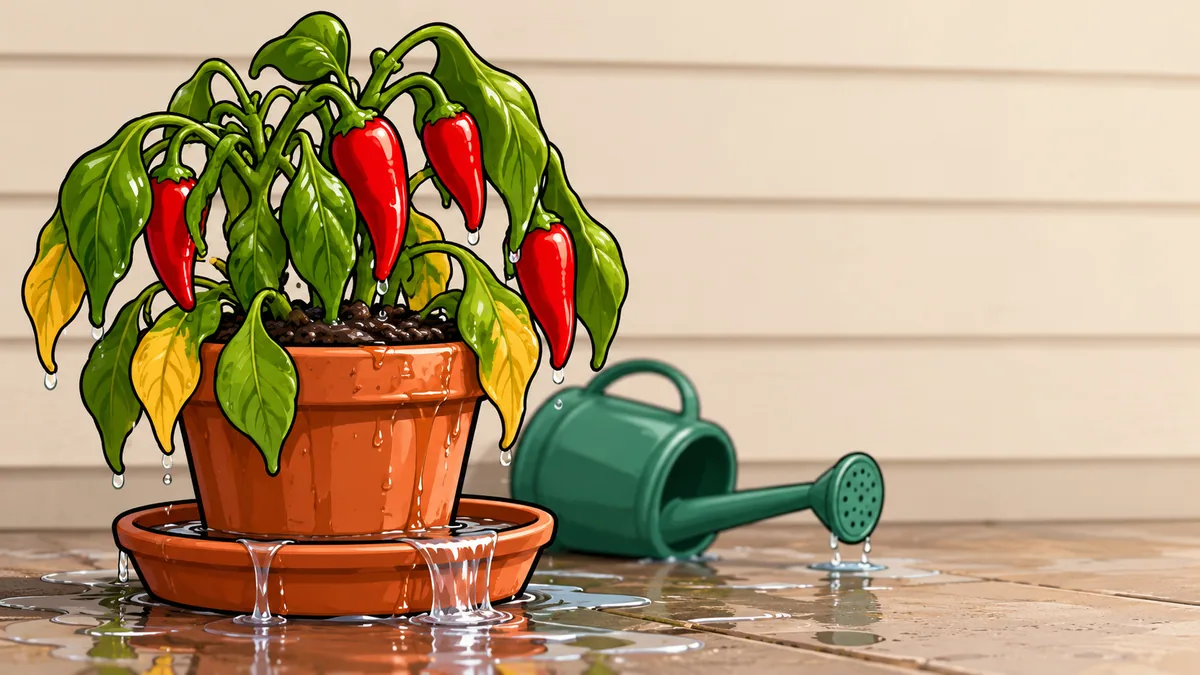
Yes, and faster than you might expect. Too much water fills the soil's air spaces, the roots run short of oxygen and die, and the plant can no longer take up water3. That last step is what traps you, because a plant that cannot drink looks thirsty.
- Soil stays saturatedWater fills the air spaces in the soil
- Roots run short of oxygenSaturated soil starves the roots (Utah State)
- Roots die backDead roots cannot take up water
- The plant wilts and yellowsLooks thirsty while the soil is wet
- You water againThe mistake that closes the loop
- Back to Soil stays saturated
You break the loop at the fourth step: before you water a wilted plant, push a finger into the soil. The numbers below show how little time the roots have once the soil fills.
Your risk climbs with heavy soil. UC IPM says the disease is severe in fine-textured, slow-draining and compacted soils, and that watering more often and for longer favors it2. Utah State says peppers do poorly in heavy, wet soil at all1, and its overwatering guide suggests you have your soil texture checked, because clay holds water while sand lets it through3.
Pepper Geek shows how to tell whether your peppers are getting too much water and what to change, which makes a useful second look next to the soil and root checks on this page.
How do you check before you water?
Look at your soil, not the leaves. These checks take a minute and stop the extra watering that causes most of the damage.
- Push a finger into the soil. In a seed tray or small pot, wait until the top is nearly dry.5
- Count back: peppers in the ground need 1–2 inches a week, including rain, given deep and not often.1
- Look for standing water after rain or irrigation. Water that sits for hours is the danger sign.28
- Check the pot for a drainage hole and for rocks or shards in the bottom, which slow drainage.10
- Notice the season. Small plants in pots need little water; fruiting plants in summer heat need water daily.10
- Water at the base, early in the day. Utah State avoids overhead watering late in the day and lets the soil dry between waterings to keep leaf spots down.1
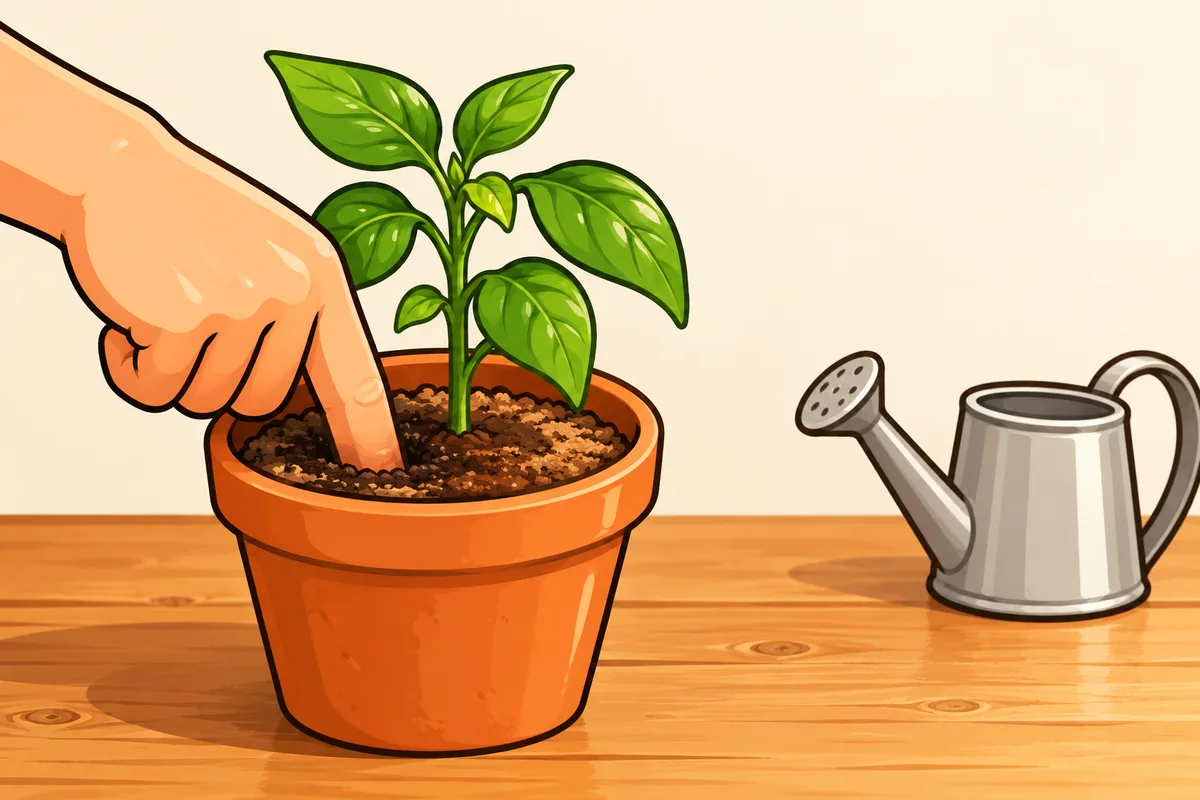
Your seedlings are the most at risk. Penn State ties damping-off, where seedlings collapse and die, to cool, wet, poorly draining soil6, so a soggy tray in a cold room is the worst case you can set up. Keep your tray warm and let the top of the mix nearly dry between waterings5.
How do you fix overwatered peppers?
Stop watering, get the water out, then change whatever caused it in your garden. These steps follow UC IPM, Utah State and UW–Madison.
- 1
Hold off on water
Let the soil dry until the top is nearly dry before the next watering.5
- 2
Give the water a way out
Use a pot with a drainage hole, filled with potting mix all the way down. Research shows a layer of rocks in the bottom slows drainage.10
- 3
- 4
- 5
Check the roots of any plant that keeps wilting
Dark brown, water-soaked roots and a dark lesion at the soil line point to Phytophthora root and crown rot.2
If root rot was the cause, UC IPM rotates that bed for 2 years away from susceptible crops, such as into corn, beans or strawberries, and uses clean seed and transplants2. The fungus survives in the soil for several years and travels in irrigation water2, so you do not want to run the runoff from a sick bed into a healthy one.
Should you repot an overwatered pepper?
Only if your pot is the problem. When you move a plant you tear fine roots, and a pepper short of roots does not need fewer. Here is how to decide.
- The pot has no drainage hole, or rocks fill the bottom. Repot. UW–Madison wants a drainage hole and a container filled with mix all the way down, because a layer of rocks or shards slows drainage10.
- The pot drains, but the mix stays wet for days. Leave the plant in place and water less often. Small plants in pots need little water; the daily schedule comes only with a big plant carrying fruit in summer heat10.
- The roots are dark brown and soft. A new pot will not save them. Those are the signs of Phytophthora root rot2, and you are better off putting the plant, mix and all, in the trash rather than the compost.
When you repot, go up to at least 5 gallons and 12 to 18 inches deep, the minimum UW–Madison sets for a pepper10. A bigger pot of mix holds water more evenly than a small one that swings from soaked to dry.
How often should you water peppers?
As often as your soil asks for it, which changes with the setting. Use these as starting points and let the finger test decide. The full schedule is on the pepper watering page.
| Where | How much | How often |
|---|---|---|
| In the ground1 | 1–2 inches a week, including rain | Deep and not often |
| Just planted out11 | One or two waterings in the first month to settle the plant | Then keep the root zone moist |
| Heavy soil11 | Enough to keep the root zone moist | Space waterings so the soil never stays saturated |
| Pot, young plant10 | Little | Only when the mix dries |
| Pot, plant in fruit in summer10 | Enough to soak the mix | Daily |
| Seed tray5 | Keep moist, not wet | When the top is nearly dry |
The pattern you see across the rows is the one UF/IFAS gives for the whole garden: young plants get light, frequent water, and mature plants get more water less often12. UF/IFAS also makes a small dip in the soil at the base of each plant so the water soaks in instead of running off12.
How much water is 1 inch a week?
More than you would give with a quick splash, and less than a flood. One inch of water over one square foot is 144 cubic inches, and a gallon holds 231 cubic inches, so 1 inch comes to about 0.6 gallon per square foot.
A pepper at Utah State's 18 inches apart in rows 18 to 24 inches apart1 has about 2.25 to 3 square feet to itself. One inch over that space is about 1.4 to 1.9 gallons a week, and 2 inches is 2.8 to 3.7 gallons, counting the rain. Give it to your plant in one or two soakings, not seven sips.
How deep you water matters as much as how much. UC IPM says pepper roots reach about 2 feet down11, and Clemson wets the soil to at least 6 inches each time13. If you dig a finger-deep hole an hour after watering and find dry soil, you watered too little; if you find standing water, you watered too much or the soil does not drain.
Does your bed drain fast enough for peppers?
Dig one test hole and you will know in an hour. Iowa State says soil that drains 1 to 3 inches an hour suits most plants, and soil under 1 inch an hour drains poorly14. Your peppers get into trouble at the slow end of that scale, because UC IPM links Phytophthora to fine-textured, slow-draining and compacted soils2.
- 1
Dig the hole
Make it at least 12 inches deep and 4 to 12 inches wide. Skip the test when your soil is already soaked, because wet walls glaze over and give you a false result.14
- 2
Fill it and let it drain once
This first fill wets the soil around your hole. It can drain in minutes or take a full day.14
- 3
Fill it again and measure
Mark the water level with a ruler, wait 15 minutes, and measure how far it fell. You want a number in inches.14
- 4
Multiply by 4
If your water dropped 1/2 inch in 15 minutes, you have 2 inches an hour, a good rate. Under 1/4 inch means your bed drains under 1 inch an hour.14
If your bed drains under 1 inch an hour, Iowa State tells you to work 2 to 4 inches of compost into the top 6 to 12 inches, and it says to use organic matter, not sand14. Sand mixed into clay can leave soil that drains worse. When your bed still holds water, build it up: UC IPM plants peppers on raised beds in well-drained soil2, and Iowa State notes that a raised bed has to be large enough to hold the plant's entire root system14. The best soil guide has the mix for a bed or a pot.
What should you do after days of heavy rain?
Start by looking at where the water sits in your garden, not at the leaves. UC IPM says Phytophthora needs standing water and that symptoms usually show up after a warm, wet period, with infection best at soil temperatures of 75 to 92°F2. New Mexico State puts the danger line at water standing more than 12 hours8.
- Walk your bed an hour after the rain stops. Water that still stands on the surface or around your stems is the risk.8
- Skip your normal watering until the top of your soil dries. New Mexico State tells flood-irrigated growers not to water when summer rains are likely and to stretch the gap to 7 days or more once rains begin.8
- Cut a channel to move standing water away, and keep it from running from a sick bed into a healthy one.2
- Check one plant that droops. If you find wet soil under a drooping plant, the roots are short of air, not thirsty.3
- Pick off flowers and pods that sit in mud, and clear fallen leaves from around the stems.1
After a wet spell, pull the plant that wilts and dies fast. UC IPM describes rapid wilting and death as the sign of crown and root rot2. Take it out with its soil, and rotate your bed away from peppers, eggplant and tomatoes for 2 years, into corn, beans or strawberries2.
Does a moisture meter beat the finger test?
Not by much, and not in your pot if it has a dense root ball. A University of Maryland garden-advice answer says nobody has tested these meters scientifically and that they probably are not as accurate as a finger, which you push 1 to 2 inches into the soil, or 3 inches in a very large pot15. For a dense root ball, it suggests a wooden skewer or popsicle stick and a look at whether damp soil sticks to the wood15.
The depth you test matters for peppers in the ground. New Mexico State finds that up to 70% of the water a full-canopy chile absorbs comes from the top 1 foot of soil8, so your trowel dug 6 to 8 inches down tells you more than the dry crust on the surface. The same guide irrigates when plants wilt in the early afternoon, and it warns that fast-growing plants may wilt late in the afternoon even the first day after watering8. A late-afternoon droop alone does not mean thirst.
If you do use a meter, check it against your finger for a week. When the two disagree, trust your finger and your skewer.
Does mulch help or hurt?
It helps, if you put it down at the right time. Maryland mulches peppers with straw, dry grass clippings or raked fall leaves7, and Clemson says mulch helps the soil hold moisture13. Even moisture is the goal: Maryland calls uniform soil moisture the aim when you water peppers7.
The catch is timing. Utah State holds organic mulch until the soil warms past 75°F1, because a cold, wet bed under straw stays cold and wet. Put the mulch down in early summer, and it keeps your watering even instead of keeping the soil soggy. Run your water under it at the base of the plants; Utah State prefers drip irrigation for peppers1, and a drip line under straw wets your root zone without soaking the surface.
Can an overwatered pepper plant recover?
It depends on what the water did to your plant's roots. Utah State says overwatering can stress a plant as much as severe drought3, and the only fix for that stress is drier soil and drainage.
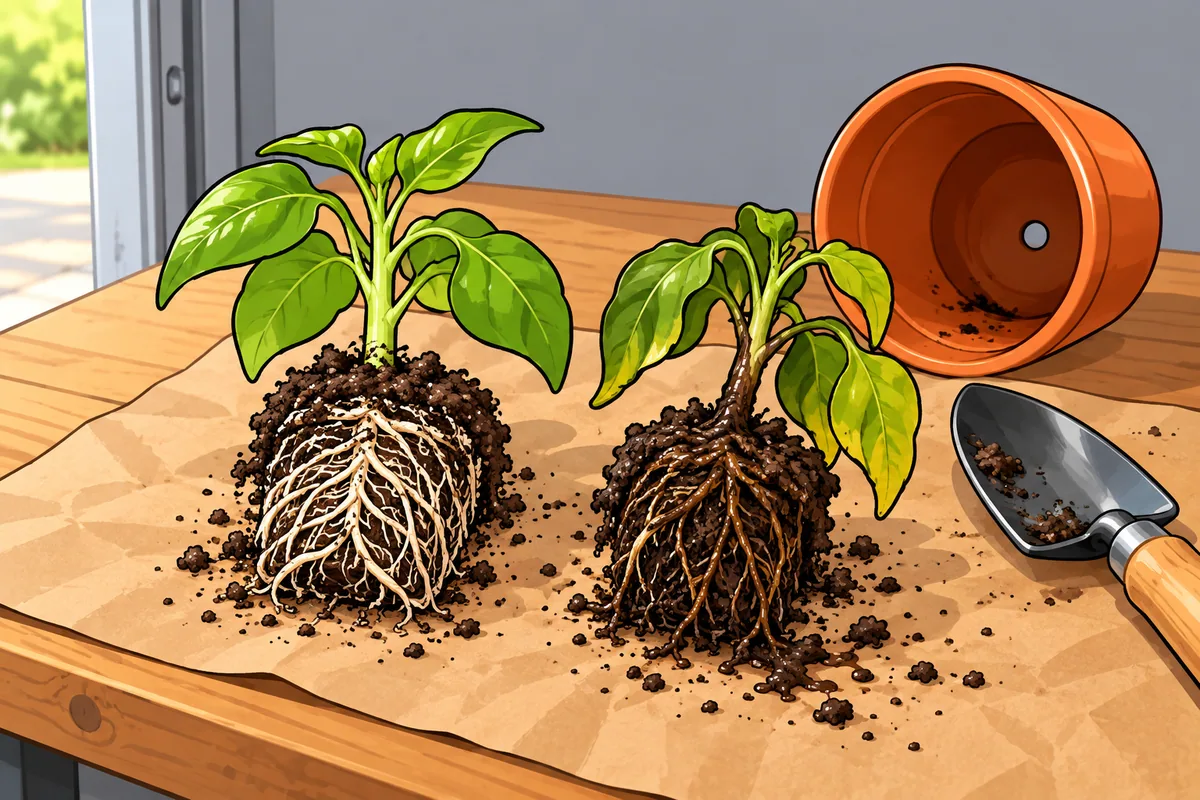
Slide your plant out of its pot, or dig beside it if it grows in the ground, and look. White, firm roots tell you the plant has what it needs to recover once the soil dries. Roots that UC IPM describes as very dark brown and water-soaked, with few side roots left2, tell you the plant has lost its means to drink.
None of the extension pages read for this guide gives a recovery time, and UC IPM does not say whether a plant with root rot comes back. If your plant pulls through but stalls on fruit afterwards, the pepper plant not producing fruit guide picks up from there.