On this page
- 1Which pest made these holes in your pepper leaves?
- 2Day damage or night damage?
- 3How to catch night feeders in the act
- 4Flea beetle shotholes on young pepper plants
- 5Slugs, snails and earwigs in a damp pepper bed
- 6Cutworms and hornworms, the two caterpillars
- 7Which pests bore holes into pepper pods as well as leaves?
- 8Are cucumber beetles or leafminers behind your holes?
- 9What chews your peppers from May to September?
- 10Do you need a spray for holes in pepper leaves?
- 11Will the leaves grow back?
- 12Sources
Which pest made these holes in your pepper leaves?
Read the hole before you buy anything. Each chewing pest leaves its own shape, its own spot on your plant and usually a calling card nearby. Find your damage in the left column, then check the clue you can see.
| What the holes look like | Where and when | Pest | The clue | First fix |
|---|---|---|---|---|
| Many tiny pits and round holes under 1/8 inch, a shothole look12 | Seedlings and young transplants in spring | Flea beetles | Tiny dark beetles that jump when you touch the leaf | Row cover over young plants |
| Irregular holes with smooth edges, anywhere on the leaf3 | Low leaves, overnight, worse in damp beds | Slugs and snails | Silvery, shiny slime trails | Remove hiding spots, hand-pick at night, trap |
| Leaves gone down to bare stalks, holes in pods45 | Upper leaves first, midsummer | Hornworms | Dark green or black droppings on the leaves below | Pick them off by hand |
| A seedling cut off at the soil, top lying beside it; holes in young fruit67 | Night, mainly in spring | Cutworms | A dull brown caterpillar curled in a C just under the soil | A collar around each stem |
| Circular to irregular holes, single or in groups; leaves skeletonized2 | Through the season | Beet armyworm | Young larvae feeding in a group | Natural enemies; narrow sprays for caterpillars |
| Numerous irregular holes or leaves chewed around the edges; seedlings missing parts8 | Night, near mulch and damp hiding places | Earwigs | Reddish brown, about 3/4 inch, pincers at the tail | Rolled-newspaper or oil-can traps |
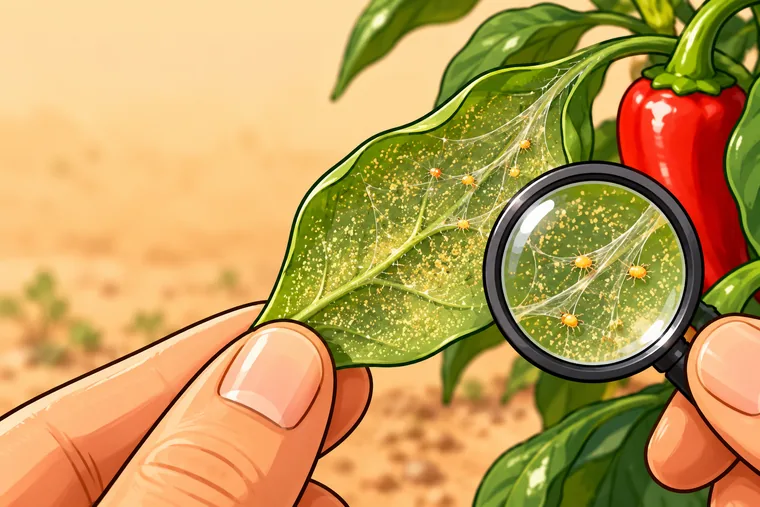
Two causes sit outside this table. If your leaves show pale speckles rather than true holes, you are looking at sap feeders such as spider mites, and if the holes start as water-soaked spots on the leaves that dry and fall out, a disease made them.
Day damage or night damage?
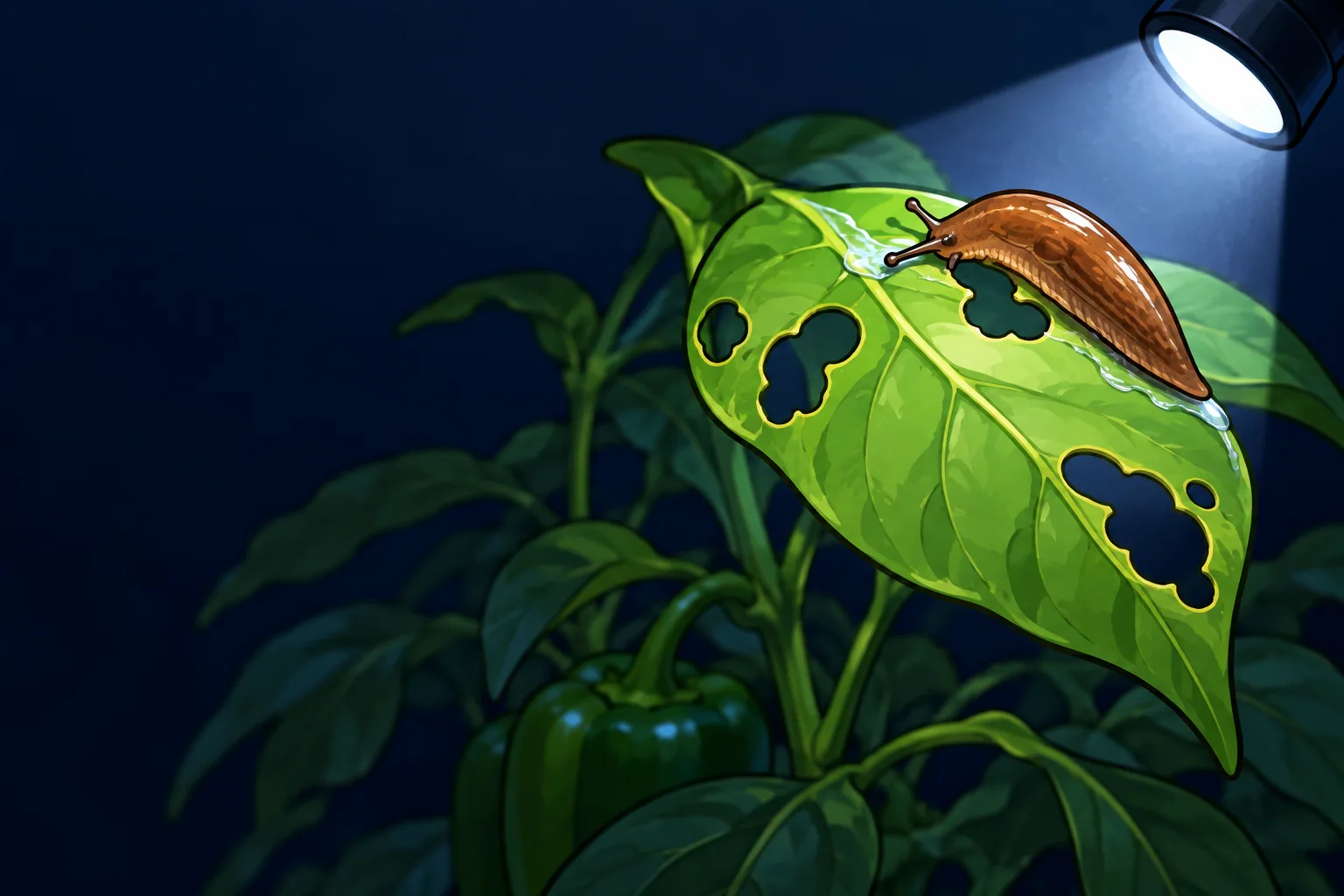
When you find fresh damage tells you as much as its shape. If the plant looks worse every morning and you never see the culprit by day, a night feeder is at work. Slugs, snails, cutworms and earwigs all feed at night and hide during the day38.
- nightWorse each morning, no pest by dayGo out after dark with a flashlight
- Slime trails: slugs or snailsSmooth-edged, irregular holes
- Stem cut at the soil: cutwormsTop left lying beside the stem
- Pincers on the tail: earwigsRagged holes, chewed edges
- dayPest visible by dayLook on and under the leaves
- springJumping specks: flea beetlesPits under 1/8 inch on young plants
- summerDroppings below: hornwormsStripped stems, up to 4 inches long
- spring
Sources for this line1. University of Minnesota Extension3. UC Statewide IPM Program, University of California4. University of Minnesota Extension6. UC Statewide IPM Program, University of California8. UC Statewide IPM Program, University of California
The season narrows it again. Flea beetles do most of their damage in spring, on young plants1. Cutworms are mainly a spring pest too6, while hornworms grow through midsummer and a second generation feeds until late summer or early fall4.
New Mexico State lists flea beetles and cutworms among the pests that damage young pepper plants, with hornworms as a problem later in the season9. So holes on your new transplants in May and holes on a big plant in August usually have different authors.
How to catch night feeders in the act
You confirm a night pest by going out to meet it. UC IPM tells you to look at night or in the early morning for slugs and snails, and to use a flashlight after dark to catch earwigs feeding38.
- 1
Water the bed in late afternoon
Damp ground draws slugs and snails out after dark.3
- 2
- 3
Look for the clue
Silvery slime means slugs or snails; a curled brown caterpillar at the soil means cutworms; pincers mean earwigs.Sources for this line3. UC Statewide IPM Program, University of California6. UC Statewide IPM Program, University of California8. UC Statewide IPM Program, University of California
- 4
- 5
Repeat until the damage stops
Check daily at first; once slug numbers fall, a weekly round can be enough.3
If you find nothing at night and the holes keep coming, go back by day and turn the leaves over. A pest that hides in plain sight, such as a hornworm, blends in with the leaves until most of the damage is done4.
Flea beetle shotholes on young pepper plants
These are the tiny holes, usually less than 1/8 inch across, that make a leaf look as if someone fired birdshot through it1. The beetles are 1/16 to 1/8 inch long, black to bronze or metallic gray, and they jump on big back legs when you disturb them1. Penn State notes that younger pepper plants suffer more than older ones2.
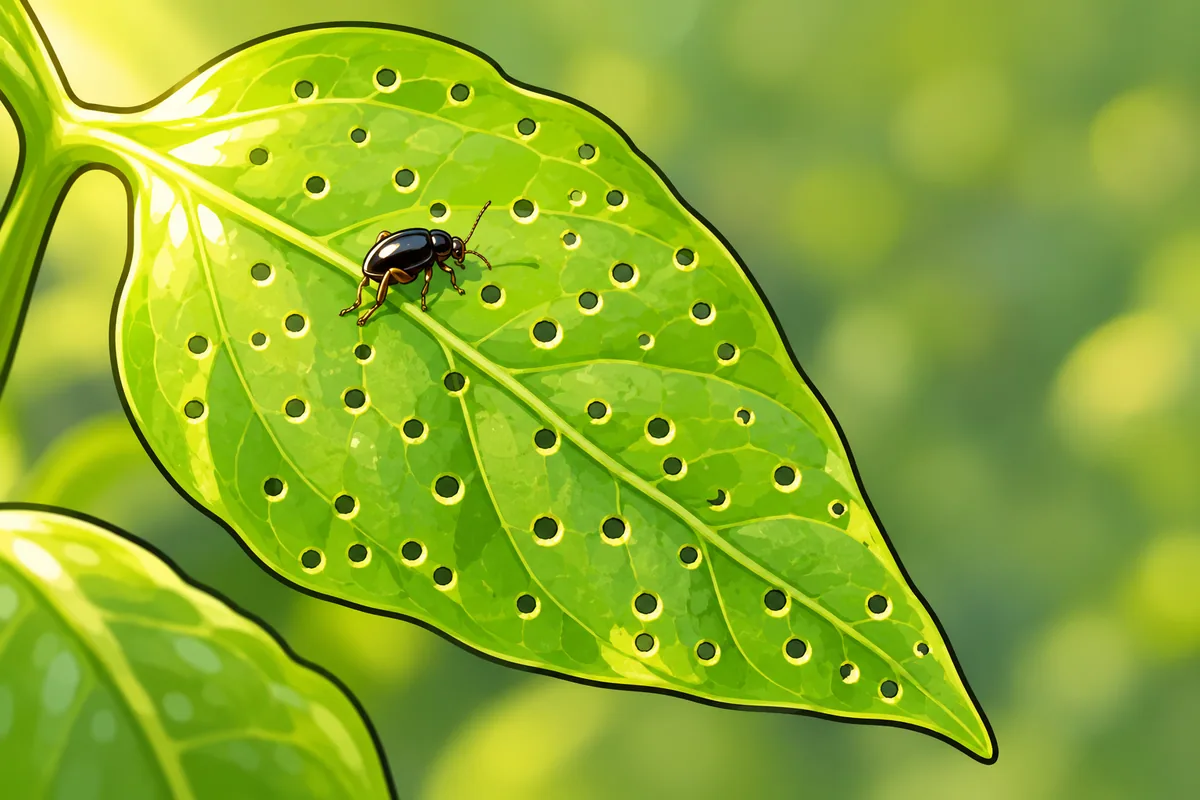
The good news is that the problem has an end date. UMN says treating in summer is generally not needed, because by the 4- or 5-leaf stage crops can survive the feeding and beetle numbers drop1. Your job is to get young plants through spring.
Cover them. UMN keeps beetles off seedlings with row covers and suggests planting a little later, since plants grow faster in warm weather and shrug off the feeding1. Utah State controls flea beetles with an insecticide dust at seeding or transplanting if you need more5. A pepper you set out on a warm date, after hardening it off, is already ahead.
Slugs, snails and earwigs in a damp pepper bed
All three love the same thing you might be giving your peppers: moist ground and cover. Your fix starts with the bed, not a bait.
Night feeders: what to change and set
- Clear boards, stones, weeds and stacked flowerpots where slugs hide by day.3
- Switch to drip lines, or water in the morning so the surface dries by night.3
- Set a board on 1-inch runners near the plants and scrape off the slugs under it every day.3
- Bury a beer or yeast-and-sugar-water trap at ground level; it draws slugs from only a few feet, so set several.3
- Edge a raised bed with a copper band 4–6 inches wide, buried an inch into the soil.3
- If you use bait, pick iron phosphate, which is safer around children, dogs and wildlife; baits alone do not control slugs long term.3
- For earwigs, lay rolled newspaper by the plants before dark and shake it into soapy water each morning.8
- Or sink a tuna can with 1/2 inch of vegetable oil and a drop of bacon grease to soil level as an earwig trap.8
Go easy on the earwigs if you can tell they are not your main problem. UC IPM points out that they feed heavily on aphids and other soft insects8, so a few in your pepper bed do some good. Salt is a bad idea for slugs: it raises the salt in your soil3.
If you mulch with straw, you give all three a daytime home. That does not mean you skip mulch; it means you check under it during your night round and set your traps right beside it.
Cutworms and hornworms, the two caterpillars
Cutworms do their worst work in a single night. They clip seedling stems near or just below the soil and leave the severed tops uneaten67. A dull brown caterpillar 1 to 2 inches long, curled into a C in the soil beside the stem, confirms it6.
You stop them with a collar. UF/IFAS makes one from a bottomless plastic cup or a waxed carton that reaches a few inches above the ground and at least an inch below it10. Put it on the day you plant, because cutworms do most of their harm in spring6.
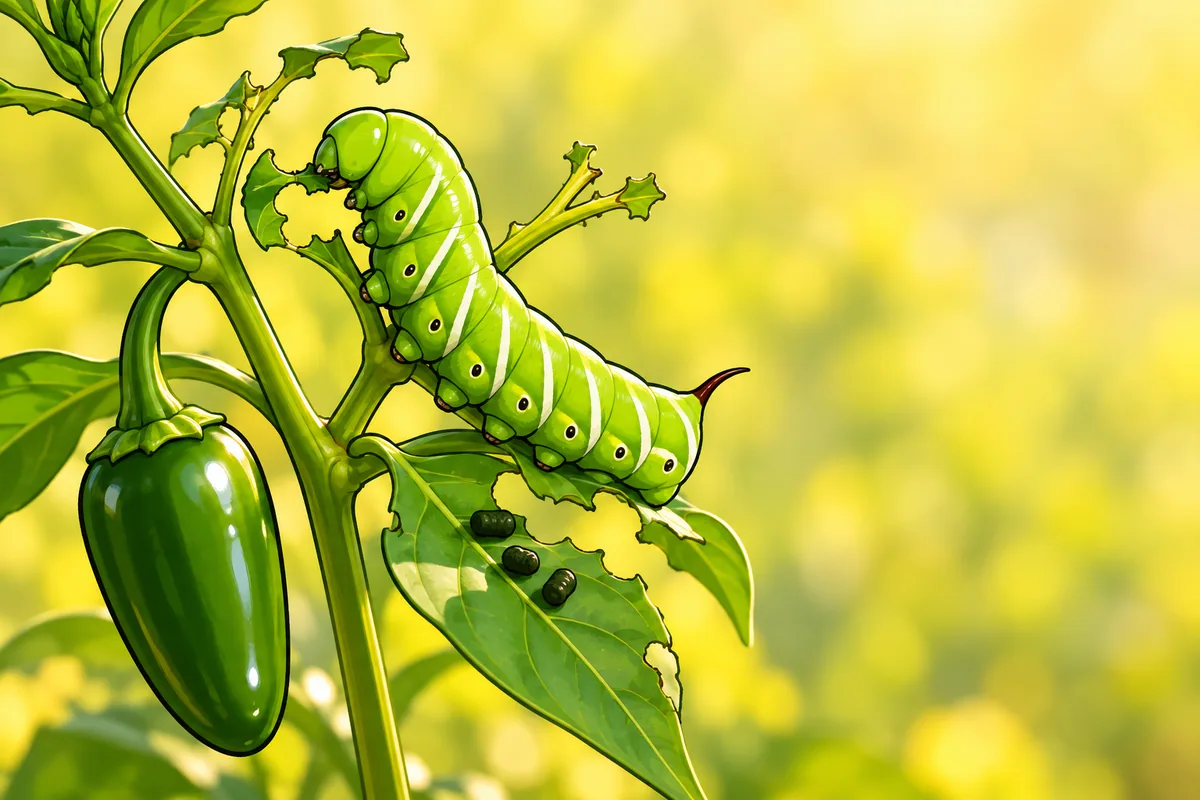
Hornworms are the opposite problem: huge, but hard to spot. They grow up to 4 inches long, start on the upper leaves and can strip a plant bare, and the last caterpillar stage eats nearly as much as all the younger stages together4. Their dark green or black droppings on the leaves below are what usually give them away.
Hand-picking is the main fix, and UMN suggests you check twice a week in summer4; Utah State saves Bt for heavy infestations5. If you find a hornworm covered in small white cocoons like grains of rice, leave it alone. Those are parasitic wasps that kill it and then go on to find others4.
Which pests bore holes into pepper pods as well as leaves?
Three do: pepper weevils, corn earworms and hornworms. When the leaves look fine and the holes sit in the pods, cut one open before you pick a fix, because what lives inside names the pest. UC IPM lists the weevil and the earworm among the pests of peppers11.
| Pest | The pod | The clue | First step |
|---|---|---|---|
| Pepper weevil12 | Marred by holes and misshapen, with yellow or red blotches; buds and young pods yellow and drop | White, legless larvae under 1/4 inch inside the pod; the adult is a dark snout beetle 0.13 inch long | Destroy the plants as soon as harvest ends, and the nightshade weeds around them |
| Corn earworm (tomato fruitworm)13 | Deep, watery cavities in the fruit | Frass in the cavity; striped caterpillars whose body color runs from green or yellow to brown | Hand-pick; Bt works only just after the eggs hatch |
| Hornworm4 | Holes in the pods, usually with leaves stripped to bare stalks | Dark green or black droppings on the leaves below | Pick by hand, twice a week in summer |
The weevil gives itself away before you see a hole. UC IPM says buds or fruits turn yellow and buds or young pods may drop12. The grub lives inside the pod, so a spray on the outside never reaches it, and UC IPM's advice is sanitation: destroy the plants as soon as harvest is over, and the nightshade weeds that host the weevil12.
Earworms bore the other way. UC IPM counts three or four generations a year and says Bt kills 40 to 60% of the population when you apply it just after the eggs hatch and before the caterpillars enter the fruit13. Once a caterpillar is inside your pod, Bt cannot reach it, so you hand-pick. UC IPM also tells you to plant early and harvest before late August, then till the plants under after harvest to cut the overwintering numbers13. That timing suits a fast pepper better than a 120-day one.
Are cucumber beetles or leafminers behind your holes?
Possibly, when the damage is light and the plant keeps growing. UC IPM lists both among its pepper pests11, and neither often does serious harm. Neither leaves the clean pits of a flea beetle or the slime of a slug, so the differences below are what you check.
Cucumber beetles
Leafminers
- Holes chewed in leaves, and sometimes in shoots and blossoms14What you seeTwisting trails under the leaf surface, and white stipples where adult flies punctured the leaf to feed15
- Beetles about 1/4 inch long: greenish yellow with twelve black spots, or yellowish orange with three black stripes (UC's western species)14The clueYellow maggots inside the leaf; the adults are small black flies, often with a yellow triangle between the wings15
- Most older plants can support substantial numbers without serious damage14How seriousMining usually has little impact on plant growth and rarely kills plants15
- Cover emerging plants with protective cloth, and take it off once they can tolerate the damage14First stepClip off and remove older infested leaves; insecticides are not very effective15
Cucumber beetles overwinter in weedy areas and move into gardens as the plants come up, with several generations a year14. A weed-free edge around your bed gives them less to start from. Leafminers rarely need treatment in a garden, and UC IPM suggests regular irrigation to keep plants vigorous15, which is the same steady watering your peppers want anyway.
What chews your peppers from May to September?
A different pest each month, so the date you find the damage narrows the list. This calendar pulls the timing from the pages above and the sources below:
- At transplanting
Flea beetles hit young plants and cutworms clip stems. Cover the plants with row cover and put a collar on each stem the day you plant.Sources for this line1. University of Minnesota Extension6. UC Statewide IPM Program, University of California10. UF/IFAS Extension (EDIS)
- As the plants come up
Cucumber beetles move in from weedy areas. Protective cloth keeps them off until the plants can take the damage.14
- June to August
Hornworms feed on the upper leaves, and a second generation feeds until late summer or early fall. Check twice a week.4
- Midsummer on
Corn earworms make three or four generations a year. If the holes are in the pods, cut one open.13
- Any damp night
- When harvest ends
Destroy the plants and the nightshade weeds around them to starve next year's pepper weevils.12
Notice that the two ends of the season need different habits. Spring is about covers and collars, midsummer is about hand-picking, and the end of the season is about cleanup.
Do you need a spray for holes in pepper leaves?
Usually not, and for several of these pests a spray is the weak option. Before you reach for one, check what the extension pages say about each pest you might have:
- Cutworms: UC IPM calls pesticides not very effective and puts collars, hand-picking at night and clearing crop debris first. For larger plants it allows Bt or spinosad sprays6.
- Slugs and snails: baits do not give long-term control unless you also remove their shelter, food and moisture. If you bait, water first and scatter it in the evening on a warm day3.
- Earwigs: baits often work poorly; daily trapping brings numbers down without any spray8.
- Hornworms: UMN says pesticides are generally not necessary, and that small caterpillars are easier to treat than big ones if you do use Bt, which only works when the caterpillar eats it4.
- Flea beetles: many insecticides carry flea beetles on the label. UMN asks you to make sure your crop is on the label too, and to count the days between spraying and harvest1.
The cheapest fix for most leaf chewers is your hands, a flashlight and a cover, in that order. You also keep the beneficial insects that eat aphids and caterpillar eggs, which a broad spray would kill along with the pest.
Will the leaves grow back?
The holes stay, but the plant keeps growing. A chewed leaf never fills in again; what you watch is the new growth at the top. If the new leaves come in clean after you fix the cause, your plant is past the worst of it.
Seedlings are the exception, because they have few leaves to lose. UMN warns that severe flea beetle damage can leave plants wilted or stunted, and Utah State says beetles can kill seedlings15. A big plant in August can lose a third of its leaves to a hornworm and still ripen its pods, as long as enough leaves stay to shade them from sunscald.
Your next step is a 10-minute round tonight with a flashlight, then a look under your leaves tomorrow. If the culprit turns out to be something other than a chewer, the pepper problems picker sorts the rest by symptom.
If your holes come with leaves that also turn yellow or curl, you have two problems at once, and each of those guides walks you through every cause.