
Pimento vs Cherry Pepper, 0 SHU Against Up to 500 or More
Two red peppers people mix up, one always sweet and one that can surprise you.
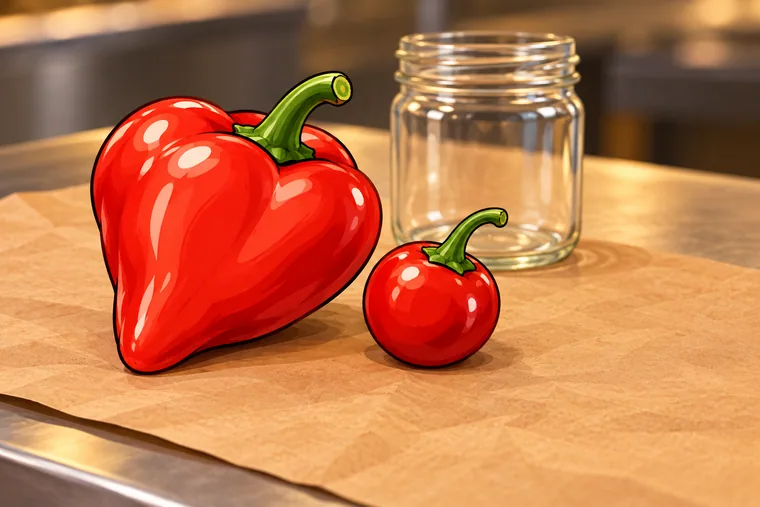
They are different peppers: the pimento is always sweet, the cherry runs from barely warm to hotter than a jalapeño.
- Pimento 0 SHU; cherry 100–500 SHU on Iowa State's chart
- Large hot cherries run milder than a serrano but hotter than a jalapeño
- Pimento: heart-shaped, about 4 inches long; cherry: round, ¾–1½ inches
On this page
- 1Are pimento peppers the same as cherry peppers?
- 2Is a cherry pepper spicier than a pimento?
- 3How do pimento and cherry peppers taste?
- 4Why does a jar of cherry peppers say hot while the pimento jar never does?
- 5Can you use cherry peppers instead of pimentos?
- 6Will your pimentos turn hot next to cherry peppers in the garden?
- 7Is it pimento or pimiento?
- 8How long do pimentos and cherries keep in your fridge?
- 9What turns a pimento into paprika?
- 10Pimento or cherry for your next jar, salad or stuffing?
Are pimento peppers the same as cherry peppers?
No. They are two different sweet-pepper shapes that both turn red, and only one of them can carry heat. Kentucky's crop profile describes pimentos as sweet, heart-shaped peppers that ripen from green to red, and cherry peppers as small, ¾ to 1½ inches across, and anywhere from sweet to hot1.
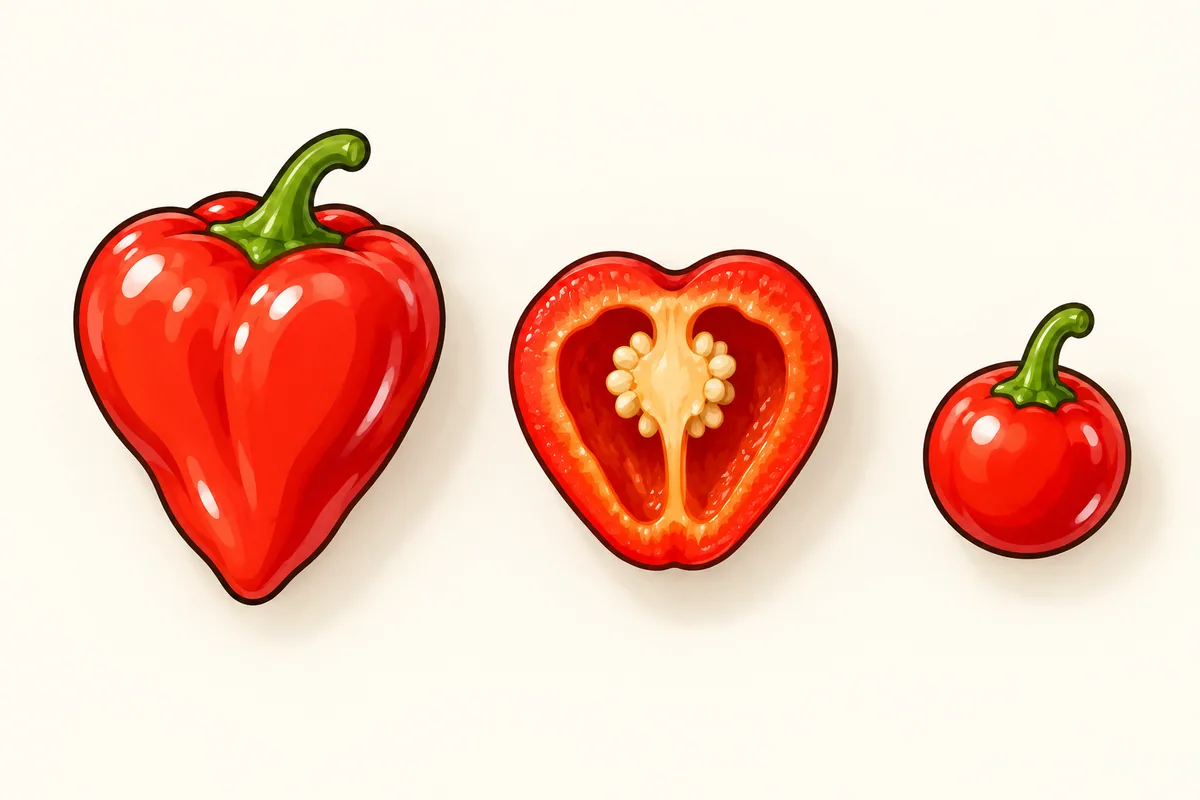
So size alone sorts most of them. Virginia Cooperative Extension measures the pimento at 2 to 3 inches wide by about 4 inches long, thick-walled, and used when red and fully ripe2. A cherry pepper of 1½ inches would sit inside that outline with room to spare.
Iowa State's pepper table backs up the walls: it lists both as thick-walled, the pimento as large and heart-shaped, and the cherry as small, round and slightly flattened, with both grown mostly for processing3. That shared thick wall is why you find both in jars.
Is a cherry pepper spicier than a pimento?
Almost always, yes, because a pimento has no heat to compete with. Iowa State's heat chart puts the pimiento in its 0 SHU band beside bell peppers, and the cherry (cereza) at 100 to 500 SHU3.
Pimento and cherry from Iowa State's chart; jalapeño from its index entry (UF/IFAS). Large hot cherries have no published range. Log scale; bars are published ranges.34
That is the cherry you meet in a garden-variety jar. The hot ones go further. Virginia's guide says large cherry peppers are very hot, milder than a serrano but hotter than a jalapeño2, and the jalapeño runs 2,000 to 8,000 SHU4.
Put the sources side by side and the picture is clear:
- Pimento, by number. Iowa State lists it in the 0 SHU band with bell peppers3.
- Pimento, in words. The UC Master Gardeners, Kentucky and Virginia all call it sweet or mild25.
- Typical cherry, by number. Iowa State gives 100 to 500 SHU, enough for a faint warmth3.
- Typical cherry, in words. The UC Master Gardeners call it mildly spicy, sweet and slightly tart5.
- Large hot cherry. Virginia gives no number, only its place between the jalapeño and the serrano2.
A pimento never brings heat; a cherry pepper's heat depends on which cherry you bought.
Kentucky defines sweet peppers as those with no capsaicin, like the 0 SHU bell1, and the pimento falls on that side of the line. So the honest answer to "are pimentos spicier?" is no, and to "are cherries spicier?" is yes, by a little or by a lot.
How do pimento and cherry peppers taste?
Both taste sweet first; the cherry adds a tart edge. The UC Master Gardeners describe the pimento as sweet, mild and smooth, with a fruity and earthy flavor, and the cherry as mildly spicy, with a sweet and slightly tart undertone, ideal for pickling5.
Pimento
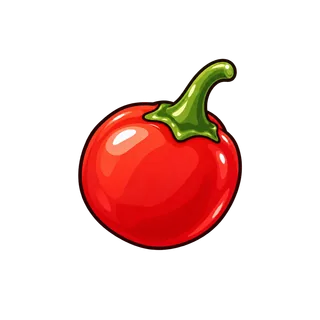
Cherry pepper
The tartness and the small, round shape are what make the cherry a pickling pepper. A pimento's broad, thick flesh suits roasting and slicing into strips, where its sweetness carries the dish.
Why does a jar of cherry peppers say hot while the pimento jar never does?
Because cherry peppers come in sweet and hot types, and pimentos come only sweet. Virginia's guide files sweet cherry with the mild peppers and large cherry with the hot ones, next to cayenne and tabasco2. Kentucky sums it up as "sweet to hot"1.
Seed catalogs add hybrids on top of that. Texas A&M lists the Cherry Bomb among its hot hybrids and specialty varieties6. So when you see "hot cherry peppers" on a label, take it at its word, and when the jar says only "cherry peppers", taste one before you build a sandwich around them.
Can you use cherry peppers instead of pimentos?
Yes, as long as you pick the sweet ones and accept a smaller pod. The thick wall carries over, so roasted, jarred or diced uses work. Weigh rather than count, since one pimento holds the flesh of several cherries.
| Your dish | Calls for | Use instead | Watch for |
|---|---|---|---|
| Diced pimento in a cheese spread | 50 g pimento | 50 g sweet cherry, seeded | A tarter, slightly warm spread |
| Roasted strips on a salad | 1 pimento | about 6 sweet cherries, halved | More skin to peel for the same flesh |
| Stuffed peppers | Pimentos | Cherries, stuffed whole | Bite-size servings instead of halves |
| Pickled cherry peppers | Cherries | Pimento strips | Loses the round shape and the tart bite |
The other direction is simple too: a pimento can stand in for a sweet cherry anywhere you cut the peppers up. You lose the tart note, so a splash more vinegar in a pickle or a dressing brings it back. For a swap list ranked by heat, the cherry pepper stand-ins give amounts for both the sweet and hot routes.
How many cherry peppers make one pimento?
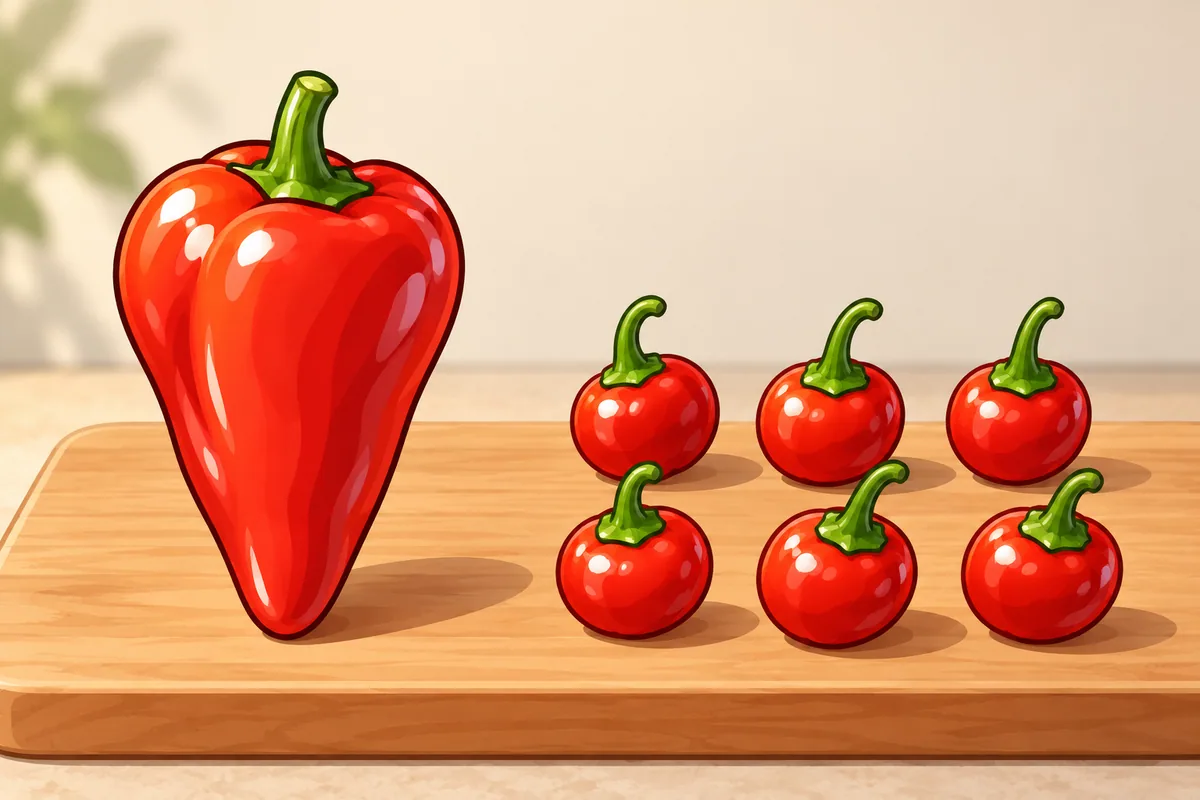
About six, if you go by volume. Treat the pimento as a cone 2½ inches wide and 4 inches long, the middle of Virginia's measurements2, and its volume comes to about ⅓ × 3.14 × 1.25² × 4, or 6.5 cubic inches. A 1¼-inch cherry, the middle of Kentucky's ¾ to 1½ inches1, is a ball of about 4/3 × 3.14 × 0.625³, or 1 cubic inch.
So when your recipe asks for one pimento, start with six sweet cherries and adjust by eye. The real pods are lumpier than our cone and ball, but the estimate gets you within a pepper or two, and both have thick walls, so the flesh per cubic inch runs close.
Will your pimentos turn hot next to cherry peppers in the garden?
No. Maryland Extension says that planting sweet types next to hot ones will not make the sweet peppers hot7. Your pimentos stay sweet beside a row of hot cherries; only seed you save from them might carry a cross.
Both peppers ripen to red, and Virginia notes that pimentos are mostly used red and fully ripe2, so plan on the longer end of that window. Maryland gives bell peppers 70 to 80 days to mature green plus 2 to 3 weeks to full color7; a thick-walled pimento follows the same slow finish. Cherry peppers you can pick from orange to deep red2, which gets your first jar going a little earlier.
The UC Master Gardeners call the pimento good for containers5, so a balcony pot works if you lack a bed. Maryland adds a warning for both: nights above 75°F slow or stop pod set7. In a heat wave you may see flowers drop, and the plant picks up again when nights cool.
Is it pimento or pimiento?
Both, and they mean the same pepper. Kentucky's crop profile writes "pimientos or pimentos" in one breath1, and Iowa State's Spanish-language guide uses pimiento3. Pimiento is the Spanish spelling; pimento is the common English one on jars and seed packets.
The spelling never changes the pepper inside. If you see either word on a label, you are looking at the sweet, heart-shaped pod from this page, not a hot pepper and not a cherry.
How long do pimentos and cherries keep in your fridge?
About as long as any fresh pepper, if you store them right. The UC Master Gardeners say fresh peppers keep best refrigerated at 45 to 55°F with 90 to 95 % humidity, that you should freeze them for long storage, and that you should keep them away from apples and bananas, whose ethylene gas harms them5.
Your crisper drawer is the closest you will get at home. When a bumper crop comes in, pickle the cherries, since they are the jar pepper, and roast and freeze the pimentos in flat bags, since their thick strips thaw well for salads and spreads.
What turns a pimento into paprika?
Drying and grinding. Kentucky says dried, ground pimientos are sold as sweet paprika1, which is why a jar of sweet paprika tastes like a concentrated version of the fresh pod.
You can use that at home. If your pimento crop outgrows your fridge, slice and dry the extras until brittle, then grind them for a homemade sweet paprika. Cherry peppers can go the same route, but a hot cherry makes a hot powder, so keep your batches labeled.
Pimento or cherry for your next jar, salad or stuffing?
- No heat at all
- PimentoRoast, slice into strips, dice into spreads; 0 SHU
- A little, or a kick
- a littleSweet cherryPickle whole, stuff as bite-size; 100–500 SHU
- a kickLarge hot cherryPickle for heat; hotter than a jalapeño
- a little
If you are filling jars, the cherry is the pepper built for it, and the pickling steps walk you through brine and processing times. If you are roasting, the pimento's thick, broad wall gives you the most flesh for the effort.
Your next step: if your cherry peppers turned out hot and you want to know how they stack against the pepper you know, the cherry pepper and jalapeño comparison lines them up.
Related in Compare
-
Cherry Peppers vs Jalapeño, 12× Apart or Neck and Neck
The round jar pepper against the one on every nacho plate.5 min read -
Calabrian Chili vs Fresno, Up to 4× Hotter by EU Rules
A protected Italian name that covers a whole region's chiles, against one Californian cultivar.6 min read -
Árbol vs Cayenne Pepper, Cayenne Is About 1.7× Hotter
Two skinny red Capsicum annuum chiles, one sold whole, one mostly ground.5 min read -
Arbol vs Guajillo Chiles, 14× Apart in One Field Trial
Two red dried chiles from the same bag aisle, one for heat and one for body.6 min read -
Chile de Árbol vs Serrano, Árbol Leads by About 1.6×
A slim dried red against a fresh green, close in heat and far apart in the pan.7 min read -
Dark Chili Powder vs Chili Powder, Same 5 Ingredients
Two jars of the same blend, roasted and weighted differently.5 min read
Sources
· 7
- 1University of Kentucky, Center for Crop Diversification Hot Peppers and Specialty Sweet Peppers, CCD-CP-101 (Kaiser, Ernst)
- 2Virginia Cooperative Extension (Relf, McDaniel; reviewed by Olsen) SPES-684: Peppers
- 3Iowa State University Extension PM 1888(S): Guía de Horticultura, El huerto doméstico, Chiles (Everhart, Haynes, Jauron)
- 4University of Florida IFAS Extension HS-859/TR010: Pepper Production in Miami-Dade County, Florida
- 5University of California Agriculture and Natural Resources, UC Master Gardeners of Ventura County Ventura Garden to Table Series: Peppers
- 6Texas AgriLife Extension Service (Joe Masabni) Jalapeño & Other Hot Peppers
- 7University of Maryland Extension Growing Peppers in a Home Garden