
Calabrian Chili vs Fresno, Up to 4× Hotter by EU Rules
A protected Italian name that covers a whole region's chiles, against one Californian cultivar.
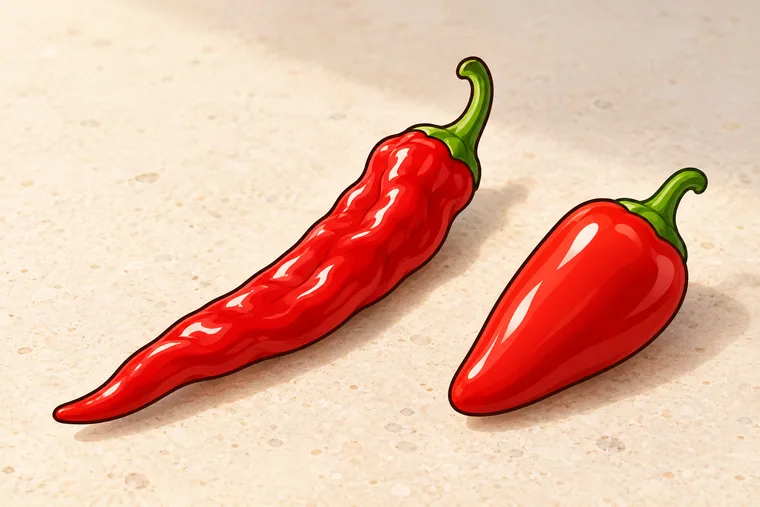
Usually the Calabrian chili. The EU specification sets it at 5,000–70,000 SHU, and the one lab test we found put a Fresno at about 17,600–21,500, so a typical Calabrian runs about twice a Fresno.
- Peperoncino di Calabria is a protected name since 2026, covering 16 varieties grown in Calabria
- The Calabrian band runs from a quarter of a Fresno's heat up to about four times it
- Swap a fresh Fresno for fresh Calabrian chilies at about twice the weight, then taste
On this page
- 1Is a Calabrian chili hotter than a Fresno?
- 2What counts as a Calabrian chili under the 2026 EU rules?
- 3How do a Calabrian pod and a Fresno differ in shape and color?
- 4Why does a dry Calabrian summer make the chilies hotter?
- 5How much Fresno replaces Calabrian chilies in a pasta sauce?
- 6Which one should go on your pizza, and which in your salsa?
- 7Can you grow your own Calabrian chilies where Fresnos do well?
- 8What should you check on a jar sold as Calabrian chilies?
Is a Calabrian chili hotter than a Fresno?
Most of the time, yes, by about double. The EU specification for the protected Calabrian chili describes medium-high heat between 5,000 and 70,000 SHU1. The only lab figures we found for a Fresno come from a Colorado field trial, where a red pod worked out at about 17,600 SHU and a green one at about 21,5002.
The Fresno figures come from capsaicin plus dihydrocapsaicin in freeze-dried pods, times the study's own factor.2 Log scale; bars are published ranges.12
Run the numbers and the overlap shows. The middle of the Calabrian band, 37,500 SHU, sits at about twice a Fresno (37,500 ÷ 17,613 is 2.1). The top of the band reaches about four times a red Fresno (70,000 ÷ 17,613), while the bottom, 5,000, is barely a quarter of one.
So a Calabrian chili can be milder than your Fresno, though it rarely is. Expect about twice the heat, and taste before you trust the label.
The two numbers also come from different kinds of evidence. The Calabrian range is a legal promise about a whole regional product; the Fresno figure is one variety measured in one summer. We show both because no extension chart gives the Fresno a range at all: Texas AgriLife lists it among its hot hybrids without a figure3.
What counts as a Calabrian chili under the 2026 EU rules?
Any of 16 named varieties, grown and processed in Calabria. The European Commission registered Peperoncino di Calabria as a protected geographical indication on 4 June 2026, and published the regulation on 11 June4. The specification behind it covers fruit of Capsicum annuum grown anywhere in the Region of Calabria1.
The variety list surprises most cooks. Alongside local names such as Calabrese, Pizzitano, Corno di Capra and Naso di cane, it includes Cayenne and Jalapeno1. A jar of protected Calabrian chili, in other words, may hold a cayenne type that grew in Calabrian soil.
Growing, harvesting, drying, stringing, cutting and grinding all have to happen inside the region1. Here are the forms the name covers:
| Form | What the specification sets |
|---|---|
| Fresh | Red fruit with a green stalk, loose or in packs up to 1 kg |
| Dried strings | 20 to 120 cm long, loose or packed |
| Dried whole or in pieces | Containers up to 3 kg; at most 15 % moisture |
| Crushed, flaked or powdered | With or without seeds, containers up to 10 kg; at most 15 % moisture |
Chilies in oil do not appear on that list. The specification names no oil product1, so the jar of crushed chilies in oil on your shelf sits outside the PGI text even when it uses Calabrian pods. Read its label on its own terms.
How do a Calabrian pod and a Fresno differ in shape and color?
A Fresno is one shape; a Calabrian chili can be several. The specification allows conical or tapering pods from 3 to 25 cm long, and round cherry types from 1 to 4 cm across1. Johnny's Fresno is a thin-walled cone of about 4 inches5.
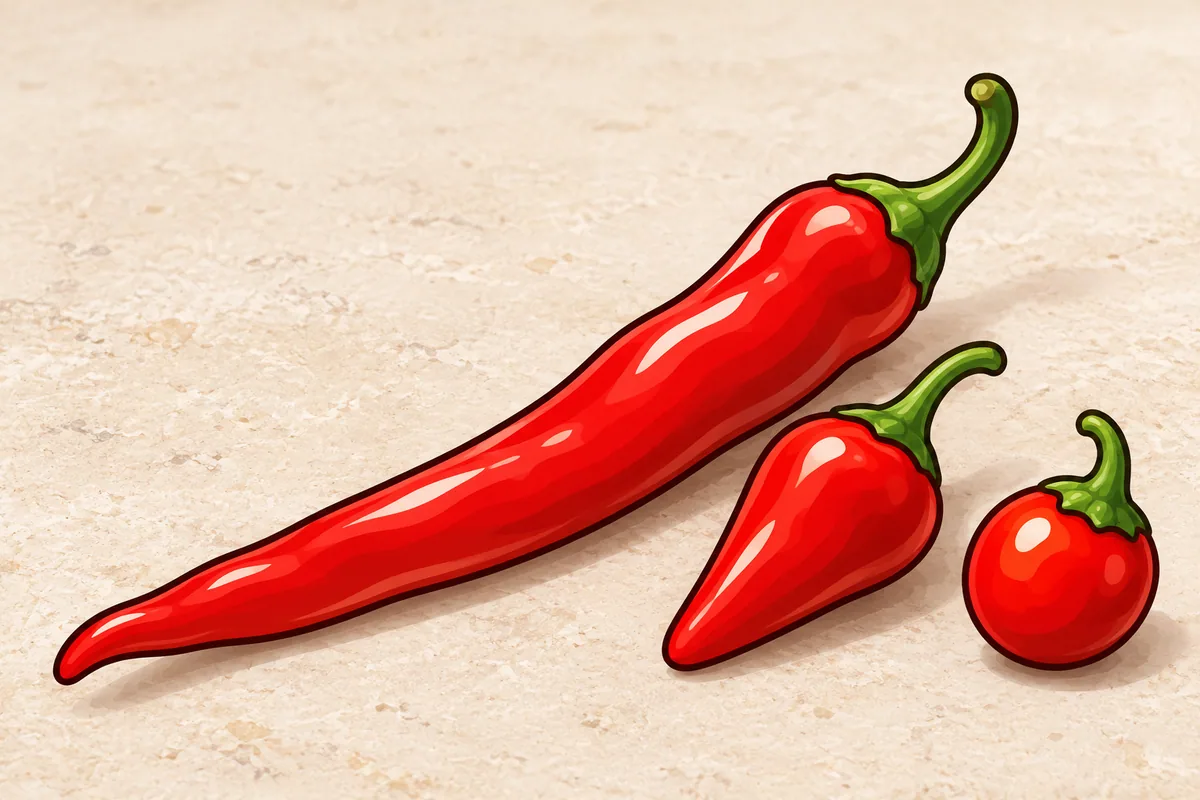
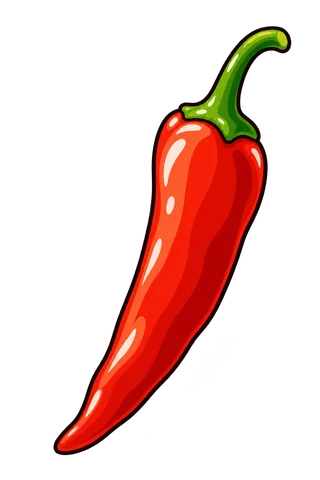
Calabrian chili (PGI)
At the market, the form tells you more than the shape. You will mostly meet Calabrian chilies dried, crushed or in a jar, and Fresnos fresh in a bin, which already decides half your recipes for you. If you do find fresh Calabrian pods, their firm flesh holds up in a long simmer, while a Fresno's thin wall softens fast in the pan.
Why does a dry Calabrian summer make the chilies hotter?
Because water stress pushes capsaicin up. The specification names summer water stress, with mid-to-high temperatures and small swings between day and night, as decisive for the capsaicinoid content of Calabrian fruit1. New Mexico State's heat guide says the same in general terms: a mild cultivar turns hotter under stress in the field7.
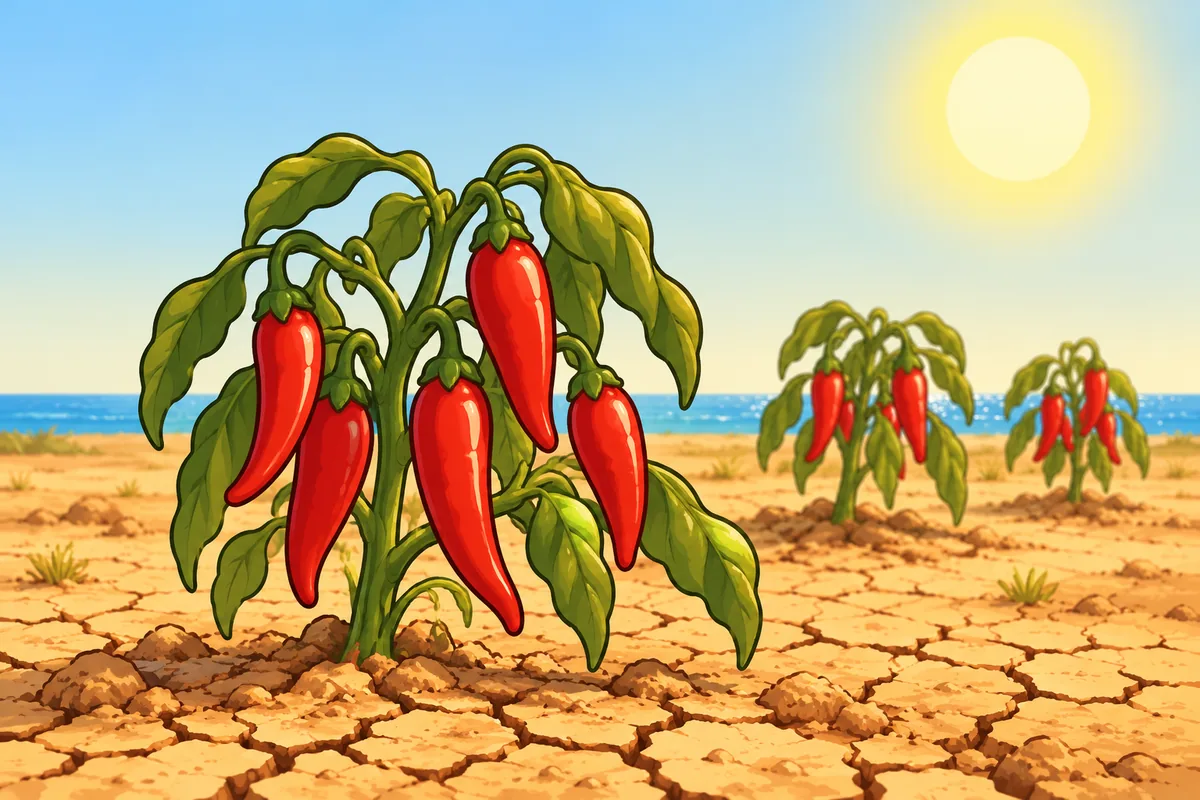
The same climate shapes the smell. The specification links Calabria's soil and weather to the aldehydes and alcohols behind the chilies' fruity and grassy notes1, and it names autumn, which runs warmer there than spring, as the main harvest1.
Your Fresno plants respond to stress too. If you grow them through a dry heat wave, expect a hotter crop than the Colorado trial measured; if you water evenly, expect something close to it. The trial also found that a Fresno lost a little capsaicin as it ripened from green to red2, so a red Fresno is, if anything, the mild end of its own range.
How much Fresno replaces Calabrian chilies in a pasta sauce?
Use about twice the weight of fresh Fresno for fresh Calabrian chilies, then taste. That follows from the midpoint ratio, but the Calabrian band is wide, so the table shows what the swap does at each end:
| Recipe asks for | If the Calabrians sit at | Fresno for the same heat | How we got it |
|---|---|---|---|
| 20 g fresh Calabrian chilies | 5,000 SHU (bottom) | about 6 g | 20 × 5,000 ÷ 17,613 |
| 20 g fresh Calabrian chilies | 37,500 SHU (middle) | about 43 g | 20 × 37,500 ÷ 17,613 |
| 20 g fresh Calabrian chilies | 70,000 SHU (top) | about 79 g | 20 × 70,000 ÷ 17,613 |
Notice how fast the middle row grows. Twenty grams of chili becomes more than forty grams of Fresno, which also adds sweetness and red color to your sauce. For a tomato sauce that is a fair trade; for a dish where the chili should stay a background note, start at the same weight and accept a milder plate.
Dried Calabrian flakes are a different case. A dried product may hold at most 15 % moisture1, so a gram of flakes carries far more chili than a gram of fresh Fresno, and the table does not apply. If you are replacing flakes, chop a small Fresno, add it to the pan, and taste before adding more.
Which one should go on your pizza, and which in your salsa?
Decide by whether the dish wants a dried chile or a fresh one. Johnny's lists its Fresno for fresh eating, stir-fries, sautéing and hot sauce5, while the Calabrian name mostly reaches you as dried, crushed or powdered chile1:
- A pizza, pasta or oil to finish a dishWants a dried or crushed chile
- Use Calabrian flakes or podsHot
- A raw salsa or a garnishWants a fresh, crunchy pod
- Use FresnosMedium
- A stir-fry or a quick sautéThin walls cook in minutes
- Fresno for body, a pinch of Calabrian for heat
The mixed branch works well because the two cover each other's gaps. Sliced Fresno gives you color and a sweet, fruity bite, and a pinch of crushed Calabrian chili lifts the heat without adding more raw pepper. When you sort through options for a pie, the pizza peppers list places both against the other common toppings.
Can you grow your own Calabrian chilies where Fresnos do well?
You can grow the varieties, though not the name. The protected name belongs to chilies grown and processed in Calabria1, so anything from your garden is simply a chile of that variety. Since the list includes cayenne and jalapeño types, you may already grow one of them.
Timing works in your favor. Johnny's Fresno gives green fruit 67 days after transplanting and red at 775, and Calabria picks its main crop in autumn1, so a cayenne-type plant set out beside your Fresnos in spring should color up in the same season.
If you want Calabrian-style heat, copy the summer rather than the seed. The specification credits dry summer stress for the heat1, and NMSU confirms that stress raises it7. Water your chile plants evenly until the fruit sets, then let the soil dry a little more between waterings, and taste a pod each week to see where your crop lands. Your Fresnos will respond to the same treatment, so give them their own bed if you want them to stay mild.
What should you check on a jar sold as Calabrian chilies?
Check where it grew, what form it is and what else is in it. The PGI only protects the name for products made under the specification1, and many jars sold as Calabrian are chilies in oil, which the specification does not cover:
Before you buy a jar or bag of Calabrian chilies
- Look for the full name Peperoncino di Calabria and the PGI mark; the name alone on a foreign product is not the protected one.14
- Read the form: fresh, dried whole, strings, pieces, flakes or powder are the forms the specification lists.1
- For dried products, a dry, brittle feel fits the 15 % moisture limit; soft, leathery flakes hold more water and less heat per gram.1
- For chilies in oil, read the ingredient list for oil, salt and vinegar, since those dilute the heat per spoonful.
- Wear gloves when you chop fresh pods of either chile, and keep your hands away from your eyes.8
If your recipe names a specific jar, the Calabrian chili paste guide covers what goes into the crushed-in-oil style, and the Calabrian swaps list stand-ins when your shop has none.
Your next step: taste a crumb of the Calabrian product you own beside a sliver of Fresno, pick the row in the swap table that matches what you tasted, and weigh your Fresno to it. If you want to see how the Fresno stacks up against a much hotter pod, the Fresno against the habanero runs the same lab figures one tier up.
Related in Compare
-
Fresno Pepper vs Habanero, 4 to 6 Times Hotter in One Lab
A cone-shaped Californian chile against a lantern-shaped Caribbean one.6 min read -
Pimento vs Cherry Pepper, 0 SHU Against Up to 500 or More
Two red peppers people mix up, one always sweet and one that can surprise you.6 min read -
Cayenne vs Jalapeño, 7.5× the Heat and Swaps
One usually ends up in a jar of powder, the other in a fresh salsa.6 min read -
Cherry Peppers vs Jalapeño, 12× Apart or Neck and Neck
The round jar pepper against the one on every nacho plate.5 min read -
Árbol vs Cayenne Pepper, Cayenne Is About 1.7× Hotter
Two skinny red Capsicum annuum chiles, one sold whole, one mostly ground.5 min read -
Arbol vs Guajillo Chiles, 14× Apart in One Field Trial
Two red dried chiles from the same bag aisle, one for heat and one for body.6 min read
Sources
· 8
- 1European Commission, Official Journal of the European Union (C/2026/1101) Publication of an application for registration of a geographical indication, 'Peperoncino di Calabria' PGI, single document EU No PGI-IT-03421
- 2Antioxidants 8(9): 364 (MDPI, peer-reviewed) Capsaicinoids, Polyphenols and Antioxidant Activities of Capsicum annuum: Comparative Study of the Effect of Ripening Stage and Cooking Methods (Hamed, Kalita, Bartolo, Jayanty)
- 3Texas AgriLife Extension Service (Joe Masabni) Jalapeño & Other Hot Peppers
- 4European Commission Commission Implementing Regulation (EU) 2026/1273 of 4 June 2026 on the registration of the geographical indication 'Peperoncino di Calabria' (PGI)
- 5Johnny's Selected Seeds, seller page for its own seed Flaming Flare (F1) Fresno Pepper Seed
- 6University of California Agriculture and Natural Resources, UC Master Gardeners of Ventura County Ventura Garden to Table Series: Peppers
- 7New Mexico State University Cooperative Extension Service (Guide H-237) Measuring Chile Pepper Heat (Bosland, Walker)
- 8New Mexico State University Cooperative Extension Service (Guide E-324) Processing Fresh Chile Peppers (revised by Nancy C. Flores)