
Fresno Pepper vs Habanero, 4 to 6 Times Hotter in One Lab
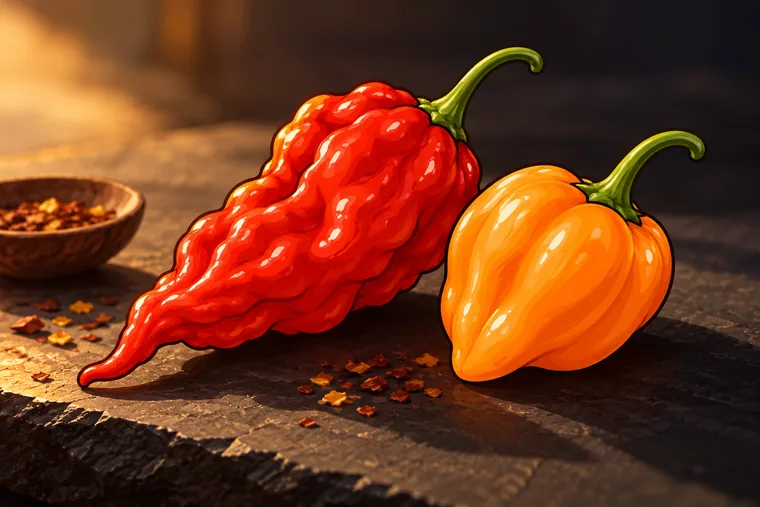
A cone-shaped Californian chile against a lantern-shaped Caribbean one.
 HabaneroExtra-hot
The habanero, by far. In one Colorado field trial a ripe habanero tested about 112,400 SHU and a red Fresno about 17,600, a 6.4× gap; green pods were 4.3× apart.
- They are different species: the Fresno is Capsicum annuum, the habanero C. chinense
- A Fresno got a little milder as it ripened red; the habanero got hotter as it turned yellow
- To swap, use about one fifth the weight of habanero in place of a Fresno, then taste
On this page
- 1How much hotter is a habanero than a Fresno?
- 2Why does a red Fresno test milder than a green one?
- 3Is a Fresno chili the same as a habanero?
- 4What does oven roasting do to a Fresno's heat and a habanero's?
- 5How much habanero replaces a Fresno, and how much Fresno replaces a habanero?
- 6Which pepper belongs in your salsa, stir-fry or bottle?
- 7How many more weeks does a habanero need than a Fresno?
- 8What goes wrong when a Fresno cook first handles habaneros?
How much hotter is a habanero than a Fresno?
About four to six times, going by the one study that grew both in the same field. Colorado State's research farm at Rocky Ford raised a Fresno and a habanero in the 2016 season, and the lab measured each at two stages1. Using the paper's own formula (capsaicin plus dihydrocapsaicin, times 16.1), you get these figures:
Calculated from the study's Table 1 (µg/g of freeze-dried pod) with its own SHU factor.1 Log scale; bars are published ranges.1
That puts a green habanero at 4.3 times a green Fresno (93,122 ÷ 21,526) and a ripe habanero at 6.4 times a red one (112,410 ÷ 17,613). The authors class the Fresno as moderately hot and the habanero as very hot1.
You will not find a Fresno range in the extension charts you may already use. Texas AgriLife names the Fresno among its hot hybrids and specialty varieties without a figure2, and the other lists below skip it. For the habanero, every chart agrees it sits in a far higher band:
The Colorado habaneros sit below most of those charts, a reminder that one field in one summer is one sample.
How do the lab's micrograms become Scoville units?
You add the two main heat compounds and multiply. A green Fresno held 848 µg/g of capsaicin and 489 of dihydrocapsaicin, so 848 + 489 = 1,337, and 1,337 × 16.1 = 21,526 SHU1. The green habanero works the same way: 3,636 + 2,148 = 5,784, times 16.1, gives 93,122.
The lab freeze-dried every pod before testing, so these figures count dry matter only1. A fresh pod on your board still holds its water, which spreads the same heat through more weight, so a raw Fresno will taste gentler than 21,526 suggests. The ratio between the two peppers does not change, because both went through the same drying, which is why we lean on the 4.3× and 6.4× rather than the raw totals. The ratio is the useful part: grown side by side, your habanero runs four to six Fresnos hot.
Why does a red Fresno test milder than a green one?
Because the two peppers ripen in opposite directions. In the Colorado pods, Fresno capsaicin fell from 848 to 735 µg/g as it turned red, while the habanero's rose from 3,636 to 4,820 as it turned yellow1.
So the gap between your two peppers widens as both ripen. If you pick a green Fresno and a green habanero, you are about 4.3× apart; wait until both color up and you are 6.4× apart. NMSU adds a second force: a mild cultivar turns hotter when any stress hits it in the field, and a hot one grown in ideal conditions comes out only moderately hot6.
For your kitchen, the takeaway is simple. A red Fresno from the store will not get hotter on the counter, and a ripe habanero will be the hottest version of itself you can buy.
Is a Fresno chili the same as a habanero?
No. They belong to different species and look nothing alike once you hold them. The Fresno is a Capsicum annuum like the jalapeño, and the habanero is a Capsicum chinense17.
Fresno
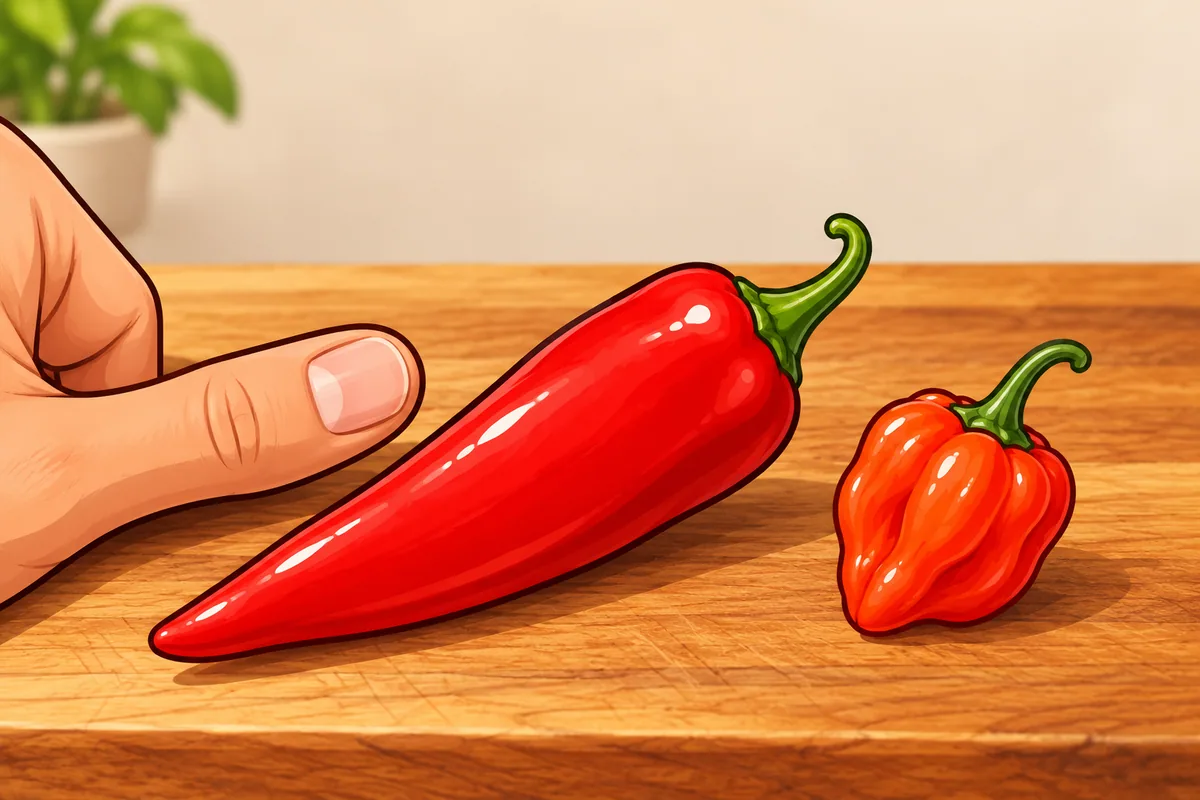
The confusion usually starts at a market bin of mixed red chiles. A red Fresno is long and pointed; a red habanero is short, wrinkled and wider at the shoulder. If the pod in your hand is longer than your thumb and tapers to a point, you are almost certainly holding the milder one.
Color will not help you as much as shape. Habaneros come in yellow, orange, red, white, brown and pink7, and Johnny's Fresno ripens to bright red8, so a red pod alone tells you nothing. Taste tells you the rest: the Fresno leans fruity and slightly sweet9, while the habanero brings a citrus note and a floral smell that fills the kitchen as soon as you cut it7.
What does oven roasting do to a Fresno's heat and a habanero's?
It trims both a little, the Fresno more than the habanero. The Colorado team roasted pods at 150 °C for 20 minutes and measured them again1. Here are the before and after figures, converted the same way as above:
| Pepper and stage | Raw | Roasted | Change |
|---|---|---|---|
| Fresno, green | 21,526 SHU | 18,080 SHU | −16 % |
| Fresno, red | 17,613 SHU | 14,973 SHU | −15 % |
| Habanero, green | 93,122 SHU | 84,928 SHU | −9 % |
| Habanero, yellow | 112,410 SHU | 103,813 SHU | −8 % |
Roasting will not rescue you from a habanero. Its capsaicin even rose slightly in the oven, while the dihydrocapsaicin dropped by about a third in green pods1, so the total fell by under a tenth. The authors put the differences down to skin thickness and how each pepper ripens.
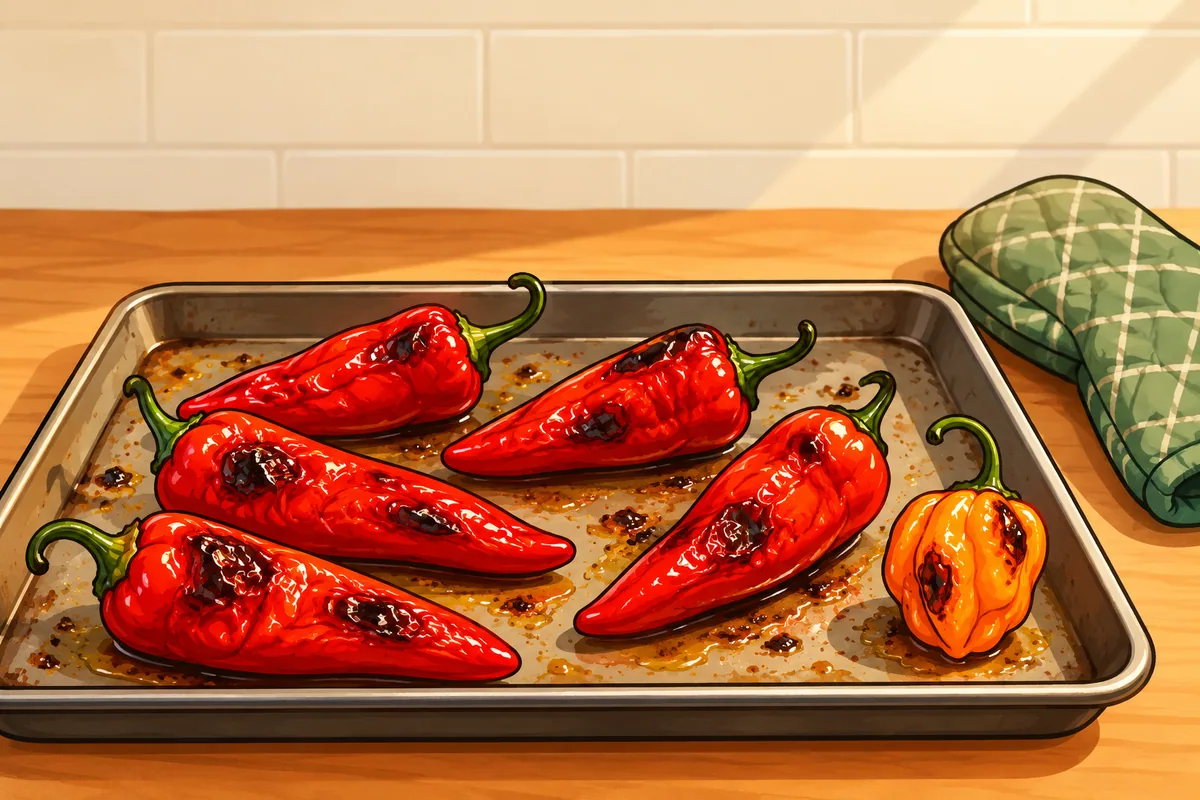
The practical reading: if you roast a tray of Fresnos for a salsa, expect it a shade milder than the raw pods. If you roast habaneros, plan the dose as if they were raw.
How much habanero replaces a Fresno, and how much Fresno replaces a habanero?
Use about a fifth of the weight one way, and four to six times the weight the other way. The table works from the trial's ratios, 4.3× for green pods and 6.4× for ripe ones1, so treat each row as an estimate and taste as you go.
| Recipe asks for | Swap with | Same heat (ripe pods) | Same heat (green pods) | How we got it |
|---|---|---|---|---|
| 50 g red Fresno, a jar of salsa | Habanero | about 8 g | about 12 g | 50 ÷ 6.4 and 50 ÷ 4.3 |
| 100 g Fresno, a batch of hot sauce | Habanero | about 16 g | about 23 g | 100 ÷ 6.4 and 100 ÷ 4.3 |
| 10 g habanero, a pot of chili | Fresno | about 64 g | about 43 g | 10 × 6.4 and 10 × 4.3 |
The last row shows the catch with going from habanero to Fresno. To match 10 g of habanero you would add a whole handful of Fresnos, which changes the texture and color of your dish. Most cooks take the lower heat and enjoy the extra fruit, or keep a pinch of hotter pepper on hand to make up the difference.
Which pepper belongs in your salsa, stir-fry or bottle?
Start from the dish and from the people eating it. Johnny's lists its Fresno for fresh eating, stir-fries, sautéing and hot sauce8, and UF/IFAS ties the habanero to hot sauces and spicy foods3:
- A raw salsa or a garnishFruit and crunch matter most
- Use FresnosMedium
- A stir-fry or sautéThin walls cook fast
- Use FresnosMedium
- A bottled hot sauceBoth work; heat decides
- for real heatUse habanerosExtra-hot
- for a medium bottleFresnos with one habanero for lift
- for real heat
Sources for this line1. Antioxidants 8(9): 364 (MDPI, peer-reviewed)3. UF/IFAS Gardening Solutions8. Johnny's Selected Seeds, seller page for its own seed
The blend branch is where the pair shines together. A sauce of red Fresnos for body and color, with one habanero for every five or six Fresnos by weight, roughly doubles the heat of a plain Fresno sauce by the trial's ratio, and you keep the bright red. Here is the arithmetic with ripe pods: 500 g of red Fresno at 17,613 SHU plus 100 g of habanero at 112,410 SHU gives (500 × 17,613 + 100 × 112,410) ÷ 600, about 33,400 SHU for the pepper part of your sauce, or 1.9 times plain Fresno1. Vinegar, salt and water then dilute both numbers by the same share. The Fresno hot sauce recipe is a good base for that experiment.
How many more weeks does a habanero need than a Fresno?
About three to six weeks more. Johnny's Flaming Flare Fresno gives green fruit 67 days after transplanting and red fruit at 778. Maryland Extension gives habanero types 90 to 120 days from transplanting10.
- Day 0
- Day 67
- Day 77
- Days 90–120
Habaneros ripen
Habanero types reach maturity in this window.10
Put dates on it and the gap gets concrete. Transplant both on 1 June, and your red Fresnos come in around 17 August, while your habaneros ripen somewhere between 30 August and 29 September810. If your first frost usually lands in September, the habanero growing guide covers starting seed early indoors to win those weeks back.
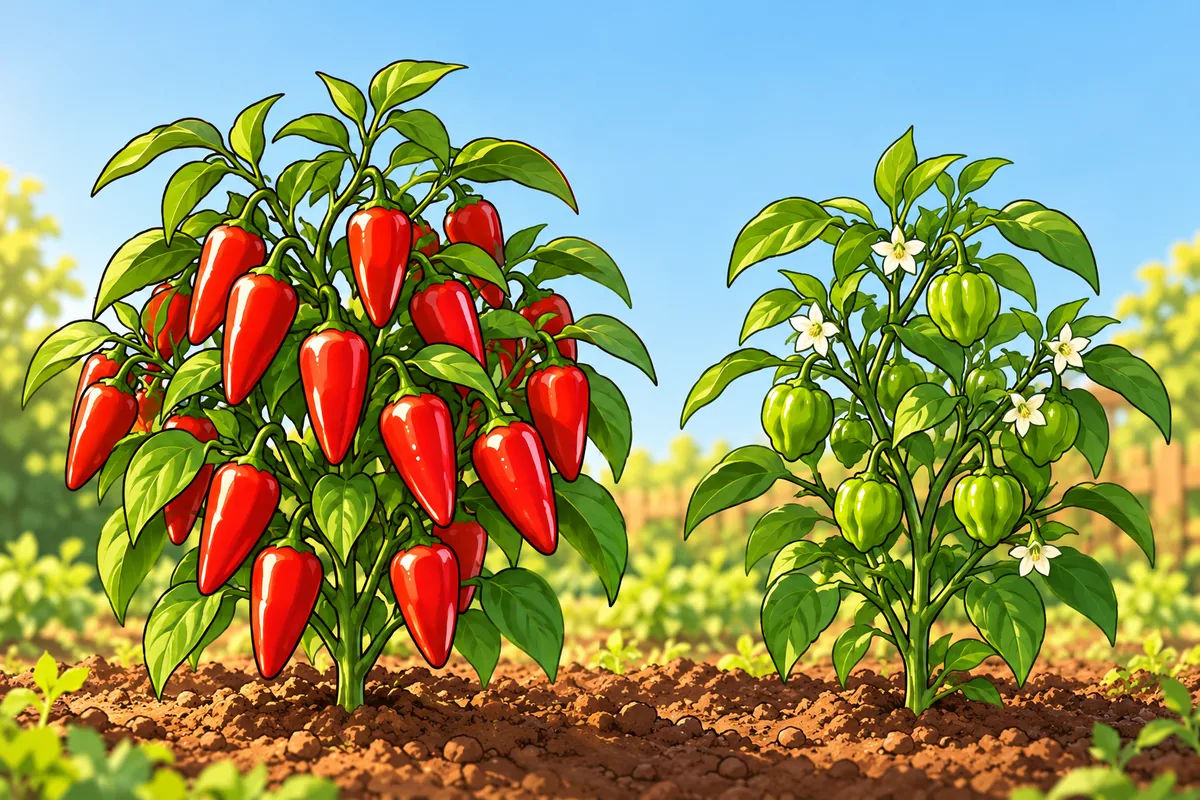
In a short northern summer, that gap decides what you harvest. Your Fresnos will color up by late summer almost anywhere peppers grow, while your habaneros may still be green at the first frost. Johnny's also warns that Fresno flowers drop in heat, so you take row covers off when sunny days pass 85 °F8.
What goes wrong when a Fresno cook first handles habaneros?
Mostly, the habits that worked for a moderately hot chile stop working. Run through these before your first habanero batch:
Before you trade Fresnos for habaneros
- Wear rubber gloves or rub a thin layer of fat on your hands, and keep your hands away from your eyes.11
- If your hands burn after cutting, soak them in plain vinegar.11
- Do not swap by count: a 4-inch Fresno is several times longer than a habanero of 0.8 to 2.4 inches, so weigh both.78
- Expect a ripe habanero to be its hottest; a ripe Fresno was its mildest in the trial.1
- Do not count on the oven: roasting cut habanero heat by under a tenth.1
The weighing point catches most people. A recipe that says "two Fresnos" means about 8 inches of chile, and two habaneros in their place carry several times the heat in a fraction of the volume. Weigh first, swap by the table, and taste.
Your next step: weigh the Fresnos your recipe uses, look up the row in the swap table, and add half that amount of habanero before you taste. If you want a milder neighbor instead, the Fresno against the jalapeño stays in the same band, and for a step between the two, the serrano and habanero pair works out a pod in the middle.
Related in Compare
-
Calabrian Chili vs Fresno, Up to 4× Hotter by EU Rules
A protected Italian name that covers a whole region's chiles, against one Californian cultivar.6 min read -
Serrano vs Habanero, the Habanero Is About 13× Hotter
A salsa chile against a hot sauce chile.6 min read -
Habanero vs Jalapeño, About 45× the Heat by Midpoint
The pepper you know against the one that scares people.7 min read -
Ghost Pepper vs Habanero, Why the Ghost Is 2.8× Hotter
Same species, very different numbers.6 min read -
Habanero vs Thai Chili, Why the Habanero Is 3× Hotter
A tiny hot chili against a fruity extra-hot one.5 min read -
Chile de Árbol vs Serrano, Árbol Leads by About 1.6×
A slim dried red against a fresh green, close in heat and far apart in the pan.7 min read
Sources
· 11
- 1Antioxidants 8(9): 364 (MDPI, peer-reviewed) Capsaicinoids, Polyphenols and Antioxidant Activities of Capsicum annuum: Comparative Study of the Effect of Ripening Stage and Cooking Methods (Hamed, Kalita, Bartolo, Jayanty)
- 2Texas AgriLife Extension Service (Joe Masabni) Jalapeño & Other Hot Peppers
- 3UF/IFAS Gardening Solutions Peppers by Scoville Units
- 4New Mexico State University, Chile Pepper Institute Heat
- 5Iowa State University Extension PM 1888(S): Guía de Horticultura, El huerto doméstico, Chiles (Everhart, Haynes, Jauron)
- 6New Mexico State University Cooperative Extension Service (Guide H-237) Measuring Chile Pepper Heat (Bosland, Walker)
- 7University of Florida IFAS Extension HS-859/TR010: Pepper Production in Miami-Dade County, Florida
- 8Johnny's Selected Seeds, seller page for its own seed Flaming Flare (F1) Fresno Pepper Seed
- 9University of California Agriculture and Natural Resources, UC Master Gardeners of Ventura County Ventura Garden to Table Series: Peppers
- 10University of Maryland Extension Growing Peppers in a Home Garden
- 11New Mexico State University Cooperative Extension Service (Guide E-324) Processing Fresh Chile Peppers (revised by Nancy C. Flores)