
Cayenne vs Jalapeño, 7.5× the Heat and Swaps
One usually ends up in a jar of powder, the other in a fresh salsa.
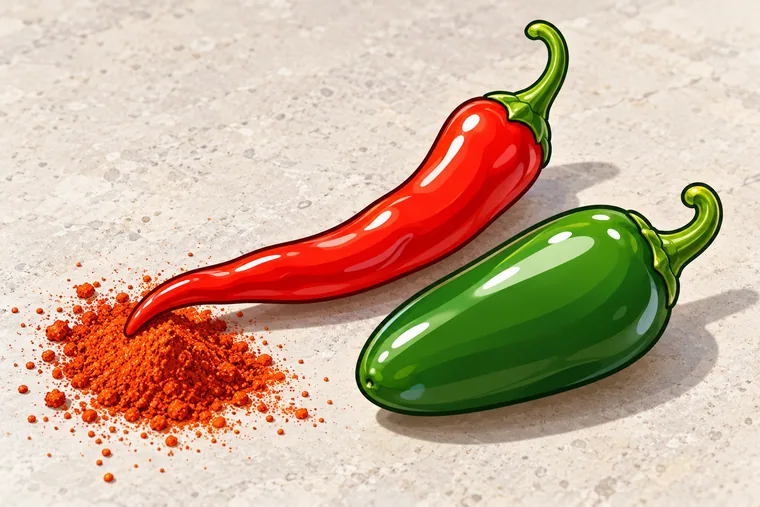
Cayenne is hotter, about 7.5 times a jalapeño by midpoint.
- Cayenne 25,000–50,000 SHU, jalapeño 2,000–8,000 SHU
- The ranges never overlap: a mild cayenne is 3 times a hot jalapeño
- Cayenne is usually dried and ground; jalapeño is usually eaten fresh
Log scale; bars are published ranges.1
On this page
- 1Is cayenne hotter than jalapeño?
- 2Does a second source agree on the gap?
- 3Can a jalapeño ever be hotter than a cayenne?
- 4How do you tell a fresh cayenne from a jalapeño?
- 5How do cooks use cayenne and jalapeño?
- 6Is a red jalapeño the same as a cayenne?
- 7What does each pepper turn into in your pantry?
- 8Are cayenne and jalapeño the same species?
- 9Which one should you reach for?
- 10Can you use jalapeño instead of cayenne?
- 11Which one makes the better hot sauce?
- 12Which one grows better in your garden?
- 13What goes wrong when you use them?
Is cayenne hotter than jalapeño?
Yes. UF/IFAS rates cayenne at 25,000 to 50,000 SHU and the jalapeño at 2,000 to 8,000, with an average jalapeño near 5,0001. On our heat bands that puts cayenne in hot and the jalapeño in medium.
Cayenne
Hotter
Log scale; bars are published ranges.1
Even the mildest cayenne on the extension range is about three times hotter than the hottest jalapeño.
How many times hotter is cayenne than jalapeño?
We compare midpoints: 37,500 SHU for cayenne and 5,000 for the jalapeño, so cayenne comes out about 7.5 times hotter. Guinness quotes the jalapeño a little higher, at around 3,000 to 8,000 SHU5, which barely moves the answer.
| Comparison | Cayenne | Jalapeño | Cayenne is |
|---|---|---|---|
| Midpoints | 37,500 SHU | 5,000 SHU | about 7.5 times hotter |
| Mild cayenne, hot jalapeño | 25,000 SHU | 8,000 SHU | about 3 times hotter |
| Hot cayenne, mild jalapeño | 50,000 SHU | 2,000 SHU | 25 times hotter |
These are figures for the pepper itself. A jar of ground cayenne can land anywhere in that span depending on which pods went into it.
Does a second source agree on the gap?
Roughly. Texas AgriLife gives an average of 3,500 to 4,500 SHU for the jalapeño and 35,000 for cayenne6. Divide 35,000 by the jalapeño midpoint of 4,000 and you get almost 9 times, against 7.5 on the UF/IFAS figures.
Both answers tell you the same thing in the kitchen. One cayenne carries the heat of somewhere between seven and nine jalapeños gram for gram, so a recipe that swaps one for the other needs a big change in amount, never a one-for-one trade.
Can a jalapeño ever be hotter than a cayenne?
Yes, when you compare bred cultivars instead of the generic ranges. NMSU measured every chile it released, and its own cayennes and jalapeños overlap7:
| Cultivar | Type | Released | Heat | Bred for |
|---|---|---|---|---|
| NuMex Primavera | Jalapeño | 1998 | 8,500–9,000 SHU | Uniformly mild heat for home gardens |
| NuMex Nematador | Cayenne | 2003 | 15,000 SHU | Hot sauce, resistance to root knot nematode |
| NuMex Jalmundo | Jalapeño | 2010 | 17,000 SHU | A jumbo pod for poppers |
| NuMex Las Cruces | Cayenne | 2010 | 17,400 SHU | The cayenne mash industry |
| NuMex Vaquero | Jalapeño | 1997 | 25,000–30,000 SHU | High yield and Phytophthora resistance |
A Vaquero jalapeño at 25,000–30,000 SHU out-burns both NMSU cayennes.
That flips the usual answer. Against the UF/IFAS ranges, cayenne is about 7.5 times a jalapeño; against these cultivars, a Las Cruces cayenne is about twice a Primavera and a Vaquero is about 1.6 times a Las Cruces (27,500 ÷ 17,400)7. If you grow from seed, the packet name tells you far more than the word cayenne or jalapeño.
How do you tell a fresh cayenne from a jalapeño?
By length and color. Fresh cayenne is a long, slim red pod; NMSU's cultivars measure 5.8 and 6.7 inches7. A jalapeño is a stubby 2 to 3 inches1 and you usually buy it dark green.
A red jalapeño is the one pod you can confuse with a cayenne at a glance. Check the shape: the jalapeño stays short and thick, and NMSU notes its immature pods are dark green before they turn red8. Look at the skin too. NMSU describes corky skin, or epidermal reticulation, as a jalapeño trait that its newer Spice jalapeños were bred to lack7, so fine corky lines on a red pod point to a jalapeño.
How do cooks use cayenne and jalapeño?
The bigger difference in your kitchen is the form. Cayenne is usually dried and ground or flaked1, so you meet it as a red powder. Jalapeños mostly go in fresh.
| Form | Cayenne | Jalapeño |
|---|---|---|
| Fresh | Not the usual form | The usual form: salads, salsa, Mexican dishes |
| Dried and ground | The usual form: powder or flakes | Not the usual form |
| Smoked | Not a named form | Chipotle (smoke-dried red jalapeño) |
Is a red jalapeño the same as a cayenne?
No. A red jalapeño is simply a ripe jalapeño, the same pod left on the plant until it changes color8, and it keeps the jalapeño's 2,000 to 8,000 SHU range1. A cayenne is a different cultivar with a longer, slimmer pod and about 7.5 times the heat by midpoint.
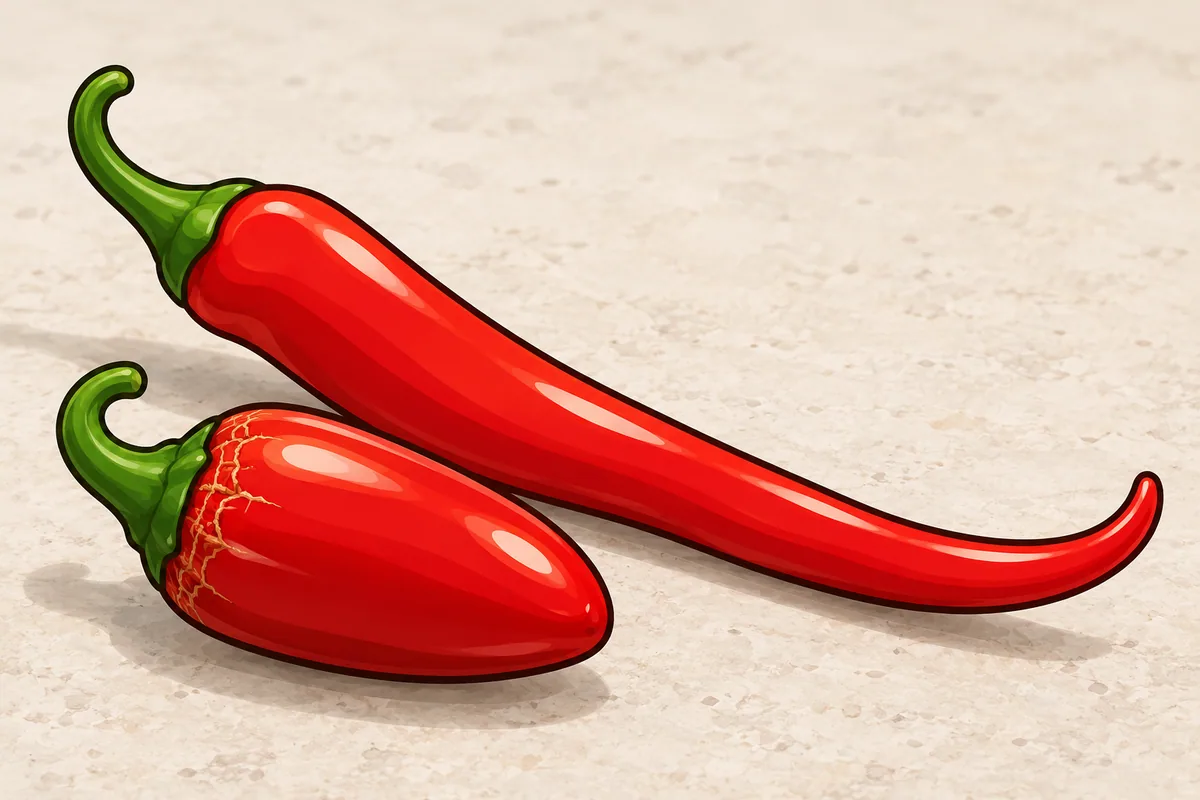
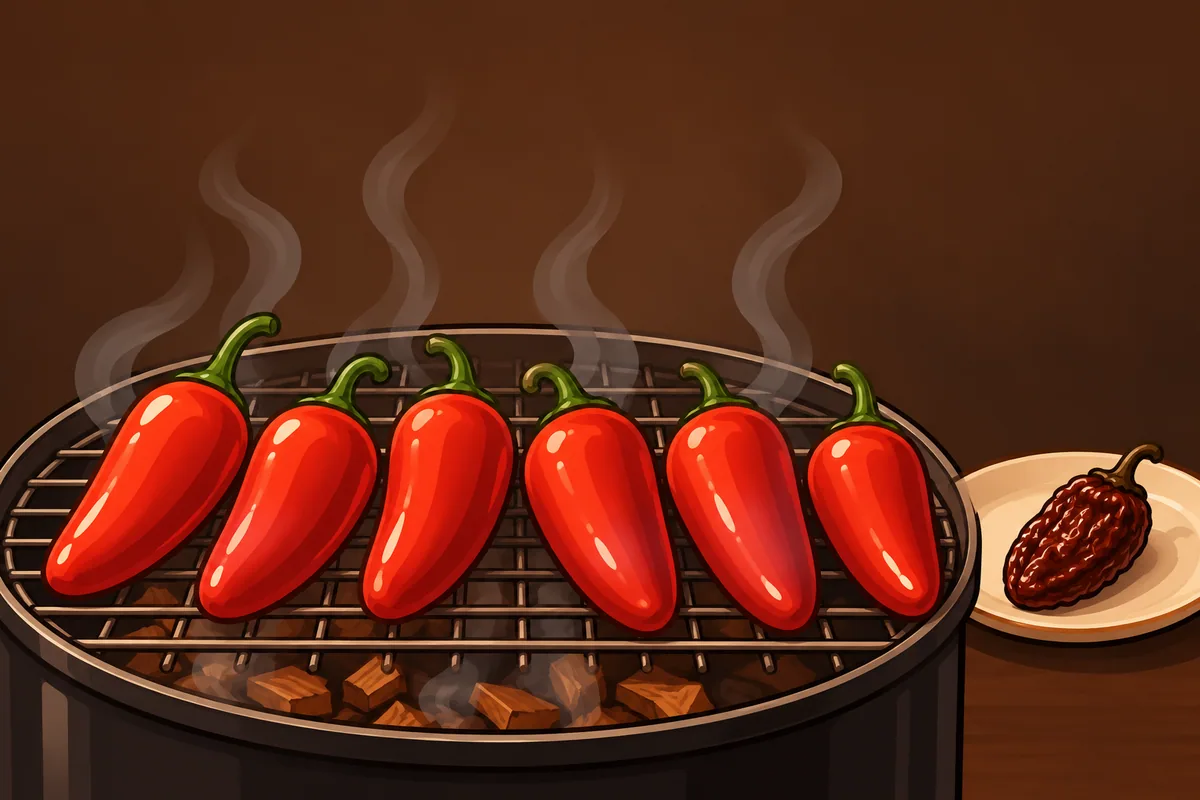
The two red pods also end up in different jars. Ripe red jalapeños that are smoke-dried become chipotle4, so they bring smoke and medium heat. Ripe red cayennes get dried plain and ground into powder or flakes1, so they bring sharp heat and little else. If your recipe says chipotle, a pinch of cayenne gives you the heat but none of the smoke.
NMSU's jumbo NuMex Jalmundo jalapeño, 3.7 by 1.4 inches and about 17,000 SHU, was bred for poppers and matures from green to red7, so a big red popper pod at a farm stand can still be a jalapeño.
What does each pepper turn into in your pantry?
Almost every cayenne you buy has been dried; almost every jalapeño has been either eaten fresh, pickled or smoked. The tree below follows each one from the plant:
- CayenneRed pods on a 2–4 foot plantHot
- driedDried and groundPowder or flakes, the usual form
- mashed and agedAged mash with vinegarFrank's RedHot lists aged cayenne first
- dried
- JalapeñoGreen pods turning redMedium
- sliced greenPickled ringsA tested recipe: 3 lb of pods for about 6 pints
- ripened redChipotleRipe red pods, smoke-dried
- sliced green
Bars show published heat ranges. Sources for this line1. University of Florida IFAS Extension4. New Mexico State University, Chile Pepper Institute9. McCormick (maker of Frank's RedHot, own product)10. National Center for Home Food Preservation (University of Georgia)
The cayenne branch explains a lot of supermarket labels. When a bottle says cayenne, you are usually buying a vinegar sauce in the Louisiana style; when a jar says cayenne, you are buying one of the ground red chili powders.
Are cayenne and jalapeño the same species?
Yes, both are Capsicum annuum13. The cayenne takes its name from the city of Cayenne in French Guiana1, and you will also see it sold as Guinea spice, cow-horn pepper or bird pepper2.
Which one should you reach for?
Decide by the job, then by the form in your kitchen. Here is how the two split, using what the sources say each pepper is for:
Reach for cayenne when
If your dish fits both lists, start with the jalapeño. You can always add a pinch of cayenne at the end, but you can't take heat back out of a pot.
Can you use jalapeño instead of cayenne?
Going the other way, a pinch of cayenne powder can stand in for a jalapeño's heat in a cooked dish, but you lose the fresh green flavor. Add it a little at a time, since the jar could hold anything from 25,000 to 50,000 SHU worth of pods.
If even a jalapeño is too hot for your table, a poblano runs 1,000 to 2,000 SHU1, and the poblano against the jalapeño shows that step down. Going up instead, the cayenne against the habanero shows the next jump, about six times again.
Which one makes the better hot sauce?
For a thin, red, vinegar sauce, cayenne. NMSU bred both of its cayennes for hot sauce production, Las Cruces specifically for the mash industry7, and the best-known bottled cayenne sauce lists aged cayenne peppers first, with vinegar, water, salt and garlic powder9.
For a green sauce or a pickle you keep in the fridge, jalapeño. Its 2 to 3 inch green pods go into salsas and pickles18, and the tested pickled ring recipe from the National Center for Home Food Preservation turns 3 pounds of them into about 6 pints10. A red jalapeño, smoked and dried, gives you chipotle for a smoky sauce instead.
So you choose by the color and the texture of the sauce you want. If you want a red jalapeño sauce, you can blend ripe red pods the way you would cayenne, and expect much less heat per spoon.
Which one grows better in your garden?
The jalapeño gives you pods sooner, and both like heat. Texas AgriLife wants hot days of 85–95°F and nights of 65–70°F for jalapeños and other hot peppers, and warns that excessive heat shrinks fruit and makes blossoms drop6.
| Cayenne | Jalapeño | |
|---|---|---|
| Plant size | 2–4 feet | Not given in these sources |
| Time to fruit | About 100 days after the seed sprouts | 75–85 days after transplanting |
| When to pick | Red and ripe, for drying | Firm and green at 2–2.5 inches, or red |
| Handles hot, humid weather | Adapts well, per UF/IFAS in Miami-Dade | Best with cool 65–70°F nights |
If you plan to dry your harvest, cayenne is the plant built for it: its pods are long, thin and red, the form UF/IFAS says usually ends up dried as powder or flakes1.
What goes wrong when you use them?
- Scraping seeds and missing the ribs. About 89 % of a pepper's capsaicin sits in the pale placenta, so you cut that out, not only the seeds, to tame a jalapeño11.
- Breathing cayenne dust. When you toast or fry cayenne, open a window; inhaled capsaicin can set off asthma in people prone to it12.
- Pickling more peppers than the recipe says. Penn State says you may cut the peppers in a tested pickle recipe but never raise them, since the acid ratio keeps the jar safe13.
Related in Compare
-
Habanero vs Cayenne Pepper, About 6× Hotter
Two different species, and a gap between their ranges.5 min read -
Poblano vs Jalapeño, 3.3× the Heat and When to Use Each
The big mild one and the small hot one.5 min read -
Anaheim Pepper vs Jalapeño, the 5× Heat Gap
Two Capsicum annuum pod types whose heat ranges overlap.5 min read -
Cayenne vs Thai Chili, Why the Smaller Pod Is 2× Hotter
Same species on most lists, double the heat, a sixth of the length.5 min read -
Árbol vs Cayenne Pepper, Cayenne Is About 1.7× Hotter
Two skinny red Capsicum annuum chiles, one sold whole, one mostly ground.5 min read -
Hungarian Wax Pepper vs Jalapeño, 1.5× Hotter by Midpoint
A long yellow pickling pepper and the green chile everyone knows, closer in heat than they look.6 min read
Sources
· 13
- 1University of Florida IFAS Extension HS-859/TR010: Pepper Production in Miami-Dade County, Florida
- 2UF/IFAS Gardening Solutions Peppers by Scoville Units
- 3PhytoKeys 200:1-423 (Pensoft) Monograph of wild and cultivated chili peppers (Capsicum L., Solanaceae)
- 4New Mexico State University, Chile Pepper Institute Chile Terminology
- 5Guinness World Records Pepper X dethrones Carolina Reaper as world's hottest chilli pepper
- 6Texas AgriLife Extension Service (Joe Masabni) Jalapeño & Other Hot Peppers
- 7New Mexico State University, Agricultural Experiment Station (Research Report 792) The Chile Cultivars of New Mexico State University Released from 1913 to 2016 (Coon and Bosland)
- 8New Mexico State University Cooperative Extension Service Guide H-240: Growing Chile Peppers in New Mexico Gardens (Walker, Bosland)
- 9McCormick (maker of Frank's RedHot, own product) Frank's RedHot Original Cayenne Pepper Hot Sauce
- 10National Center for Home Food Preservation (University of Georgia) Pickled Jalapeño Rings
- 11Heliyon (Cell Press) A comprehensive review of capsaicin: Biosynthesis, industrial productions, processing to applications, and clinical uses
- 12National Capital Poison Center (poison.org) Capsaicin: When the Chili Is Too Hot (Amanda McDaniel-Price, RN)
- 13Penn State Extension Preserving Those Colorful Garden Peppers (Martha Zepp)