
Hungarian Wax Pepper vs Jalapeño, 1.5× Hotter by Midpoint
A long yellow pickling pepper and the green chile everyone knows, closer in heat than they look.
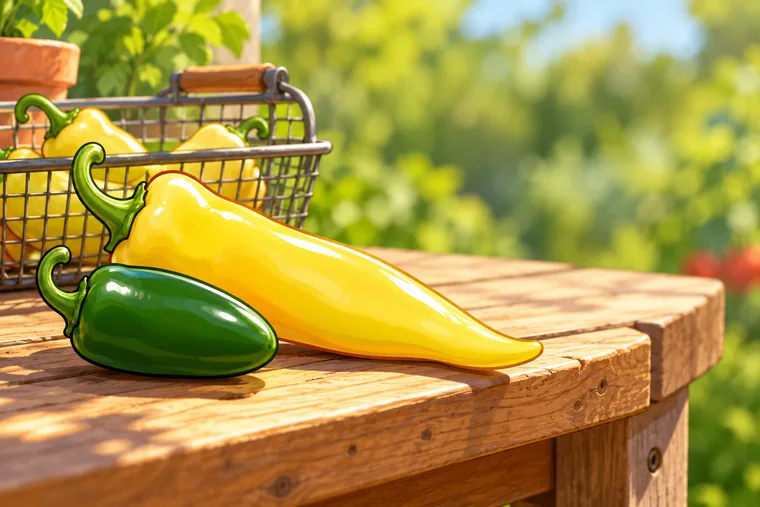
The Hungarian wax pepper usually runs a little hotter: about 1.5 times a jalapeño by midpoint, and its bigger pod carries more heat per pepper.
- Hungarian wax 5,000–10,000 SHU; jalapeño 2,000–8,000 SHU (UF/IFAS)
- USDA weighs a raw Hungarian pepper at 27 g and a jalapeño at 14 g
- Both pickle in the same NCHFP hot pepper recipe; swap them by weight, not by count
On this page
- 1Is a Hungarian wax pepper hotter than a jalapeño?
- 2Why does one wax pepper carry more heat than one jalapeño?
- 3How do you tell a Hungarian wax pepper from a banana pepper?
- 4What happens as each pepper ripens?
- 5How do you pickle Hungarian wax peppers and jalapeños?
- 6Can you use a Hungarian wax pepper instead of a jalapeño?
- 7Which one gives you more vitamin C per pepper?
- 8Which is easier to grow in a short summer?
- 9Is a Hungarian wax pepper the pepper behind Hungarian paprika?
- 10What to read next
Is a Hungarian wax pepper hotter than a jalapeño?
Usually, by a little. UF/IFAS puts the Hungarian wax pepper at 5,000 to 10,000 Scoville units and the jalapeño at 2,000 to 8,000, with an average around 5,0001. The two ranges overlap from 5,000 to 8,000 SHU, so a hot jalapeño can beat a mild wax pepper.
Hungarian wax
Log scale; bars are published ranges.1
Their ranges share the 5,000–8,000 SHU stretch, so a single pod of either can be the hotter one.
How many times hotter is the wax pepper?
We compare midpoints first: 7,500 SHU for the Hungarian wax against 5,000 for the jalapeño (UF/IFAS's own average), so about 1.5 times. The ends of the ranges show you the spread.
| Comparison | Hungarian wax | Jalapeño | Result |
|---|---|---|---|
| Midpoint against average | 7,500 SHU | 5,000 SHU | wax about 1.5× hotter |
| Hot wax, mild jalapeño | 10,000 SHU | 2,000 SHU | wax 5× hotter |
| Mild wax, hot jalapeño | 5,000 SHU | 8,000 SHU | jalapeño 1.6× hotter |
The last row is the one that surprises you at the cutting board. A fat, late-summer jalapeño at the top of its range out-heats a wax pepper at the bottom of its own.
Why does one wax pepper carry more heat than one jalapeño?
Because it is twice the pepper. USDA weighs one raw Hungarian pepper at 27 g and one raw jalapeño at 14 g23. Multiply weight by the midpoint heat and the wax pod brings nearly three times the heat to your pan, pod for pod.
| Pepper | Pod weight | Midpoint | Weight × heat | Relative |
|---|---|---|---|---|
| Hungarian wax | 27 g | 7,500 SHU | 202,500 | about 2.9× |
| Jalapeño | 14 g | 5,000 SHU | 70,000 | 1× |
So if a recipe says "one jalapeño, minced" and you reach for one whole wax pepper instead, you are adding about three jalapeños' worth of heat. That is the most common way this swap goes wrong, and it has nothing to do with the SHU ratio alone.
How do you tell a Hungarian wax pepper from a banana pepper?
You often can't by eye, and that is the real risk. UF/IFAS says the Hungarian wax looks quite like a banana pepper but runs much hotter: 5,000–10,000 SHU against 0–5001. A bin of long yellow peppers can hold either.
- Read the sign twice. UF/IFAS says people also call the wax pepper "hot wax" or "hot yellow pepper"1. "Hot" on the label is your clue.
- Taste a sliver of the tip. Cut a thin ring from the tip end and taste it. A banana pepper gives you sweetness; a wax pepper gives you a jalapeño-like bite or more.
- Check the color stage. Both start yellow, so color does not separate them at the store.
- Ask what it was grown for. Maryland Extension lists banana peppers among sweet varieties4; a farmer who grew hot wax peppers will tell you.
The sweet banana pepper entry covers the mild twin pod by pod, with its heat and uses. The short version: a mild yellow pepper is no stand-in for a jalapeño, and a hot one is.
What happens as each pepper ripens?
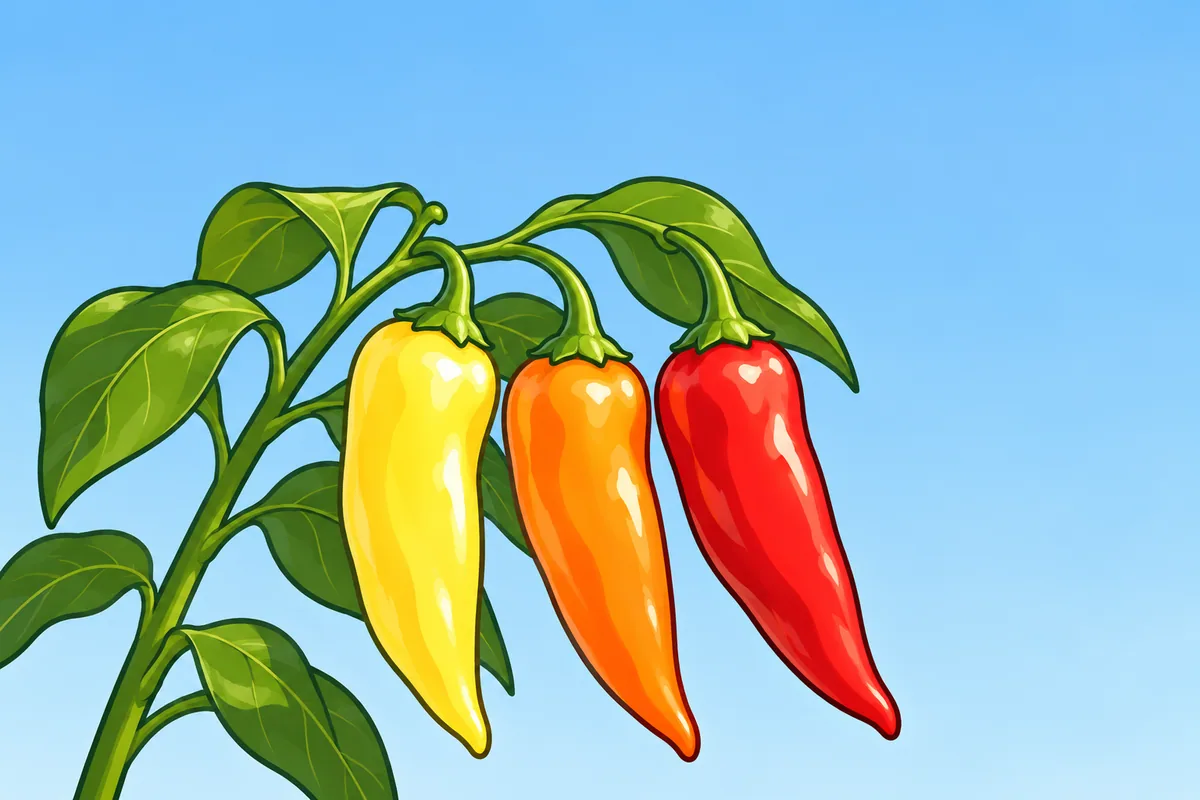
Both change color, in different orders. UF/IFAS describes each sequence1:
Maryland Extension's rule covers both: you can harvest peppers green, or let them ripen and change color on the plant4. Most people pick wax peppers yellow and jalapeños green, but if you leave a few on the plant, you get orange and red wax pods for a colorful jar and red jalapeños you could smoke, since UF/IFAS notes that smoked ripe jalapeños become chipotle5.
How do you pickle Hungarian wax peppers and jalapeños?
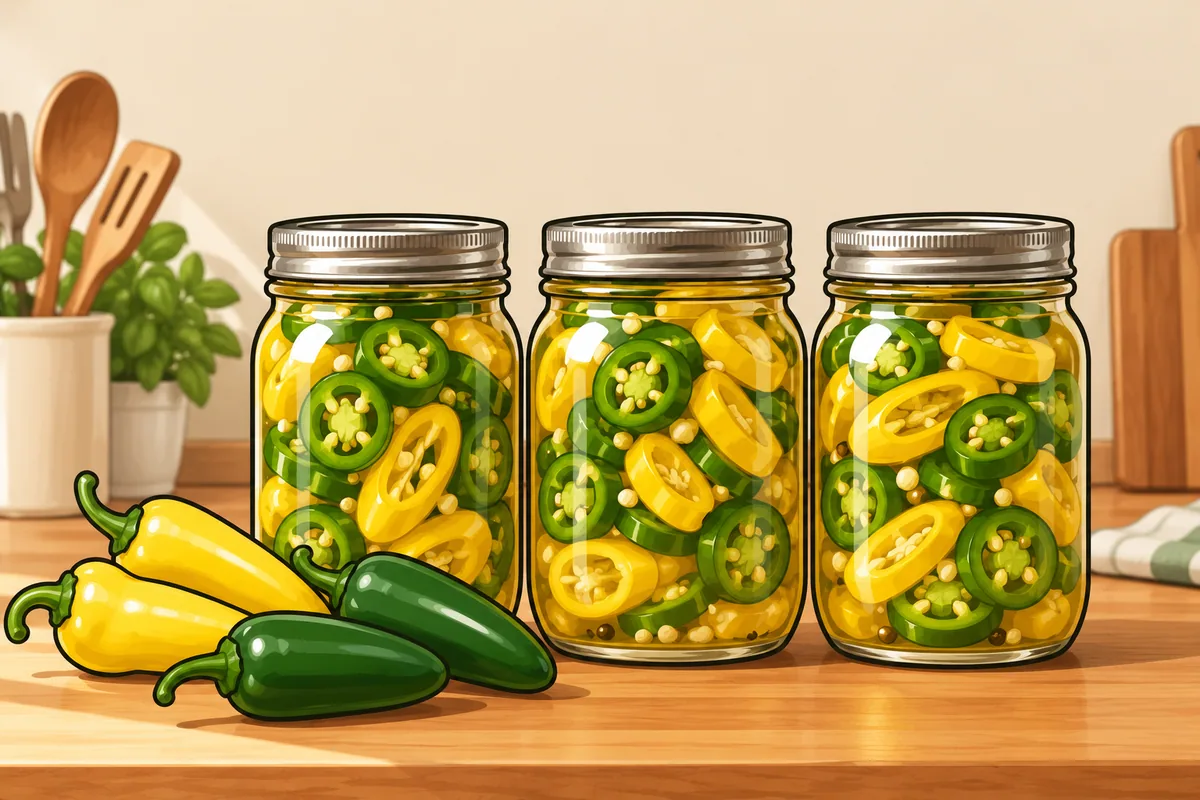
With the same tested recipe. The National Center for Home Food Preservation's pickled hot peppers recipe names Hungarian, banana, chile and jalapeño as the hot peppers to use, so you can mix your wax peppers and jalapeños in one batch6. It makes about 9 pints from 4 pounds of hot long peppers and 3 pounds of mixed sweet red and green peppers.
- 1
Glove up and prep
Wear rubber gloves. Wash the peppers; leave small ones whole with 2 to 4 slits each, and quarter large ones.6
- 2
Blister and peel
Blanch in boiling water, or blister in a 400°F oven or under the broiler for 6 to 8 minutes, then cool and peel the skins off.6
- 3
Pack the jars
Flatten small peppers and pack into jars, leaving 1/2 inch of headspace.6
- 4
Make the brine
Combine 5 cups of 5% vinegar, 1 cup of water, 4 teaspoons of canning or pickling salt, 2 tablespoons of sugar and 2 garlic cloves; boil, simmer 10 minutes, remove the garlic.6
- 5
Fill and process
Pour the hot brine over the peppers to 1/2 inch headspace, adjust lids, and process half-pints or pints in a boiling-water canner: 10 minutes up to 1,000 ft, 15 at 1,001–6,000 ft, 20 above 6,000 ft.6
Stick to the recipe's vinegar, water and salt amounts; they set the acidity that makes the jars safe on a shelf. If you want rings for nachos instead of whole pods, the banana pepper pickles follow the same logic for long yellow peppers.
Can you use a Hungarian wax pepper instead of a jalapeño?
Yes, by weight. Since the wax pepper runs about 1.5 times hotter at the midpoint, about two thirds the weight of wax pepper matches a jalapeño's heat. Here is the arithmetic for a salsa that calls for three jalapeños: 3 × 14 g is 42 g of jalapeño3, and 42 g ÷ 1.5 is about 28 g of wax pepper, which is roughly one 27 g pod2.
So one wax pepper replaces about three jalapeños in heat. You lose the green color and gain a yellow one, and you get the wax pepper's wax-like rind in the bite.
Going the other way, use about three jalapeños for each wax pepper a recipe names. If you are stuffing peppers, though, the long wax pod gives you more room for filling than a 2–3 inch jalapeño1, so the swap changes the dish's shape as much as its heat.
Which one gives you more vitamin C per pepper?
The wax pepper, because it is bigger. Per 100 g, USDA lists 118.6 mg of vitamin C for raw jalapeño and 92.9 mg for raw Hungarian pepper23. Per pod, the 27 g wax pepper comes out ahead.
| Nutrient | Hungarian (27 g pod) | Jalapeño (14 g pod) |
|---|---|---|
| Energy | about 8 kcal | about 4 kcal |
| Vitamin C | about 25 mg | about 17 mg |
| Potassium | about 55 mg | about 35 mg |
| Fiber | about 0.3 g | about 0.4 g |
The jalapeño packs more vitamin C per gram; the wax pepper gives you more per pod. Either way, a few peppers in your salsa add real vitamin C for very few calories.
Which is easier to grow in a short summer?
About the same. Maryland Extension gives most hot types 70 to 85 days from transplanting, and it warns that plants set out before the soil reaches 65°F may stall4. It spaces plants 12 to 24 inches apart in rows 30 to 36 inches wide.
What differs is what you pick. If your summer ends early, pick your wax peppers yellow and your jalapeños green; both are usable at that stage, and you skip the extra weeks to red. UF/IFAS adds one practical warning for jalapeños: even jalapeño plants sometimes show severe iron deficiency on the high-pH soils of Miami-Dade1, so if your soil runs alkaline, ask your local extension office about a soil test before you plant.
Handle both with gloves at harvest if you pick a lot. The poison center advises rubber, latex or nitrile gloves when you work with hot peppers7.
Is a Hungarian wax pepper the pepper behind Hungarian paprika?
No, and the heat tells you why. NMSU's Chile Pepper Institute defines paprika as any non-pungent chile that ripens red and gets used as a spice or for color8. A Hungarian wax pepper at 5,000 to 10,000 SHU1 is pungent by any measure, so it falls outside that definition even though it shares the country name.
USDA's food list adds a naming trap of its own: its entry "Peppers, hungarian, raw" is the one we use for the wax pepper's pod weight and nutrients2. When you shop, "Hungarian" on a fresh pepper usually points to a hot wax type, while paprika on a spice jar points to a ground red pepper chosen for color. If a recipe wants sweet paprika, a wax pepper will add heat it never asked for.
What to read next
If you came here from a jar of pickles, the Hungarian wax entry is your next stop, with its full heat data and uses.
If the jalapeño is your baseline, see how it measures against a long red chile in cayenne beside jalapeño, or against a mild green roaster in poblano beside jalapeño.
Related in Compare
-
Cayenne vs Jalapeño, 7.5× the Heat and Swaps
One usually ends up in a jar of powder, the other in a fresh salsa.6 min read -
Poblano vs Jalapeño, 3.3× the Heat and When to Use Each
The big mild one and the small hot one.5 min read -
Hatch Chile vs Poblano, 10 NMSU Lines From 0 to 9,000 SHU
New Mexico's long green against Mexico's short, dark stuffing chile.7 min read -
Poblano vs Bell Pepper, 2,000 SHU Against Zero
One stuffing pepper with a little heat, one with none at all.6 min read -
Thai Chili vs Jalapeño, Why the Small Pod Is 15× Hotter
A one-inch pod with fifteen times the heat.5 min read -
Anaheim Pepper vs Jalapeño, the 5× Heat Gap
Two Capsicum annuum pod types whose heat ranges overlap.5 min read
Sources
· 8
- 1University of Florida IFAS Extension HS-859/TR010: Pepper Production in Miami-Dade County, Florida
- 2USDA Agricultural Research Service, FoodData Central (SR Legacy) Peppers, hungarian, raw (FDC ID 168578)
- 3USDA Agricultural Research Service, FoodData Central (SR Legacy) Peppers, jalapeno, raw (FDC ID 168576)
- 4University of Maryland Extension Growing Peppers in a Home Garden
- 5UF/IFAS Gardening Solutions Peppers by Scoville Units
- 6National Center for Home Food Preservation (University of Georgia, USDA-supported) Pickled Hot Peppers
- 7National Capital Poison Center (poison.org) Capsaicin: When the Chili Is Too Hot (Amanda McDaniel-Price, RN)
- 8New Mexico State University, Chile Pepper Institute Chile Terminology