On this page
- 1What do you need for 9 pints of pickled banana peppers?
- 2How do you pickle and can banana peppers?
- 3How many banana peppers fill one pint jar?
- 4How long do you process the jars at your altitude?
- 5How do you make hot pickled banana peppers?
- 6Can you change the sugar, vinegar or cut?
- 7Why are your pickled peppers soft, cloudy or unsealed?
- 8Store the jars, then use them
- 9Sources
What do you need for 9 pints of pickled banana peppers?
Seven pounds of sweet banana peppers, a sweet vinegar brine, garlic and canning salt. The amounts come from Penn State Extension's Pickled Sweet Peppers recipe, which tells you to use your favorite sweet peppers and lists banana among the sweet pickled types1. We add the grams so you can weigh everything.
| Ingredient | Amount | Grams | Notes |
|---|---|---|---|
| Sweet banana peppers | 7 lb | 3,175 g | About 69 medium pods at 46 g each |
| Sugar | 3½ cups | 700 g | Granulated |
| Vinegar, 5 % acidity | 3 cups | About 717 g (710 ml) | Check the label says 5 % |
| Water | 3 cups | 710 g (710 ml) | |
| Garlic | 9 cloves | 27 g | 1 clove per pint jar |
| Canning or pickling salt | 4½ tsp | About 27 g | ½ tsp per pint jar |
The sugar is not a typo. This is a sweet pickle, which suits a mild pepper: UF/IFAS rates sweet banana peppers at 0–500 SHU7, and the UC Master Gardeners describe their taste as mild, tangy and slightly sweet, with crisp, thick flesh that people often pickle8. If you want a sharper, less sweet jar, the hot version further down uses far less sugar. You may well end up making both, a sweet batch for sandwiches and a hot batch for pizza night, so plan your canner days around two loads.
You also need 9 pint jars with new lids and bands, a boiling-water or atmospheric steam canner with a rack, a jar lifter and a big pot for the brine. Penn State packs into sterile jars1, so get the jars hot and clean before you start cutting.
Beyond the peppers, your canning run needs three things, and each one has a job in the steps below.
Canning gear for pickled peppers
These three items turn the ingredient list into jars that seal and keep.
Boiling-water canner with a rack and fitted lid
You lower the filled jars onto the rack, put the lid on and process them under at least 1 inch of briskly boiling water.
- NCHFP describes boiling-water canners as having a fitted lid and a removable rack
- Where: Stovetop
- Size: No more than 4 inches wider than the burner
- Water: At least 1 inch over the jars
- View on Amazon: Mason-type canning jars with two-piece lids
Mason-type canning jars with two-piece lids
You fill regular or wide-mouth Mason-type jars and close each one with a new self-sealing lid.
- View on Amazon: Canning or pickling salt
Canning or pickling salt
You use a salt without anti-caking additives, so the brine stays clear.


As an Amazon Associate we earn from qualifying purchases. We choose product types from what their labels and extension sources say; the commission does not change what we recommend. Our affiliate disclosure
How do you pickle and can banana peppers?
Cut, boil, pack, process. The whole run takes about 1 hour 10 minutes of work, 45 minutes to prepare the peppers and 25 minutes at the stove, plus the time your canner takes to come to a boil and a night of cooling.
- 1
Prepare the peppers (about 30 minutes)
Wash the peppers, cut them into quarters, remove the cores and seeds, trim any blemishes and slice the quarters into strips.1
- 2
Set out the jars (about 15 minutes)
Have 9 sterile pint jars ready and hot. Put 1 garlic clove and ½ teaspoon of canning salt into each pint jar; half-pints get half of each.1
- 3
Boil the brine (about 10 minutes)
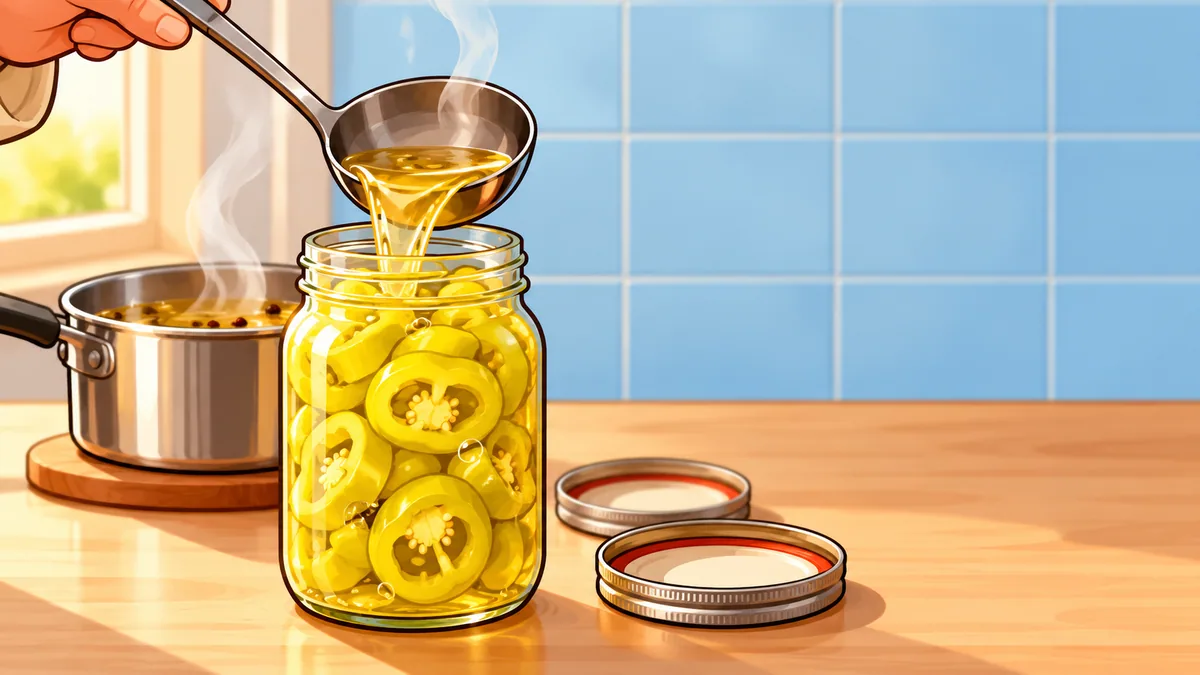
Bring the vinegar, water and sugar to a boil and boil for 1 minute. The salt goes in the jars, not the brine.1
- 4
Heat the peppers (about 5 minutes)
Add the pepper strips to the boiling brine and bring it back to a boil.1
- 5
Pack and cover (part of the stove time)
Pack the hot strips into the jars, cover them with the hot brine and leave ½ inch of headspace. Wipe the rims and put on the lids and bands.1
- 6
Process (5 minutes at up to 1,000 ft)
Process the jars in a boiling-water or atmospheric steam canner for the time in the altitude table.1
- 7
Rest and cool (5 minutes, then 12–24 hours)
Turn off the heat, wait 5 minutes, lift the jars out with a jar lifter, and cool them 12 to 24 hours before you check the seals. Do not retighten the bands.1
Those times add up: 30 + 15 minutes of prep, then 10 + 5 + 5 + 5 minutes at the stove, the packing included, for about 1 hour 10 minutes. A big batch of peppers or a slow knife stretches the prep; the stove times stay the same.
Wear gloves if any of your banana peppers turn out to be the hot kind. Penn State's guide says to wear plastic gloves when you handle hot peppers1.
How many banana peppers fill one pint jar?
About seven or eight medium pods. The recipe's 7 pounds, 3,175 g, spread over 9 pints puts about 353 g of pepper in each jar before trimming, and USDA weighs a medium banana pepper, about 4½ inches long, at 46 g2.
That gives you a shopping rule you can use at any farm stand: 353 ÷ 46 = about 7.7 medium pods per pint, or roughly 69 for the full batch. With small 4-inch pods at 33 g you need about 11 per pint; with large 5-inch ones at 75 g, about 52. Buy a few extra, since you lose the cores, seeds and any blemished bits when you trim.
If you are filling fewer jars, USDA also gives you a volume check: one cup of banana pepper weighs 124 g2, so a pint's worth is just under 3 cups of cut pepper before it goes into the brine. Measure a cup of your strips against that figure once, and you can skip the scale next time.
How long do you process the jars at your altitude?
Five minutes near sea level, longer as you go up. Here are Penn State's times for sweet pickled peppers, the same for half-pints and pints1; if you do not know your altitude, look up your town before canning day.
| Altitude | Minutes |
|---|---|
| 0–1,000 ft | 5 |
| 1,001–6,000 ft | 10 |
| Above 6,000 ft | 15 |
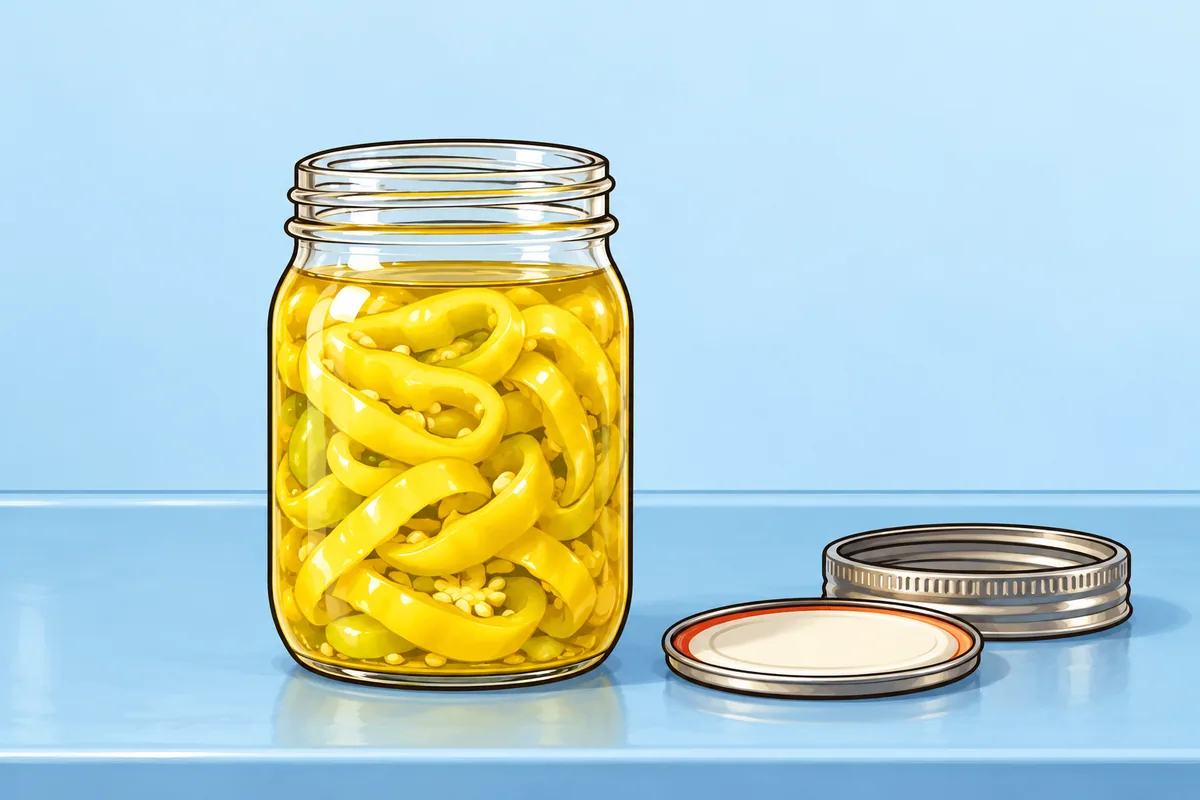
Both recipes on this page ask for the same ½ inch, at packing and again after you pour the brine11. Measure it with a ruler the first time; after one batch, your eye learns where ½ inch sits.
How do you make hot pickled banana peppers?
Switch to the National Center for Home Food Preservation's Pickled Hot Peppers recipe, which names banana among the peppers it is written for11. It is a different recipe, not the sweet one with hot peppers added, so follow it as written. Other peppers and other brines have their own tested routes, gathered under how to pickle peppers.
Sweet jar (Penn State)
Hot jar (NCHFP)
- 7 lb sweet peppers, cut in stripsPeppers4 lb hot long red, green or yellow peppers plus 3 lb sweet red and green
- 3 cups 5 % vinegar, 3 cups water, 3½ cups sugarBrine5 cups 5 % vinegar, 1 cup water, 4 tsp salt, 2 tbsp sugar, 2 garlic cloves simmered 10 minutes
- ½ tsp salt and 1 clove per pint, in the jarSalt and garlicIn the brine; the garlic comes out before you pour
- Left onSkinsBlanched or blistered, then peeled
- 5 minutes, hot packProcess at 0–1,000 ft10 minutes
The hot recipe asks you to slash small whole peppers 2 to 4 times or quarter large ones, then blanch them or blister their skins in a 400°F oven or under the broiler for 6 to 8 minutes and peel them11. You leave ½ inch of headspace and process 10 minutes up to 1,000 ft, 15 minutes up to 6,000 ft and 20 minutes above11.
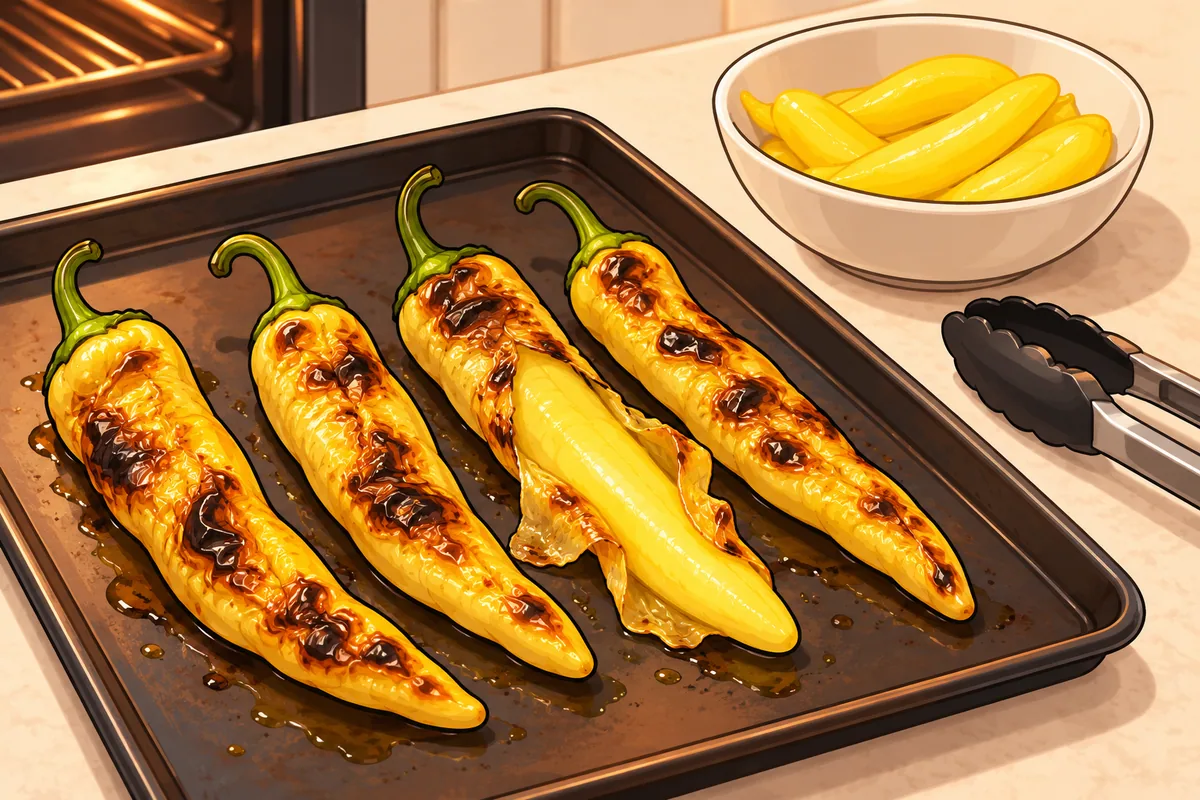
Pick the heat for your hot jar
The hot recipe is 4 parts hot pepper to 3 parts sweet by weight, so about 57 % of each jar is the hot pepper you choose. That share sets the jar's heat, and the table works it out from each pepper's range.
| Hot pepper you choose | Its heat (SHU) | Worked jar heat |
|---|---|---|
| Hot banana or Hungarian wax | 5,000–10,000 | About 4,300 SHU |
| Jalapeño | 2,000–8,000 | About 2,900 SHU |
| Sweet banana only (the Penn State jar) | 0–500 | Under 500 SHU |
UF/IFAS notes that Hungarian wax looks a lot like a banana pepper but runs 5,000–10,000 SHU against 0–5007. So if your farm stand sells "hot banana peppers", treat them as the first row and use the NCHFP recipe. The same tested jar works for the hot round pods in cherry pepper recipes, since NCHFP writes it for long hot peppers of several kinds.
Can you change the sugar, vinegar or cut?
Some things, yes; the parts that keep the jar safe, no. Tested pickle recipes rely on their vinegar and their processing time, so leave those alone and play with the rest.
An Oregon State extension session from Clackamas County covers how to pickle hot peppers with the right acidity, which is the reason the vinegar lines in the list below stay fixed, and the amounts on this page stay the tested ones.
Safe to change
- Pepper colors: mix yellow banana peppers with red or orange sweet peppers
- Jar size: half-pints instead of pints, with half the garlic and salt per jar
- Which tested recipe you follow: sweet or hot
Keep as written
- Vinegar strength: always 5 % acidity
- Vinegar and water amounts
- Processing time for your altitude
- ½ inch headspace
- Adding oil, onions or extra vegetables to the jar
Want less sugar? Do not cut it from the sweet recipe on your own. Use the hot recipe instead, whose brine carries only 2 tablespoons of sugar, and follow it exactly as NCHFP writes it. Want rings rather than strips? The sweet recipe cuts strips, and we found no tested version for rings, so we keep to strips here.
Why are your pickled peppers soft, cloudy or unsealed?
Most problems trace back to a step that ran long or a jar that did not seal. Here are the usual ones and what to do.
- A lid did not seal. Penn State's advice: replace the lid and process the jar again, or store it in the refrigerator1.
- Soft strips. Stick to the recipe's single return to the boil and its processing time; extra minutes in hot brine only cook the strips further.
- Peppers float. Strips shrink a little in the jar, so pack them firmly but without crushing, then top up the brine to the ½ inch line.
- Cloudy brine. Use canning or pickling salt, as both recipes ask, rather than whatever salt is in your shaker.
- A hotter jar than you planned. Some banana peppers on sale are hot types. Taste a sliver of each batch before you pickle it, and pick the right recipe.
Store the jars, then use them
Wash, dry and label your sealed jars with the date and which recipe you used, sweet or hot, then keep them in a clean, cool, dark place. A label saves you from opening a hot jar when you wanted the sweet one on a child's sandwich. Penn State says canned goods are best within a year and stay safe as long as the lids stay vacuum sealed1. Any jar that did not seal goes in the fridge.
Use them on sandwiches, pizza and salads, or chop them into a relish. If you like pickled heat on the same sandwich, pickled jalapeños follow the hot-pepper route.
Next, pick your recipe, sweet or hot, and buy 7 pounds of peppers for one full canner load. If you cannot find banana peppers at all, the banana pepper swaps tell you what to pickle instead.
If you would rather bottle a sauce from the hot ones, the hot sauce making guides start from the same peppers, and the recipes hub lists every other dish for a big pepper harvest.