On this page
- 1What can you use instead of aji amarillo?
- 2Which aji amarillo swap should you pick?
- 3What is aji amarillo, and how hot is it?
- 4How do you replace aji amarillo paste?
- 5Is ají mirasol hotter than aji amarillo?
- 6Can you use rocoto, Anaheim or poblano instead?
- 7Why did your stand-in ají paste come out too hot or orange?
- 8Make the blend a day ahead
- 9Sources
What can you use instead of aji amarillo?
Nothing copies it exactly, so you rebuild two things: the fruity heat and the yellow color. A habanero brings the heat and the fruit; a yellow bell pepper brings the color and body with no heat. For dried aji amarillo or powder, cayenne matches the heat almost gram for gram.
| Swap | Heat vs aji amarillo | How much for 10 g aji amarillo | Best for | Flavor note |
|---|---|---|---|---|
| Habanero plus yellow bell pepper1 | Matched by the blend: habanero 100,000–350,000 SHU, bell 0 | 1.8 g habanero + 8.2 g yellow bell | Paste, ají de gallina, causa | Habanero: fruity, citrus-like, floral |
| Habanero alone1 | Hotter: 100,000–350,000 SHU, about 5.6 × | 1.8 g | Cebiche and escabeche, sliced thin | Fruity, citrus-like, floral |
| Scotch bonnet1 | Hotter: 100,000–350,000 SHU, about 5.6 × | 1.8 g | The same jobs as a habanero | Same species as habanero; flavor not described |
| Tabasco pepper1 | About the same: 30,000–50,000 SHU, about 1 × | 10 g | Sauces where the color does not show | Not described by the source |
| Thai (bird's eye)2 | Hotter: 50,000–100,000 SHU, about 1.9 × | 5 g | Simmered or stir-fried dishes | Not described by the source |
| Ají mirasol3 | The same pepper, dried: 1 × by solids | 1.3 g dried pod4 | Soaked and blended into paste | The same pepper |
| Cayenne powder2 | About the same: 25,000–50,000 SHU, about 0.9 × | 11 g, about 6 teaspoons5 | Recipes that call for amarillo powder | Not described; usually dried for powder or flakes |
| Aji dulce1 | Much milder: 500–1,500 SHU, about 0.03 × | 10 g, plus heat from a row above | A mild pot, for fruit and color | Sweet flavor |
If you can find ají mirasol, use it: it is the same pepper with the water taken out. Otherwise the habanero blend is the only swap that brings back both the fruit and the yellow. Cayenne gets your heat right and loses the fruit; aji dulce gives you a sweet pepper flavor and almost none of the heat.
Habanero plus yellow bell, the best all-round swap
The habanero's midpoint is 225,000 SHU1, so 18 % habanero in the blend lands near aji amarillo's 40,000. The yellow bell fills the other 82 % with color and body and no heat. Roast both, blend them, and you have a paste that looks and bites about right.
Habanero alone, for cebiche
A habanero brings a fruity, citrus-like flavor and a floral aroma1, close to the tropical fruit the supplier describes in aji amarillo6. It runs about 5.6 times hotter, so you use under a fifth of the weight. Slice it paper thin, and your cebiche keeps the fruit but loses the yellow.
Scotch bonnet, the habanero's twin
UF/IFAS gives the Scotch bonnet the same 100,000–350,000 SHU as the habanero1, and both are the same species. Use it exactly as you would a habanero, 1.8 g per 10 g. No source we read describes its flavor, so we do not claim the same fruit.
Tabasco peppers, a match on heat
At 30,000–50,000 SHU1, the Tabasco pepper shares aji amarillo's midpoint, so you swap gram for gram. No source we read describes its taste or color, so use it in a sauce where your color does not matter.
Thai chiles, when color does not matter
A Thai chile rates 50,000–100,000 SHU2, about twice aji amarillo by midpoint. Use about half the weight, minced, in a simmered dish. You get the heat and none of the fruit or yellow.
Ají mirasol, the same pepper dried
Dried aji amarillo is sold as ají mirasol3. Drying takes red chiles from 88 % water to 7 %47, so 1.3 g of dried pod stands in for 10 g fresh, an estimate from USDA's generic figures. Soak it and blend it with some of the water.
Cayenne powder, for amarillo powder
Cayenne runs 25,000–50,000 SHU and is usually dried and ground2. That is about 0.9 times aji amarillo, so you use 11 g, about 6 teaspoons by USDA's weight5, for 10 g of amarillo powder. Your dish gets the heat and turns orange-red instead of yellow.
Aji dulce, for fruit and color without heat
UF/IFAS describes aji dulce's sweet flavor at only 500–1,500 SHU1. Use it gram for gram for the pepper taste, then add heat from a habanero if you want it. On its own it makes a mild pot your kids can eat.
Which aji amarillo swap should you pick?
Your first question is which form your recipe asks for, because each form has its own best swap. Follow the branch that matches what you have in the cupboard:
- Fresh or frozen podsSliced into cebiche or escabeche
- heat and fruitThin-sliced habaneroAbout 1.8 g per 10 g
- heat and fruit
- Aji amarillo pasteThe most common form in jars
- heat and colorHabanero + yellow bell18 g + 82 g per 100 g
- heat and color
- Ají mirasol or powderDried pods or ground
- heat onlyCayenne powderAbout 11 g per 10 g
- heat only
Sources for this line1. University of Florida IFAS Extension2. UF/IFAS Gardening Solutions6. PRODERNA (J.H. Lüttge GmbH), ingredient supplier, spec for its own product
Then match the dish. Peruvian cooks use aji amarillo fresh or dried, mostly as a seasoning, and for sauces and pastes3:
- Ají de gallina, causa or a creamy sauce: the habanero and yellow bell blend, because the color shows.13
- Cebiche or escabeche: a little fresh habanero, sliced thin; the dish needs the fruity heat more than the color.13
- Chupe, cau cau or sudado: the blend, stirred in early so the habanero heat spreads through the pot.13
- A recipe that calls for ají mirasol or aji amarillo powder: mirasol if you find it, else cayenne powder, about 11 g for 10 g, by heat.Sources for this line2. UF/IFAS Gardening Solutions3. Bioversity International, with INIA and Peru's Ministry of Agriculture and Irrigation6. PRODERNA (J.H. Lüttge GmbH), ingredient supplier, spec for its own product
- A mild version for kids: aji dulce or yellow bell pepper alone, for the sweet pepper flavor without the heat.1
If your dish leans on the raisin and tropical fruit notes the supplier describes6, the habanero blend is your best bet. Cayenne and Thai chiles bring heat and nothing that tastes of fruit.
What is aji amarillo, and how hot is it?
Aji amarillo is a Capsicum baccatum pepper, also called ají or ají escabeche, and an important part of the native diet in Bolivia and Peru8. The pod is orange or yellow, and cooks use it fresh or dried; dried, it goes by the name ají mirasol3.
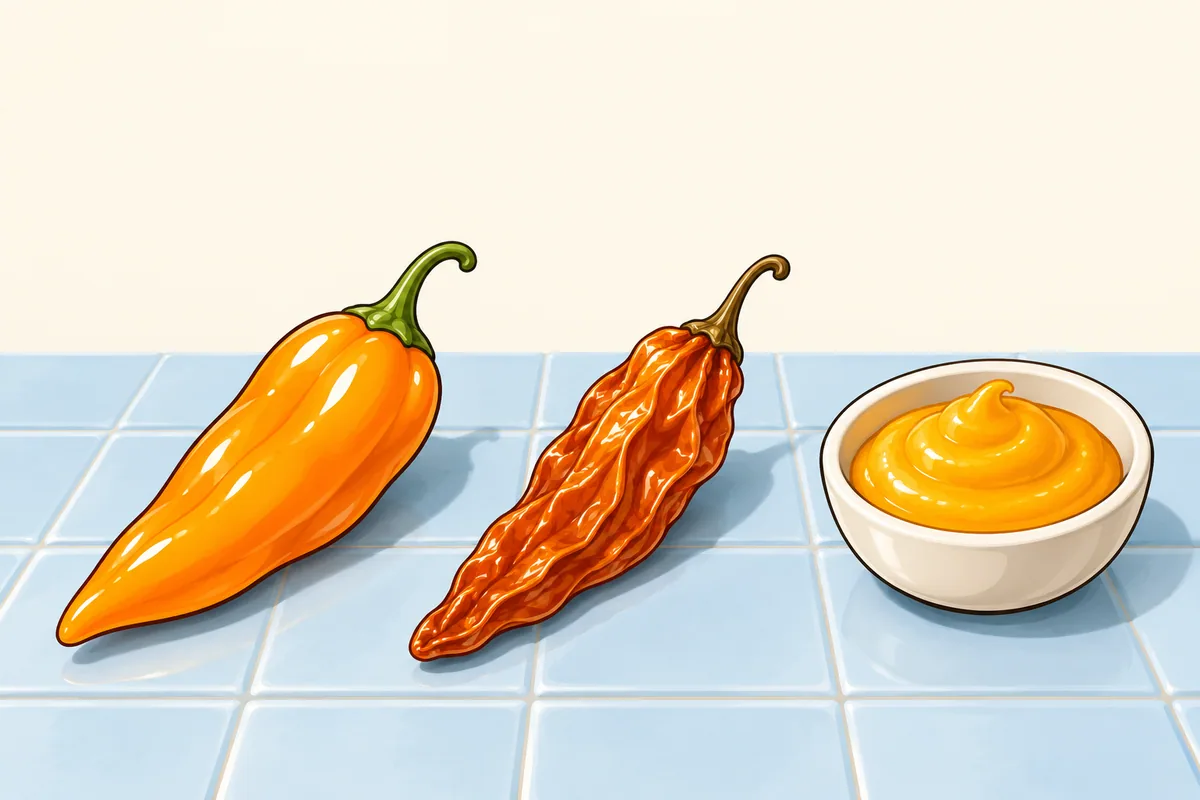
You may see it labelled ají escabeche, amarillo, verde or criollo, and Peruvian farmers grow it along the coast from Tacna in the south up to Lambayeque3. If your shop sells a jar with any of those names, you have the right pepper.
No university or peer-reviewed source we read prints a heat range for it. PRODERNA, a German ingredient supplier, rates its own dried aji amarillo pods and powder at 30,000 to 50,000 SHU and describes a tropical, fruity taste with a raisin aroma6. We use that spec, with its midpoint of 40,000 SHU, for every ratio on this page.
That puts your pepper in the same band as cayenne at 25,000–50,000 SHU, and well below a habanero at 100,000–350,000 SHU1. So your swap problem is mostly about flavor and color: plenty of peppers match the heat, and very few match the fruit.
How do you replace aji amarillo paste?
Blend habanero and yellow bell pepper so your mix averages about 40,000 SHU per gram. The habanero midpoint is (100,000 + 350,000) ÷ 2 = 225,000 SHU1, so 40,000 ÷ 225,000 ≈ 0.18: about 18 % of the blend is habanero.
A worked example for 100 g of paste
| Ingredient | Weight | Heat units | Note |
|---|---|---|---|
| Habanero, seeded | 18 g | 18 × 225,000 = 4,050,000 | Fruity, citrus-like heat |
| Yellow bell pepper, roasted | 82 g | 82 × 0 = 0 | Color and body |
| Blend | 100 g | 4,050,000 ÷ 100 = 40,500 per gram | Against the 40,000 midpoint |
Roast the bell pepper first if your recipe uses a cooked paste, and blend with a little oil or water until smooth. Start with 12 g of habanero, taste, and add the rest; one habanero can sit near 100,000 SHU while the next is near 350,0001.
Here is why 12 g is a safe start. Even if your habanero sits at the top of its range, 12 × 350,000 ÷ 100 = 42,000 SHU per gram, right at the aji amarillo midpoint1. If it sits at the bottom, the full 18 g gives only 18,000 SHU per gram, so you can keep adding until it tastes right.
How many peppers is that?
USDA weighs one large yellow bell pepper at 186 g9, so the 82 g in the table is a little less than half of one. USDA has no habanero record at all, so weigh the habanero on a kitchen scale; a guess by eye can be off by a whole pod.
Making the blend, step by step
- 1
Put on gloves
Wear gloves, and glasses if you have them, to keep the capsaicin oil away from your eyes and face.10
- 2
Seed the habanero and scrape out the placenta
The white placenta holds the highest concentration of capsaicin, so removing it takes off heat you did not plan for.10
- 3
Roast the yellow bell pepper
Char it under the grill or over a flame, then peel it. Put roasted peppers in the fridge within two hours.10
- 4
Blend the bell pepper first
Blend the 82 g of bell pepper with a spoon of oil or water until smooth, then add 12 g of habanero.1
- 5
Taste and finish
Taste a little on a cracker, then add the last 6 g of habanero in two steps if you want more heat.1
Scaling it to a jar
Peruvian shops sell aji amarillo paste in jars of about 250 g3. To replace one jar, you need 45 g of habanero and 205 g of yellow bell pepper: 45 × 225,000 ÷ 250 = 40,500 SHU per gram1. That is about 1.1 large yellow bell peppers by USDA's weight9.
Is ají mirasol hotter than aji amarillo?
Gram for gram, yes, because drying removes the water and leaves the same capsaicin in a much smaller weight. USDA's records for red hot chiles show how big that change is47:
So 1 g of dried pod carries the solids of about 7.8 g of fresh pod: (100 − 7.15) ÷ (100 − 88.02) = 7.847. If your recipe asks for 100 g of fresh aji amarillo, use 100 ÷ 7.8 ≈ 13 g of mirasol or powder.
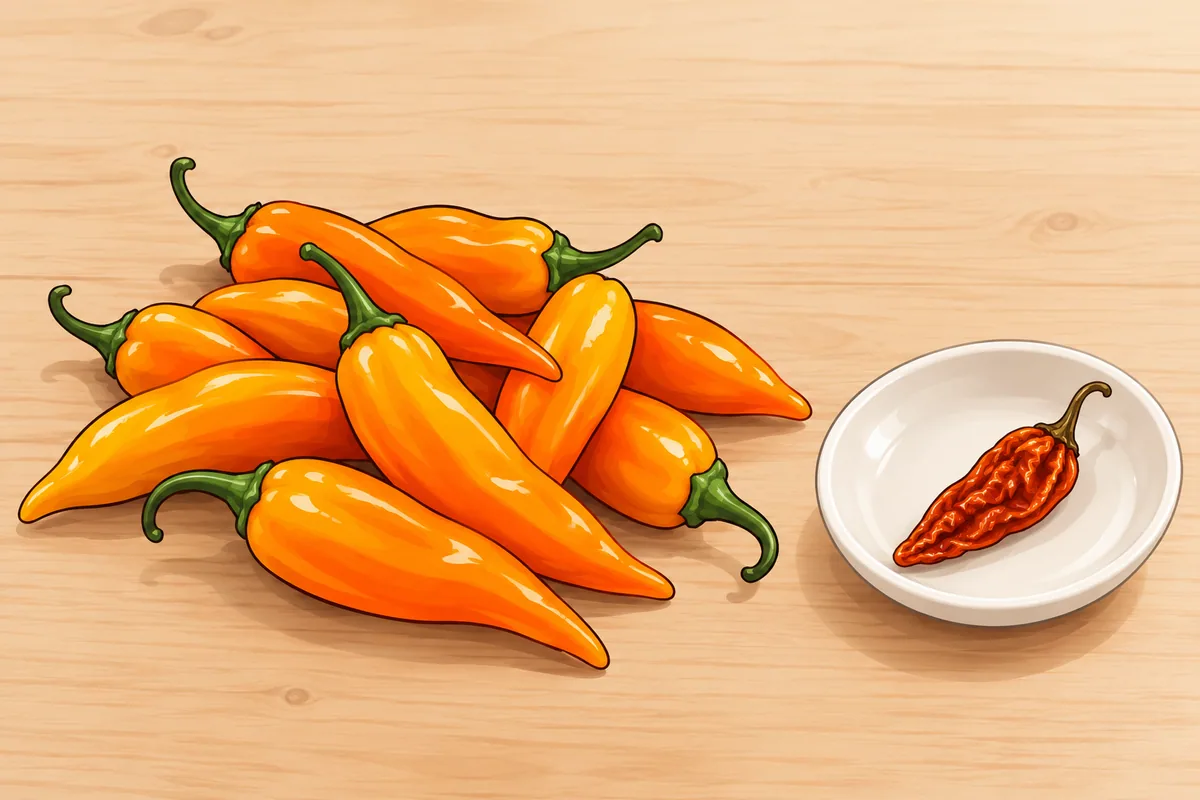
Soak the dried pods, then blend them with enough of the soaking water to bring the weight back to about 100 g. These are USDA's generic red chile figures, not aji amarillo's own, so taste before you add the last few grams.
For a recipe that asks for aji amarillo powder and you only have cayenne, use 11 g for every 10 g. USDA weighs a teaspoon of cayenne at 1.8 g5, so 11 g is about 6 teaspoons, or 2 level tablespoons. You get the heat back and none of the fruit.
Can you use rocoto, Anaheim or poblano instead?
You can, though each one misses in its own way. Rocoto overshoots your heat, and the two Mexican chiles barely bring you any:
Rocoto
The poblano carries a rich melon flavor1, which works in a creamy ají de gallina if you accept a green color. For a mild family pot, a roasted Anaheim with a single gram of habanero gives you some warmth without the full 40,000 SHU.
Why did your stand-in ají paste come out too hot or orange?
Most problems you will meet come from three things: habanero heat that varies pod to pod, the wrong bell pepper color, and too much water. Here is what each one looks like and how you fix it:
- Too hot after one taste. Your habanero sat near 350,000 SHU1. Blend in more roasted yellow bell pepper, 20 g at a time, until the heat drops.
- Too mild. Add habanero 2 g at a time; the full 18 g per 100 g matches the midpoint, and a low-end pod may need a little more.
- The color turned orange-red. A red bell pepper went in, or the pepper charred too far. Use yellow bell only; the yellow is the color your dish shows.
- Thin and watery. You used too much soaking water or blended the bell pepper wet. Simmer the paste in a pan for a few minutes, stirring, until it thickens.
- Burning fingers an hour later. The capsaicin oil stayed on your skin. Gloves prevent it next time10.
Make the blend a day ahead
Make the blend a day ahead if you can, so you can taste it cold and adjust. A cold paste tastes milder than a hot sauce, so judge it at the temperature you will serve it. The aji amarillo entry has its species and uses, and the aji panca swaps cover the other paste in most Peruvian pantries.
For a bigger batch, freeze the paste in an ice cube tray, then move the cubes to a bag11. Whole habaneros freeze without blanching: wash, stem, pack with no headspace and freeze12, so you can keep a bag ready for the next pot. For any other pepper, the swap chart runs the same ratio.