
Scotch Bonnet Scoville, 100,000–350,000 SHU
The squat, lobed Caribbean cousin of the habanero.
 Extra-hot
Short answer
100,000–350,000 SHU
- The same species and the same published range as the habanero
- Jamaican farms start picking about 12 weeks after transplanting
On this page
- 1How hot is a Scotch bonnet?
- 2How is a Scotch bonnet different from a habanero?
- 3What does a Scotch bonnet taste like?
- 4Which dishes really need a Scotch bonnet?
- 5Which colors and varieties are there?
- 6How long does a Scotch bonnet take to grow?
- 7How long do fresh Scotch bonnets keep?
- 8How do you cook with a Scotch bonnet without the burn taking over?
- 9What goes wrong with Scotch bonnets?
- 10Can you freeze Scotch bonnets?
- 11Why does a habanero swap one for one with a bonnet?
How hot is a Scotch bonnet?
A Scotch bonnet rates 100,000 to 350,000 Scoville heat units, the range UF/IFAS lists for it right beside the habanero1. The midpoint, 225,000 SHU, puts it in the extra-hot band, roughly 45 times an average jalapeño at about 5,000 SHU2. If you've cooked with jalapeños, picture one Scotch bonnet doing the work of a few dozen.
Log scale; bars are published ranges.Sources for this line1. UF/IFAS Gardening Solutions2. University of Florida IFAS Extension6. HortScience 42(2):222-224
Other sources print one number instead of a range, and that's where your confusion starts. The NMSU Chile Pepper Institute puts the Scotch bonnet at 350,000 SHU on its list of the hottest chiles it has tested, above its own orange habanero figure7.
Plan for the top of the range: gram for gram, a hot Scotch bonnet carries about 70 times the heat of an average jalapeño. The 350,000 figure sits exactly at the top of the extension range7, so the two sources agree more than they seem to.
How is a Scotch bonnet different from a habanero?
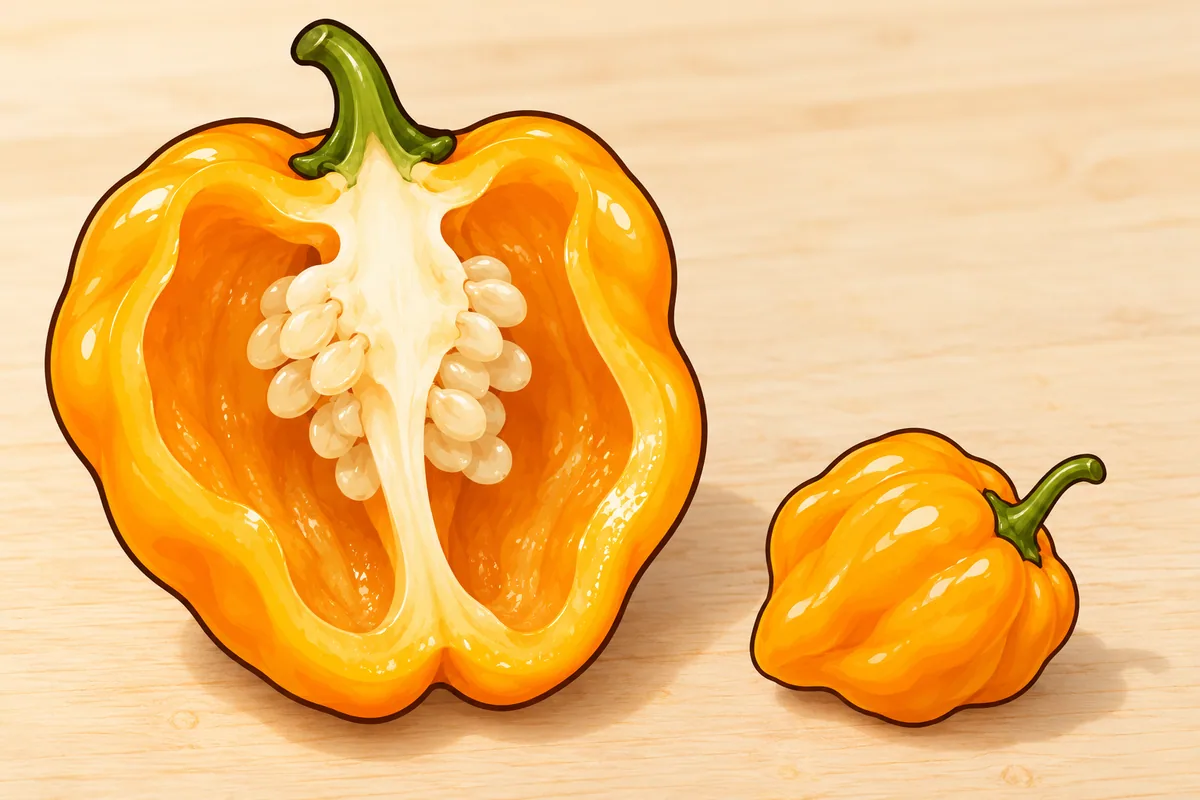
By shape and by where it grows, not by heat or species, so your recipe won't care much which one you use. Both are Capsicum chinense with the same published range1, and the genus monograph says the species goes by habanero in Mexico and the United States and by Scotch bonnet in the Caribbean islands3.
Scotch bonnet
The shape is the part you can check at your market with your own eyes. UF/IFAS says the name comes from its likeness to a Scottish tam o' shanter hat and that the pod runs slightly smaller than a habanero2. Jamaica's export handbook grades a top-quality pod by the classic three to four lobes and the cup-and-saucer shape, at least 3.5 cm across5.
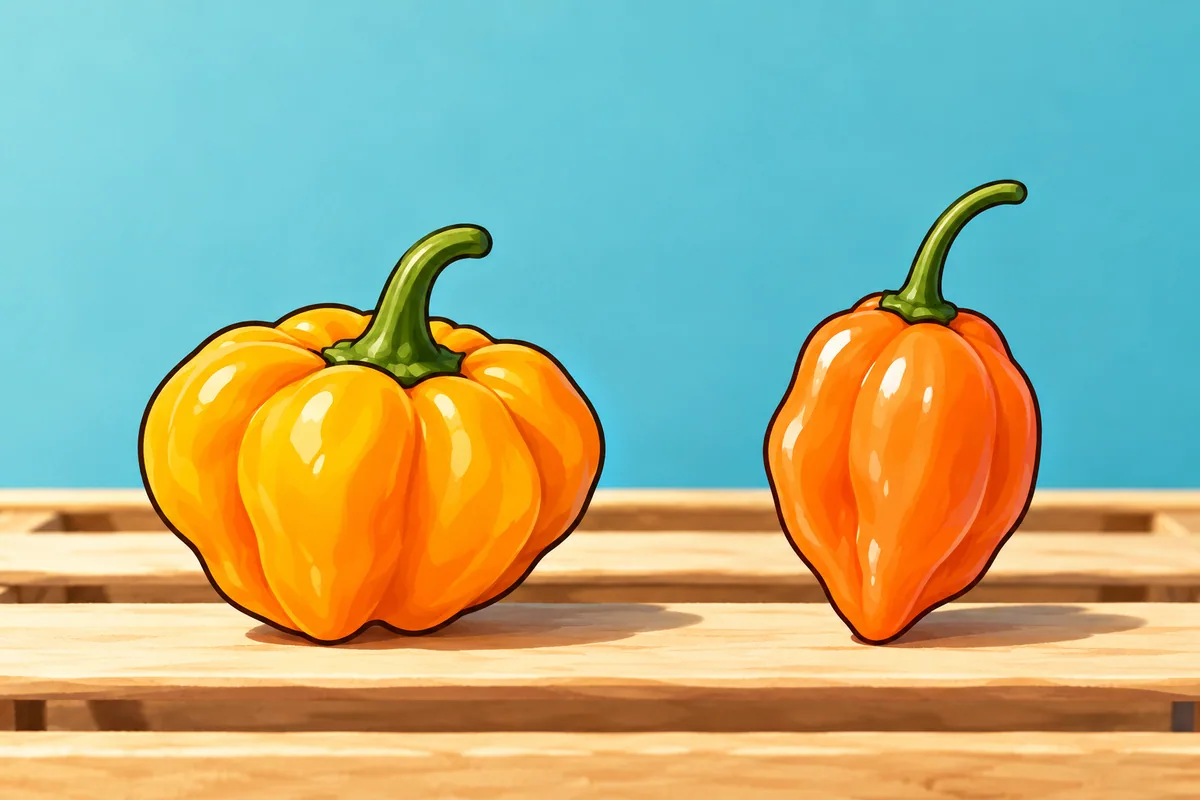 Three to four rounded lobes5Wider than tall: the cup-and-saucer shape5Habanero: slightly larger, up to about 2.4 inches long2
- Three to four rounded lobes5
- Wider than tall: the cup-and-saucer shape5
- Habanero: slightly larger, up to about 2.4 inches long2
The Scotch bonnet and habanero head to head lines up both on the same heat axis. If you came here from the habanero entry, the short version is that a recipe won't notice the swap, but a Jamaican cook might.
What does a Scotch bonnet taste like?
The UC Master Gardeners of Ventura County sum it up as fiery heat with a fruity flavor4, and you smell the fruit the moment you cut one. That puts it right beside the habanero, which the same list describes as fruity with a subtle smokiness.
The thin, waxy flesh UF/IFAS describes2 matters in the kitchen: a Scotch bonnet gives you less pulp per pod than a bell or a poblano, so most of what you add is heat and aroma, not body.
If you want that bonnet aroma with almost no burn, Caribbean and Puerto Rican cooks reach for ají dulce, a small sweet chile of the same squat look. A Puerto Rican sofrito recipe from the University of Illinois Chicago Heritage Garden uses six of them for a whole batch, beside green peppers, onion, garlic and culantro8. Keep the two apart in your kitchen, because one bite tells you which is which only after it's too late.
- Fruity
- Fiery
Which dishes really need a Scotch bonnet?
The ones built around it, where you'd taste the difference if it were missing. UF/IFAS names Caribbean jerk sauce and marinade as its best-known use2, and the UC Master Gardeners call it a staple in Caribbean and West African cuisine4.
| Dish | What the pepper does there | Habanero swap? |
|---|---|---|
| Jerk sauce and marinade2 | Sets the heat and the fruity top note of the marinade | Works for heat; the flavor shifts slightly smokier |
| Caribbean hot sauces2 | The base pepper of the bottle | Works; same species and range |
| West African cooking4 | Fiery heat and fruit | Works; same range |
Honestly, your swap holds almost everywhere, because the two share a species and a heat range1. The bottled side of the story, from vinegar sauces to mustard ones, lives on the Caribbean hot sauce page.
Pepper Geek, a pepper channel, made this 2025 video on why Jamaica guards its Scotch bonnet so closely, so you can see the pod in its home island setting and hear why it matters to Jamaican cooks, which helps you understand the pepper behind the jerk dishes above.
Which colors and varieties are there?
UF/IFAS says Scotch bonnets usually ripen red or yellow2, and the seed lists you'll browse also sell chocolate ones. For the separate color lines we found no primary heat figure, so the table leaves those cells empty instead of borrowing a seller's number.
| Type | What you see | Heat |
|---|---|---|
| Export grade, Jamaica5 | Picked full green or with a blush of yellow or orange | Within the species range |
| Yellow, ripe12 | The classic bonnet in one of its two usual ripe colors | 100,000–350,000 SHU for the type |
| Red, ripe12 | The other usual ripe color | 100,000–350,000 SHU for the type |
| Yellow or red as a named seed line | Sold by color | No primary figure for a single line |
| Chocolate | Dark brown when ripe | No primary figure found |
The export detail may surprise you: Jamaican growers pick for shipping when the fruit is full green or just blushing, with a fresh green stalk and cap5. A green Scotch bonnet in a shop is often a mature pod, not an unripe mistake.
How long does a Scotch bonnet take to grow?
About four months from your seed tray to the first picking, then four to five months of harvests. These stages come from the Jamaican Ministry of Agriculture's handbook for field growers5.
- Day 7–12
Seedlings come up
One seed per cell, 0.5 cm deep, watered lightly about twice a day.5
- Week 5–6
Transplant
Seedlings stand 12–15 cm tall; harden them off for 5–7 days first.5
- About day 40 after transplant
First flowers
The handbook times a feed of sulphate of ammonia or urea for this point.5
- About 12 weeks after transplant
Picking starts
Snap each pod off at the stalk joint, in the cool of morning or evening.5
- Next 4–5 months
Weekly harvests
About 360 kg of fruit a week from 3,000 plants on 0.4 ha with drip irrigation.5
Add it up and your plan comes to 5 to 6 weeks in trays plus about 12 weeks in the field before the first pod, roughly 17 to 18 weeks in all5. The Scotch bonnet growing guide adapts these stages for a pot or a garden bed.
How long do fresh Scotch bonnets keep?
Not long on your counter, so buy only what you'll cook this week. The Jamaican handbook gives these figures for harvested fruit5:
How do you cook with a Scotch bonnet without the burn taking over?
Decide first whether you want the pepper's heat or only its fruit. The heat sits mostly in the white ribs: a capsaicin review puts about 89 % of a chile's capsaicin in the placenta and only 5 to 6 % in the outer flesh11. That gives you three ways to use one pod:
- Whole and unbroken, in a pot of stew, soup or rice and peas: you get the fruity smell and a gentle warmth, as long as the skin stays intact. Lift it out before you serve.
- Pierced once with a knife tip: some juice leaks into the pot, and the dish turns noticeably hotter. Taste every few minutes.
- Chopped with ribs and seeds, in jerk marinade or a sauce: the full 100,000 to 350,000 SHU goes in1. Start with half a pod in your batch and add more next time.
Wear gloves for the last two. Poison Control advises rubber, latex or nitrile gloves for hot peppers and an open window while you cook them, since capsaicin in the air can make you cough12.
What goes wrong with Scotch bonnets?
Most trouble you'll hit comes from a mix-up at the shop or a pod that breaks in the pot.
Problems and their fixes
- The pepper you bought has no heat: you may have picked up ají dulce, the small sweet seasoning pepper Caribbean and Puerto Rican cooks also use. Taste a sliver of the tip before you cook the batch.8
- The stew turned fiery halfway through: the whole pod split. Lift it out at once, add more of the base, and next time keep the heat below a hard boil.
- Your hands burn after chopping: capsaicin oil on the skin. Use gloves; Poison Control suggests warm water flushes or a little vegetable oil on the skin afterwards.12
- Pods shrivel in two days: room temperature in a warm kitchen. The Jamaican handbook gives 2 to 5 days at 25–27 °C, so move them somewhere cooler.5
- Pods spoil early in the fruit bowl: ripening mangoes, papayas or tomatoes speed them up. Store them apart.5
If you get juice in your eye, rinse with warm water for 15 minutes, and call Poison Control at 1-800-222-1222 in the US if it doesn't ease12.
Can you freeze Scotch bonnets?
Yes, and it's the easiest way to keep a big bag from the Caribbean market. New Mexico State University's chile guide says you can freeze chiles whole and unpeeled, pack them flat in containers no deeper than 2 inches so they freeze fast, and keep them up to 12 months13. Push out as much air as you can; the guide notes that air pockets grow frost on the pods13.
A frozen bonnet goes soft when it thaws, so it suits jerk marinade, stews and sauce better than a fresh salsa. Label the bag; once frozen, a bonnet and a sweet ají dulce look almost alike.
Why does a habanero swap one for one with a bonnet?
Reach for a habanero, one for one: same species, same 100,000 to 350,000 SHU range1. Milder options and amounts are in the Scotch bonnet swap list, and if you're weighing it against a much hotter pod, the Scotch bonnet against the ghost pepper shows the gap.
If you still wonder whether the two are really one plant, USDA's germplasm system lists bonnet pepper and habanero pepper among the English common names of C. chinense14, one more sign that the two names point at the same species. Its most famous record holder, the Trinidad Moruga Scorpion, comes from the same islands.
Related peppers
 HabaneroExtra-hot100,000–350,000 SHU
 Trinidad Moruga ScorpionSuper-hot1,200,000–2,000,000 SHU
 Ghost pepperSuper-hot1,001,304 SHU average
Published ranges.Sources for this line2. University of Florida IFAS Extension6. HortScience 42(2):222-22415. New Mexico State University News Center
Related in Peppers
-
Jalapeño Scoville, 2,000–8,000 SHU and Chipotle
The medium-heat chile most heat comparisons start from.6 min read -
Datil Pepper Scoville, 100,000–300,000 SHU
St. Augustine's own small, sweet-tangy chinense.6 min read -
Poblano Pepper Scoville, 1,000–2,000 SHU
A big, thick-walled, mild chile from the valley of Puebla.5 min read -
Carolina Reaper Scoville, 1.64 Million SHU
A fruity, sweet superhot from South Carolina, bred from a habanero and a Naga Viper.7 min read -
Serrano Pepper Scoville, 10,000–25,000 SHU
A slim, fleshy chile one clear step above the jalapeño.5 min read -
Aji Panca Heat, 500–1,500 SHU, Peru's Great Dried Ají
Peru's dark, mild, berry-scented dried pepper: almost never eaten fresh, always there for color.6 min read
Sources
· 15
- 1UF/IFAS Gardening Solutions Peppers by Scoville Units
- 2University of Florida IFAS Extension HS-859/TR010: Pepper Production in Miami-Dade County, Florida
- 3PhytoKeys 200:1-423 (Pensoft) Monograph of wild and cultivated chili peppers (Capsicum L., Solanaceae)
- 4University of California Agriculture and Natural Resources, UC Master Gardeners of Ventura County Ventura Garden to Table Series: Peppers
- 5Ministry of Agriculture, Jamaica, and the Food and Agriculture Organization of the United Nations Growing Scotch Bonnet Pepper in Jamaica (McGlashan, De Bac, Goldsmith, Williamson, Protz)
- 6HortScience 42(2):222-224 'Bhut Jolokia', the world's hottest known chile pepper, is a putative naturally occurring interspecific hybrid (Bosland and Baral)
- 7New Mexico State University, Chile Pepper Institute Heat
- 8University of Illinois Chicago, UIC Heritage Garden Puerto Rican Sofrito
- 9Pepper Geek Why Jamaica Protects This Pepper Like Treasure
- 10University of Maryland Extension Growing Peppers in a Home Garden
- 11Heliyon (Cell Press) A comprehensive review of capsaicin: Biosynthesis, industrial productions, processing to applications, and clinical uses
- 12National Capital Poison Center (Poison Control) Capsaicin: when the chili is too hot (Amanda McDaniel-Price, RN)
- 13New Mexico State University Cooperative Extension (Guide E-324) Processing Fresh Chile Peppers (revised by Nancy C. Flores and Cindy Schlenker Davies)
- 14USDA Agricultural Research Service, Germplasm Resources Information Network (GRIN) Taxon: Capsicum chinense Jacq.
- 15New Mexico State University News Center NMSU's Chile Pepper Institute names the Trinidad Moruga Scorpion hottest pepper on earth (Justin Bannister)