
Paprika Scoville Heat, Sweet Under 500 SHU or Hot Over 8,000
A ground red pepper sold for color first and heat second.
 Mild
Short answer
Sweet paprika: under 500 SHU
- NMSU's NuMex Sweet paprika measures 300 SHU, about 1/17 of an average jalapeño
- Hungarian hot grades start at 200 mg/kg capsaicin (about 3,200 SHU) and Kalocsa's top grade passes 8,000
- Heat
- 500 SHU1
- Origin
- Hungary, SpainSources for this line3. European Commission, Official Journal of the European Union C 44/84. European Commission, Official Journal of the European Union C 3035. Ministerio de Agricultura, Pesca y Alimentación (Spain)6. WIPO Lisbon System, appellation of origin AO-1212 (EU specification ES/PDO/005/0321)
- Flavor
- Sweet, roasted3
On this page
- 1How hot is paprika, from a sweet tin to a hot one?
- 2What pepper is paprika made from?
- 3How does a Szeged pod become a tin of paprika?
- 4Which protected paprikas can you buy?
- 5What does the ASTA number on a paprika tin mean?
- 6Which paprika cultivars do American growers plant?
- 7How much does a spoonful of paprika give you?
- 8Why does paprika go brown in the jar?
- 9What do you do when a dish has too much paprika?
- 10Can you make paprika from peppers you grow?
- 11Which paprika should you buy for your dish?
How hot is paprika, from a sweet tin to a hot one?
A sweet tin barely registers. New Mexico State University says the chile industry accepts at most 500 SHU for a paprika-type pepper1, and its own NuMex Sweet paprika measures 300 SHU. An average jalapeño rates about 5,0008, so that tin carries roughly a seventeenth of the burn, gram for gram.
Hot paprika is a different product, and you can tell from the label. Hungary's two protected paprikas sort their tins by capsaicin, and the top grades climb well past the sweet ceiling you know.
300SHUNuMex Sweet, a standard New Mexico paprika1
≤ 100 mg/kgcapsaicin in non-pungent Szegedi paprika3
> 500 mg/kgcapsaicin in Kalocsa's hot grade4
What do the Hungarian heat grades mean in Scoville units?
The specifications print capsaicin in milligrams per kilogram, which equals parts per million. Labs turn parts per million into SHU by multiplying by 169, so you can work each grade out yourself. The table does that for you; treat the results as estimates, since the limits count capsaicin alone.
| Paprika | Grade | Capsaicin limit | About this many SHU |
|---|---|---|---|
| Szegedi3 | Non-pungent (sweet) | up to 100 mg/kg | up to 1,600 |
| Szegedi3 | Moderately hot | 100–200 mg/kg | 1,600–3,200 |
| Szegedi3 | Hot | over 200 mg/kg | over 3,200 |
| Kalocsai4 | Moderately hot | 30–200 mg/kg | 480–3,200 |
| Kalocsai4 | Spicy | 200–500 mg/kg | 3,200–8,000 |
| Kalocsai4 | Hot | over 500 mg/kg | over 8,000 |
| Pimentón de Murcia5 | Extra and Primera | up to 0.003 % (30 mg/kg) | up to 480 |
Read the grade word on the tin: "sweet" and "hot" paprika can sit more than five times apart. A Kalocsa hot grade starts where a mild jalapeño sits, while the rules cap a Szeged sweet tin at 1,600 SHU.
What pepper is paprika made from?
Mild red Capsicum annuum, dried and ground. The US Food and Drug Administration defines paprika as the ground dried pod of mild capsicum2, and both Hungarian specifications name the long-podded var. Longum34.
So when you buy "paprika pepper", you buy a product more than a pod. NMSU's crop guide says paprika in the US is a product, not a pod type, so it can come from many types of C. annuum, and that the word simply means chile in Hungarian7. The NMSU Chile Pepper Institute puts it most broadly: any non-pungent chile, red at maturity, used as a spice or for color10. That is why the Spanish ñora, a small round pod, ends up in a tin with the same name as a long Hungarian one.
How does a Szeged pod become a tin of paprika?
By resting, drying and stone grinding, and the Szegedi specification sets each step. Here is the path a pod takes before it reaches your shelf, with the numbers the rules give you.
- Plant in MaySeedlings raised from late February to early April
- Pick in stagesEach pass takes only the ripe pods
- Rest two weeksPost-ripening in a ventilated store
- DryFrom about 80 % water to below 10 %
- MillstonesThe grind warms the powder and spreads the oil
- ConditionWater back in, up to 8–11 % moisture
The millstones do more than crush. As the paprika passes between them it warms up, and the warmth releases oil from the seeds and pigment from the skin, which then coat the granules and give the powder an even color3. Kalocsa caps that heat: its grinding has to stay below 80 °C4.
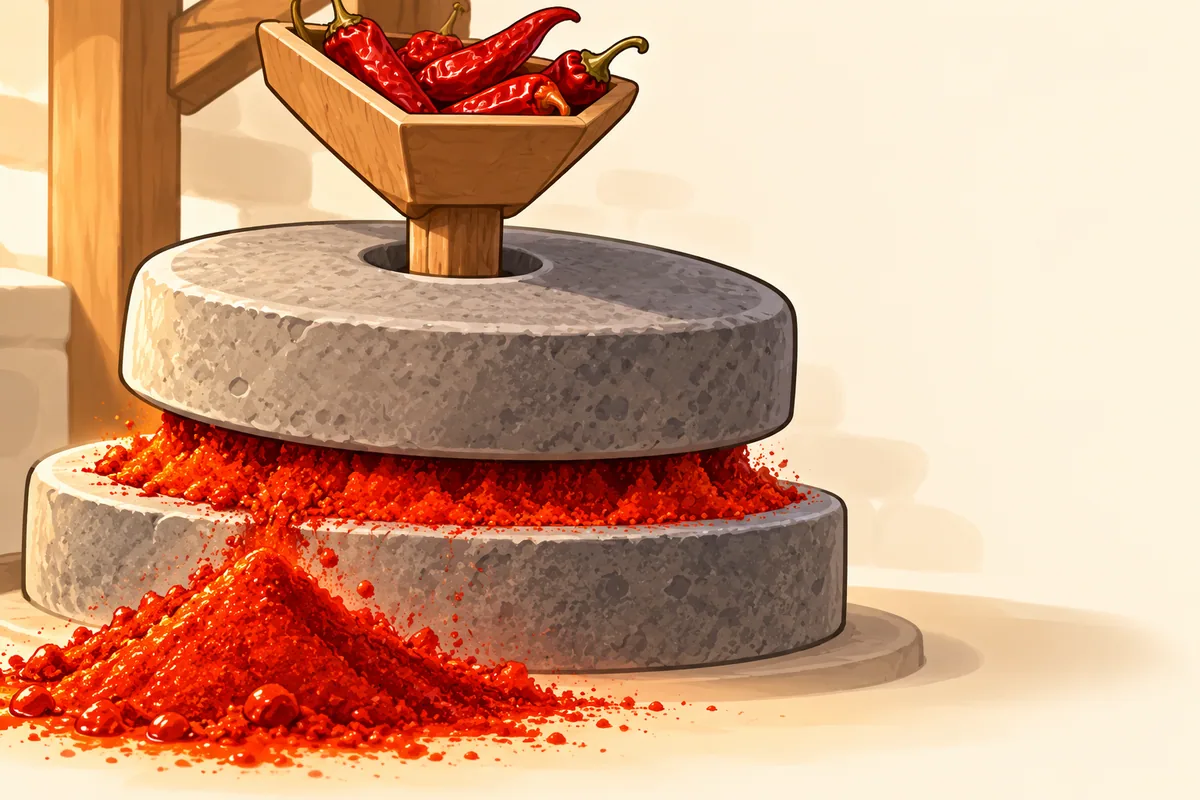
The finished powder has to pass a 0.5 mm sieve and may hold no additives3. If your supermarket tin feels gritty or looks dull, it probably skipped some of these steps.
Eater visits a Hungarian family farm in this video, so you can watch the hand picking and the turning of red pods into powder that the rules above describe.
Which protected paprikas can you buy?
Four European paprikas carry a protected name, two from Hungary and two from Spain. Each specification sets its own color floor, heat grades and drying method, so you can read a lot from the name on your tin.
| Paprika | Where | Drying | Heat grades | Color floor |
|---|---|---|---|---|
| Szegedi3 | Szeged area, Hungary | Sacks under eaves, drying chambers or belt dryers | Sweet, moderately hot, hot | ASTA 120 at packing |
| Kalocsai4 | Kalocsa area, across six Hungarian counties | Below 10 % moisture, surface at most 80 °C | Moderately hot, spicy, hot | ASTA 85 at best-before |
| Pimentón de Murcia5 | Murcia and nearby towns, south-east Spain | Sun or hot air | Sweet only | ASTA 120 (Extra), 90 (Primera) |
| Pimentón de la Vera6 | La Vera, northern Cáceres, Spain | Oak smoke for 10–15 days | Sweet, bittersweet, hot | Not compared here |
The big split for your cooking is smoke. Only La Vera dries over oak fires, so only La Vera tastes of smoke; the smoked paprika entry covers that style, and the Hungarian and Spanish paprikas side by side settles which suits a goulash and which a paella. Hungarian paprika also has its own flavor words in law: the Szegedi rules describe a sweet taste reminiscent of ripe, baked butternut squash3, and the Kalocsai rules an aroma like caramelized roasted seeds4.
The wider family of peppers behind those tins lives in the Hungarian peppers and Spanish peppers lists.
What does the ASTA number on a paprika tin mean?
It scores the red. The American Spice Trade Association method measures extractable color, and NMSU says the industry expresses chile color in ASTA units12. A higher number means more pigment per spoonful, so less powder turns your sauce the same red.
120–220ASTA range of New Mexican chile crops12
120minimum for Szegedi paprika at packing3
303NuMex Garnet, NMSU's high-color paprika1
Color is what you pay for, and the rules guard it. US labels may list paprika simply as "spice and coloring" unless they name it13, and the FDA allows it to color foods generally without batch certification2. NMSU lists sausages, cheeses and fruit gelatins among the foods it colors7, which is why you meet paprika in places that never taste of pepper.
Which paprika cultivars do American growers plant?
New Mexico breeds most of them, and each release has a measured heat and color. If you grow paprika for your own powder, these are the figures to pick by.
| Cultivar | Released | Heat | Color |
|---|---|---|---|
| NuMex R Naky | 1985 | 260–760 SHU | 188 ASTA |
| NuMex Conquistador | 1989 | Under 10 ppm capsaicinoids (no heat) | Not given |
| NuMex Sweet | 1990 | 300 SHU | 157 ASTA |
| NuMex Garnet | 2004 | 160 SHU | 303 ASTA |
| NuMex R. Vince Hernandez | 2015 | Under the 500 SHU industry limit | 250 ASTA average |
Seed catalogs also sell Alma, Fehér Özön, Paprika Supreme and Elephant Ears as paprika peppers. We found no primary source with heat or color figures for any of them, so they get no numbers here; treat a packet's claim as the seller's word until a trial backs it.
Hungary's protected paprikas name their own seed lists. Szeged allows 19 state-recognised varieties, from Bíbor to Zuhatag, three of them marked hot3, and Kalocsa allows 174.
How much does a spoonful of paprika give you?
A little color chemistry for you, not a meal. FoodData Central lists ground paprika per 100 g; you'll rarely use more than a few grams, so we scaled the figures to 5 g, about a heaped spoonful, as an estimate.
26,200 µgbeta-carotene per 100 g (about 1,310 µg in 5 g)14
21.1 mgiron per 100 g (about 1.1 mg in 5 g)14
282 kcalper 100 g (about 14 kcal in 5 g)14
Those carotenoids are the same pigments the ASTA score measures. FoodData Central also lists 18,900 µg of lutein and zeaxanthin per 100 g14, which is where the red and orange tones in your tin come from.
Why does paprika go brown in the jar?
Heat, light and time break down the red pigment, and ground paprika loses it faster than whole pods. NMSU's postharvest guide spells out each cause12:
Causes of a dull tin, and the fix for each
- A warm cupboard over the stove: color loss speeds up as temperature rises. Keep your tin in a cool spot; NMSU recommends 32 to 41°F in the dark for dried chile.12
- A clear jar on an open shelf: light fades the pigment. Store paprika in the dark, in a closed tin or an opaque jar.12
- Buying a big bag of powder: ground chile loses color faster than whole pods. Buy small amounts, or grind whole dried pods as you need them.12
- A tin older than a year: Szegedi paprika may carry a best-before date of at most 12 months. Check the date before you rely on it for color.3
- Clumps in the powder: it picked up moisture. NMSU stores dried chile at about 10 to 11 % moisture; keep the lid tight and the spoon dry.12
A browned tin still tastes of paprika, just weaker. Use a little more of it in a stew where color matters less, and buy fresh for a dish where the red is the point.
What do you do when a dish has too much paprika?
Sweet paprika rarely makes your dish too hot; the usual problem you'll taste is a bitter or dusty taste and a color that turned rust-brown. Hot paprika is the one that can overshoot the heat. These kitchen fixes are our practical suggestions, not tested rules:
- 1
Taste for which problem you have
Burning heat means a hot grade went in; a bitter, dusty edge means too much powder or a scorched pan.
- 2
Make the pot bigger
Add more of the base (stock, tomato, beans or cream) so the same paprika spreads through more food.
- 3
Balance the bitterness
A spoonful of sour cream, a squeeze of lemon or a pinch of sugar softens a bitter, dusty taste.
- 4
Next time, add it to warm oil off the heat
The Szegedi rules show why oil matters: grinding warms the powder so its oil and pigment coat every grain. Stir paprika into warm fat away from the flame so it colors the oil without scorching.3
For cooking, pick the tin by what you want: Szegedi or Murcia sweet for color and a roasted pepper taste, a Kalocsa spicy grade when you want a gentle burn, and La Vera when the recipe asks for smoke. If your recipe says chili powder, that is a blend rather than a single pepper; the paprika and chili powder comparison shows what changes when you swap one for the other.
Can you make paprika from peppers you grow?
Yes, if you pick a mild red pod and dry it hard. NMSU's commercial method dries the fruit to 4 to 6 % moisture, grinds it, then brings it back up to 8 to 11 %7, the same window the Hungarian rules aim for. Your home version follows that order:
- Pick a low-heat red pod. A NuMex Sweet or Garnet from the cultivar table gives you a sweet tin; a hot pod gives you a hot one, whatever you call it.
- Pick only fully red fruit. Paprika's value is color, and NMSU puts high red color first7; a half-green pod dries brown.
- Dry until the pods snap. Traditionally growers spread the fruit on roofs or on the ground in the sun12; you can use a dehydrator or a low oven instead.
- Grind small batches. Ground chile loses color faster than whole pods12, so you keep the dried pods whole and grind a jar at a time.
The full method, with temperatures and times for an oven or a dehydrator, is in the homemade paprika guide.
Which paprika should you buy for your dish?
Match the tin to the job, since sweet, hot and smoked paprika do different work in your pan:
- Goulash or chicken paprikash: a Hungarian sweet grade for color and roasted pepper taste, with a spoonful of a moderately hot grade if your family likes a little burn.
- Deviled eggs, potato salad or a dusting on hummus: any sweet paprika; you want the red on top, not heat.
- Paella, chorizo-style sausage or a smoky stew: La Vera, the only one of the four dried over oak smoke6.
- A dish you want hot without changing its color: a Kalocsa spicy or hot grade, which can pass 8,000 SHU by our worked figures4.
If you're out of paprika or want more heat, start with the paprika swap list, which gives amounts for each option.
Before you reach for the red jar beside it, check paprika against cayenne. Cayenne runs 25,000 to 50,000 SHU8, so a pinch of it replaces a spoonful of your sweet paprika.
Related peppers
Related in Peppers
-
Peperoncino Is Italy's Hot Chili, Not the Mild Pepperoncini
The small, thin, red chili Italians dry, crush and stir into oil, and why it isn't the pickled pepperoncini in your sandwich.6 min read -
Aji Panca Heat, 500–1,500 SHU, Peru's Great Dried Ají
Peru's dark, mild, berry-scented dried pepper: almost never eaten fresh, always there for color.6 min read -
Aleppo Pepper, the Halaby Flake Cured With Oil and Salt
A burgundy flake from the old Silk Road city of Aleppo, sweet and fruity first, with a moderate heat behind it.6 min read -
Espelette Pepper, 10 Basque Communes and 15 Days on the Wall
A conical red pepper from the French Basque Country whose powder the AOP rules call strong but not burning.7 min read -
Hatch Chile Heat, 300–9,000 SHU Across NuMex Types
The long green chile of southern New Mexico, named after the town where it first grew for market.6 min read -
Jalapeño Scoville, 2,000–8,000 SHU and Chipotle
The medium-heat chile most heat comparisons start from.6 min read
Sources
· 14
- 1New Mexico State University Circular 706: The Chile Cultivars of New Mexico State University, 1913–2022 (Coon, Walker, Lozada, Guzman, Bosland)
- 2US Food and Drug Administration, Code of Federal Regulations (govinfo, 2024 edition) 21 CFR 73.340 Paprika (color additive)
- 3European Commission, Official Journal of the European Union C 44/8 Publication of an application (2010/C 44/05): 'Szegedi fűszerpaprika-őrlemény' or 'Szegedi paprika' (PDO)
- 4European Commission, Official Journal of the European Union C 303 Publication of an application (2011/C 303/12): 'Kalocsai fűszerpaprika-őrlemény' (PDO)
- 5Ministerio de Agricultura, Pesca y Alimentación (Spain) Pliego de condiciones de la Denominación de Origen "Pimentón de Murcia"
- 6WIPO Lisbon System, appellation of origin AO-1212 (EU specification ES/PDO/005/0321) Pimentón de la Vera: particulars concerning the quality, reputation or characteristics
- 7New Mexico State University The Wonders of New Mexico Chile (crop description)
- 8University of Florida IFAS Extension HS-859/TR010: Pepper Production in Miami-Dade County, Florida
- 9HortScience 42(2):222-224 'Bhut Jolokia', the world's hottest known chile pepper, is a putative naturally occurring interspecific hybrid
- 10New Mexico State University, Chile Pepper Institute Chile Terminology
- 11Eater How One of the Most Vibrant Spices Is Made (Vendors)
- 12New Mexico State University Cooperative Extension (Guide H-236) Postharvest Handling of Dehydrated Chiles (Marisa M. Wall, revised by Stephanie J. Walker)
- 13US Food and Drug Administration, Code of Federal Regulations (govinfo, 2024 edition) 21 CFR 101.22 Foods; labeling of spices, flavorings, colorings and chemical preservatives
- 14USDA Agricultural Research Service, FoodData Central (SR Legacy) Spices, paprika (FDC ID 171329)