
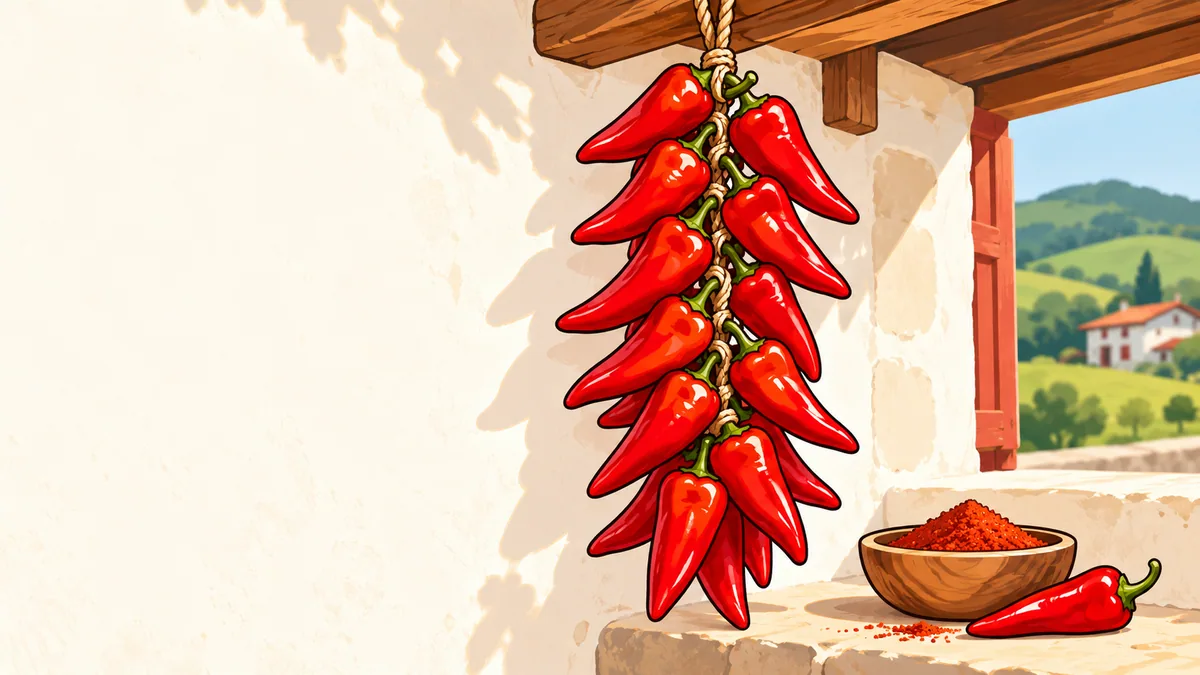
Espelette Pepper, 10 Basque Communes and 15 Days on the Wall
A conical red pepper from the French Basque Country whose powder the AOP rules call strong but not burning.
Short answer
Strong but not burning, in the words of its AOP rules
- Grown, matured and ground only inside 10 Basque communes, from Gorria or a matching local seed
- Pods hang at least 15 days before a short oven finish and a grind to particles of 5 mm or less
On this page
- 1How hot is Piment d'Espelette?
- 2What does the AOP require before a pod can carry the name?
- 3Which Basque communes may grow it?
- 4Why does a tropical plant ripen at the foot of the Pyrenees?
- 5How does a fresh Espelette pod turn into powder?
- 6How many pods go into one jar of Espelette powder?
- 7How do you tell real Espelette on the shelf?
- 8Where does Espelette belong in your cooking?
- 9Can you grow Gorria peppers at home?
- 10How did a chile from the Americas become Basque?
- 11What to do with your first jar of Espelette
How hot is Piment d'Espelette?
Warm, never fierce. The official AOP specification describes a strong but not burning heat that shows up on the palate, and says the powder's heat comes on progressively or as a feeling of warmth, sometimes long, sometimes short1. It prints no Scoville number, and we won't invent one for you.
You can still place it. Sweet paprika sits at the bottom of the shelf and cayenne runs 25,000 to 50,000 SHU in UF/IFAS's chart2. Espelette lands between them: hotter than paprika on your tongue, far gentler than cayenne, and you taste fruit before you feel any heat.
Read "strong but not burning" as a promise about balance: the rules reject a powder that only burns.
The heat also depends on how you use it. A pinch stirred into a sauce at the start of cooking spreads out and fades into the background. The same pinch dusted on eggs at the table lands straight on your tongue, so you notice it more.
What does the AOP require before a pod can carry the name?
A long list, and that list is what you pay for when you buy a jar. The European Union registered Piment d'Espelette as a protected designation of origin in 2002, under Regulation (EC) No 1495/2002, and approved changes to the rules in 20133. France's INAO keeps the specification, which its national committee revised again on 20 June 20241. You can hold your jar up against the rules below.
| Rule | What the specification says |
|---|---|
| Species and seed | Capsicum annuum L., Gorria or a local variety of the same type |
| Fresh pod | Conical, smooth, no green, 7–14 cm long without the stalk |
| Strings | 20, 30, 40, 60, 80 or 100 pods of even size, tied by hand |
| Picking | By hand, only pods at least 80 % red |
| Growing | Open field only; no greenhouses |
| Maturing before powder | At least 15 days in a warm, airy place, a façade or a shelter, with no heat |
| Powder | Particles no larger than 5 mm, moisture under 12 %, orange to red-brown |
| Additives | No colorings, additives or preservatives, only an inert gas |
Two rules shape your powder more than the rest. Each batch comes from a single farm, and the rules forbid mixing powders from two harvest years1. That's why two jars from two producers can taste a little different: you are tasting one farm's year each time.
Which Basque communes may grow it?
Only ten, and most of them only in part, so you could walk across the whole area in a day. The specification lists Larressore and Souraïde in full, and parts of Ainhoa, Cambo-les-Bains, Espelette, Halsou, Itxassou, Jatxou, Saint-Pée-sur-Nivelle and Ustaritz, all in the Pyrénées-Atlantiques1.
All of it sits in the Labourd, the western part of the French Basque Country. Every step, from sowing to packing, has to happen inside that area1. A grower in the next valley can plant the same Gorria seed, but their powder can't carry the name, and neither can yours if you grow it at home.
Fields need approval too, which tells you how tightly the area is watched. A grower applies to INAO to have a plot identified before planting, and the plot then grows only peppers for the appellation1.
Why does a tropical plant ripen at the foot of the Pyrenees?
Because the hills around Espelette build a pocket of weather that suits it. If you garden in a damp, mild place, these numbers will look familiar1:
1,800 mmaverage yearly rain at Espelette1
180days a year with some rain1
25°Caverage July maximum1
23frost days a year on average1
A line of hills about 100 m high blocks the sea breezes that would dry the plants, and the mountains to the south catch Atlantic air and wring rain out of it1. The clouds also keep nights close to daytime temperatures, which your own pepper plants would like too.
Then comes the wind. The rules describe the haize hegoa, a warm south wind that blows night and day in autumn and winter and helps the pods ripen and dry1. That's the wind drying the strings you'd see on village walls if you visited in October.
How does a fresh Espelette pod turn into powder?
Slowly, on purpose, and you can taste the difference. Pods for powder hang or rest for at least two weeks before any oven touches them, and the rules forbid fast drying during that time1.
- Pick by handAt least 80 % red
- SortWithin 48 hours, no cold store
- Mature15 days minimum on a façade or shelf
- Destem and oven-finishA few hours
- GrindParticles 5 mm or less
- Vacuum-sealWithin 24 hours of grinding
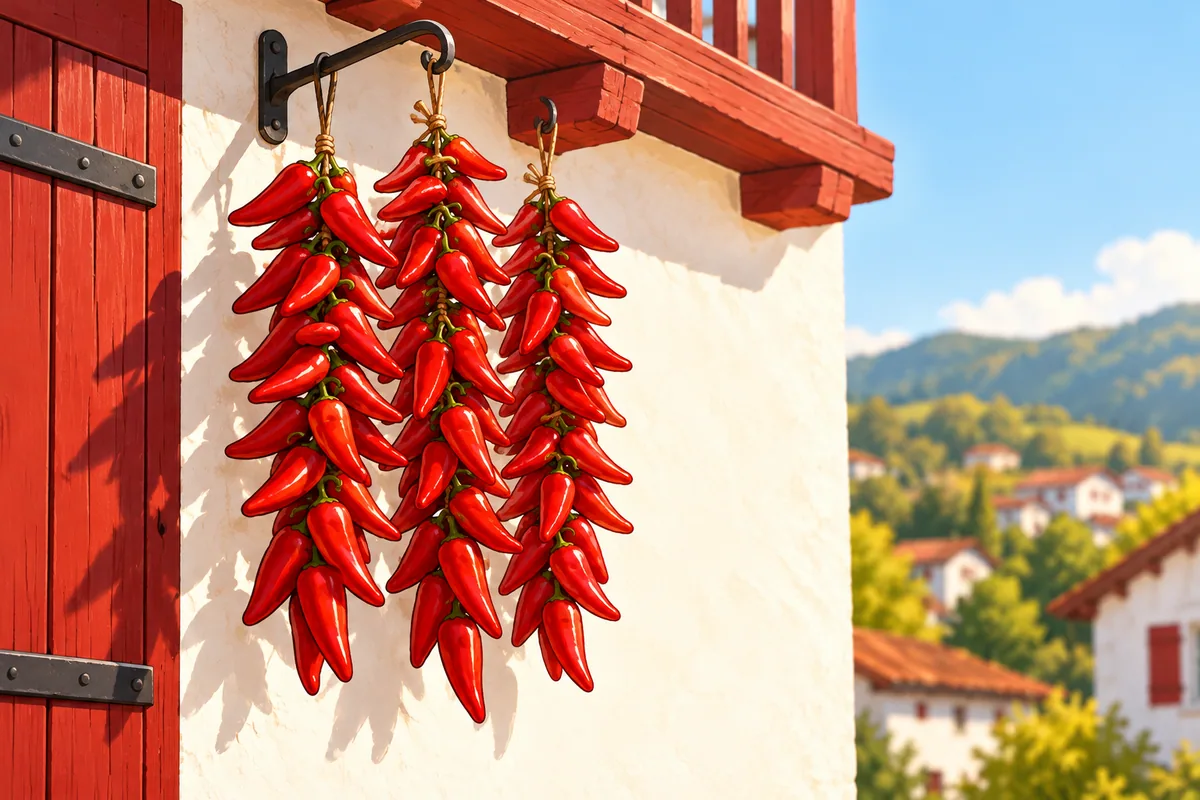
Late pods get extra time, so a December jar in your cupboard has waited longest. Pods picked between 2 and 15 December mature for at least 25 days instead of 151. Under a shelter, the pods lie in a single layer on open racks spaced at least 10 cm apart, and only unheated air may move over them.
If you dry your own peppers, this is the lesson to borrow. A slow, airy first stage lets the pod's color and aroma settle, and a short heat at the end only finishes the job. The pepper drying guide covers the oven and dehydrator side of that finish.
TasteFrance Magazine visits an Espelette grower in the Basque hills in this short film, so you can watch how the pods are handled and dried, and you can match what you see to the maturing rules above.
How many pods go into one jar of Espelette powder?
More than you'd guess, and the rules let you work it out yourself. For yield estimates the specification counts each fresh pod at 35 grams, caps a plant at 1 kg of fresh peppers a year, and caps a field at 30 tonnes per hectare1. The 2024 revision sets at least 6.5 kg of fresh peppers for every kilogram of powder, down from 8 kg in the earlier wording1.
| Amount of powder | Fresh pods needed (6.5 kg rule) | Fresh pods needed (8 kg rule) |
|---|---|---|
| 1 kg | about 186 pods (6.5 kg) | about 229 pods (8 kg) |
| 250 g bag | about 46 pods | about 57 pods |
| 50 g jar | about 9 pods | about 11 pods |
Here's the math for the jar: 50 g of powder × 6.5 = 325 g of fresh pods, and 325 ÷ 35 is about 9 pods. Now set that against the plant cap. One plant gives at most 1 kg of fresh pods, so at best it fills about three 50 g jars a year.
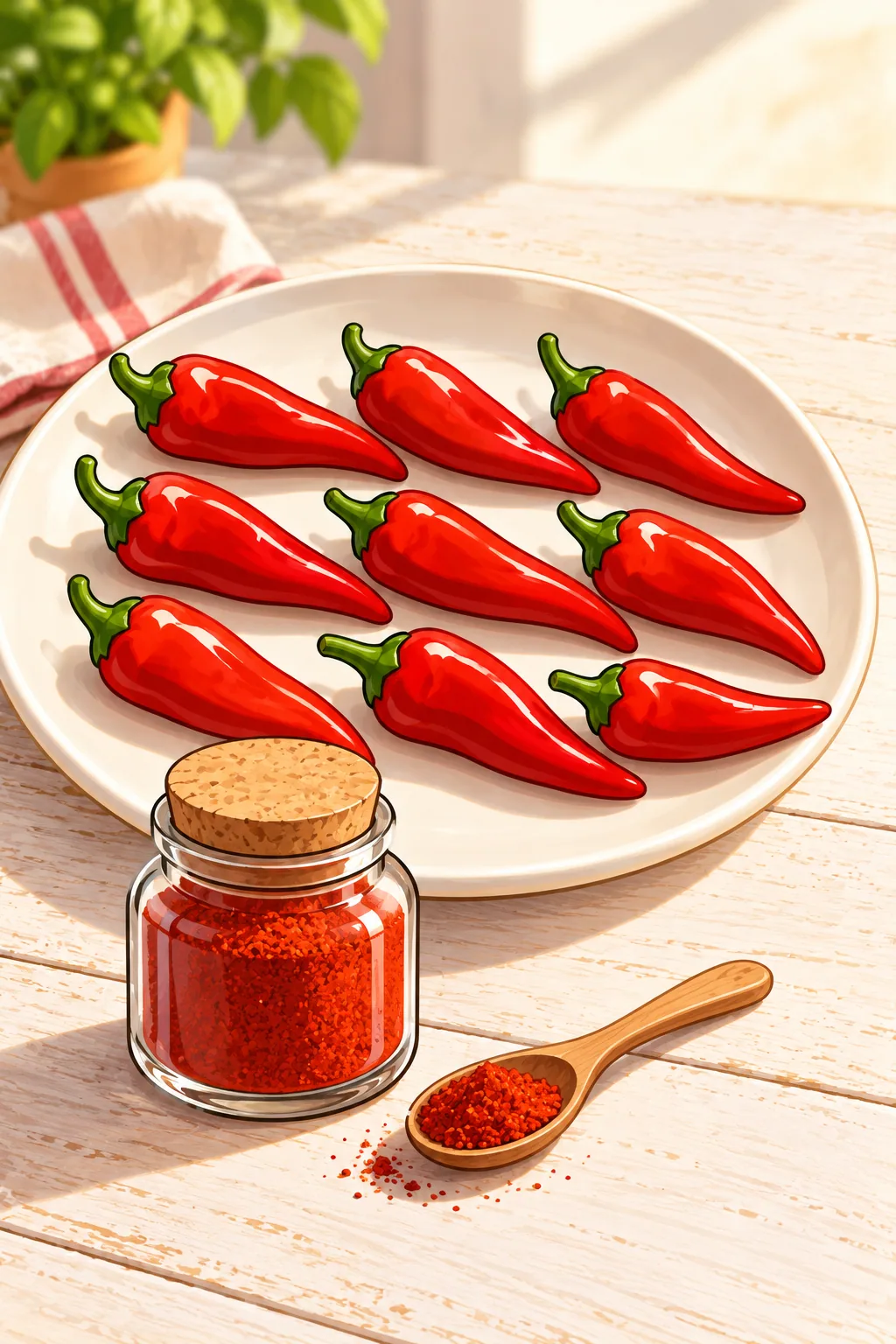
That's the honest reason your small jar costs what it does. Each pod is picked by hand, hung for two weeks, destemmed and ground by one farm, and a whole plant only covers a few jars.
How do you tell real Espelette on the shelf?
Look for the marks the rules require, and you'll spot a fake in seconds. The AOP name has to appear in letters at least 1.3 times the size of the largest other text on the label, next to the EU's AOP symbol1.
Five checks before you buy
- The words Piment d'Espelette, or the Basque Ezpeletako Biperra, with AOP right beside them.1
- The European Union's AOP symbol on the pack, with the name right after it.1
- On powder, a tamper-proof mark that also shows the harvest year.1
- On a string, a tamper-proof tag that states the number of pods.1
- Powder between orange and red-brown, the color range the rules set.1
Labels that say "Espelette style" or "Basque pepper" without the AOP mark are a different product. They may taste fine, but nobody checked where they grew or how long the pods hung.
Where does Espelette belong in your cooking?
Anywhere you'd reach for black pepper and want fruit with it, at your stove or at your table. That's literally how it started: in the 17th century, these peppers replaced costly imported black pepper for seasoning and preserving meat1. Today, the rules note, local charcuterie makers, ready-meal makers and restaurants build their products on it, and top French chefs keep it in their kitchens1.
At home, think of it as a finishing powder. Dust it on fried eggs, a tomato salad, grilled fish or a bowl of white beans, where you can see the color and taste the toasted note. Add a second pinch to a stew at the end rather than the start, so the aroma survives.
| Powder | Heat you'll feel | Best job in your kitchen |
|---|---|---|
| Piment d'Espelette1 | Warm, strong but not burning | Finishing eggs, fish, beans, charcuterie |
| Sweet paprika5 | Up to about 500 SHU | Color and body in stews and rubs |
| Aleppo flakes6 | Sweet, fruity, slightly tangy | Coarse flakes on dips and grilled meat |
| Cayenne2 | 25,000–50,000 SHU, sharp | A small amount of real heat in a big pot |
The closest swap by feel is a mix of sweet paprika and a pinch of cayenne. If you'd rather keep a coarse flake, Aleppo pepper brings a similar gentle fruit with more oil. Neither copies the hay note the rules describe, so keep your Espelette for the dishes where you'll taste it.
Can you grow Gorria peppers at home?
Yes, and you'll find it a manageable plant. The specification describes an annual up to 80 cm tall with white flowers and hanging conical fruits that ripen red1. Seed sold as Gorria grows the same type, though your pods won't be AOP unless they grow in those ten communes.
- 1
Wait for warm soil
The rules say the plant only starts to grow once soil passes 12 °C and grows well at a steady 20 °C, so don't rush it into cold ground.1
- 2
Plant out in spring or early summer
Basque growers plant between 1 April and 15 July, in open ground, never under a greenhouse.1
- 3
Give each plant room
Keep at least 40 cm between single plants in the row and about 50–60 cm between rows.1
- 4
Water evenly
The specification warns that the plant tolerates neither drought nor waterlogged roots; even moisture matters more than a lot of water.1
- 5
Pick when red
Take pods once they're at least 80 % red, and keep picking until frost.1
- 6
Cover on cold nights
Growers may lay fleece over plants from 5 pm to 10 am on frosty spring and autumn nights.1
In a cooler garden, that soil temperature rule decides your timing. The planting dates guide shows you how to read your own last frost and soil warmth, and a pot on a sunny wall can stand in for the sheltered Basque valley.
How did a chile from the Americas become Basque?
Over about four centuries, through home gardens. You can follow each step in the specification, from Spain to the 2024 rule change1:
- 16th century
The pepper reaches the Espelette area, probably through Spain, much as maize came up the Nive valley.1
- 17th century
Records mention Capsicum peppers used as a spice in place of costly black pepper, to season and keep meat.1
- 1745
Father Manuel de Larramendi's Basque lexicon mentions Espelette pepper as a spice.1
- 1993
Growers, processors and packers found the Syndicat du Piment d'Espelette.1
- 2002
The EU registers the name as a protected designation of origin.3
- 20 June 2024
INAO's national committee approves the latest revision of the rules.1
For most of that history, women grew it. The specification says the crop lived in kitchen gardens tended by women, and that the money from it was, until fairly recently, the grower's own income on small mixed farms1. The strings drying on house fronts each autumn grew out of that habit.
It also stands alone in France. The rules call Espelette the only traditional pepper grown in France for use as a spice1. If you're curious how other peppers ended up far from the Americas, the pepper origins guide maps the routes.
What to do with your first jar of Espelette
Open it and smell it first: you should get fruit and toast before anything else. Then use a pinch on something plain, like a fried egg or a bowl of beans, so you learn its taste before it disappears into a stew.
Once you know it, set it beside its Basque neighbor, the pickled guindilla from the Spanish side of the border, or try the roasted piquillo from Navarre for a sweet red pepper you eat whole.
To compare Espelette's family with every other pepper by heat, open the Pepper Index and sort by species.
Related peppers
Published ranges.5
Related in Peppers
-
Cayenne Pepper Scoville, 25,000–50,000 SHU
The long red chile behind most ground red pepper and a lot of vinegar hot sauce.6 min read -
Chiltepin Heat, 70,000–160,000 SHU in a Pea-Sized Wild Pod
The wild bird pepper of Sonora, Arizona and Texas, picked from shrubs that grow under desert trees.6 min read -
Count Dracula Pepper Heat, 25,000–50,000 SHU on Black Leaves
A compact hot pepper grown for its near-black foliage, with pods that ripen from black to blood red.5 min read -
Cherry Pepper Scoville, 0 SHU Sweet to Hot
A small round pepper, sweet or hot, grown for jars and stuffing.6 min read -
Ñora Pepper, Sweet Pimentón Pod Under 480 SHU
The small round sweet pepper behind Murcia's pimentón.5 min read -
Thai Chili Pepper Scoville, 50,000–100,000 SHU
A small, sharp chile about an inch long, also sold as bird's eye.6 min read
Sources
· 6
- 1Institut national de l'origine et de la qualité (INAO) Cahier des charges de l'appellation d'origine Piment d'Espelette, modification approved by the national committee on 20 June 2024
- 2University of Florida IFAS Extension HS-859/TR010: Pepper Production in Miami-Dade County, Florida
- 3European Commission, EUR-Lex Commission Implementing Regulation (EU) No 1120/2013 approving non-minor amendments to the specification for Piment d'Espelette (PDO)
- 4TasteFrance Magazine Espelette Chilli Pepper: The Basque Country’s Gentle Heat | Meet The Maker
- 5New Mexico State University Circular 706: The Chile Cultivars of New Mexico State University, 1913–2022 (Coon, Walker, Lozada, Guzman, Bosland)
- 6University of California Agriculture and Natural Resources, UC Master Gardeners of Ventura County Ventura Garden to Table Series: Peppers