
Piquillo Pepper, the Sweet Flame-Roasted Pod of Lodosa
A small triangular red pepper that almost always reaches you roasted, peeled and in a jar.
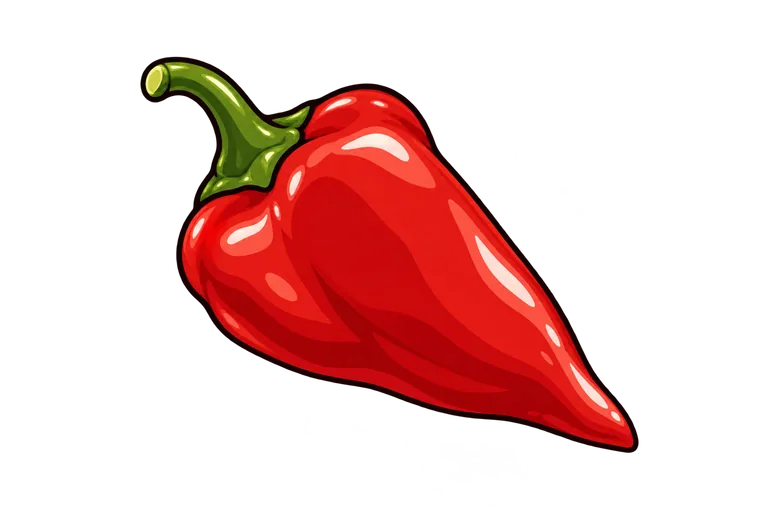
Sweet, with no published Scoville figure: the official spec calls its flavor sweet.
- 35–50 g pods, no longer than 10 cm
- Grown and roasted in 8 towns of southern Navarra
On this page
- 1What does the official spec say a piquillo is?
- 2Is a piquillo pepper hot at all?
- 3Which towns can grow a real piquillo de Lodosa?
- 4How do piquillos go from field to jar?
- 5Should you buy piquillos in a jar or on a tray?
- 6How do you judge a jar of piquillos?
- 7When are piquillos sown, planted and picked?
- 8How do you cook with piquillo peppers?
- 9What goes wrong with piquillos?
- 10Your next step with piquillos
What does the official spec say a piquillo is?
A small, triangular, sweet red pepper with a sharp tip and thin flesh. Spain's protected designation of origin, the PDO Pimiento del Piquillo de Lodosa, writes the fresh pod's measurements into its specification1:
The same text describes a strong red color, a triangular shape ending in a sharp point, two or three seed chambers, and fruit that hangs from the plant1. Hold one up and you see why cooks love it for filling: a wide open shoulder and a pointed, closed tip that holds a stuffing in place.
Those thin walls are why you almost never see a fresh piquillo in a shop. Growers raise it for roasting and peeling, and it comes to your kitchen ready to use.
Is a piquillo pepper hot at all?
No, or so little that the people who define it don't mention heat. The PDO specification lists the flavor as sweet and repeats that the roasted pepper keeps its sweet taste1. It gives no Scoville figure, and we haven't found a primary source that measured one, so this entry shows no number.
For you, that means a piquillo works like a red bell pepper with more flavor: a whole jar won't make your dish hot. You can serve it to children, to a guest who avoids chiles, or to yourself on a night when you want color and sweetness without a burn. If a recipe from northern Spain asks for piquillos, it wants that sweetness and the smoke from the roasting, not heat. If you want warmth with the same sweetness, the dried ñora from Murcia is the Spanish pepper to look at next.
Which towns can grow a real piquillo de Lodosa?
Only eight, and you can check the town on many jar labels. The PDO limits growing and processing to municipalities in the Ribera Baja of Navarra, along the Ebro and Ega rivers1:
The 8 towns of the PDO zone
- Andosilla
- Azagra
- Cárcar
- Lerín
- Lodosa
- Mendavia
- San Adrián
- Sartaguda
The specification ties the pepper's quality to the place. The zone is semi-arid, with about 400 mm of rain a year, hot dry summers from May to September and strong swings between day and night temperatures, which the text credits for how the pepper ripens1. Soils are brown limestone soils on marl, with wide alluvial plains along the rivers1.
It's an old crop there, so the jar you open carries more than a century of local practice. The specification cites a mention of canned piquillos from the area in "El Practicón," a cookbook from 1893, and notes that Navarra's government first authorized the designation in 19861. The Spanish peppers hub puts the piquillo next to the country's other named pods, and the peppers by country map shows where Spain sits in the bigger story.
How do piquillos go from field to jar?
By hand, by flame, and without water. The PDO sets a rule at each step, and those rules explain the flavor you taste1.
- Hand-pickedEvery 10 to 15 days, at the right ripeness
- Rested under coverA few days to deepen the red
- Roasted over direct flameFuel oil and diesel are not allowed
- Peeled, cored and seededNever soaked or washed in water or chemicals
- Sorted by color and size
- Packed whole, in strips or piecesLiquid at most 3 % of the jar
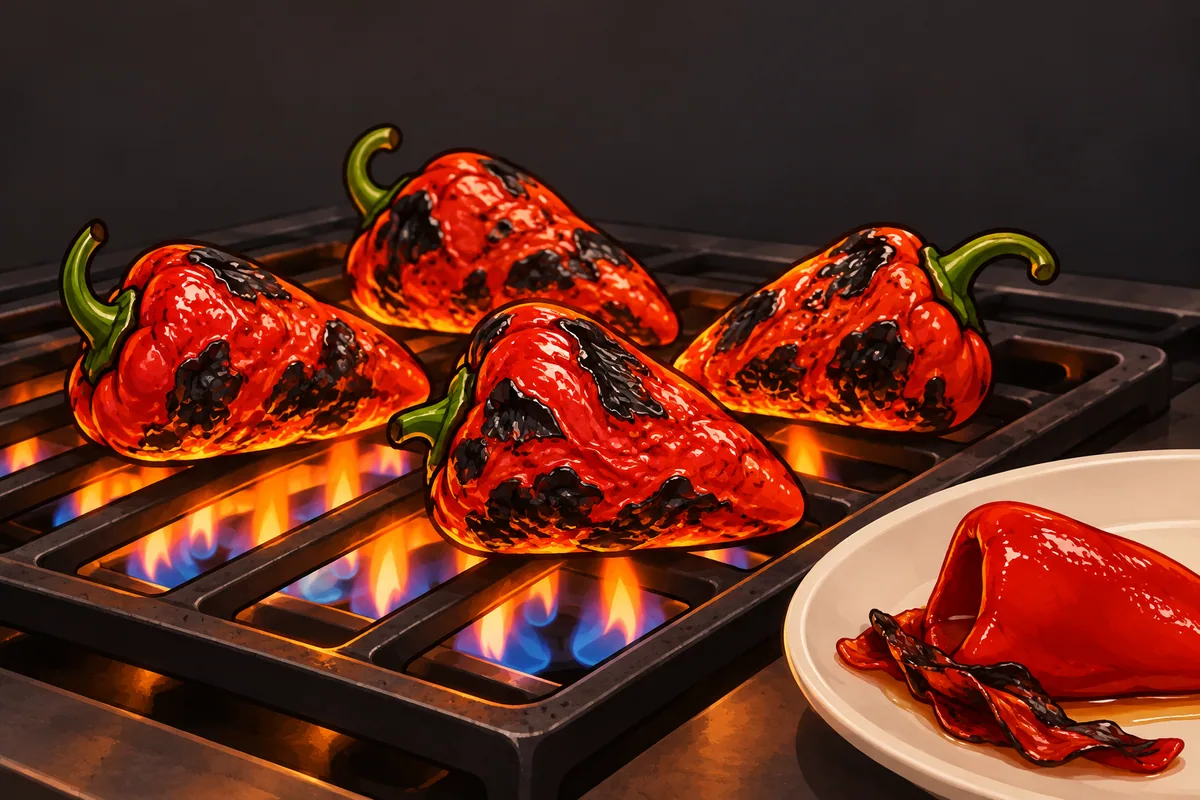
The no-water rule matters more than it sounds, and you can taste the difference side by side. Rinsing a roasted pepper washes away the charred bits and the juices that carry the smoke, so a piquillo from the PDO keeps flavor a rinsed pepper loses. When you roast red peppers at home, you can copy that: peel them with your fingers and a paper towel instead of under the tap. The pepper roasting page covers the broiler and grill methods.
Should you buy piquillos in a jar or on a tray?
The PDO allows two forms, and they don't keep the same way. "Asado al natural" is the roasted pepper packed in bags or trays with no further processing, while the canned version goes into jars or tins that the factory then sterilizes with heat and cools fast1. Both forms must be processed inside the same eight-town zone where the peppers grow1.
For you, the choice comes down to timing. Pick the tray for a dinner this week, since it skips the sterilizing step and has to stay cold; pick the jar for your pantry shelf. Each form comes whole, in regular strips or in irregular pieces, and the label has to say which presentation you're buying1.
How do you judge a jar of piquillos?
Look for the marks first, then the grade. Both tell you what you're paying for. A PDO jar carries the name "Pimiento del Piquillo de Lodosa," the official PDO logo and a numbered back label that the regulating council issues; nobody can reuse the numbered label1. Only two commercial grades qualify, Extra and First, and the spec sets them apart with numbers1.
| Rule | Extra | First |
|---|---|---|
| Total defects | 10 % or less | 20 % or less |
| Seeds per pepper | 20 or fewer | 40 or fewer |
| Firm peppers | 90 % or more | 80 % or more |
| Loose pieces in a jar of whole peppers | None | None |
The spec counts sunburnt patches, missing pieces, peppers split wide open and black, rotten cores as defects1. For stuffing, pay for Extra: you'll get more whole, firm pods with few seeds to pick out. For a sauce or a spread, First grade or the strips cost less and taste the same once blended.
When are piquillos sown, planted and picked?
Spring sowing, summer growth and a long picking season. The specification gives the calendar growers in the zone follow1.
- First week of March
Sown in seedbeds
Seedlings start under cover.1
- From the second half of April
Transplanted
Rows 0.90 m apart with plants 0.30 m apart, about 37,000 plants per hectare.1
- Through the summer
Light watering
Light irrigation every 10 to 12 days and low doses of nitrogen.1
- Harvest
Picked by hand
Every 10 to 15 days, as each round of fruit ripens.1
If you want to grow piquillos yourself, that calendar is a useful model: start seeds indoors in early spring and plant out once the soil warms in late spring. Pods that hang low on a compact plant need a clean mulch underneath so they don't rot where they touch wet soil.
How do you cook with piquillo peppers?
Straight from the jar, mostly. They're already roasted and peeled, so your job is to warm them or fill them, and a weeknight dinner can be on your table in twenty minutes. Treat these amounts as kitchen starting points and adjust them to your taste.
- Stuffed piquillos: fill each pod with about a tablespoon of soft cheese, salt cod or rice, then bake or pan-fry until warm. Extra-grade pods hold their shape best. More peppers that suit filling are on the peppers for stuffing list.
- Tapas: lay strips on toast with olive oil, a little garlic and flaky salt.
- Sauce: blend a jar of drained piquillos with olive oil and a splash of sherry vinegar for a red sauce to serve with fish or eggs.
- Salads and rice: slice them into strips and stir them in at the end so they keep their color.
Save the liquid from the jar. It's mostly pepper juice, and a spoonful seasons a vinaigrette. Once you open a jar, keep it in your fridge with the peppers covered by their liquid, and use them within the time the label gives you.
What goes wrong with piquillos?
Most problems trace back to the jar you picked or how you handled the pods. Each fix below takes you less than a minute.
Problems and fixes
- Pods tear when you stuff them: you bought strips or First grade. For stuffing, buy whole Extra grade, which allows the fewest defects.1
- Too many seeds in the filling: Extra allows up to 20 seeds per pepper, First up to 40, so rinse the inside lightly or switch grades.1
- The stuffing comes out watery: drain the pods on a towel for ten minutes before you fill them.
- A sharp, sour taste: some jars add an acid to lower the pH; the PDO caps that liquid at 3 % of the contents, so check the label for added acid.1
- You roasted a hot pepper by mistake and your fingers sting: Poison Control lists warm water, vegetable oil or diluted vinegar soaks for skin.2
Your next step with piquillos
Buy one jar of whole Extra-grade piquillos and stuff half of them tonight; blend the rest into a sauce. You'll learn in one meal how much smoke and sweetness the pepper brings, and you'll know which grade you want next time. If your shop doesn't stock them, the piquillo swap list gives you other sweet red peppers and how to roast them so they come close.
Related peppers
Published ranges.Sources for this line3. Ministerio de Agricultura, Pesca y Alimentación (Spain)4. New Mexico State University5. New Mexico State University, Chile Pepper Institute (seed shop)6. University of Florida IFAS Extension
Related in Peppers
-
Espelette Pepper, 10 Basque Communes and 15 Days on the Wall
A conical red pepper from the French Basque Country whose powder the AOP rules call strong but not burning.7 min read -
Peppadew Pepper Heat, Under 650 SHU in a Sweet Brine
The small round red pepper from South Africa, hand-cored, pickled sweet and sold under one trademark.6 min read -
Biquinho Pepper, the 2.6 cm Brazilian Pod With No Heat
A crunchy little red pod Brazil eats pickled, often with no burn at all.6 min read -
Chiltepin Heat, 70,000–160,000 SHU in a Pea-Sized Wild Pod
The wild bird pepper of Sonora, Arizona and Texas, picked from shrubs that grow under desert trees.6 min read -
Count Dracula Pepper Heat, 25,000–50,000 SHU on Black Leaves
A compact hot pepper grown for its near-black foliage, with pods that ripen from black to blood red.5 min read -
Hatch Chile Heat, 300–9,000 SHU Across NuMex Types
The long green chile of southern New Mexico, named after the town where it first grew for market.6 min read
Sources
· 6
- 1Ministerio de Agricultura, Pesca y Alimentación (Spain); approved by Commission Implementing Regulation (EU) 2020/1528 Pliego de condiciones de la Denominación de Origen Protegida «Pimiento del Piquillo de Lodosa»
- 2National Capital Poison Center (Poison Control) Capsaicin: when the chili is too hot
- 3Ministerio de Agricultura, Pesca y Alimentación (Spain) Pliego de condiciones de la Denominación de Origen "Pimentón de Murcia"
- 4New Mexico State University Circular 706: The Chile Cultivars of New Mexico State University, 1913–2022 (Coon, Walker, Lozada, Guzman, Bosland)
- 5New Mexico State University, Chile Pepper Institute (seed shop) Red Cherry Sweet Pepper
- 6University of Florida IFAS Extension HS-859/TR010: Pepper Production in Miami-Dade County, Florida