
Cayenne vs Thai Chili, Why the Smaller Pod Is 2× Hotter
Same species on most lists, double the heat, a sixth of the length.
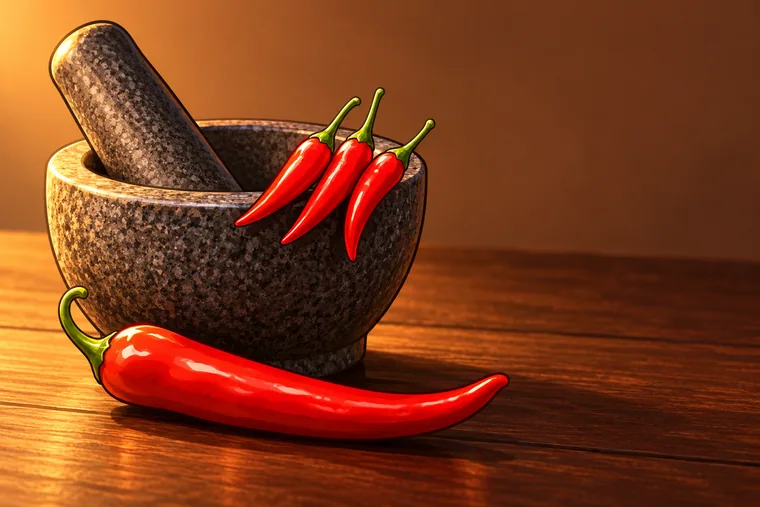
The Thai chili is hotter: twice the cayenne's heat at the bottom, the middle and the top of the ranges.
- Thai chili 50,000–100,000 SHU; cayenne 25,000–50,000 SHU
- A Thai pod is about 1 inch long; cayenne cultivars run 5.8–6.7 inches
- Use about half as much Thai chili when you swap it in
Log scale; bars are published ranges.1
On this page
- 1Is a Thai chili hotter than cayenne?
- 2Does a second source keep the 2× rule?
- 3How big is a Thai chili next to a cayenne?
- 4Are cayenne and Thai chili the same species?
- 5How many Thai chilies equal one cayenne pod?
- 6Do you need a fresh Thai chili or ground cayenne?
- 7Can you use Thai chili instead of cayenne?
- 8Which plant should you grow?
- 9How do you keep each one?
- 10Why do six small Thai chilies burn more than one cayenne?
Is a Thai chili hotter than cayenne?
Yes, by exactly double. UF/IFAS gives the Thai chili 50,000 to 100,000 SHU and the cayenne 25,000 to 50,000 SHU2. The two ranges sit end to end: where your cayenne stops, the Thai chili starts.
| Point | Thai chili | Cayenne | Thai chili is |
|---|---|---|---|
| Mild end | 50,000 SHU | 25,000 SHU | 2 times hotter |
| Midpoint | 75,000 SHU | 37,500 SHU | 2 times hotter |
| Hot end | 100,000 SHU | 50,000 SHU | 2 times hotter |
A hot cayenne and a mild Thai chili can both measure 50,000 SHU, and that is the only point where they meet1.
Pick a random pod of each and your Thai chili can still land anywhere from even to four times hotter (100,000 against 25,000)1. Two times is the number you cook with.
Does a second source keep the 2× rule?
Close to it. Texas AgriLife gives cayenne an average of 35,000 SHU3, a bit under the UF/IFAS midpoint of 37,500. Against the Thai midpoint of 75,000, that makes the Thai chili about 2.1 times hotter, so you can keep cooking with the doubling rule.
How big is a Thai chili next to a cayenne?
Much smaller. UF/IFAS describes the Thai pod as about 1 inch long and under 1/5 inch wide1. NMSU's cayenne cultivars measure 5.8 inches (NuMex Nematador, 0.6 inch wide) and 6.7 inches (NuMex Las Cruces, 1 inch wide)4.
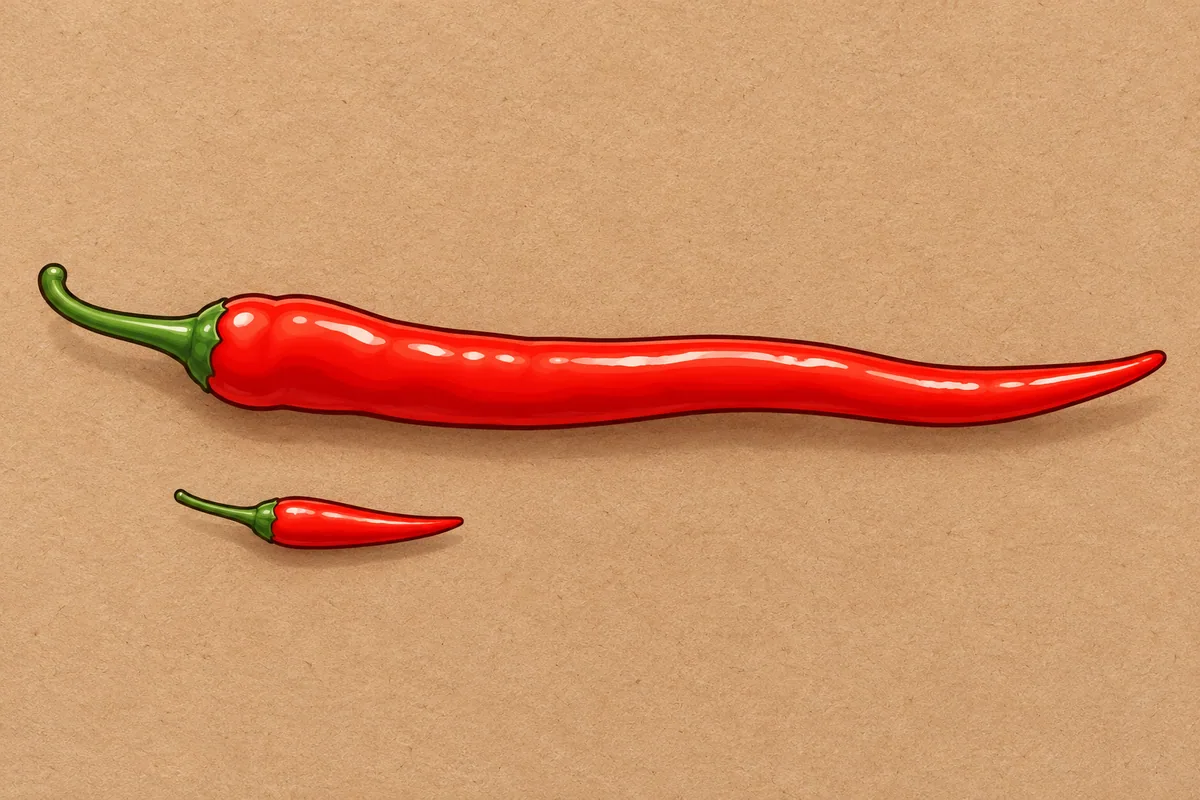
So by length, one cayenne equals about six Thai pods, while each Thai pod carries twice the heat per gram. Those two facts pull in opposite directions, so counting pods misleads you; weigh or measure chopped pepper instead.
Are cayenne and Thai chili the same species?
On most lists, yes: UF/IFAS calls both cultivars of Capsicum annuum1. The University of Guam's extension table files Thai under C. frutescens instead5, and UF/IFAS itself notes the Thai pepper often gets confused with C. frutescens cultivars.
Thai chili
Hotter
The "other name" row matters when you shop: the same small pod also sells as bird's eye chili, and that name has a wild cousin of its own. The species question changes nothing in your pan, though. Whatever list you follow, the Thai pod still runs 50,000 to 100,000 SHU and the cayenne 25,000 to 50,0001, so you can cook from the heat figures and let the botanists settle the label.
How many Thai chilies equal one cayenne pod?
About half a cayenne's weight in Thai chili, and less if your cayenne is a mild mash type. NMSU gives one useful anchor: its NuMex Las Cruces cayenne weighs about 1 ounce, roughly 28 g, at 6.7 inches long4.
- 1
Start from the cayenne's weight
One Las Cruces cayenne weighs about 1 ounce, roughly 28 g.4
- 2
Halve it for a range cayenne
At twice the heat by midpoint, about 14 g of Thai chili matches one range cayenne of that weight.1
- 3
- 4
Taste and adjust
Thai pods vary by double within their range, so add the last third only after tasting.1
NuMex Nematador, the other NMSU cayenne, sits at 15,000 SHU4, so the same adjustment applies. If you bought your cayenne fresh at a market, you rarely know the cultivar, and the 2 to 1 rule is your safe starting point. Ground cayenne is the same story in a jar: the label rarely names the pods, so you start low, add a pinch of Thai heat at a time, and stop when the dish tastes right to you and to the people at your table.
Do you need a fresh Thai chili or ground cayenne?
Ask two questions: do you need a fresh pod or a dry spice, and how much heat can your table take? The tree below sorts your answers.
- A fresh podChopped fresh into the dish
- you want more heatThai chili50,000–100,000 SHU, about 1 inch longHot
- you want less heatFresh cayenneHalf the heat, six times the length
- you want more heat
- A dry spiceRubs, spice blends, a pinch at the table
- the usual formGround cayenne25,000–50,000 SHU, sold as powder or flakes
- the usual form
Bars show published heat ranges. Sources for this line1. University of Florida IFAS Extension2. UF/IFAS Gardening Solutions4. New Mexico State University, Agricultural Experiment Station (Research Report 792)
You can put dried Thai chilies in the dry branch too. You can dry them at 140°F for 8 to 12 hours until tough to brittle6 and crush them into red pepper flakes that run about twice as hot as cayenne flakes.
Can you use Thai chili instead of cayenne?
Ground cayenne is the harder swap, because you are matching a dry powder to a fresh pod. Add one finely chopped Thai chili at a time and taste between additions.
Here is the arithmetic with real numbers. Say your curry paste calls for 20 g of fresh red cayenne. At twice the heat per gram1, 10 g of Thai chili gives you the same burn, and you can make up the missing 10 g with a mild red pepper if the paste needs the bulk and the color. Going the other way, 10 g of Thai chili becomes 20 g of fresh cayenne. If you want to step down in heat instead, a jalapeño next to cayenne works the other way, and a habanero next to cayenne goes up past the Thai chili.
Which plant should you grow?
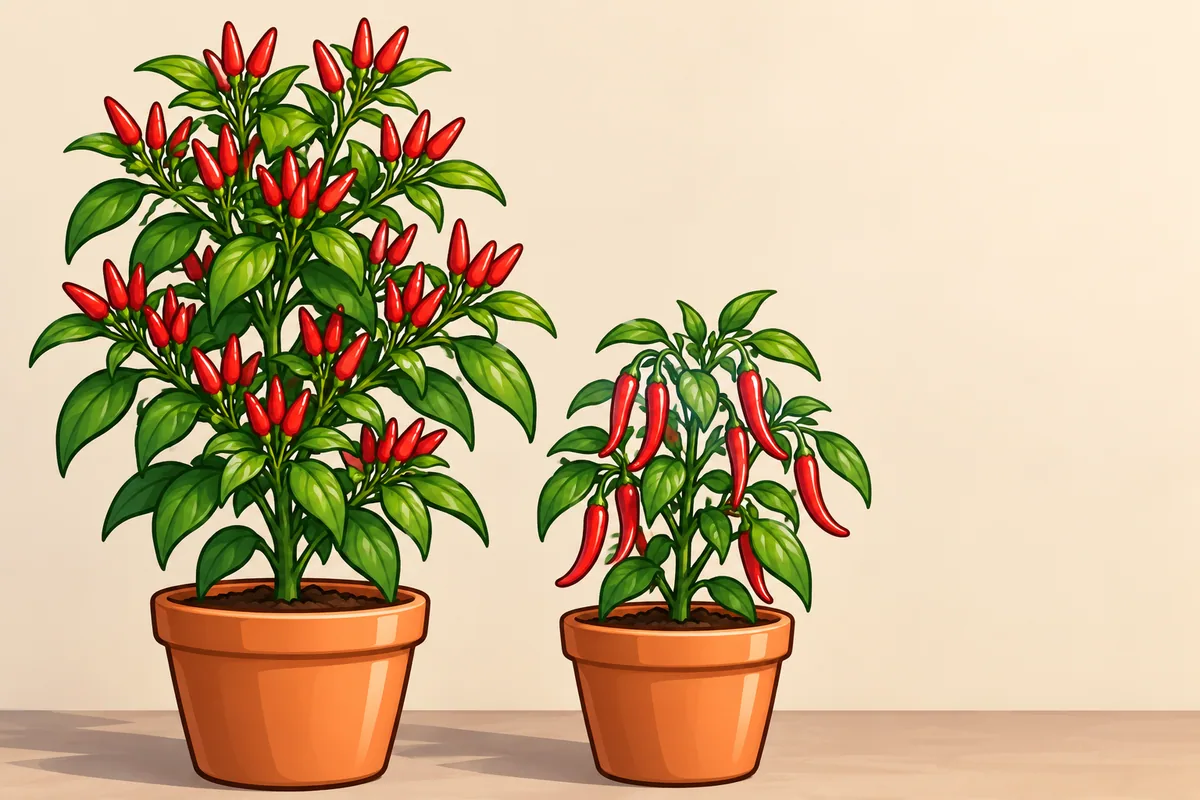
The Thai chili if you want a plant that keeps going, the cayenne if you want one big crop to dry. UF/IFAS describes the Thai pepper as a perennial that can grow up to 6 feet, setting two or three pods at a node, and the cayenne as a 2 to 4 foot plant with ripe fruit about 100 days after the seed sprouts1.
Pests in your garden can decide the question too, before heat or flavor ever comes up. NMSU bred NuMex Nematador for resistance to the southern root knot nematode, which it calls a major pest for cayenne growers, and NuMex Las Cruces for high resistance to beet curly top virus4. If either problem has hit your beds before, a resistant cayenne is the safer pick for those beds.
Where you get frost, both plants die back, so you grow the Thai chili as an annual or move it indoors in a pot. If you garden on a balcony, a tall perennial is a lot of plant, while a 2 to 4 foot cayenne fits a large container.
How do you keep each one?
You buy them in different forms, so you store them differently:
- Fresh Thai pods keep best at 45–50°F with high humidity; colder than 45°F, they suffer chilling injury5, so use the crisper drawer, the warmest part of your fridge.
- Extra Thai pods freeze well whole and raw once you wash them and pull the stems, says Penn State Extension8. You can chop them straight from the freezer.
- Cayenne powder keeps 6 to 12 months in a cool, dark, airtight jar6. Light fades dried peppers quickly8, so keep the jar in a cupboard rather than on a sunny shelf.
If your cayenne powder has gone pale, check the date you opened it; past the 6 to 12 months Colorado State gives dried peppers6, a fresh jar is the simple fix.
Why do six small Thai chilies burn more than one cayenne?
The mistake you are most likely to make is counting pods. Six Thai chilies laid end to end match one long cayenne, but every gram of them carries twice the heat1, so the row of small pods burns far more. If a dish already burns, a glass of milk helps you more than water: in a 2019 test of seven drinks, whole and skim milk cut the burn the most10.
Related in Compare
-
Habanero vs Cayenne Pepper, About 6× Hotter
Two different species, and a gap between their ranges.5 min read -
Bird's Eye vs Thai Chili, Usually 1 Pepper at 50,000+ SHU
Mostly one pepper, with a wild cousin that shares the name.5 min read -
Cayenne vs Jalapeño, 7.5× the Heat and Swaps
One usually ends up in a jar of powder, the other in a fresh salsa.6 min read -
Cayenne Pepper vs Kashmiri Chilli, Heat and Color Data
A deep red chilli from the north of India against the red pepper in every spice rack.6 min read -
Thai Chili vs Jalapeño, Why the Small Pod Is 15× Hotter
A one-inch pod with fifteen times the heat.5 min read -
Habanero vs Thai Chili, Why the Habanero Is 3× Hotter
A tiny hot chili against a fruity extra-hot one.5 min read
Sources
· 10
- 1University of Florida IFAS Extension HS-859/TR010: Pepper Production in Miami-Dade County, Florida
- 2UF/IFAS Gardening Solutions Peppers by Scoville Units
- 3Texas AgriLife Extension Service (Joe Masabni) Jalapeño & Other Hot Peppers
- 4New Mexico State University, Agricultural Experiment Station (Research Report 792) The Chile Cultivars of New Mexico State University Released from 1913 to 2016 (Coon and Bosland)
- 5University of Guam, College of Natural and Applied Sciences, Cooperative Extension and Outreach FPP-05: Hot Pepper (Capsicum spp.), Important Crop on Guam (Tuquero, Chargualaf, Marutani)
- 6Colorado State University Extension, PreserveSmart Drying Peppers-Hot
- 7Heliyon (Cell Press) A comprehensive review of capsaicin: Biosynthesis, industrial productions, processing to applications, and clinical uses
- 8Penn State Extension Preserving Those Colorful Garden Peppers (Martha Zepp)
- 9National Capital Poison Center (poison.org) Capsaicin: When the Chili Is Too Hot (Amanda McDaniel-Price, RN)
- 10Physiology & Behavior 208:112557 Putting out the fire: Efficacy of common beverages in reducing oral burn from capsaicin (Nolden, Lenart, Hayes)