
Cayenne Pepper vs Kashmiri Chilli, Heat and Color Data
A deep red chilli from the north of India against the red pepper in every spice rack.
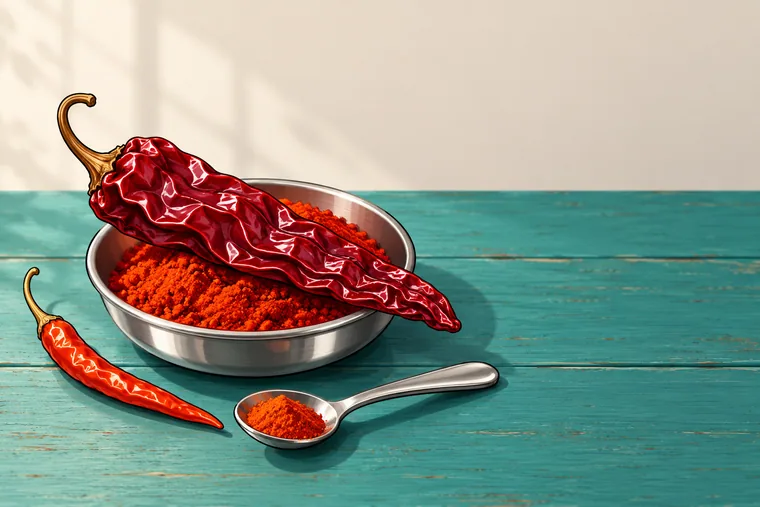
On the Spices Board's own figures, Kashmir chilli works out to about 52,000 SHU, right at the top of cayenne's 25,000–50,000 range; a mild 'Kashmiri' powder is likely a different, low-heat chilli.
- Kashmir chilli: 0.325% capsaicin and 54.10 ASTA colour (Spices Board India)
- Cayenne: 25,000–50,000 SHU, usually dried and ground (UF/IFAS)
- For color without heat, paprika or Byadagi does the job; for heat, cayenne swaps close to one for one
On this page
- 1Is Kashmiri chilli hotter than cayenne?
- 2How do you turn 0.325% capsaicin into Scoville units?
- 3Why does your Kashmiri powder taste milder than that?
- 4How do other Indian chillies sit next to cayenne?
- 5Is cayenne the same thing as "red pepper" on a label?
- 6Which one turns a curry red?
- 7Where do Kashmir chilli and cayenne grow?
- 8How do you cook with each one?
- 9How do you swap cayenne for Kashmiri chilli powder?
- 10What goes wrong when you swap Kashmiri chilli and cayenne?
- 11Where to go next
Is Kashmiri chilli hotter than cayenne?
About the same, if you go by the Indian government's own data. Spices Board India lists Kashmir chilli at 0.325% capsaicin1, which works out to roughly 52,000 SHU. UF/IFAS puts cayenne at 25,000 to 50,000 SHU2, so the Kashmiri chilli in that table sits right at cayenne's hot end.
Kashmir chilli
By the Board's capsaicin figure, a Kashmir chilli is a cayenne-class chilli, not a mild one.
That surprises a lot of cooks, because Kashmiri powder has a mild reputation. The next two sections show you the arithmetic and the likely reason for the gap.
How do you turn 0.325% capsaicin into Scoville units?
You multiply the capsaicin, in parts per million, by a fixed factor. The 2013 Molecules study converted its HPLC results at 16.1 SHU per part per million of capsaicin3, and NMSU calls HPLC the most accurate way to measure chile heat5.
| Step | Arithmetic | Result |
|---|---|---|
| Percent to parts per million | 0.325% × 10,000 | 3,250 ppm capsaicin |
| Parts per million to SHU | 3,250 × 16.1 | about 52,300 SHU |
| Against cayenne's top | 52,300 ÷ 50,000 | about 1.05 times |
Two cautions keep you honest. The Board gives capsaicin only, while a lab total adds dihydrocapsaicin, so a full reading could run higher. And one figure describes one kind of sample, so your bag can land above or below it, the same way NMSU says field stress shifts any chile's heat5.
Why does your Kashmiri powder taste milder than that?
The answer sits in the same Board table. It lists several red chillies with very different heat and colour, and one of them, Byadagi from Karnataka, carries negligible capsaicin with a colour value of 159.91. That is the profile of a chilli you buy for color.
| Chilli | Where it grows | Capsaicin | Estimated SHU | ASTA colour |
|---|---|---|---|---|
| Kashmir | Himachal Pradesh, Jammu and Kashmir | 0.325% | about 52,300 | 54.10 |
| Byadagi (Kaddi) | Dharwar, Karnataka | Negligible | near 0 | 159.9 |
| Guntur Sannam S4 | Guntur, Warangal, Khammam | 0.226% | about 36,400 | 32.11 |
| Bird's eye (Dhani) | Mizoram, Manipur | 0.589% | about 94,800 | 41.7 |
The Board also notes that paprika, Byadagi and similar high-colour, low-pungency chillies go to colour extraction1. So when a powder sold as Kashmiri gives you a deep red curry with little bite, you are tasting that kind of chilli. Check the pack for the chilli's name and origin if you want to know which one you have.
How do other Indian chillies sit next to cayenne?
Spread across the whole cayenne range and past it. Run the Board's other figures through the same 16.1 factor and you get a ladder you can use when a recipe names a regional chilli13:
- Byadagi carries negligible capsaicin, so it adds red and almost no heat. Think of it as India's paprika.
- Guntur Sannam S4, at 0.226% capsaicin, lands around 36,400 SHU, in the middle of cayenne's 25,000–50,000 band2.
- Kashmir, at 0.325%, reaches about 52,300 SHU, the hot end of cayenne.
- Bird's eye (Dhani) from Mizoram and Manipur, at 0.589%, works out near 94,800 SHU, almost twice cayenne's top.
So if your recipe names Guntur chilli powder, cayenne is a fair match for heat. If it names bird's eye, you need nearly twice the cayenne for the same burn, and you should taste first. Each of these is one sample figure, so let your tongue have the final say.
Is cayenne the same thing as "red pepper" on a label?
Usually, yes. UF/IFAS says cayenne also goes by Guinea spice, cow-horn pepper, aleva and bird pepper, and that in powdered form people often call it simply red pepper4. It is a single Capsicum annuum chile, dried and ground into powder or flakes.
That matters when you shop for a Kashmiri swap. A jar that says "red pepper" is cayenne-class heat; a jar that says "chili powder" in a US store is usually a seasoning blend, such as McCormick's mix of chili pepper, spices, salt and garlic6, a different product from either chilli. Kashmiri powder on an Indian shelf names the chilli, and the Board's table tells you what that chilli can carry.
Which one turns a curry red?
The Kashmir chilli does more of the coloring than the Guntur, and a Byadagi does far more than either. Board colour values run 54.10 for Kashmir, 32.11 for Guntur Sannam and 159.9 for Byadagi1, so a spoon of Byadagi puts about three times the red of a spoon of Kashmir into your pot.
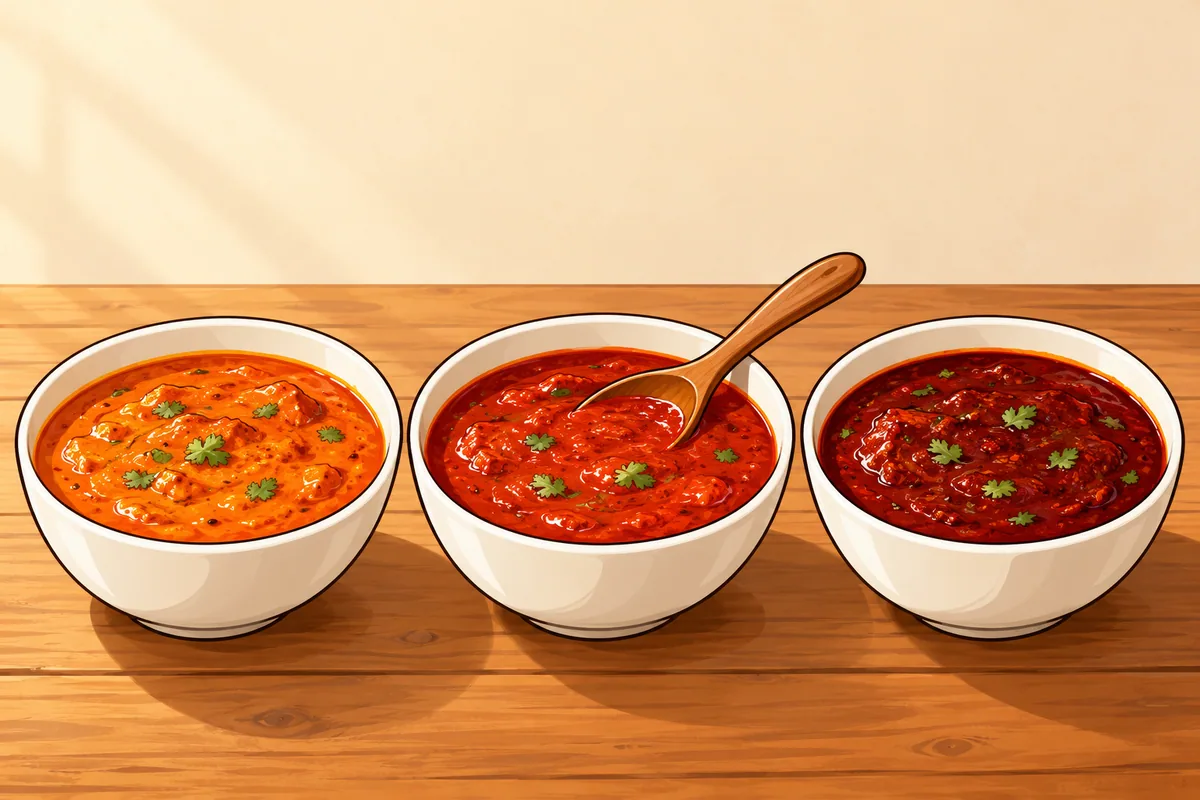
Cayenne's sources describe it only as red4. USDA does show its pigment load, though: 100 g of ground cayenne holds 21,840 µg of beta-carotene7. The Board describes the Kashmir pod as deep red1, and that deep red is what you are paying for when a recipe names it.
Put numbers on that. Say you want the red of 3 teaspoons of Kashmir chilli. Byadagi's colour value is about three times higher (159.9 against 54.10), so roughly 1 teaspoon of Byadagi gives you a similar red1. The heat moves the other way: the 3 teaspoons of Kashmir bring cayenne-class heat with them, while the Byadagi brings almost none. Same color, very different curry.
If color is the job, reach for the highest colour value you can find, not the hottest chilli.
Where do Kashmir chilli and cayenne grow?
In very different places. The Board says Kashmir chilli grows in temperate regions such as Himachal Pradesh and Jammu and Kashmir, plus North India's sub-tropical belt in winter, with a harvest from November to February1. Cayenne takes the hot side.
Kashmir chilli
If you grow peppers in a cool, short summer, a cayenne still finishes in about 100 days from germination4. Seed sold as Kashmiri is outside what these sources cover, so treat any grow claim on a packet with care.
How do you cook with each one?
Both go into the pot as dried, ground chilli. The Board says dry chilli goes into curried dishes, curry powder and seasonings across India1, and UF/IFAS says people mostly dry cayenne and use it as ground powder or flakes to flavor dishes4.
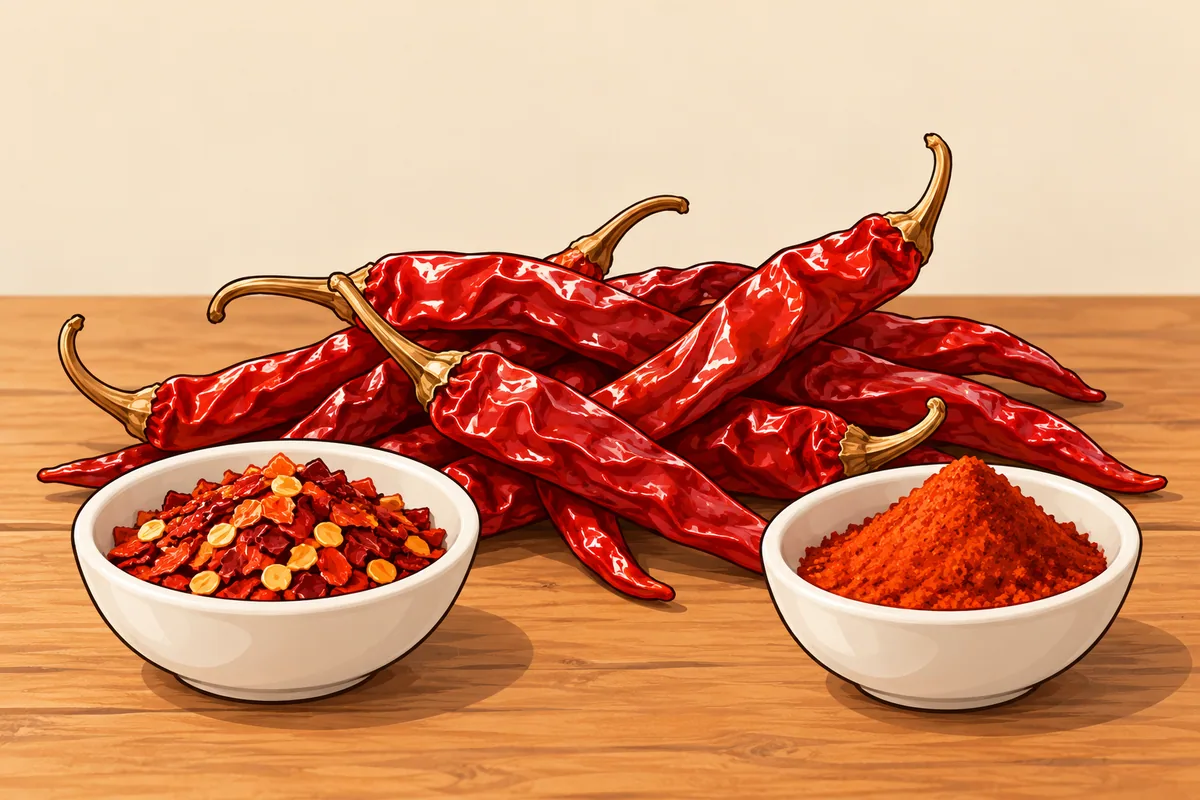
The difference shows up in how much you add. A recipe that leans on a high-colour, low-heat Kashmiri powder may ask for a tablespoon or more, because the cook wants the red. Cayenne recipes tend to ask for a pinch or a quarter teaspoon, because the cook wants the heat. If you see a big spoon measure next to "Kashmiri" in your recipe, that is your clue that it wants color, and cayenne at that amount will overshoot.
How do you swap cayenne for Kashmiri chilli powder?
Ask what the recipe wants the Kashmiri powder to do. If it is there for color, a straight cayenne swap gives you the heat and too little red; if it is there for heat, cayenne does the job.
- rogan josh red, tandoori colorMostly colorUse paprika; NMSU defines it as a non-pungent red chile for spice or color
- a hot masalaMostly heatCayenne about 1:1 against the Board's Kashmir figure
- most curriesColor and some heatPaprika plus a pinch of cayenne, tasted as you go
Sources for this line1. Spices Board India (Ministry of Commerce and Industry, Government of India)2. UF/IFAS Gardening Solutions8. New Mexico State University, Chile Pepper Institute
Here is a worked case. Your curry calls for 2 teaspoons of Kashmiri powder and tastes mild when you make it, so your powder is the color kind. Use 2 teaspoons of paprika for the red, since NMSU defines paprika as any non-pungent red chile used for spice or color8, then add cayenne a quarter teaspoon at a time. USDA weighs a teaspoon of ground cayenne at 1.8 g7, so each quarter teaspoon adds under half a gram of a 25,000–50,000 SHU spice2.
If your Kashmiri powder runs hot, closer to the Board's figure, cayenne swaps about spoon for spoon. You keep the heat and lose some of the deep red the Board describes in the Kashmir pod1.
Going the other way takes one test. If a recipe wants a quarter teaspoon of cayenne and all you have is Kashmiri powder, warm a pinch of yours in a spoon of oil and taste it. A hot one swaps one for one; a mild, color-type one would need several spoons to reach cayenne's heat, and your dish would turn deep red long before it turned hot.
What goes wrong when you swap Kashmiri chilli and cayenne?
Mostly color and heat land in the wrong place. This table covers the usual surprises.
| Problem | Likely cause | Fix |
|---|---|---|
| Curry tastes far hotter than usual | Cayenne replaced a high-colour, low-heat powder | Use paprika for the color and add cayenne by the quarter teaspoon |
| Curry looks pale and orange | Cayenne carries less deep red than a Kashmir or Byadagi chilli | Add paprika, or a high-colour chilli such as Byadagi (colour value 159.9) |
| Two bags of 'Kashmiri' taste different | The name covers more than one chilli and sample | Read the origin on the pack and taste a pinch in warm oil first |
The third row matters most when you shop. Two packs with the same word on the front can hold chillies that sit far apart in the Board's own table, from negligible capsaicin to 0.589%1.
Where to go next
If you are standing over a recipe that names Kashmiri chilli and you have none, the Kashmiri chilli swaps rank the stand-ins with amounts, so you can cook tonight with what is in the cupboard.
If cayenne is the one you keep, see how it stacks up against a fresh green chile in cayenne beside jalapeño, and against a much hotter pod in cayenne beside habanero.
And when the next jar you pick up prints a heat number, the Scoville units tell you how far to trust it.
Related in Compare
-
Cayenne vs Jalapeño, 7.5× the Heat and Swaps
One usually ends up in a jar of powder, the other in a fresh salsa.6 min read -
Habanero vs Cayenne Pepper, About 6× Hotter
Two different species, and a gap between their ranges.5 min read -
Cayenne vs Thai Chili, Why the Smaller Pod Is 2× Hotter
Same species on most lists, double the heat, a sixth of the length.5 min read -
Árbol vs Cayenne Pepper, Cayenne Is About 1.7× Hotter
Two skinny red Capsicum annuum chiles, one sold whole, one mostly ground.5 min read -
Dark Chili Powder vs Chili Powder, Same 5 Ingredients
Two jars of the same blend, roasted and weighted differently.5 min read -
Hungarian Wax Pepper vs Jalapeño, 1.5× Hotter by Midpoint
A long yellow pickling pepper and the green chile everyone knows, closer in heat than they look.6 min read
Sources
· 8
- 1Spices Board India (Ministry of Commerce and Industry, Government of India) Chilli: Different Varieties
- 2UF/IFAS Gardening Solutions Peppers by Scoville Units
- 3Molecules 18(11):13471-13486 Characterization of Different Capsicum Varieties by Evaluation of Their Capsaicinoids Content by High Performance Liquid Chromatography, Determination of Pungency and Effect of High Temperature (González-Zamora et al.)
- 4University of Florida IFAS Extension HS-859/TR010: Pepper Production in Miami-Dade County, Florida
- 5New Mexico State University Cooperative Extension Service (Guide H-237) Measuring Chile Pepper Heat (Bosland, Walker)
- 6McCormick & Company, manufacturer page for its own product McCormick Chili Powder, 2.5 oz
- 7USDA Agricultural Research Service, FoodData Central (SR Legacy) Spices, pepper, red or cayenne (FDC ID 170932)
- 8New Mexico State University, Chile Pepper Institute Chile Terminology