
Bird's Eye vs Thai Chili, Usually 1 Pepper at 50,000+ SHU
Mostly one pepper, with a wild cousin that shares the name.
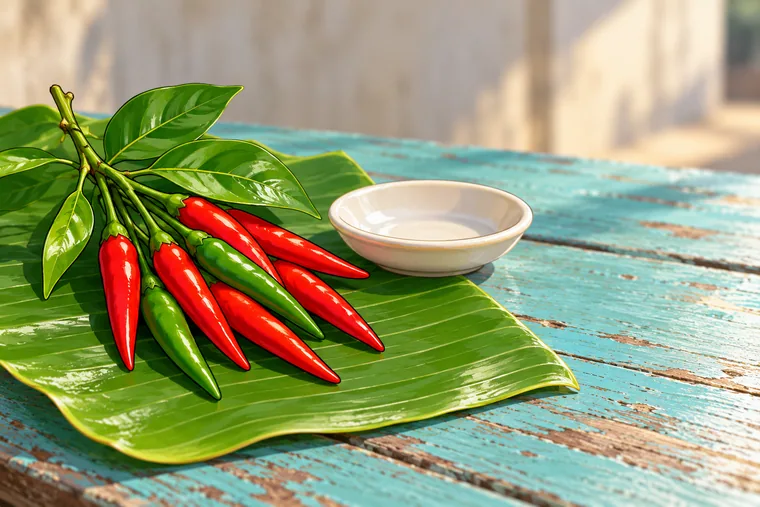
In most shops they are the same pepper: UF/IFAS lists the Thai pepper as also called bird's eye chili.
- One heat range for both names: 50,000–100,000 SHU
- "Bird pepper" and "birdseye" can also mean the wild, round chiltepin
- About 15 times a jalapeño's heat by midpoint
Log scale; bars are published ranges.1
On this page
- 1Are bird's eye chilies and Thai chilies the same?
- 2How hot is a bird's eye or Thai chili?
- 3How do you tell a Thai chili from a wild bird pepper?
- 4Does a wild bird pepper burn the same way?
- 5Are red bird's eye chilies hotter than green ones?
- 6How many Thai chilies replace the peppers you know?
- 7How do you grow Thai chilies?
- 8Which species is a bird's eye chili?
- 9How do you keep fresh Thai chilies?
- 10What should you buy when a recipe says bird's eye?
- 11What goes wrong with bird's eye chilies?
Are bird's eye chilies and Thai chilies the same?
Usually, yes. UF/IFAS lists the Thai pepper at 50,000 to 100,000 SHU and says it is also called bird's eye chili or bird's chili2. So a bag you find labelled either way at an Asian grocery most likely holds the same small, slender pod.
The name stretches further than you might expect, though. "Bird pepper" is a common name with several owners, and the sources pin it to three different plants:
| When people say | The plant | The pod |
|---|---|---|
| Thai chili, bird's eye chili12 | A Thai cultivar of Capsicum annuum | Slender, about 1 inch long |
| Chiltepin, bird pepper, birdseye34 | A wild pepper, C. annuum var. glabriusculum | Usually round |
| Bird pepper (Antilles, Belize, Trinidad)4 | Capsicum frutescens, the tabasco species | Held upright on erect stalks |
If the pod in your hand is long and thin, it is the Thai type; if it is round like a pea, it is the wild chiltepin.
How hot is a bird's eye or Thai chili?
Both names share one range, 50,000 to 100,000 SHU, from the same UF/IFAS lists1. That puts it in our hot band, just under the habanero, which starts where the Thai range ends.
Log scale; bars are published ranges.1
Fifteen times is the midpoint against the jalapeño average, so if your dish takes three jalapeños, one Thai pod already makes it hot. We found no primary heat figure for the wild chiltepin, so it stays off the chart.
How do you tell a Thai chili from a wild bird pepper?
By shape. UF/IFAS describes the Thai pod as about 1 inch long and less than 1/5 inch wide at the shoulder1, a thin spike. The NMSU Chile Pepper Institute calls the chiltepin a wild pepper that is usually round3.
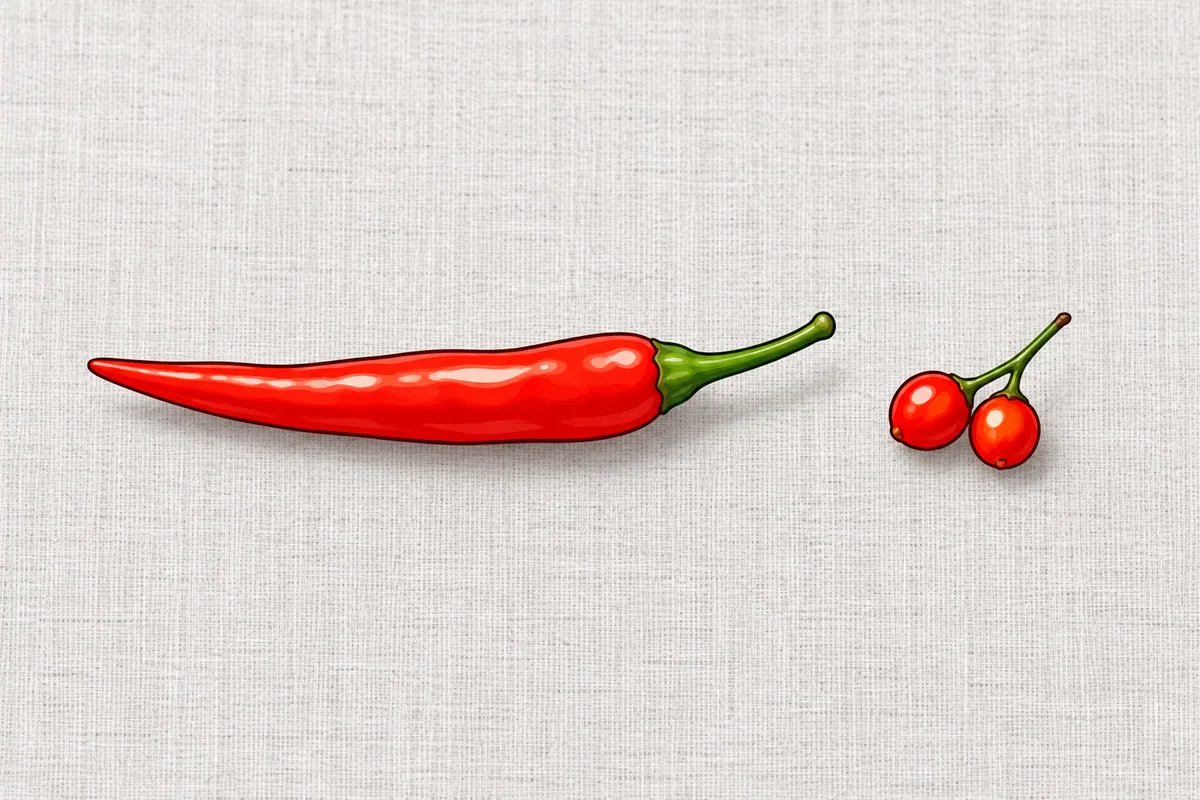
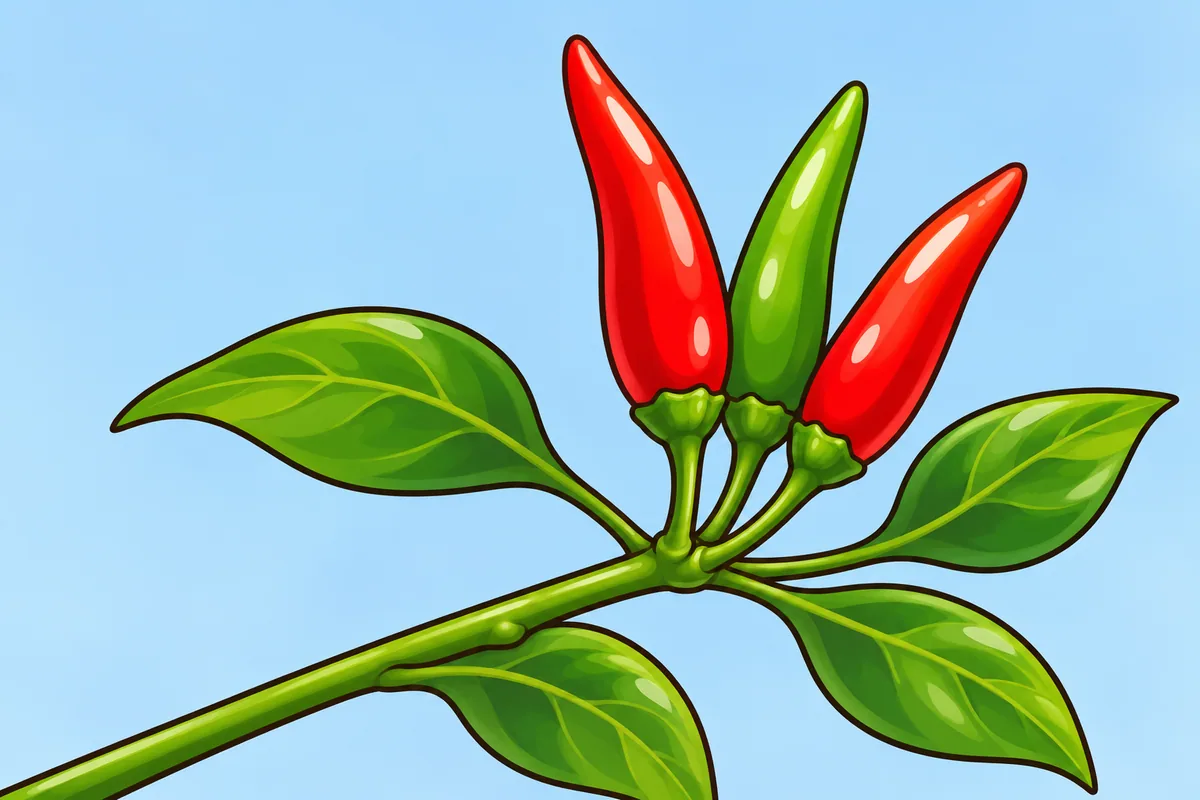
You will rarely see the round one fresh in a supermarket. Most of the time your choice is between green and red Thai pods of the same plant, and UF/IFAS notes the plant often sets two or three pods at a node1, so you see them in small clusters on the stem.
Does a wild bird pepper burn the same way?
Not quite. NMSU's garden guide describes the chiltepin and piquin as very small and hot, with heat that fades quickly5. You feel a sharp hit that leaves soon after, while a Thai pod chopped into a curry keeps its heat through the whole bowl you eat.
We found no primary figure for how long a Thai chili's burn lasts, so we don't put a number on it. What you can count on is the range: 50,000 to 100,000 SHU per gram of Thai pod1, about twice the cayenne at every point of its range.
Are red bird's eye chilies hotter than green ones?
Not by any rule you can count on. A capsaicin review in Heliyon reports that capsaicin builds up as the fruit develops and peaks about 40 to 50 days into that growth, after which some of it can break down6. A full-size green pod and a red one picked later can carry similar heat, and the red one has had time to lose a little.
What you can count on is color: both come off the same plant, so you pick red or green for the look of your dish. If heat matters more than color, NMSU's advice on measuring heat applies at home too: tasting is quick and cheap, if not exact7, so you bite a sliver from each bag before you cook.
How many Thai chilies replace the peppers you know?
Work by weight and by midpoint, since the pods in one bag differ in size and you will never count them the same way twice. With the Thai range at 50,000 to 100,000 SHU, its midpoint sits at 75,0001, and the amounts below follow from that.
| Recipe calls for | Their midpoint | Thai chili is | Use instead |
|---|---|---|---|
| 30 g jalapeño | 5,000 SHU | about 15 times hotter | about 2 g Thai chili |
| 20 g fresh cayenne | 37,500 SHU | 2 times hotter | 10 g Thai chili |
| 10 g habanero | 225,000 SHU | a third as hot | about 30 g Thai chili |
Prep matters more with a pod this small and this hot. Wear rubber, latex or nitrile gloves when you slice a bag of them, open a window if you fry them, and keep your hands away from your eyes8. If your fingers still sting afterward, NMSU suggests soaking them in plain vinegar9.
The jalapeño row is the one that surprises people, because a recipe written for jalapeños usually lists them by the handful. Two grams is a very small amount on a kitchen scale, so you add it in pieces and taste as you go.
How do you grow Thai chilies?
From seed, in warm weather, and for more than one year if your winters stay frost-free. UF/IFAS calls the Thai pepper plant a perennial that can reach 6 feet1. The University of Guam's extension guide says hot pepper seeds usually sprout within 2 weeks and the plants grow best with days of 75–85°F and nights of 50–60°F10.
- Sow seedSeeds usually sprout within 2 weeks
- Grow warmBest at 75–85°F days and 50–60°F nights
- Pods ripenMost hot peppers mature 60–110 days after planting
- Pick any stageGreen or red, two or three pods per node
- Keep the plantIn the tropics it grows on for more than one season
- Back to Sow seed
Frost breaks the loop for most of us. The same Guam guide notes that peppers die easily in frost, so in temperate climates you grow them as annuals10, or you bring a potted plant indoors before the first cold night. The hot pepper plants page covers how the Thai plant's habit differs from the big-podded types.
Which species is a bird's eye chili?
It depends on the source. UF/IFAS calls the Thai pepper a cultivar of Capsicum annuum and notes it often gets confused with C. frutescens cultivars1. The University of Guam's extension table puts "Thai" under C. frutescens and "bird" under C. annuum10, the reverse.
The genus monograph explains the muddle. It records "bird pepper" as a common name for the wild C. annuum var. glabriusculum in the United States and the Caribbean, and again for C. frutescens in the Antilles, Belize and Trinidad4. Two species, one nickname. We follow UF/IFAS in the index and list the Thai chili under C. annuum.
How do you keep fresh Thai chilies?
Cool, but not cold. The Guam extension guide stores hot peppers at 45–50°F and 95 % humidity and warns that anything colder than 45°F causes chilling injury10. A standard fridge runs colder than that, so the crisper drawer is the warmest spot you have.
| Method | How | How long |
|---|---|---|
| Cool storage | 45–50°F at about 95 % humidity; below 45°F the pods suffer chilling injury | Short term; above 50°F they change color, lose weight and decay |
| Freezer | Wash, pull the stems, freeze the pods whole and raw | No time given by Penn State |
| Dried | Dry at 140°F for 8–12 hours in a dehydrator, until tough to brittle; condition 4–10 days | 6–12 months in a cool, dark, airtight jar |
Colorado State cuts pods into rings of 1/4 to 3/8 inch before drying12, and you can dry peppers in the oven if you have no dehydrator. Keep the jar out of the light: Penn State notes dried peppers fade quickly in it11.
What should you buy when a recipe says bird's eye?
Red and green pods come off the same plant, so you pick by the color your dish needs. If a recipe from the Caribbean asks for bird pepper, it may mean a different plant altogether, and the bird's eye chili entry tracks those regional names.
What goes wrong with bird's eye chilies?
Mistakes and the fix
- Storing them in the coldest part of the fridge. Below 45°F the pods get chilling injury; keep them in the crisper drawer.10
- Leaving dried pods on a sunny shelf. Light fades dried peppers fast; use an opaque or cupboard-stored jar.11
- Buying round wild pods for a Thai recipe. The chiltepin is a different plant with a heat that fades quickly; look for the slender 1-inch Thai pod.Sources for this line1. University of Florida IFAS Extension3. New Mexico State University, Chile Pepper Institute5. New Mexico State University Cooperative Extension Service
- Rubbing your eyes after chopping. Wear rubber, latex or nitrile gloves; if capsaicin gets in your eyes, flush them with warm water for 15 minutes.8
If you want a milder chili for the same dish, a jalapeño sits about 15 times lower by midpoint1. If you want to go hotter, the Thai chili against the habanero shows the next step up.
Related in Compare
-
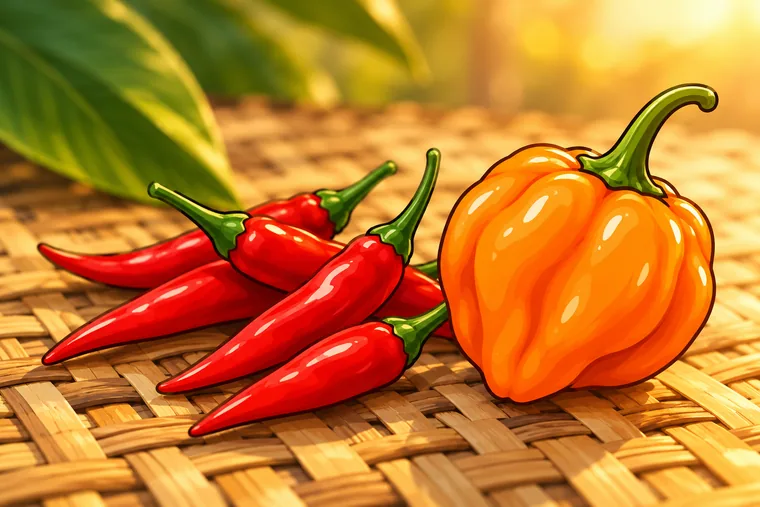
Habanero vs Thai Chili, Why the Habanero Is 3× Hotter
A tiny hot chili against a fruity extra-hot one.5 min read -
Thai Chili vs Jalapeño, Why the Small Pod Is 15× Hotter
A one-inch pod with fifteen times the heat.5 min read -
Cayenne vs Thai Chili, Why the Smaller Pod Is 2× Hotter
Same species on most lists, double the heat, a sixth of the length.5 min read -
Thai Chili vs Serrano, About 4× the Heat at Half the Size
A tiny Southeast Asian chili and a slim Mexican green one that cooks swap all the time.6 min read -
Serrano vs Habanero, the Habanero Is About 13× Hotter
A salsa chile against a hot sauce chile.6 min read -
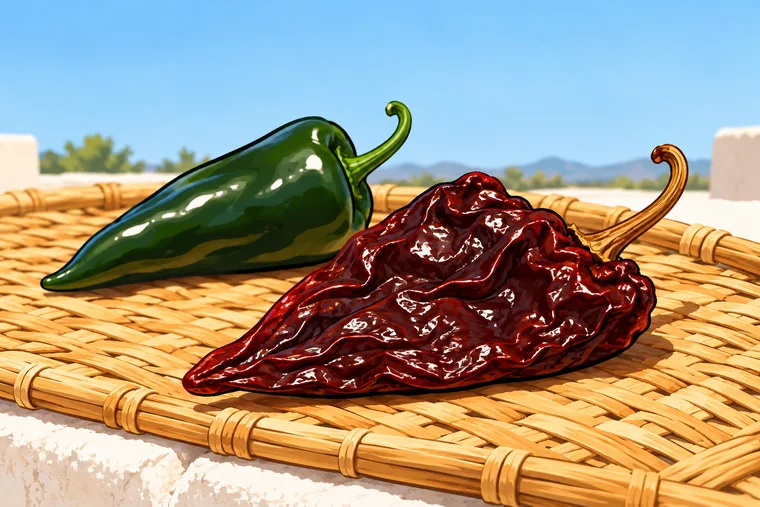
Ancho vs Poblano, One Pepper Picked Green or Dried Red
Fresh green, ripe red, then dried: one plant, three stages, two names.6 min read
Sources
· 12
- 1University of Florida IFAS Extension HS-859/TR010: Pepper Production in Miami-Dade County, Florida
- 2UF/IFAS Gardening Solutions Peppers by Scoville Units
- 3New Mexico State University, Chile Pepper Institute Chile Terminology
- 4PhytoKeys 200:1-423 (Pensoft) Monograph of wild and cultivated chili peppers (Capsicum L., Solanaceae)
- 5New Mexico State University Cooperative Extension Service Guide H-240: Growing Chile Peppers in New Mexico Gardens (Walker, Bosland)
- 6Heliyon (Cell Press) A comprehensive review of capsaicin: Biosynthesis, industrial productions, processing to applications, and clinical uses
- 7New Mexico State University Cooperative Extension Service (Guide H-237) Measuring Chile Pepper Heat (Bosland, Walker)
- 8National Capital Poison Center (poison.org) Capsaicin: When the Chili Is Too Hot (Amanda McDaniel-Price, RN)
- 9New Mexico State University Cooperative Extension Service (Guide E-324) Processing Fresh Chile Peppers (revised by Nancy C. Flores)
- 10University of Guam, College of Natural and Applied Sciences, Cooperative Extension and Outreach FPP-05: Hot Pepper (Capsicum spp.), Important Crop on Guam (Tuquero, Chargualaf, Marutani)
- 11Penn State Extension Preserving Those Colorful Garden Peppers (Martha Zepp)
- 12Colorado State University Extension, PreserveSmart Drying Peppers-Hot