
Peter Pepper, the Heirloom That Gets Hotter for 90 Days
A red heirloom chile with an odd shape, a seed-bank record and heat that builds right up to harvest.
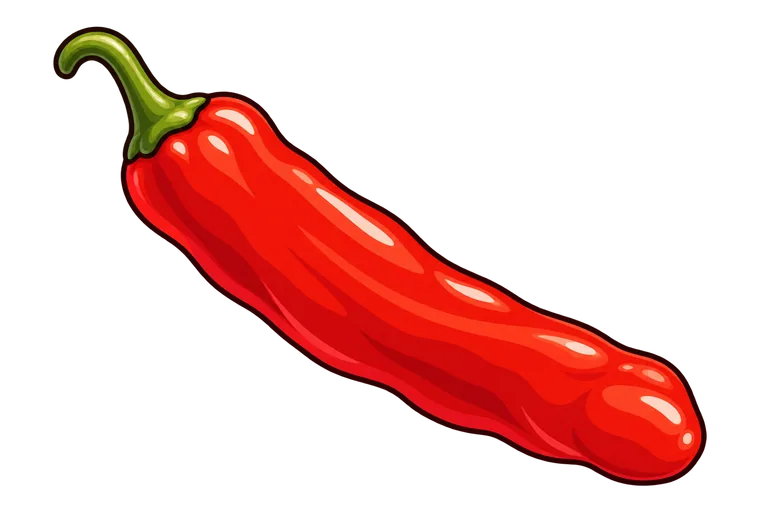
Pungent, with no Scoville figure in the sources we read: USDA's seed bank records only that heat is present.
- Capsaicinoids rose 4.6 times between day 10 and day 90 in one study
- Pods about 4½ inches long, green ripening red, 90+ days
On this page
- 1What is a Peter pepper?
- 2How hot is a Peter pepper?
- 3When should you pick a Peter pepper?
- 4Why does the Peter pepper look the way it does?
- 5How do you pickle Peter peppers?
- 6What else can you cook with Peter peppers?
- 7How do you grow a Peter pepper without losing it to root rot?
- 8What goes wrong with Peter peppers?
- 9What to do next with Peter peppers
What is a Peter pepper?
A pungent heirloom chile, Capsicum annuum, that the USDA keeps in its national seed bank as accession PI 5935661. The record lists two donors, H.W. Alfrey Seed and Paul W. Bosland of New Mexico State University, and shows the seed arriving in January 19941. Its observations are short: an elongated fruit, green when young and red when ripe, on a compact plant about as wide as it is tall, with pungency present1.
You can order a small packet of that seed bank stock for research, but most gardeners buy from seed companies, which sell red, yellow and orange forms. The rest of this entry sticks to what the record, one seller and one lab study can tell you.
When you shop for seed, look for two words on the packet: the species, Capsicum annuum, and open-pollinated, which is how the seller lists its red Peter2. An open-pollinated variety is one you can save seed from and grow again, which is how heirlooms like this one stay in gardens. If the packet gives no species and no days to harvest, you have little to go on, so buy from a seller that prints both.
How hot is a Peter pepper?
Hot enough to notice, but none of the primary sources we read gives it a Scoville number. The USDA record notes only that pungency is present1, and the seller calls the pods hot without a figure2. So you won't see a heat range on this entry.
There is better data than a single SHU, though. A team at the University of Cádiz grew Peter peppers in a glasshouse, tagged new fruit and measured total capsaicinoids, the compounds that burn, in milligrams per gram of fresh pod3.
| Pepper and stage | Capsaicinoids (mg per g fresh pod) |
|---|---|
| Peter, day 10 | 0.283 |
| Peter, day 90 | 1.301 |
| Malagueta (piri piri), day 33 | 2.119 |
What do those numbers tell you?
Two things. First, a Peter pod picked at 90 days carries about 4.6 times the capsaicinoids of a 10-day pod (1.301 ÷ 0.283), and the study found the rise ran in a straight line the whole way3. Second, a ripe Peter pod held less than two thirds of what a 33-day malagueta held in the related study (1.301 ÷ 2.119)4. Both teams measured fresh pods with the same kind of instrument, so the comparison is fair as a rough guide, though plants grown elsewhere will differ.
In plain kitchen terms: a ripe Peter pepper is clearly hot, but gentler than the little piri piri pods from the malagueta line. If you're used to a cayenne, treat a Peter pod with the same respect until your first taste tells you more.
When should you pick a Peter pepper?
As late as you can, but before it over-ripens. That's the study's own conclusion: harvest based on capsaicinoids should come as late as possible, and before the fruit shows signs of over-ripening3.
- Day 10
Young pod
Lowest heat, 0.283 mg/g; dihydrocapsaicin leads.3
- Day 50
The switch
Dihydrocapsaicin peaks as the main compound; after this, capsaicin takes over.3
- Day 90
Full heat
1.301 mg/g, the highest point measured.3
- Past ripe
Too late
Pick before the fruit shows over-ripening.3
For you, the rule is simple. If you want mild pickles, pick green pods early; if you want the full burn, wait for deep red, firm pods and pick them before they soften.
Does the switch at day 50 change how the heat feels? Probably not much. The related malagueta study gives capsaicin a pungency of 16,000,000 SHU and dihydrocapsaicin 15,000,000 SHU as pure compounds, and calls the difference small4. What you'll notice is the total going up, not the mix changing.
Why does the Peter pepper look the way it does?
Because of its shape, which is the reason most people have heard of it. The seller describes a cylindrical pod with a bulbous end and calls it famous for its distinctive phallic shape2; the USDA record files it simply as elongate1. That shape has kept the variety alive as a garden conversation piece, and it's why the seller lists it as one2. Nothing about the shape changes how you cook it, so treat it like any other hot red chile in your kitchen.
How do you pickle Peter peppers?
Whole, in a vinegar brine, which is the first use the seller lists2. These steps are kitchen practice for a quick refrigerator pickle; for canned pickles that sit on a shelf, follow a tested recipe.
- 1
Glove up and wash
Wear rubber, latex or nitrile gloves, as Poison Control advises, then wash and dry the pods.5
- 2
Pierce each pod
Poke each pod near the stem with a knife tip so the brine can get inside.
- 3
Pack the jar
Stand the pods upright in a clean jar with garlic and dill.
- 4
Pour hot brine
Cover with hot vinegar brine, let it cool, cap it and refrigerate.
- 5
Wait
Leave the jar in the fridge for several days before you taste.
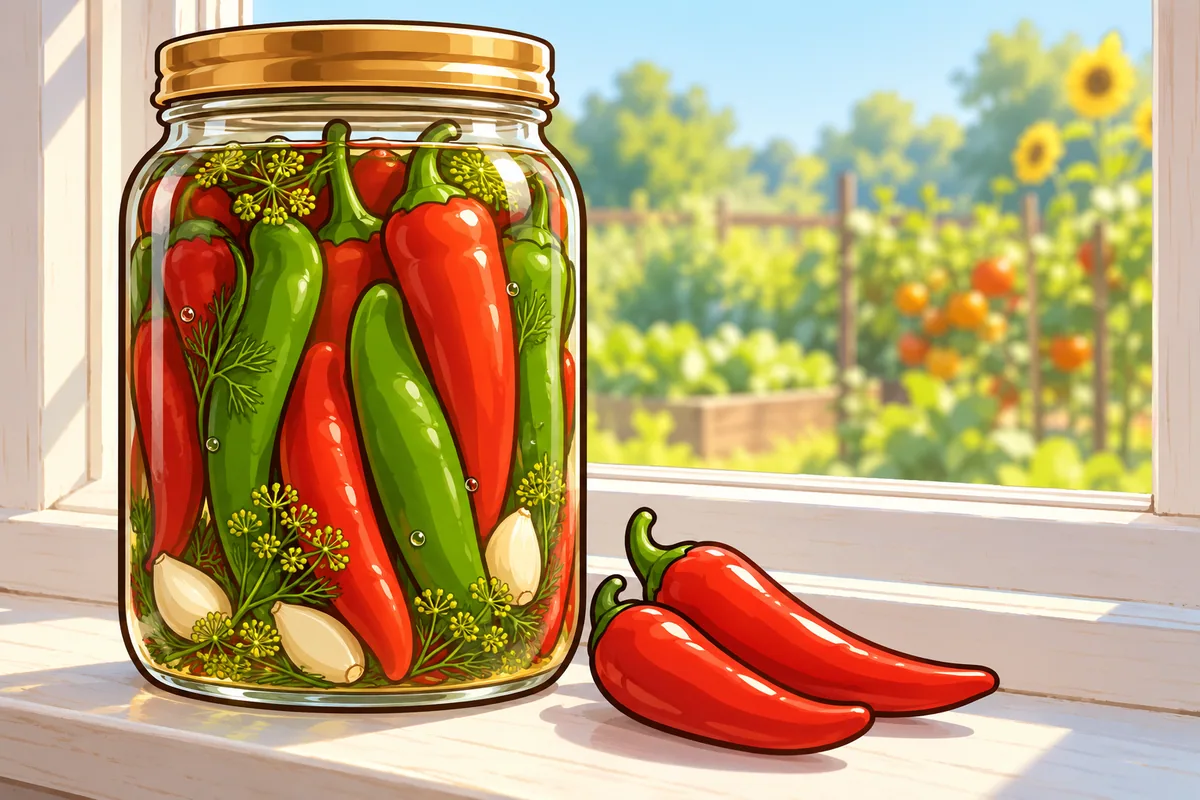
The seller also lists salsa, hot sauce and seasoning powder as uses2. Mixing green and red pods in one jar gives you a range of heat in every batch, because the young green pods carry far less capsaicinoid than ripe red ones3. For a tested canning method and brine ratios, the pepper pickling guide has the details, and the peppers for pickling list suggests partners for the same jar.
What else can you cook with Peter peppers?
Anything that wants a hot red chile with enough flesh to chop. The seller's list goes beyond pickles2, and each use suits a different stage of the pod. Amounts here are kitchen starting points.
- Fresh salsa: mince one ripe red pod into a bowl of tomato salsa for four, then taste after ten minutes and add more if you want it.
- Hot sauce: blend a handful of red pods with vinegar, garlic and salt; strain it if you like a thin sauce.
- Seasoning powder: dry red pods until brittle, then grind them with a window open and gloves on.
- Stir-fries and eggs: slice a green pod into rings for a milder, grassy heat.
If you grow more than you can use, freeze the extras. NMSU's chile guide says chile keeps up to 12 months in the freezer, in flat packs no deeper than 2 inches so it freezes fast and stays firm6. A frozen pod slices thinly straight from the bag, which is handy when you only want a little heat in one dish.
How do you grow a Peter pepper without losing it to root rot?
Give it drainage above all. The USDA record scores the accession 9 for Phytophthora root rot, "dead plants", the worst score on that scale1. That doesn't mean your plant will die, but it tells you this line has no resistance to a disease that thrives in wet soil.
Checks before you plant
- Plant in a raised bed or a pot with drainage holes, never in a low spot where water sits.1
- Water deeply, then let the top of the soil dry before you water again.
- Expect a compact plant about as wide as tall; the seller lists 24–36 inches.12
- Count on 90+ days to harvest and start seeds indoors early if your summer is short.2
Because the plant stays compact, it also suits a patio pot, where you control the soil and the water. It fits well in the kind of mixed display the ornamental peppers guide describes.
What goes wrong with Peter peppers?
Most trouble you will meet with this pepper is about timing, the brine or your hands.
Problems and fixes
- Your pods taste mild: you picked them young. Heat kept rising until day 90 in the ripening study, so leave the next ones on the plant.3
- The plant wilts and collapses in wet weather: likely root rot, to which this line has no resistance. Move to a pot or raised bed next season.1
- Your fingers burn after packing the jar: Poison Control lists warm water flushes, vegetable oil or diluted vinegar soaks for skin.5
- Pickles went soft: the pods were over-ripe. Pick firm red pods before they soften.3
What to do next with Peter peppers
If you have a plant, mark a few young pods with a twist tie and pick one at a time over the next weeks; you'll taste for yourself how the heat builds. Then pack your best red pods into a jar of brine this weekend. If you'd like to compare it with a pepper whose heat is measured, the jalapeño entry gives you a published range to taste against.
Related peppers
Published ranges.7
Related in Peppers
-
Cherry Pepper Scoville, 0 SHU Sweet to Hot
A small round pepper, sweet or hot, grown for jars and stuffing.6 min read -
Bird's Eye Chili Heat and Names, 50,000–100,000 SHU
A tiny upright chile whose name points to the animals that plant it.6 min read -
Thai Chili Pepper Scoville, 50,000–100,000 SHU
A small, sharp chile about an inch long, also sold as bird's eye.6 min read -
Biquinho Pepper, the 2.6 cm Brazilian Pod With No Heat
A crunchy little red pod Brazil eats pickled, often with no burn at all.6 min read -
Calabrian Chili Heat, 5,000–70,000 SHU by EU Rule
Peperoncino di Calabria: the protected chili of Italy's toe, sold fresh, on strings, as flakes and as powder.7 min read -
Chiltepin Heat, 70,000–160,000 SHU in a Pea-Sized Wild Pod
The wild bird pepper of Sonora, Arizona and Texas, picked from shrubs that grow under desert trees.6 min read
Sources
· 7
- 1USDA ARS, Germplasm Resources Information Network (GRIN-Global) PI 593566, 'Peter Pepper', Capsicum annuum L.
- 2Reimer Seeds (seed seller's product page for its own seed) Peter Pepper Red Seeds
- 3Chemistry & Biodiversity 13(8):1068-1075 Evolution of Capsaicinoids in Peter Pepper (Capsicum annuum var. annuum) During Fruit Ripening (Barbero, de Aguiar, Carrera and others)
- 4Molecules 22(5):736 (MDPI) Ontogenetic Variation of Individual and Total Capsaicinoids in Malagueta Peppers (Capsicum frutescens) during Fruit Maturation (Fayos, de Aguiar, Jiménez-Cantizano and others)
- 5National Capital Poison Center (Poison Control) Capsaicin: when the chili is too hot
- 6New Mexico State University Cooperative Extension (Guide E-324) Processing Fresh Chile Peppers (revised by Nancy C. Flores and Cindy Schlenker Davies)
- 7University of Florida IFAS Extension HS-859/TR010: Pepper Production in Miami-Dade County, Florida