
Gypsy Pepper, the 1981 AAS Sweet Pepper Ready in 55–65 Days
An early, heavy-cropping sweet pepper with thin-walled, wedge-shaped fruit that ripens from pale yellow to red.
 Mild
Sweet, no heat to speak of
- Ready 55–65 days after transplant, on a bushy plant that needs no stake
- Pick it pale greenish yellow or let it turn red; ripe fruit is a little sweeter
On this page
- 1Is a Gypsy pepper hot?
- 2What does a Gypsy pepper look like?
- 3What does a Gypsy taste like next to a bell pepper?
- 4Where did the Gypsy pepper come from?
- 5Should you pick your Gypsy peppers yellow or red?
- 6How do you grow Gypsy peppers in a pot?
- 7How do you cook with Gypsy peppers?
- 8Gypsy, bell or Cubanelle for your kitchen?
- 9Why are your Gypsy plants dropping flowers?
Is a Gypsy pepper hot?
No. All-America Selections records the Gypsy as a sweet pepper1, and the University of Arkansas lists it as a sweet frying pepper2. No primary source we found gives it a Scoville figure, so we don't print one.
For a sense of where "sweet" sits, UF/IFAS puts the bell pepper at zero Scoville units and the Cubanelle, another sweet frying type, at about 1,0003. Expect a Gypsy to taste like a sweet pepper you can hand to anyone at the table, with no heat to warn them about. If a pod ever bites, it crossed with a hot pepper or came from mislabeled seed.
Iowa State's extension heat chart puts its sweet neighbors, the bell, pimiento and sweet banana pepper, together in the 0 SHU band4. That's the company you can expect a Gypsy to keep on your plate, and it's why you can use it raw by the handful in a salad for children.
What does a Gypsy pepper look like?
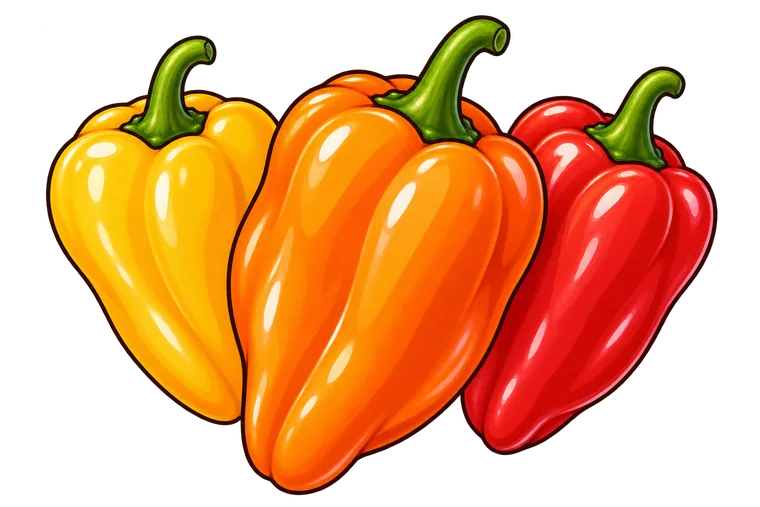
A tapered wedge, a bit like a stretched bell pepper, that changes color as it ripens. AAS describes wedge-shaped fruit harvested light greenish yellow and turning red1; its sweet-pepper list calls them 3–4 inch tender fruits5.
| Trait | Published value |
|---|---|
| Fruit shape | Wedge-shaped |
| Fruit length | 3–4 inches in the description; 5–6 inches in the spec table |
| Color | Light greenish yellow, turning red |
| Plant height | 18–20 inches in the description; 12–20 in the spec table |
| Plant spread | 14–18 inches |
| Habit | Bushy, no staking needed, suits containers |
| Days | 55–65 from transplant |
| Disease resistance | Tobamo P (tobacco mosaic virus) |
The AAS record contradicts itself on length and height, so we print both figures. In your garden, expect fruit somewhere between your palm and your hand's length on a plant about knee-high.
Between yellow and red, the pods pass through orange, so a plant in late summer often carries all three colors at once. That's why seed catalogs love photographing it, and why a single plant can fill a salad bowl with three colors from one variety.
What does a Gypsy taste like next to a bell pepper?
Lighter and crunchier, in our reading of the record. AAS calls the fruit very tender, crunchy and sweet1, and the difference you'll notice first is the wall. Iowa State's bell list praises cultivars such as 'Bell Boy' for thick walls and 'Big Bertha' for stuffing4; a Gypsy's wedge has a thinner, more tender wall that cooks in minutes and stays crisp raw.
That makes it the better pick when you want peppers to melt into a pan of onions or to stay crunchy in a salad, and the weaker one when you want a sturdy cup to bake whole. If your recipe says "stuff the peppers", halve your Gypsies lengthwise instead of trying to fill them upright.
- Sweet
- Crunchy
- Tender
Where did the Gypsy pepper come from?
From a US seed company, and it arrived with an award. AAS lists the Gypsy hybrid as its 1981 national vegetable winner, bred by Petoseed Co., which later became part of Seminis Vegetable Seeds1.
- 1981
All-America Selections winner
Gypsy hybrid wins as a national edible winner, praised for early, heavy yields of yellow sweet peppers.1
- Breeder
Petoseed Co., later Seminis
AAS names Petoseed Co./Seminis Vegetable Seeds as the breeder.1
- 2013
Still in the trials
LSU AgCenter's bell pepper trial notes that Gypsy did well each year, reaching mature color on the vine.6
- 2021
Still on extension lists
University of Arkansas lists Gypsy at 65 days as a yellow-to-red sweet frying pepper.2
Four decades later it still turns up on extension lists, which tells you something: gardeners keep growing it because it crops early and reliably. As a hybrid, the seed you save from your own pods won't grow true to the plant you picked them from, so buy fresh seed each year if you want the same Gypsy again.
Should you pick your Gypsy peppers yellow or red?
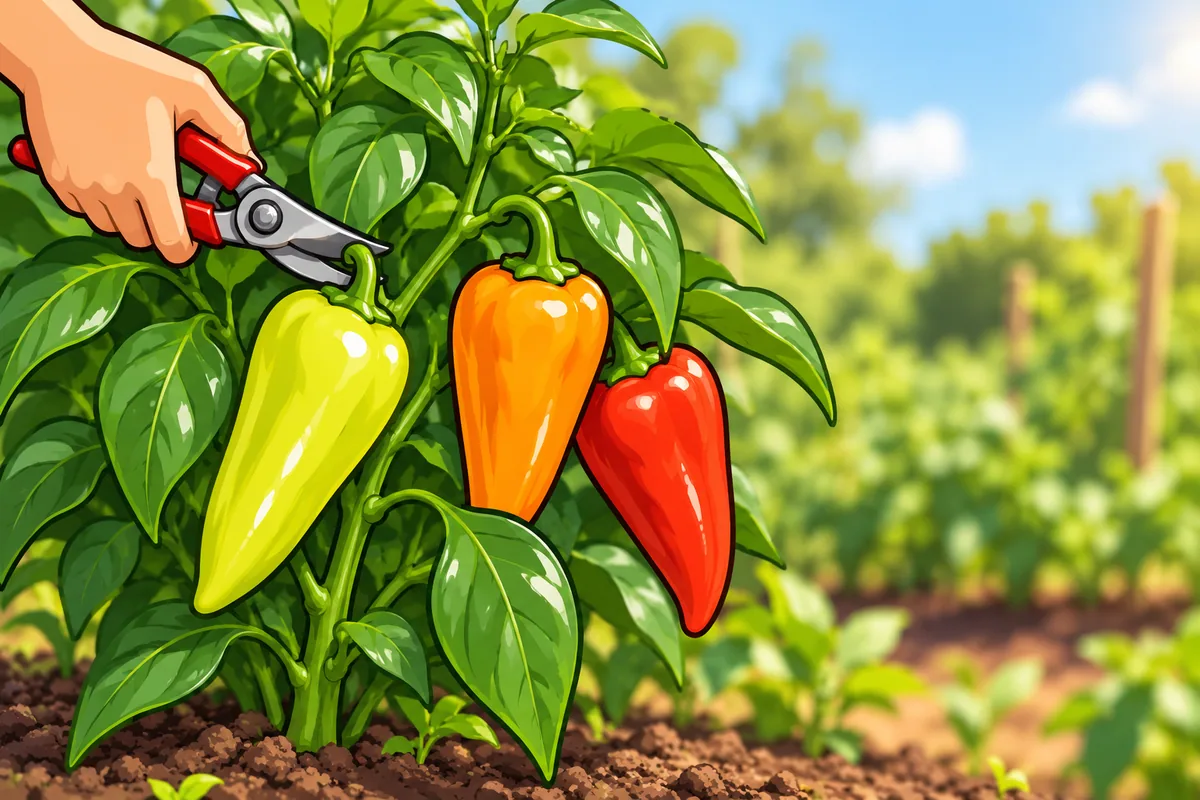
Either works, and the choice depends on whether you want more peppers or sweeter ones. AAS describes harvest at light greenish yellow, turning red1; Iowa State notes that fully ripe sweet peppers are a little sweeter and higher in vitamins than unripe ones4.
Pick it pale yellow
Let it turn red
- As soon as the wedge reaches full size1WhenWeeks later, once the color has turned fully6
- Crisp and mildly sweet1TasteA little sweeter, with more vitamins4
- Picking early pushes the plant to set more fruitPlantFewer pods over the season, each one riper
- Salads, dips and frying12Best forRoasting and eating raw for sweetness7
A good habit: pick most of your pods yellow through midsummer to keep the plant producing, then leave the last flush to turn red as the season winds down. LSU's trial found Gypsy reliably reaching mature color while still on the vine6, so you can count on that late red crop.
How do you grow Gypsy peppers in a pot?
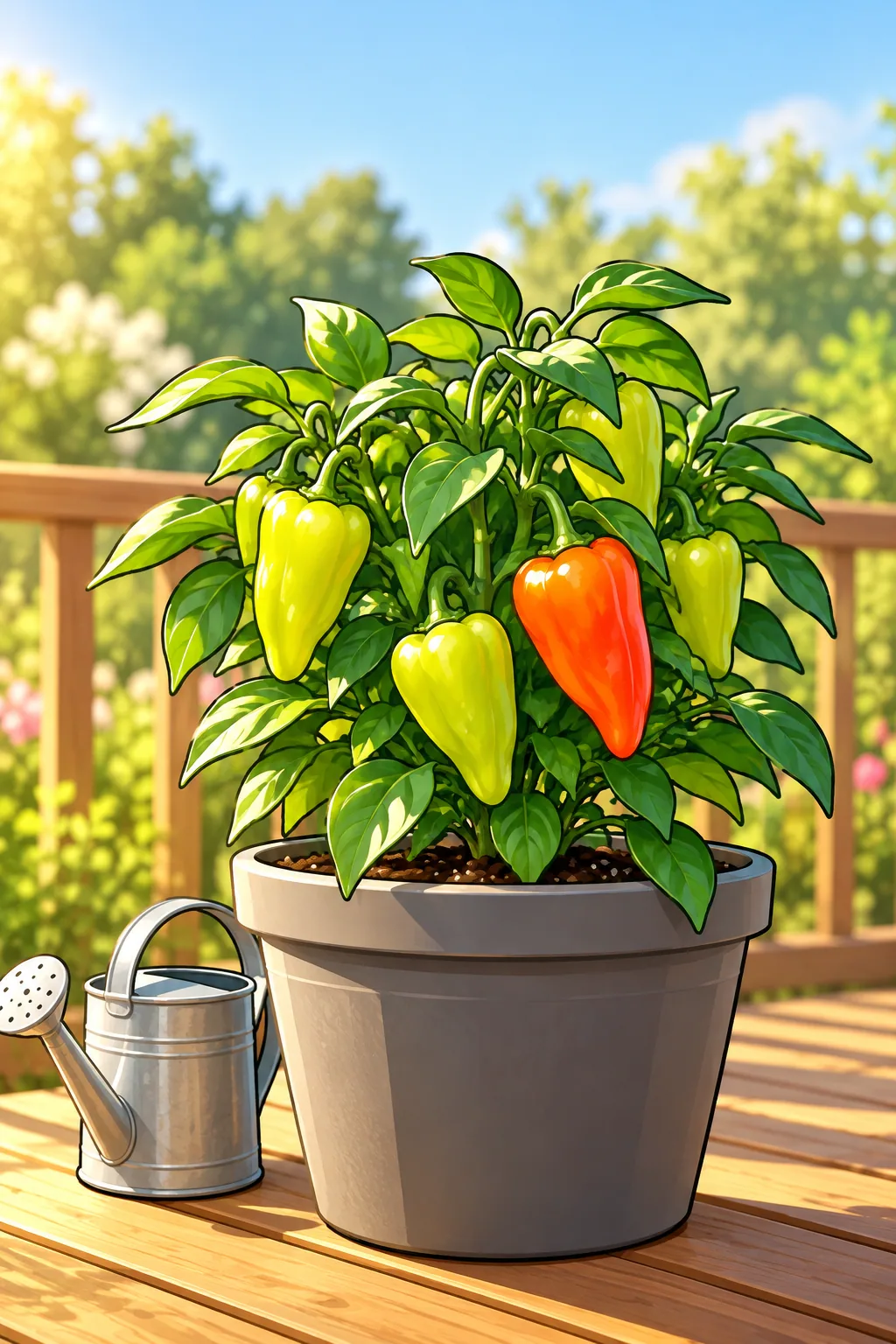
Easily: it's one of the friendlier peppers for a container. AAS describes a bushy plant that needs no staking and suits containers1.
- 1
Start seed indoors
Sow 6 to 8 weeks before your planting-out date, as Iowa State advises for peppers.4
- 2
Plant out after frost
Move plants outdoors once frost is no longer a risk. In the ground, space them 18 inches apart in rows 24 to 30 inches apart.4
- 3
Pick a pot that fits
The plant spreads 14 to 18 inches and stays about 18 to 20 inches tall, so a large patio pot holds one plant comfortably.1
- 4
Feed and water evenly
Iowa State suggests a starter solution after transplanting and steady water through flowering and fruit set.4
- 5
Start picking at 55 to 65 days
Harvest begins 55 to 65 days after transplant.1
Sweet peppers fruit best in steady, moderate temperatures. Iowa State notes the highest yields of sweet peppers come at a steady 60–70 °F, and that their flowers drop when nights fall below 60 °F or rise above 85 °F4. On a hot balcony, that means some afternoon shade in a heat wave pays off in pods.
The variety's tobacco mosaic virus resistance helps too1. It won't protect your plant from every disease, but it removes one common reason a pepper plant stalls with mottled, curled leaves.
How do you cook with Gypsy peppers?
Raw, fried or roasted. AAS points to salads and dips1, and the University of Arkansas files it as a sweet frying pepper2.
- Raw, in salads and dips. The thin, tender wall stays crunchy, so slice rings into a salad or cut strips for a dip.
- Fried. Slice and fry in olive oil until soft and lightly browned; thin walls cook through fast.
- Stuffed, halved. Cut a wedge lengthwise, fill it with cheese or rice and bake it; the tapered shape makes neat boat-shaped halves.
- Roasted for peeling. The red ones especially, for a sweet, smoky salad.
Roasting and freezing a big harvest
NMSU's guide to fresh peppers gives the method. Slit each pod so steam can escape, then blister it under a broiler or on a grill at 400–450 °F for 6 to 8 minutes, turning it now and then until the skin lifts7. Cover the hot peppers so they steam, peel them once cool, refrigerate them within 2 hours and use them within 3 days, or freeze them in packs no deeper than 2 inches for up to 12 months7.
How long do fresh Gypsy peppers keep?
Two to three weeks if you store them cool and humid. Iowa State gives 2 to 3 weeks for fresh peppers at 45–50 °F and 85–90 % relative humidity4, which in your kitchen means a loose bag in the crisper drawer rather than the back of the coldest shelf.
Thin walls lose water faster than a thick bell does, so check your bag after a week and use any pods that start to soften first, in a fry-up or a sauce. If your plant gives you more than you can eat in a fortnight, roast and freeze the surplus with the method above, and you'll have sweet peppers for winter stews.
Gypsy, bell or Cubanelle for your kitchen?
Pick Gypsy for an early crop of thin-walled peppers, a bell for thick walls and stuffing whole, a Cubanelle for frying long strips. The table sets the three side by side.
| Pepper | Heat | Days | Shape | Best for |
|---|---|---|---|---|
| Gypsy1 | Sweet, no published SHU | 55–65 from transplant | 3–4 inch wedge | Salads, frying, early crops |
| Bell34 | 0 SHU | About 63–80 for the bells on Iowa State's list | Blocky, thick-walled | Stuffing whole, roasting |
| Cubanelle3 | About 1,000 SHU | Not given here | Long and tapered | Frying in strips |
Gypsy's edge is time. Iowa State's list of sweet bell cultivars runs about 63 to 80 days4, so a Gypsy at 55 to 65 days can give you your first sweet peppers a week or two ahead of most bell peppers planted the same day. In a short summer, that head start can decide whether you get a red harvest at all.
Why are your Gypsy plants dropping flowers?
Usually temperature, and most of the other problems you'll meet have equally simple causes.
Gypsy pepper problems and their fixes
- Flowers fall off without setting fruit: nights went below 60 °F or above 85 °F. Wait out the spell; set fruit returns when nights settle.4
- Pods have dark, sunken, leathery tips: blossom end rot from low calcium in the fruit, made worse by uneven watering. Water evenly and mulch.4
- Pale, papery patches on the sunny side: sunscald. Keep the leaves healthy so they shade the fruit, and feed lightly to keep the plant growing.4
- Saved seed gave odd plants: Gypsy is a hybrid. Buy fresh seed each year.1
- Your pods never turned red: the season ran out. Pick them yellow; they're ready at that stage too.1
If your plant set no fruit at all, the causes run wider than temperature; the no-fruit troubleshooter walks through them one by one.
Your next step for a mixed pot: the best peppers for containers list pairs well with a Gypsy, and the Pepper Index lets you filter for every other sweet pepper you could grow beside it.
Related peppers
Published ranges.3
Related in Peppers
-
Count Dracula Pepper Heat, 25,000–50,000 SHU on Black Leaves
A compact hot pepper grown for its near-black foliage, with pods that ripen from black to blood red.5 min read -
Cherry Pepper Scoville, 0 SHU Sweet to Hot
A small round pepper, sweet or hot, grown for jars and stuffing.6 min read -
Calabrian Chili Heat, 5,000–70,000 SHU by EU Rule
Peperoncino di Calabria: the protected chili of Italy's toe, sold fresh, on strings, as flakes and as powder.7 min read -
Chiltepin Heat, 70,000–160,000 SHU in a Pea-Sized Wild Pod
The wild bird pepper of Sonora, Arizona and Texas, picked from shrubs that grow under desert trees.6 min read -
Espelette Pepper, 10 Basque Communes and 15 Days on the Wall
A conical red pepper from the French Basque Country whose powder the AOP rules call strong but not burning.7 min read -
Siling Labuyo, the Philippine Wild Chili Sold at ₱800 a Kilo
The Philippines' everyday wild chili: soaked in cane vinegar, cooked into stews, and even eaten as a leaf.6 min read
Sources
· 7
- 1All-America Selections (award body, its own winner record) Pepper Gypsy hybrid
- 2University of Arkansas Cooperative Extension Service FSA6015: Home Gardening Series, Peppers (Craig R. Andersen), revised 2021
- 3University of Florida IFAS Extension HS-859/TR010: Pepper Production in Miami-Dade County, Florida
- 4Iowa State University Extension PM 1888(S): Guía de Horticultura, El huerto doméstico, Chiles (Everhart, Haynes, Jauron)
- 5All-America Selections AAS Winning Sweet Peppers
- 6LSU AgCenter Results of the 2013 Bell Pepper Trials (Fontenot and Johnson)
- 7New Mexico State University Cooperative Extension (Guide E-324) Processing Fresh Chile Peppers (revised by Nancy C. Flores and Cindy Schlenker Davies), revised January 2016